 Skip to content
Under the September 1, 2025 guideline change, Texas raised the monthly net-resource cap to $11,700, increasing maximum presumptive support to $2,340 for one child and $2,925 for two children. If you're preparing for court in Travis County, that change can affect your initial order, modification request, or enforcement calculation.
You may be looking at a petition, a proposed wage-withholding order, or an arrears notice and wondering whether the number is correct. The answer depends on more than gross salary. Texas courts examine net resources, statutory guideline percentages, possession arrangements, medical and childcare expenses, other support obligations, and whether applying the guideline amount would be unjust or inappropriate.
For high-income Austin parents, the 2025 cap changes the strategy. For parents with equal possession, it prevents an assumption that “50/50 means no support.” For parents seeking a modification, it raises questions about which orders can be recalculated and how the updated cap interacts with changed financial circumstances.
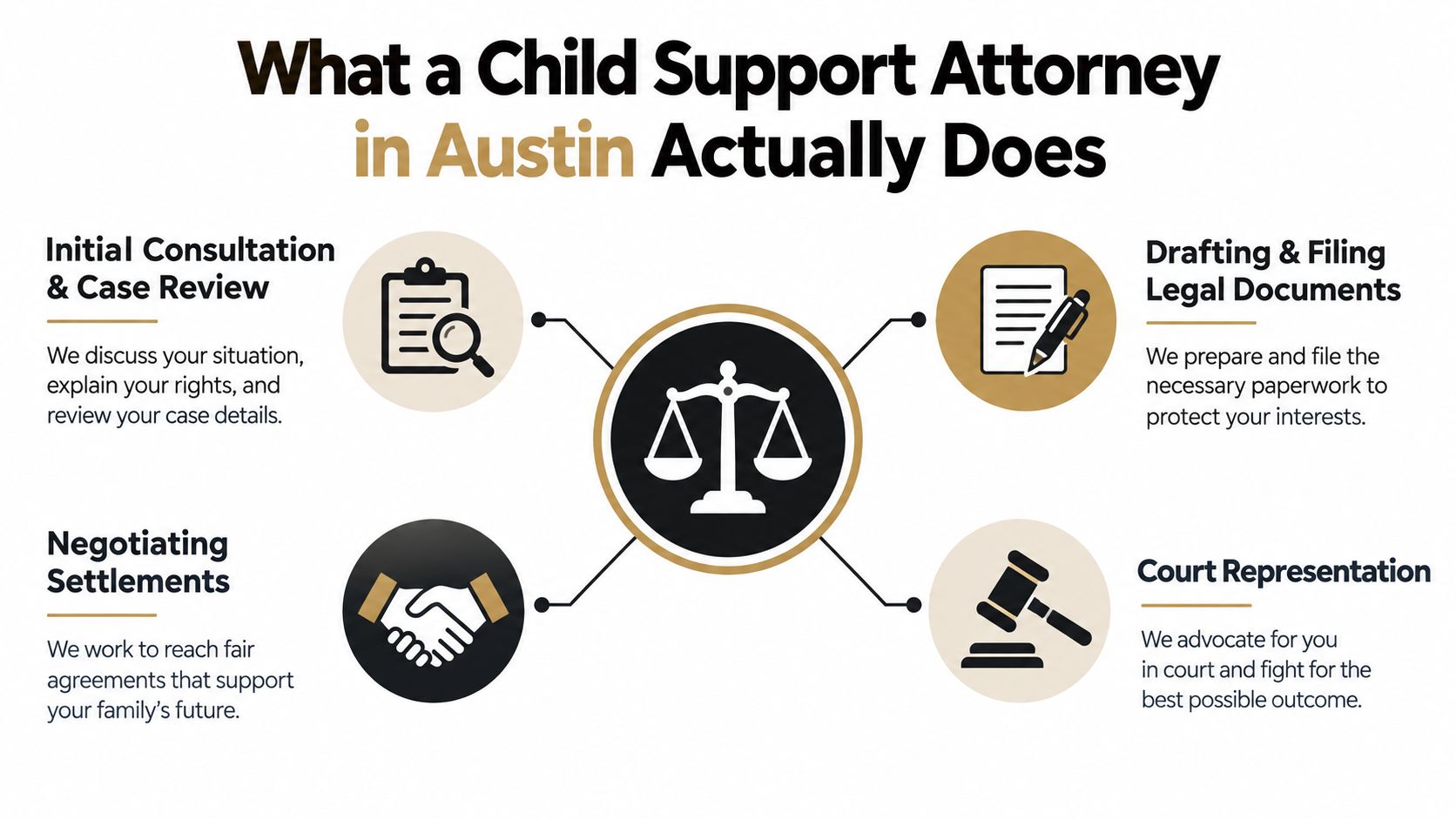
What a Child Support Attorney in Austin Does
When a Travis County parent receives an income-withholding notice from the Texas Office of the Attorney General, the first task is to verify every income figure and deduction listed. An error in net resources, medical support, or possession details can lock in an incorrect order and create years of avoidable disputes. Do not sign or ignore the paperwork before checking the underlying records.
A child support attorney in Austin handles four core legal functions:
- Establishing an order: Counsel addresses parentage, calculates support, prepares pleadings, handles medical support, and presents evidence for the initial order.
- Modifying an order: The lawyer evaluates whether changed income, employment, medical needs, possession, or other material circumstances support a modification under Texas law.
- Enforcing an order: Counsel can pursue arrears, wage withholding, liens, contempt, and other remedies after a parent fails to pay.
- Defending against unsupported claims: A parent may need to challenge inflated income, inaccurate arrears records, improper deductions, or an unjustified deviation request.
The governing framework is Texas Family Code Chapter 154. Section 154.123 addresses circumstances that may justify a deviation when the guideline amount would be unjust or inappropriate. The guideline schedule remains the presumptive starting point, while the evidence determines whether the court should apply or adjust it.
Practical rule: Bring evidence, not only explanations. Pay records, tax documents, possession calendars, insurance statements, and payment histories carry more weight than general accusations.
The OAG Child Support Division and a private attorney serve different roles. The OAG can establish and enforce support administratively, generally without charging the parent for those services. A private lawyer represents one parent's interests, negotiates settlements, examines disputed income, and litigates issues requiring individualized courtroom strategy.
Use the OAG process for a straightforward order when the financial information is accurate and uncontested. Hire private counsel when the case involves high income, self-employment, a contested deviation, equal possession, or disputed arrears. Those disputes require a focused review of records and a strategy built for the Travis County court process.
How Texas Calculates Child Support After the 2025 Cap Change
Texas begins with the obligor's monthly net resources, not gross income. The calculation generally examines earnings and other income sources, then applies permitted deductions and the statutory guideline percentage. Parents who need to identify potentially included income sources can review What Counts as Net Resources for Child Support.
Effective September 1, 2025, the guideline table applies up to $11,700 in monthly net resources. The guideline percentages remain unchanged: 20% for one child, 25% for two, 30% for three, 35% for four, and 40% for five or more children. The Texas Attorney General's monthly child support calculator reflects the updated cap and calculation structure.
At the cap, the presumptive amounts are:
| Number of Children | Guideline Percentage | Maximum Monthly Support |
|---|---|---|
| One | 20% | $2,340 |
| Two | 25% | $2,925 |
| Three | 30% | $3,510 |
| Four | 35% | $4,095 |
| Five or more | 40% | $4,680 |
For example, if the court determines that the obligor has $11,700 in monthly net resources and there are two children, the presumptive calculation is $11,700 multiplied by 25%, producing $2,925 per month. The calculation isn't based on the parent's gross annual salary alone.
Income above the cap doesn't automatically disappear from the case. The court can consider additional resources when deciding whether support above the guideline amount is appropriate, particularly where the children have significant needs or the evidence supports a deviation. That analysis is different from spousal maintenance, which has its own statutory framework and shouldn't be treated as an extension of the child support table.
Guideline support is the starting point. It isn't always the final order.
A lawyer should verify the net-resource base before arguing about the final amount. Tax treatment, recurring compensation, self-employment records, insurance obligations, and other deductions can change the calculation. The updated cap makes that review especially important in Austin cases involving substantial compensation.
For a broader explanation of the formula, see how child support is calculated in Texas. The court still treats the guideline amount as presumptive, not automatic.
Deviations Under Section 154.123 and Proof Under Section 154.125
The guideline percentage creates a presumption, but Texas law allows a court to depart from it. Under Texas Family Code §154.123, a judge may order a different amount when applying the guideline would be unjust or inappropriate.
The court can evaluate factors including:
- The child's needs: Age, health, education, and special expenses can matter.
- Each parent's ability to contribute: The judge can compare both parents' resources rather than looking at the obligor in isolation.
- Possession and access: A 50/50 schedule may influence the analysis, but it doesn't automatically eliminate support.
- Childcare and travel: Work-related childcare and substantial travel expenses can affect the practical cost of parenting.
- Other children: Children in another household and court-ordered support may be relevant.
- Medical obligations and benefits: Health insurance, uncovered medical expenses, and employer-provided benefits can shape the final order.
High-income cases require careful presentation. A parent may argue that the cap already produces an appropriate result. The other parent may present evidence of private education, extraordinary medical care, specialized services, or other needs that justify additional contribution. Neither position wins without a factual record.
Section 154.125 addresses the proof required when a party seeks a support amount different from the guidelines. The requesting party must file a written declaration or introduce evidence establishing the amount that would be appropriate. That requirement makes documentation central, not optional.
An Austin attorney should organize the evidence so the judge can follow the requested deviation without reconstructing the family's finances. Useful materials may include pay records, daycare invoices, insurance statements, special-needs assessments, school expenses, and proof of each parent's actual contribution.
A parent seeking a lower amount faces the same burden. A claim that support is unaffordable won't carry much weight without reliable evidence of income, expenses, and available resources. The practical framework is explained in how judges calculate child support deviations in Texas.
Real-World Austin Scenarios and High-Income Calculations
Consider a technology professional in Austin earning $240,000 in gross annual income. Gross income alone doesn't establish the guideline amount, because Texas calculates support from net resources. If the court determines that this parent's monthly net resources reach the $11,700 cap, and there are two children, the presumptive support amount is $2,925 per month under the 25% guideline.
That result doesn't end the case. The attorney must examine recurring bonuses, equity compensation, deductions, insurance, and evidence supporting or opposing a deviation. A high salary can create a dispute about what the court should consider beyond the presumptive table, but it doesn't allow either side to skip the net-resource analysis.
A genuine 50/50 possession schedule creates a different argument. Equal possession can affect expenses and may support a deviation under §154.123, but the higher-earning parent may still owe support under the standard calculation. The schedule is evidence. It isn't a mathematical cancellation of the obligation.
A small-business owner presents another challenge. Business revenue isn't automatically the owner's personal net resources, and reported business expenses may require examination. A lawyer should review bank records, tax returns, distributions, personal expenses paid through the business, and documented add-backs before accepting the claimed figure.
| Scenario | Monthly Net Resources | Children | Support Per §154.062 | Deviation Risk |
|---|---|---|---|---|
| Technology professional at the cap | $11,700 | Two | $2,925 | Additional support may be argued if evidence supports it |
| Parents with genuine 50/50 possession | Must be proven from records | Varies | Depends on each parent's resources | Equal possession doesn't automatically eliminate support |
| Small-business owner | Must be established from business and personal records | Varies | Depends on proven net resources | High if income, add-backs, or benefits are disputed |
Overtime, RSUs, bonuses, and second-job income should be addressed directly. A recurring source may support inclusion, while irregular compensation may require a careful historical and evidentiary analysis. The strongest strategy is to identify the actual resource, prove its treatment, and connect the requested result to the statute.
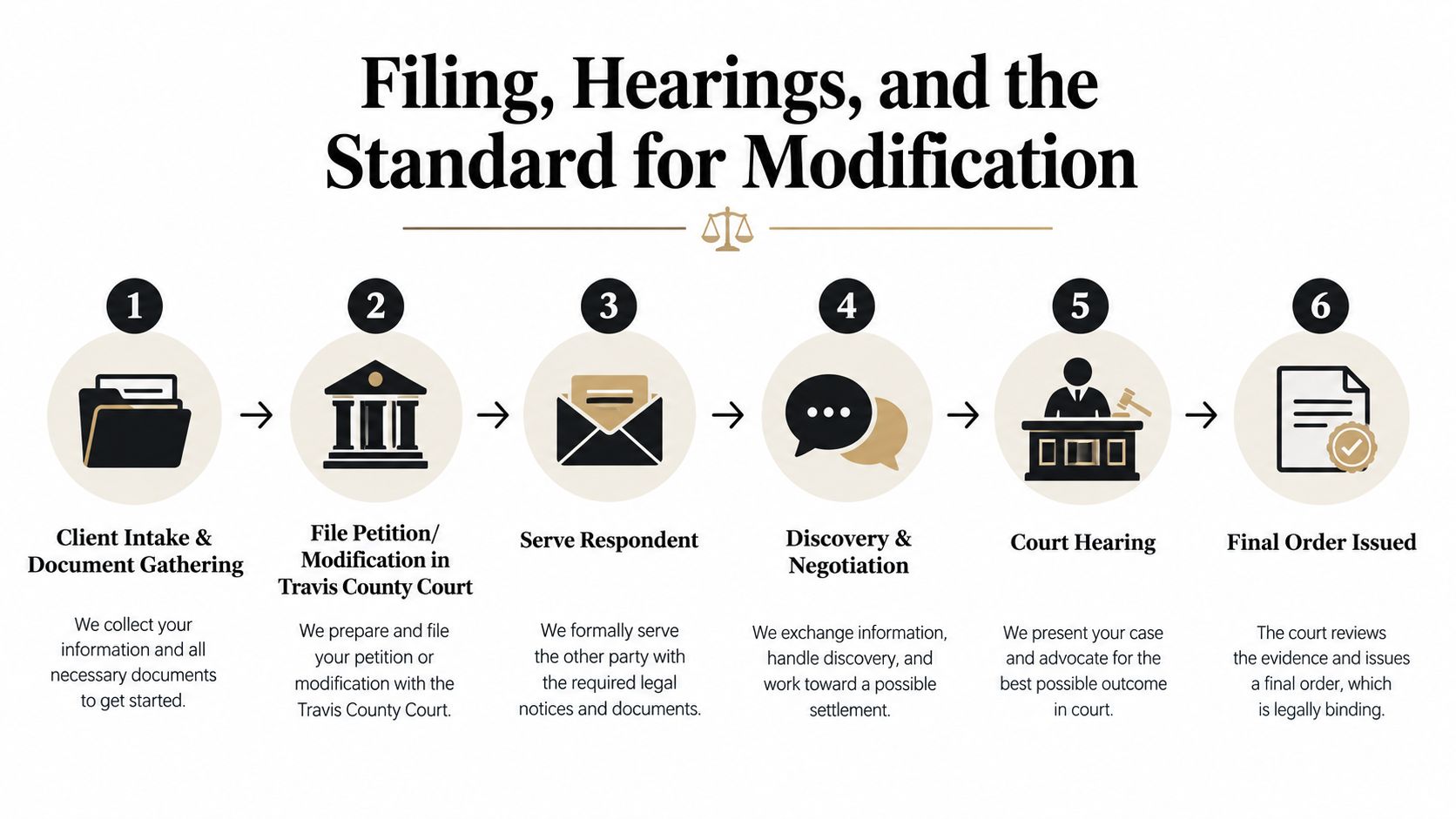
Filing, Hearings, and the Standard for Modification
A child support case moves through defined procedural stages. Missing one can create avoidable delay or leave the judge without the evidence needed to rule.
Start with the correct filing
A parent seeking an original order files the appropriate petition. A parent seeking a change files a modification motion in the proper Travis County district court. The pleading should identify the requested relief, explain the legal basis, and attach or reference the existing order when modification or enforcement is involved.
Complete service and financial exchange
The responding parent must receive legal notice through proper service unless a valid waiver or other procedure applies. When OAG services are involved, the agency's role should be addressed in the case.
Financial disclosure then becomes central. Gather tax returns, pay stubs, employer compensation records, business documents, insurance information, and proof of relevant expenses. Self-employed parents need especially careful preparation because the court may need more than a standard payroll statement.
Prepare for temporary and final hearings
If support is contested during the case, the court may hear temporary-orders evidence. The final hearing or bench trial requires organized exhibits, testimony, and a clear calculation. A lawyer should prepare the judge to see the requested amount, the supporting records, and the response to the opposing party's theory.
Under Texas Family Code §156.401, modification generally requires a material and substantial change in circumstances or another statutory basis. Texas practice often focuses on the commonly discussed 20% or $100 threshold, but the applicable facts and order must be examined carefully before relying on that shorthand.
The September 1, 2025 cap change can affect modification arguments, particularly where an existing order was calculated under an earlier cap. It doesn't automatically rewrite every prior order. Counsel must examine the order date, current circumstances, pleadings, and whether the statutory modification standard is satisfied.
Enforcement Tools When a Parent Will Not Pay
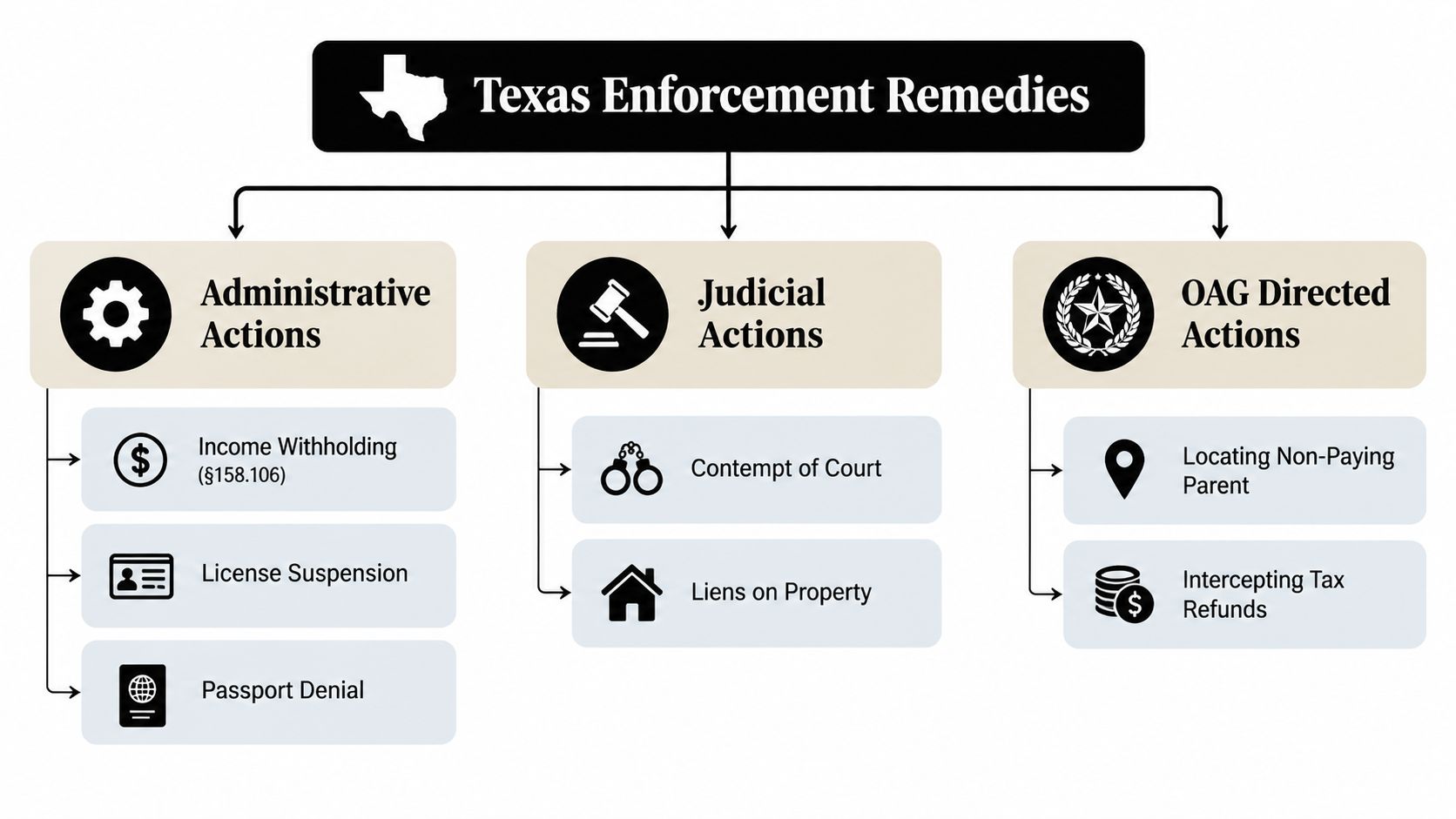
An unpaid child support order is an enforceable court obligation, not merely a private debt. Texas offers administrative and judicial remedies, and the right choice depends on the payment history, employment, assets, and evidence showing whether the parent can pay. For a detailed guide on enforcement procedures, see how to enforce child support in Texas.
The Office of the Attorney General may pursue license suspension and liens against property, bank accounts, retirement plans, insurance proceeds, and other assets. Administrative action often works best when the parent has traceable employment or identifiable accounts. Review the available remedies through the Texas Attorney General's child support enforcement guidance, then determine whether agency action addresses the actual problem.
Administrative collection
Income withholding directs an employer to deduct support from wages. License remedies can affect driving, occupational, and recreational privileges when statutory requirements are satisfied. Tax-refund interception and other agency procedures may also collect arrears.
These tools are useful when the parent is employed, the order is clear, and the payment ledger is accurate. They may produce little when the parent is self-employed, changes jobs, hides assets, or contests the accounting. In those cases, obtain financial records and address the specific collection barrier rather than relying on repeated agency requests.
Judicial enforcement
A private enforcement action can ask the court to confirm arrears, enforce the order, require payment, impose liens, or consider contempt. Contempt can result in serious sanctions, but the case must establish that the parent understood the order, had the ability to comply, and failed to do so. A parent who cannot pay may need to seek modification instead of stopping payments. A later modification generally does not erase existing arrears.
Texas has faced substantial child-support arrears statewide. The Texas child support statistics source discusses arrears interest at 6% and the conditions for identifying a parent as a child support evader. Those issues can materially affect the balance and the pressure applied to collect it.
No automatic dollar threshold triggers a warrant. The court examines the order, payment history, evidence of ability to pay, and statutory requirements.
When to Hire an Attorney and What It Costs
Hiring a child support attorney in Austin is a strategic decision when the dispute involves facts the standard worksheet can't resolve. The strongest trigger points include the $11,700 cap, self-employment income, stock compensation, equal possession, relocation, and a contested modification.
Don't choose counsel based only on the lowest quoted fee. Ask what work the fee covers, who will prepare the financial analysis, whether court appearances are included, and how the lawyer handles disputed evidence.
Fee structures vary by case and attorney:
| Fee Model | Typical Range | Best For | Key Caveat |
|---|---|---|---|
| Flat fee | $1,500 to $3,500 | Uncontested original orders | Scope may exclude hearings or disputes |
| Limited scope | Varies | Reviewing an OAG draft order or specific issue | You remain responsible for other tasks |
| Hourly representation | $250 to $500 per hour | Contested matters | Total cost depends on discovery and litigation |
| Hybrid retainer | Varies | Cases needing a defined base plus ongoing work | Billing terms must be written clearly |
These figures and structures are market descriptions, not a promise from a particular lawyer. Filing fees, process servers, expert accountants, complex business analysis, and appellate work may be billed separately. Ask for a written engagement agreement before work begins.
A small operational detail can also matter. If a firm needs help handling incoming calls while attorneys are in hearings, a parent may encounter a legal intake system supported by a best answer service for attorneys. That kind of service doesn't replace legal advice, but it can help route prospective-client inquiries to the appropriate office.
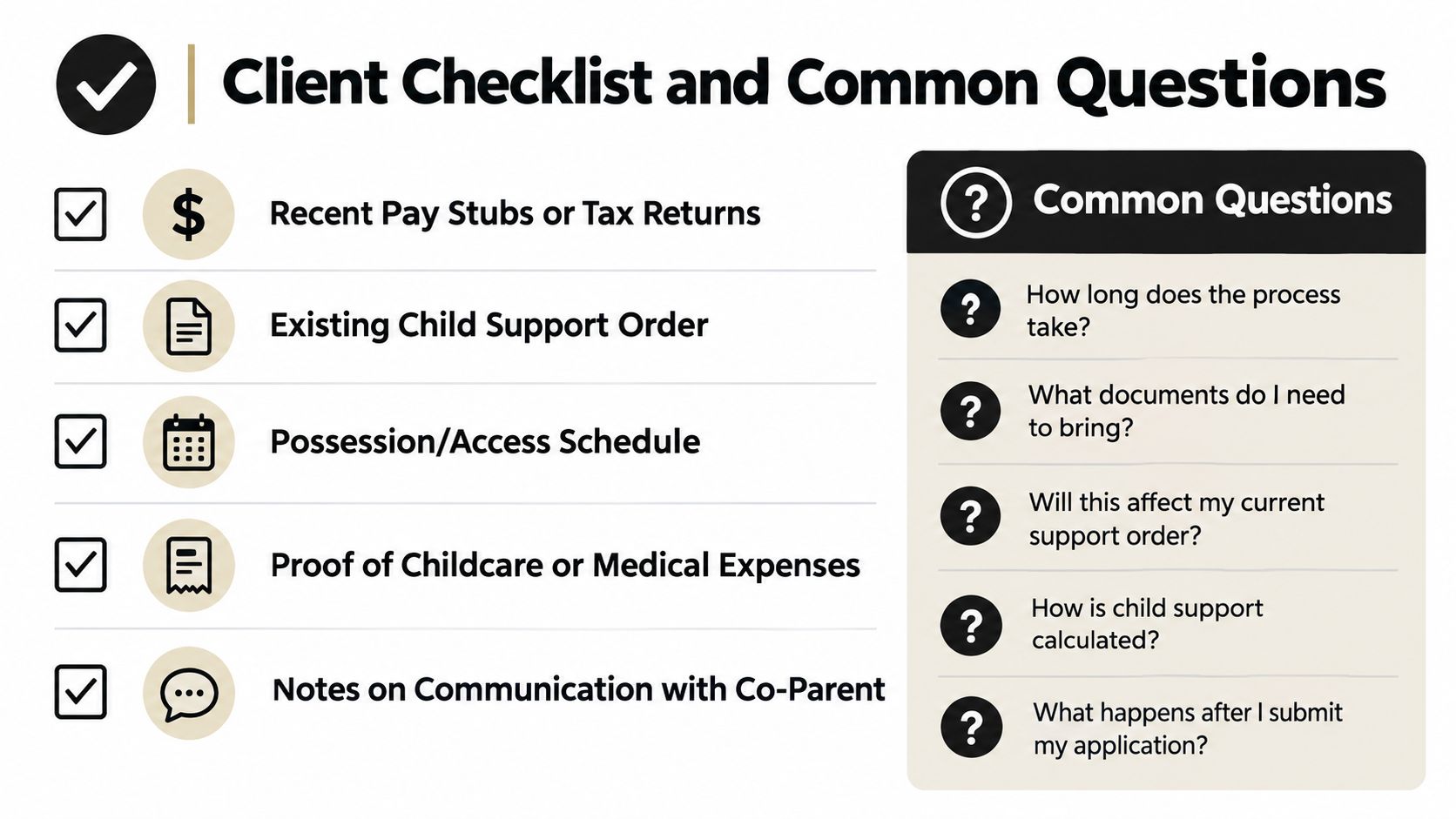
Bring the following to the first strategy session:
- Income records: Recent pay stubs, compensation statements, and two years of tax returns.
- Existing orders: Every child support, custody, medical-support, or withholding order.
- Possession evidence: A 12-month possession calendar and records of exchanges.
- Expense documentation: Childcare, health insurance, medical, education, and special-needs records.
- Communication history: Messages showing agreement, missed payments, disputed income, or conflict.
Texas Child Support Law Office of Bryan Fagan handles establishing, modifying, enforcing, and defending child support orders, including high-income cases, arrears, medical support, and complex income disputes. Treat the first meeting as a working session, not a storytelling session.
Client Checklist and Common Questions
Before consulting counsel, assemble the documents that determine the calculation and the dispute. Bring income records, the existing order, a possession calendar, proof of childcare or health-insurance costs, and a written list of the issues you believe are contested.
Common Texas questions
Does child support automatically change when a parent gets a new job?
No. A new job doesn't rewrite an existing order. The parent seeking a different amount must pursue modification and prove the applicable statutory basis.
How long does a modification take in Travis County?
A contested modification typically takes 6 to 12 months from filing to hearing. The actual timing depends on service, discovery, court availability, settlement efforts, and the complexity of the financial evidence.
Can support be reduced after a job loss?
Yes, if the parent proves a material and substantial change with reliable evidence. Stopping payment without obtaining a modified order leaves the existing obligation in place.
Do child-support arrears expire?
Texas has no statute of limitations on enforcement of child-support arrears. Payment records and the official ledger still matter because the parties may dispute the amount, credits, or interest.
What happens if a parent hides income?
The judge can evaluate the available evidence, attribute income where appropriate, award retroactive support, and impose enforcement remedies. Self-employment, cash income, business benefits, and unexplained deposits require focused financial investigation.
The OAG is often a practical starting point for simple, cooperative cases. A private Austin attorney is the better choice when income is complex, the cap matters, possession is contested, arrears are disputed, or one parent is withholding financial information.
If you're facing a Travis County child support hearing, modification, enforcement action, or high-income calculation, contact the Texas Child Support Law Office of Bryan Fagan for a focused review of your order, net resources, possession schedule, and evidence. Bring the financial records and existing orders listed above so the legal team can help you identify the strongest next step.


