 Skip to content
The most popular advice about child support in San Antonio is also some of the most dangerous: “If custody is 50/50, nobody pays support.” Texas courts don't use that shortcut. They calculate support from statutory net resources, custody facts, medical coverage, and the child's needs. A parent who relies on a handshake agreement, an online calculator, or an old article about the income cap can walk into court with the wrong expectation and a growing arrearage balance.
If you're searching for a child support lawyer in San Antonio, focus on the numbers and the order. The decisive questions are what each parent can prove, which deductions Texas law permits, whether income is being reported accurately, and whether the requested amount follows or departs from the guidelines.
Understanding Texas Child Support Law
50/50 possession doesn't automatically erase support
Texas child support belongs to the child. It isn't a punishment for the paying parent, and it isn't a reward for the parent who receives the payment. A shared possession schedule can affect the overall analysis, but it doesn't create an automatic zero-support result. The court still examines the statutory framework, including net resources and the circumstances of the child and both parents under the Texas Family Code.
A parent may have substantial earnings even while exercising equal possession. Another parent may carry health-insurance costs, ordinary child expenses, or a different share of the financial burden. Those facts can matter when the court applies the guidelines or considers a deviation under Texas Family Code §154.123. The right question isn't whether the calendar looks equal. The right question is how the law applies the financial evidence to the actual order being requested.
The baseline calculation begins with monthly net resources, not a parent's preferred description of fairness. Texas Family Code §154.062 identifies the resource categories and deductions used in determining support. Texas Family Code §154.125 then supplies the guideline percentage framework, subject to the statutory cap discussed below. The Texas Family Code's child-support provisions are summarized in this Texas child support law resource.
Informal deals create formal problems
Suppose two parents agree that one will pay less because the other parent has started allowing more overnight possession. Unless the enforceable order is changed through the proper legal process, the ordered amount remains due. A private text message or verbal promise generally doesn't replace the court's command, and the receiving parent's temporary cooperation doesn't prevent later enforcement of the unpaid balance.
That risk cuts both ways. A receiving parent who accepts less may later seek enforcement of the full ordered amount. A paying parent who stops paying because visitation breaks down may face arrears, wage withholding, or contempt proceedings. Support and possession are separate legal obligations. If one order is violated, address that violation through the court rather than trading obligations informally.
Practical rule: Never treat an informal child-support arrangement as a modification. Get the agreement reduced to an enforceable order before changing the payment amount.
San Antonio cases are handled in the Bexar County system, but the governing standards come from the Texas Family Code. A judge needs admissible financial records, not a general assertion that the result feels unfair. That is why accurate pay records, tax documents, insurance information, and payment histories matter from the first filing.
How Courts Calculate Child Support Payments
Texas child support looks mechanical on paper. In court, the result depends on whether the financial evidence supports each input. The judge identifies the paying parent's monthly net resources under Texas Family Code §154.062, subtracts legally permitted deductions, and applies the guideline percentage for the number of children. This explanation of how Texas courts calculate net resources outlines the figures the court must examine.
The calculation starts with evidence
A salaried employee usually proves income with pay statements and employer information. A self-employed parent, business owner, contractor, or commission-based earner requires closer review. Tax returns, bank records, profit-and-loss statements, contracts, and business records may all be relevant. Gross receipts do not automatically equal net resources. The court separates legitimate business costs from personal spending described as a business expense.
Permitted deductions may include applicable taxes and other expenses recognized by statute. Health-insurance premiums and union dues can affect the calculation when they meet the legal requirements. A voluntary expense, inflated write-off, or personal cost routed through a business does not automatically reduce support.
Reviewing what counts as net resources for child support requires more than collecting one pay stub. Compare the claimed income with the parent's broader financial records. Missing commissions, unexplained deposits, unusual deductions, and inconsistent business records can change the figure presented to the judge.
Apply the guideline percentage
After determining reliable net resources, the court applies the guideline percentage:
| Number of Children | Percentage of Net Resources |
|---|---|
| One child | 20% |
| Two children | 25% |
| Three children | 30% |
| Four children | 35% |
| Five or more children | 40% |
These percentages come from the Texas statutory guidelines identified in Texas Family Code §154.125. The applicable net-resource cap limits the standard calculation. The court must also address medical support and other orders when the facts require them.
For a San Antonio employee whose verified monthly net resources fall below the statutory cap, the judge confirms the reliable monthly figure, identifies the children covered by the order, and applies the matching percentage. For one child, the guideline amount is 20% of the applicable net resources. Equal possession time does not automatically change that result, and a parent's belief that the percentage is unfair does not replace the statutory calculation.
Check the inputs before disputing the output. An omitted employer-paid benefit, incorrectly counted insurance premium, unreported commission, or unsupported business deduction can produce the wrong support amount. Accurate records give the court a defensible number.
High-Income Cases and the 2025 Cap Update
High-income child-support cases do not end with a salary figure. Texas courts begin with verified net resources, apply the statutory guidelines up to the applicable cap, and then decide whether the evidence supports a different amount. An informal agreement that ignores bonuses, business income, benefits, or allowable deductions can fail as soon as the court reviews the underlying records.
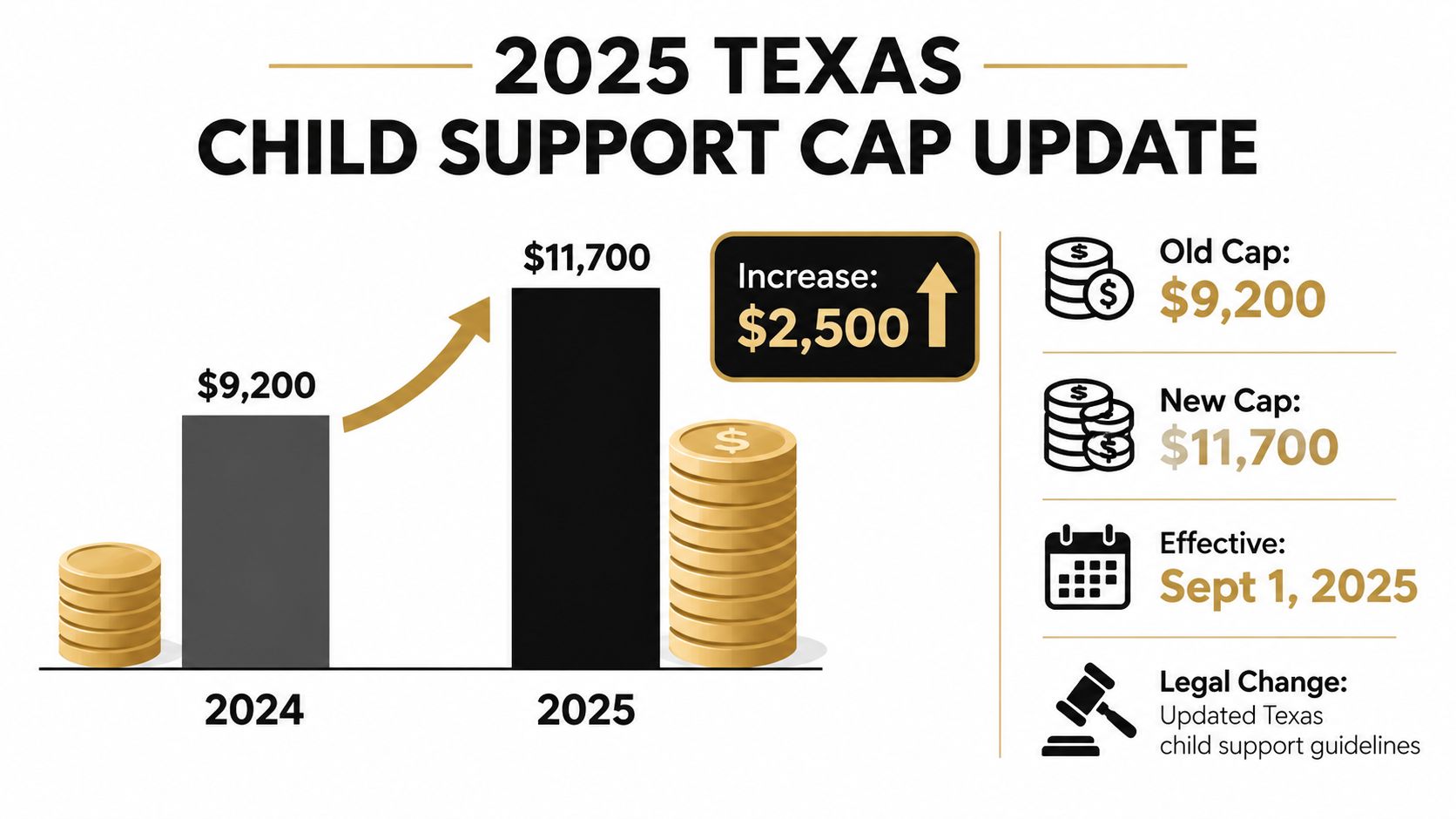
Texas raised the statutory monthly net-resources cap on September 1, 2025, from $9,200 to $11,700. The guideline formula now reaches further into the income range relevant to high earners in Bexar County. The change affects the standard calculation, but it does not create an automatic award above the cap.
What the new cap does
For monthly net resources at or below $11,700, the statutory percentages produce these presumptive guideline amounts:
- One child: $2,340 per month, based on 20%.
- Two children: $2,925 per month, based on 25%.
- Three children: $3,510 per month, based on 30%.
- Four children: $4,095 per month, based on 35%.
- Five or more children: $4,680 per month, based on 40%.
The figures and percentages reflect the statutory guidelines in Texas Family Code §154.125. They are a benchmark for the standard order, not a promise that every high-income case will end at the listed amount.
The cap does not erase the need to prove income accurately. A court may review payroll records, tax returns, commission statements, business accounts, employer-paid benefits, and claimed deductions. A parent who reports only base salary while excluding bonuses or business income risks presenting an incomplete net-resources figure.
Above-cap requests require proof
A court may consider a deviation under Texas Family Code §154.123. The parent requesting more than the guideline amount must connect the request to the child's actual needs and the financial circumstances of both parents. A high salary by itself does not establish that an above-cap award is appropriate. The parent opposing the request should also address the evidence, rather than treating the cap as an automatic stopping point.
For executives, physicians, business owners, and other high-income parents, prepare records that explain education, medical care, childcare, extraordinary expenses, financial resources, and legally relevant lifestyle evidence. In Bexar County, the strength of that factual record often determines whether the court stays with the guideline benchmark or considers a deviation.
Courtroom position: Treat the cap as the starting benchmark. Then prove why the court should, or should not, order more.
Older online guidance may still use the prior ceiling. Confirm that any estimate reflects the 2025 cap before relying on it in negotiation or at a hearing.
The Legal Process in San Antonio
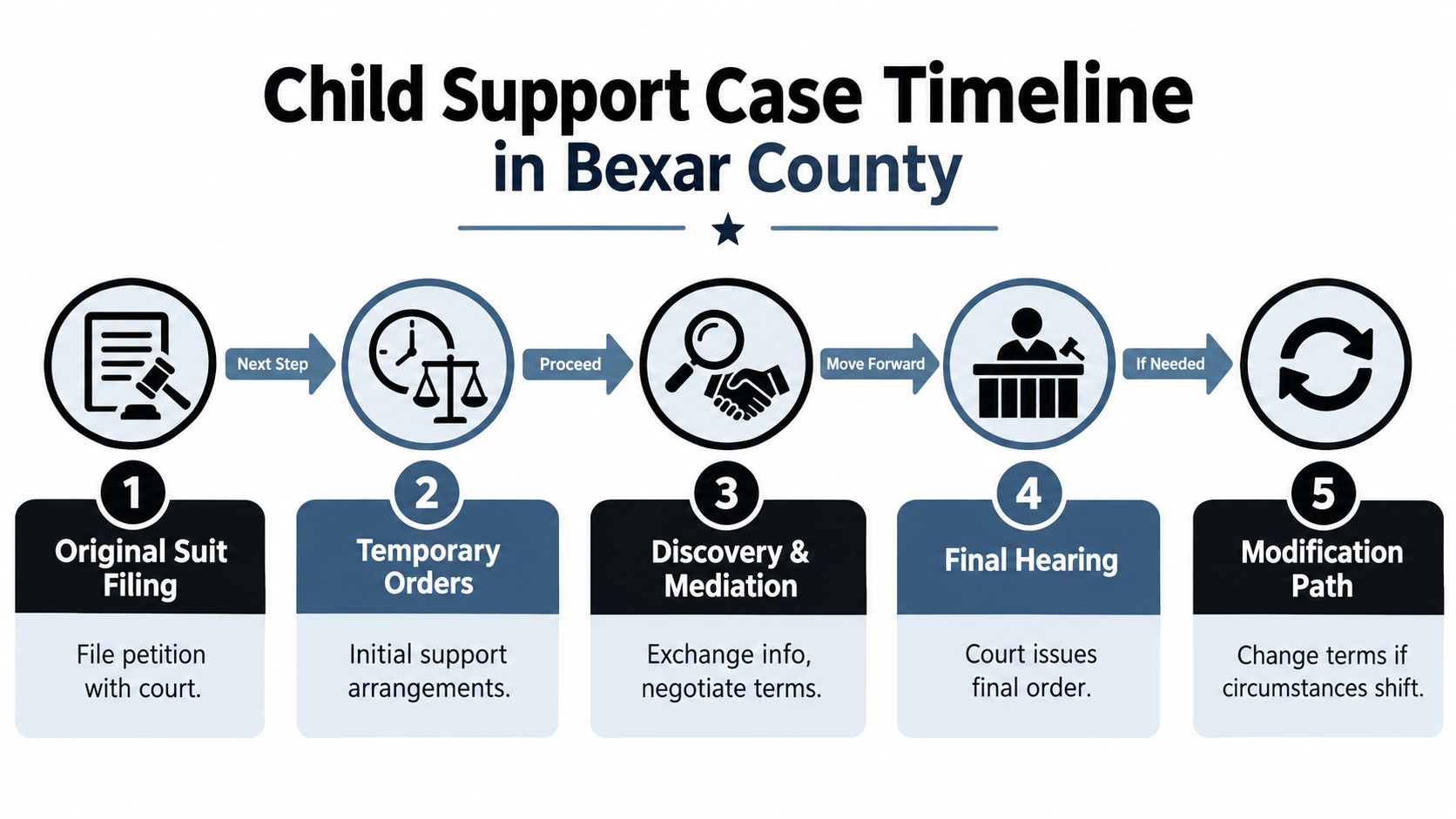
A Bexar County child-support matter usually begins with identifying the legal vehicle. An original suit affecting the parent-child relationship establishes parentage, conservatorship, possession, and support. A Title IV-D enforcement case involves the Texas Attorney General's child-support system. A private modification asks an existing court to change support based on legally sufficient grounds.
Filing and service come first
The petitioner files the appropriate pleading in the court with jurisdiction. The other parent must receive legally effective notice, usually through formal service or a valid waiver. Skipping service, using an incorrect address, or assuming that a text message is notice can create a serious defect and may lead to a default result or delay.
A parent seeking temporary relief may request temporary orders. Those orders can address interim child support, medical support, possession, and related responsibilities while the case proceeds. The requested relief should be supported by financial information and a clear explanation of the immediate need.
The Bexar County court process and local considerations deserve separate attention in this child-support court guide for Bexar County.
Evidence controls the later stages
After filing, the parties exchange information through required disclosures, discovery, informal document requests, or subpoenas when appropriate. Financial disputes often turn on missing pay records, incomplete tax returns, unexplained deposits, business expenses, insurance proof, and inconsistent statements about employment.
Mediation may resolve the dispute, but any agreement still needs to become an enforceable order. If the parties don't resolve the issues, the court conducts a hearing or trial. The judge considers testimony, admitted exhibits, the statutory guidelines, and any evidence supporting a deviation.
Modification requests need disciplined handling
The Texas Attorney General's modification process can involve information gathering, specialist review, and court action if necessary. The agency advises submitting only one modification request because duplicate requests can delay processing. A parent seeking relief should submit complete income information, medical-insurance proof, the existing order, and documents showing the claimed change.
The process doesn't move automatically just because a parent believes the current order is unfair. The court or agency needs evidence, a proper response, and an enforceable order changing the obligation. Until that happens, the existing order controls.
Enforcement, Arrears, and Modifications
Texas enforcement is not passive. Income withholding is the primary collection mechanism, and Texas law also permits liens, tax-refund interception, license suspension, and contempt remedies when support becomes delinquent. The legal framework includes enforcement procedures under Chapter 157 and income withholding under Chapter 158 of the Texas Family Code.
Arrears survive informal compromises
If the order requires a particular payment and the parent pays less, the unpaid difference can become arrears. The receiving parent may say the reduced amount was acceptable at the time, but that conversation doesn't automatically change the enforceable order. A paying parent should never assume that cash, direct transfers, or payments made outside the designated system will be credited without reliable proof.
Wage withholding can redirect income quickly after an order is issued. Counsel must verify the disposable-income base, the exact withholding terms, and whether the case is handled through Title IV-D or as a private order. Delivery and enforcement procedures can differ, and a mismatch can create confusion about credits or balances.
Modification requires a legal threshold
Under Texas Family Code §156.401, modification generally requires a material and substantial change in circumstances or satisfaction of the applicable three-year rule. The Attorney General identifies the three-year pathway through a change that meets the 20% or $100 threshold. The numbers and legal standard should be applied to the existing order and current evidence, not guessed from an online calculator.
Build the record before filing:
- Income records: Preserve pay statements, tax filings, commission records, contracts, and business documents.
- Insurance proof: Keep records showing premiums, coverage, and changes in medical insurance.
- Payment history: Match bank records, withholding statements, receipts, and state-account information.
- Changed circumstances: Document the date and nature of job changes, custody changes, new expenses, or other material developments.
A modification doesn't erase existing arrears. It changes the future obligation only when the court enters the appropriate order, subject to the terms of that order. If enforcement is pending, address the arrears and modification together rather than assuming one automatically pauses the other.
How a Child Support Lawyer Protects Your Interests
A capable child support lawyer in San Antonio doesn't merely enter numbers into a calculator. The lawyer tests whether the numbers are complete, legally deductible, and supported by documents. That means comparing pay records with tax filings, examining business expenses, reviewing deposits, and identifying signs that a parent is underreporting income or voluntarily reducing earnings.
Self-employment requires particular scrutiny. A business owner may report a low taxable figure while receiving personal benefits through the business. The issue isn't to label every deduction suspiciously. It's to distinguish a legitimate operating expense from a personal cost that should remain available when the court determines net resources.
Strategy follows the calculation
Counsel can also address medical support, insurance premiums, possession schedules, wage withholding, arrears, and requests for deviation under §154.123. In a 50/50 case, the attorney should present the actual financial burden rather than relying on the slogan that equal time means equal support. In a high-income case, the attorney should either prove why the capped guideline amount is sufficient or document the child-specific reasons for additional support.
The strongest presentation gives the judge a clean path from evidence to order. Organize the records, identify disputed figures, explain the statutory treatment, and request precise relief. A vague complaint about hidden income is weaker than a documented comparison showing what was reported, what the records reveal, and why the difference matters under §154.062.
Preparation matters: The lawyer who controls the financial record usually controls the support argument.
The Texas Child Support Law Office of Bryan Fagan handles establishing, modifying, enforcing, and defending Texas child-support orders, including high-income disputes, retroactive support, wage garnishment, arrears, medical support, and complex income questions. A firm that manages a high volume of inquiries may also consider whether to set up an AI receptionist so prospective clients can receive consistent intake information while attorneys focus on case analysis.
Frequently Asked Questions
Can I stop paying if the other parent denies visitation?
No. You can't unilaterally stop child-support payments because the other parent violates possession or visitation terms. Support and possession are separate obligations. File an enforcement action or seek other relief under the Texas Family Code, but continue complying with the support order unless a court changes it.
How is retroactive support handled?
Retroactive support concerns support for a period before the current order was entered. The court examines the child's circumstances, the parents' resources, prior support provided, and the statutory factors governing the requested relief. Don't assume a retroactive claim will match the current guideline calculation. Bring payment records, communications, insurance information, and evidence showing what each parent contributed.
When does wage withholding stop after arrears are paid?
Paying the balance doesn't always stop withholding automatically. The underlying order, income-withholding terms, arrears accounting, and agency or court records must be reviewed. Obtain written confirmation of the balance and pursue the proper administrative or court process to terminate or adjust withholding. Keep proof of every payment until the withholding change is confirmed.
Does a modification request automatically change my payment?
No. The existing order remains enforceable until a new order takes effect. The Texas Attorney General's modification process may involve review and court proceedings, but filing a request isn't the same as receiving relief. Submit complete documents and respond promptly rather than reducing payments based on an anticipated result.
For additional guidance on structuring useful legal FAQs, this AISEOGrow FAQ guide offers a practical content framework, but it doesn't replace advice about your specific order, evidence, or court deadlines.
Texas Child Support Law Office of Bryan Fagan helps San Antonio parents establish, modify, enforce, and defend child-support orders using accurate net-resource evidence and current Texas guidelines. If your case involves the $11,700 cap, 50/50 possession, wage withholding, arrears, retroactive support, or disputed income, visit Texas Child Support Law Office of Bryan Fagan to request a focused review of your situation.


