 Skip to content
You've separated from the other parent, the bills keep arriving, and informal promises haven't produced reliable support. You're searching for how to file for child support in Austin, but the filing decision is only the starting point. The more important question is whether you're opening the right case, in the right forum, with financial evidence strong enough to support the order your child needs.
In Travis County, venue, service, income proof, and the choice between the Texas Office of the Attorney General and a private lawsuit can shape the result. The 2025 increase in Texas's net-resource cap also makes older orders and high-income cases require closer analysis, not a routine form submission. Texas Family Code provisions, including §154.125, §154.123, §157.001, and §154.132, provide the legal framework, but strategy determines how that framework is applied to your facts.
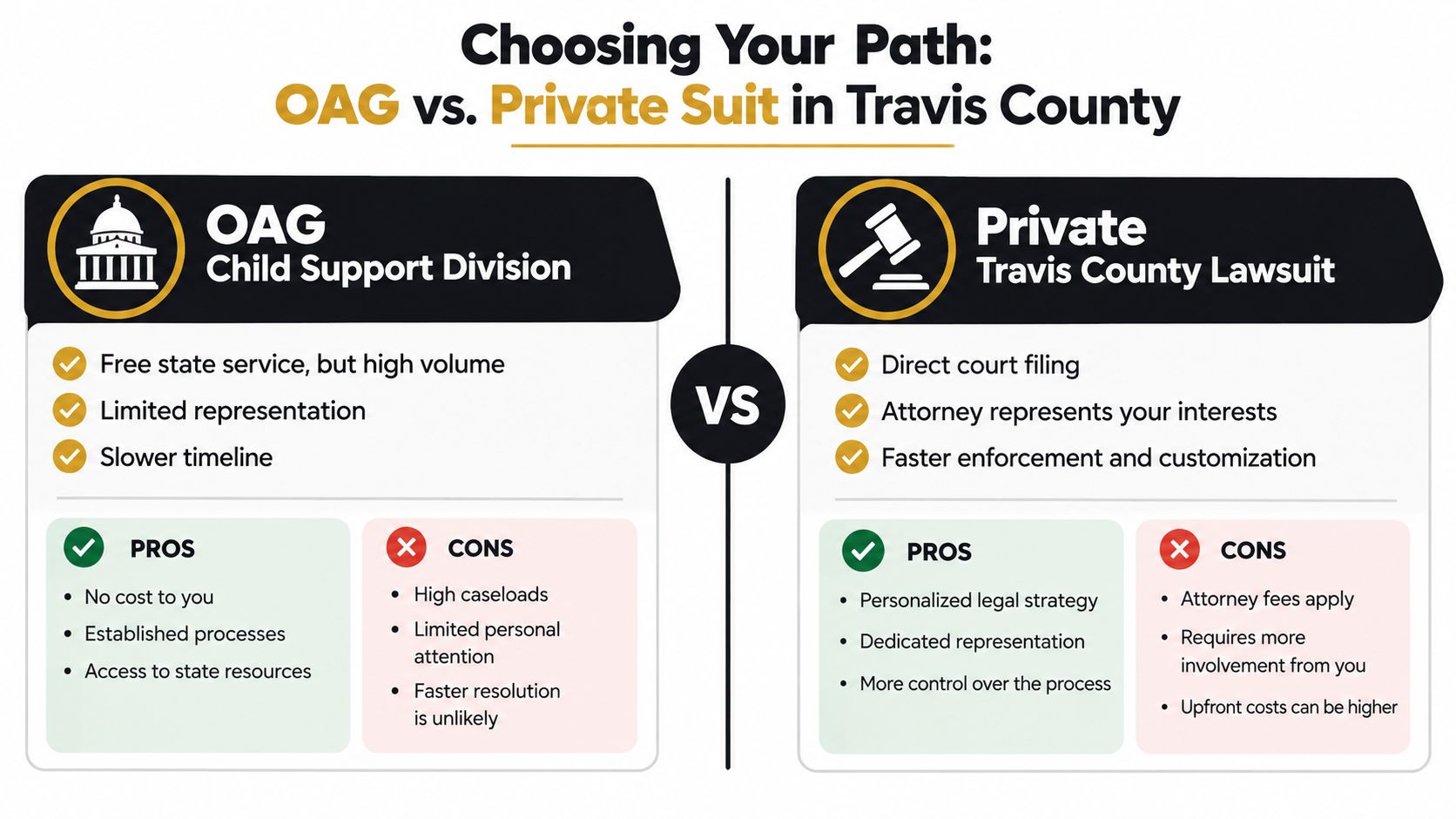
Choosing Between the OAG and a Private Travis County Suit
The first decision is whether to apply through the Texas Office of the Attorney General Child Support Division or file a private Suit Affecting the Parent-Child Relationship, commonly called a SAPCR, in Travis County district court. Both routes can establish support, but they serve different litigation needs.
The OAG route is practical when you need the state to establish paternity, obtain an initial support order, or enforce an existing order without privately managing every procedural step. Texas allows a parent to open a child support case online through the OAG, and the state says mailed paper applications take longer to process than online applications. The application is free, although federal rules require a $35 annual service fee in qualifying cases where the family has never received TANF. The fee is deducted from child support payments and can apply to each qualifying case. See the Texas Attorney General's application guidance.
When the OAG route makes sense
Choose the OAG when the dispute is relatively straightforward and your priority is establishing or enforcing a basic support obligation. The OAG can pursue enforcement tools available under Texas law, including income withholding and other collection remedies. It doesn't represent either parent individually, however. Its role is to administer the child support case, not to develop a private litigation strategy for your financial interests.
For a general explanation of the agency's function, The Texas Attorney General Child Support Division Explained describes what the division does and when parents may use it. If you need a formal review of an existing order, the Texas child support review process is a separate strategic consideration from opening a new case.
When a private suit is the stronger choice
A private Travis County SAPCR gives you direct control over pleadings, discovery, temporary orders, negotiations, and trial presentation. That matters when custody, possession, medical support, retroactive support, or disputed income must be addressed in the same proceeding. It also matters when one parent earns bonuses, operates a business, receives nontraditional compensation, or contests the other parent's income calculation.
A private lawsuit can be especially important when you need temporary orders while the case proceeds or when support is tied to a broader custody conflict. The filing fee isn't the only cost to consider, but the value of private representation is the ability to build the evidentiary record, demand financial documents, and present a custom-built argument under Texas Family Code §154.123.
Strategic rule: Use the OAG for administrative establishment and enforcement needs. Use a private Travis County suit when the financial or custody issues require direct advocacy.
Navigating the Travis County Filing Process
A Travis County filing succeeds when the documents, venue, and service plan are correct from the beginning. Texas Law Help explains that child support cases are generally filed in the county where the child lives, subject to Texas venue rules. Filing may occur electronically through e-file Texas or in person at the district clerk's office. See the Texas Law Help guidance on establishing paternity and support.
The Travis County district clerk's family division is located at 1700 Guadalupe Street in Austin. The county lists weekday hours of 8:00 AM to 4:30 PM or 5:00 PM, depending on the filing unit. Confirm the applicable filing-unit hours before appearing in person, particularly if you're filing close to a deadline.

Prepare the case before submitting it
Your petition should identify the child, the parents, the requested conservatorship and possession provisions, child support, medical support, and any other relief needed. Bring completed petitions, copies, and supporting documents when filing under Travis County procedures. If paternity hasn't been legally established, include the appropriate paternity request rather than assuming the court can calculate support without resolving parentage.
The filing process should also account for service. After filing, the other parent must receive legally sufficient notice through formal service or an accepted waiver. A case that is filed but not properly served cannot move efficiently to a binding hearing.
Handle filing costs correctly
If you can't pay the court costs, submit a Statement of Inability to Afford Court Costs instead of abandoning the case. This filing asks the court to evaluate your financial circumstances and determine whether costs should be waived or deferred. Complete it carefully and truthfully. Missing information can create avoidable delays.
Travis County's Domestic Relations Office also lists a separate application for child support enforcement. That gives local residents another county-level route for support-related paperwork, while the OAG remains the state child support agency.
Once the petition is filed and service is completed, prepare for the hearing rather than treating filing as the finish line. Bring organized income records, proposed support calculations, information about health insurance, and a clear position on custody and possession. For enforcement-specific local information, review child support enforcement in Travis County.
Calculating Guideline Support and the 2025 Cap
Before filing, calculate the likely support range. The result depends on net resources, the number of children, and the applicable Texas guideline provisions. Texas Family Code §154.125 sets the guidelines and the net-resource cap used for the presumptive calculation. For a full formula walkthrough, review How to Calculate Child Support in Texas.
Effective September 1, 2025, Texas raised the guideline cap from $9,200 to $11,700 in monthly net resources. The revised cap applies to orders finalized on or after that date. Older orders generally do not change automatically. The statutory update is discussed in the 2025 Texas guideline-cap analysis.
For one child, the guideline percentage is 20% of applicable net resources. At the current cap, that equals $2,340 per month. The percentage rises as the number of children increases. The following figures apply the Texas guideline percentages to the $11,700 cap, as explained in How Child Support Is Calculated in Texas.
2025 Texas Child Support Guideline Maximums
| Number of Children | Guideline Percentage | Maximum Monthly Support |
|---|---|---|
| One child | 20% | $2,340 |
| Two children | 25% | $2,925 |
| Three children | 30% | $3,510 |
| Four children | 35% | $4,095 |
| Five or more children | 40% | $4,680 |
These examples assume monthly net resources at or above the cap. They apply the guideline percentages to $11,700, not to every dollar earned above that amount.
Why the cap changes litigation strategy
A parent earning above the cap should not assume the court will calculate support from total gross income. The guideline amount is a presumptive baseline. Under Texas Family Code §154.123, the court may order a different amount when the guideline result does not fairly reflect the child's needs or the parents' circumstances.
That analysis matters in high-income and 50/50 possession cases. Equal or nearly equal parenting time does not automatically eliminate support. The court can consider each parent's resources, actual child-related expenses, insurance, education, healthcare, and the child's overall circumstances. A parent seeking a deviation must present evidence supporting the requested amount.
Courtroom focus: The issue is whether the evidence supports the presumptive guideline amount or a reasoned deviation under §154.123.
Your filing should identify whether you seek a new order, address an existing order, or request modification of an existing order. The 2025 cap is not automatically retroactive, so calculate the applicable amount before treating it as the expected result.
Proving Income and Handling Complex Financial Disputes
The formula is only as reliable as the income information presented to the court. A paycheck can be easy to document. A business owner's true resources, an executive's bonus structure, or a parent receiving irregular distributions requires a more disciplined investigation.

Build the income record from multiple sources
Don't rely on a single tax return. A complete financial picture may require pay statements, compensation plans, bonus records, bank statements, business ledgers, profit-and-loss statements, loan applications, and records of distributions or reimbursements. The purpose is to establish net resources under the Texas Family Code, not merely to repeat a parent's preferred income figure.
Self-employed parents often have legitimate business expenses, but personal expenses routed through a company can complicate the analysis. A court can examine whether reported deductions reflect genuine costs of producing income or reduce the apparent resources available for support.
Use discovery when the numbers don't reconcile
When documents conflict, formal discovery can require the other parent to produce records and answer sworn questions. Subpoenas may be appropriate for third-party financial records. In a substantial dispute, a forensic accountant can trace deposits, compare reported income with spending, and identify unexplained transfers or business benefits.
The court isn't required to accept a financial statement that conflicts with credible evidence. If a parent claims low income while maintaining spending patterns inconsistent with that claim, the issue becomes earning capacity and available resources, not just the number printed on a tax form.
Present a deviation argument with proof
The current cap limits the guideline calculation, but §154.123 permits the court to consider factors supporting a different amount. A parent seeking support above the presumptive guideline level must connect specific child-related needs to admissible evidence. A parent opposing a deviation should challenge unsupported expenses, duplicated costs, and assumptions that don't reflect the child's actual circumstances.
In a 50/50 arrangement, present a complete expense allocation. Identify who pays for housing, health insurance, childcare, school expenses, activities, and unreimbursed medical costs. Equal possession can affect the practical financial burden, but it doesn't replace the court's analysis of resources and proven needs.
Evidence beats accusation: Don't tell the judge that income is hidden. Show the document trail, the unexplained discrepancy, and the support calculation that follows from the evidence.
Planning for Enforcement and Future Modifications
A support order should be drafted with enforcement in mind. Under Texas Family Code §157.001, a party may seek enforcement of a SAPCR order when the other parent fails to comply. Available remedies can include contempt, income withholding, liens, and other statutory enforcement tools. The Texas legal framework also recognizes wage withholding under Chapter 158, which can make payment more consistent when the obligor has identifiable employment income.
The initial order should state the obligation clearly. Ambiguous language creates enforcement problems. Make sure the order identifies the amount, payment schedule, medical support responsibilities, effective date, and any conditions affecting payment. Keep proof of payments and maintain a running record of missed or partial payments.
Treat modification as a new evidentiary case
Texas child support modifications aren't automatic. The OAG states that an active case may be reviewed through a formal Request for Review, and an order may be changed through the Child Support Review Process or a court hearing. Eligibility generally requires either a material and substantial change in circumstances or a difference between the current order and the guideline amount of at least 20% or $100. See the OAG support modification process.
A new job, sustained income change, changed medical needs, or a substantial shift in possession may support review, but the parent requesting modification still has to prove the relevant facts. A filing that merely asserts changed circumstances without supporting records gives the court little basis to act.
Protect the modification record
Parents should preserve income documents, payment histories, medical bills, insurance records, and possession calendars as circumstances change. If a parent's income rises above the updated cap, the existing order won't necessarily adjust on its own. Determine whether the proper remedy is a modification, enforcement action, or both.
The best enforcement strategy is often created before the first hearing. A precise order, a documented payment history, and complete financial records give you an advantage if the other parent later stops paying or disputes the amount.
Frequently Asked Questions About Austin Child Support
Where should I file a Travis County child support case?
A case usually belongs in the county where the child lives under Texas venue rules. In Austin, filing can be completed electronically through e-file Texas or in person with the Travis County district clerk's family division at 1700 Guadalupe Street. Confirm the correct case type and required documents before filing.
Does the 2025 cap automatically change an older order?
Generally, no. The cap increased to $11,700 in monthly net resources effective September 1, 2025, but that change applies to orders finalized on or after that date. An older order usually requires a formal modification request rather than an automatic recalculation. The court still must apply the applicable modification standards and consider the evidence.
Does 50/50 custody mean neither parent pays support?
No. Equal possession doesn't automatically cancel child support. The court can consider each parent's net resources, expenses, insurance obligations, and the child's needs under Texas Family Code §§154.123 and 154.125. The result depends on the complete financial and possession picture.
Should I use the OAG or file privately to enforce unpaid support?
Use the OAG when you want state enforcement services and the matter doesn't require individualized litigation. A private enforcement action may be more appropriate when you need contempt, discovery, a disputed arrears calculation, or immediate courtroom advocacy. Enforcement under Chapter 157 requires a clear order and proof of noncompliance.
Is child support taxable income or deductible?
Child support generally receives different tax treatment from wages and ordinary support payments. Because tax consequences depend on the specific payment and family circumstances, review a focused resource on the tax effects of child support payments and discuss the details with a qualified tax professional.
What should I bring to the first hearing?
Bring organized evidence of income, employment, health insurance, childcare, medical costs, possession, and prior payments. If income is disputed, bring records that show the discrepancy rather than relying on argument. Your proposed order should state the relief you want in precise, enforceable terms.
If your Austin case involves the 2025 cap, disputed income, 50/50 possession, enforcement, or modification, Texas Child Support Law Office of Bryan Fagan can evaluate the financial record and develop a courtroom strategy under the Texas Family Code. Visit Texas Child Support Law Office of Bryan Fagan to request guidance on filing, calculating, enforcing, or modifying your child support order.


