 Skip to content
Yes, severance pay is subject to child support withholding in Texas under Family Code §158.214, and the amount withheld generally mirrors what would be taken from regular wages. Since September 1, 2025, guideline calculations for high-income parents use a monthly net-resources cap of $11,700, which can make the withholding from a lump-sum payment substantial.
You've just lost your job, and payroll tells you that child support will come out of your severance before the money reaches your account. Or you're the custodial parent and want to know whether a former employer can intercept termination pay before it disappears. In both situations, the answer turns on the existing withholding order, the amount of severance, the support obligation it represents, and the statutory withholding limits.
Texas doesn't place severance outside the child support enforcement system. It treats termination-related compensation as income that can be withheld, while separate procedures may be available if the underlying support order no longer reflects the obligor's financial circumstances.
How Texas Treats Severance Pay for Child Support
A terminated parent may receive a lump-sum severance payment covering several pay periods. The payment can feel different from ordinary wages because the employment relationship has ended, but Texas law focuses on what the payment represents. If it's income paid because employment ended, it can be reached for child support.
Texas Family Code §158.214 defines severance pay as income paid on termination of employment in addition to the employee's usual earnings from that employer. When an employer receives an income-withholding order or writ, the employer must withhold from severance the amount that would have been withheld if the payment were ordinary earnings. The statute keeps that withholding subject to the maximum limits in §158.009. See the Texas Family Code provisions governing severance withholding.

Why the payment isn't protected
The important distinction is between classification and calculation. Classification answers whether the payment is subject to withholding. Texas answers that question directly for severance. Calculation determines how much the employer takes under the existing order and whether the statutory ceiling limits the deduction.
That means a parent generally can't avoid withholding by asking for a final payment instead of continuing wages. Renaming the payment, delaying its distribution, or treating it as a private employment settlement won't automatically remove it from the withholding process. Payroll must examine the order and the nature of the payment, not just whether the worker still receives a paycheck.
A severance payment may also coincide with unpaid current support, arrears, medical support, or another court-ordered obligation. Those issues can affect the amount processed, but they don't create a general exemption. Parents who want to understand how Texas handles other termination-related compensation can review whether child support can be taken from a bonus in Texas.
Practical rule: Treat severance as potentially reachable support income from the moment the employer confirms the payment. Waiting until after distribution often makes correction harder.
Statutory Definitions and Employer Obligations
When an employee receives a severance check after termination, the employer's withholding duty does not end with the last regular paycheck. Under Texas Family Code §158.214, an income-withholding order or writ reaches severance paid to the obligor. Payroll must follow the order rather than decide that a lump-sum payment falls outside ordinary earnings.
The employer's timing matters. The Texas Employer Quick Reference Guide states that withholding must begin no later than the first pay period after the employer receives the order or notice, and that severance must be withheld when paid. The Texas employer guide to child support withholding helps payroll, the employee, and the receiving parent compare the order with the payment schedule.
The paycheck-equivalence method
A practical review usually follows four steps:
- Identify the amount the existing support order requires from ordinary monthly earnings.
- Determine the compensation period represented by the severance.
- Apply the ordinary withholding amount across that period.
- Check the statutory maximum under Texas Family Code §158.009 and remit the amount through the required child support payment system.
Suppose the order requires $100 per month and the severance represents two months of compensation. The employer would generally calculate $200, subject to the statutory maximum. This applies the existing withholding obligation to a payment covering multiple compensation periods. It does not create a new support order. The Texas Workforce Commission explanation of severance withholding describes this paycheck-equivalence approach.
The same method produces $1,200 when the order requires $600 per month and the severance covers two months. The lump sum can therefore produce a larger single deduction while the monthly support order remains unchanged. The result still depends on the order's language, the period covered by the payment, and the statutory ceiling.
What payroll should verify
Payroll should review the withholding order, payment description, covered compensation period, and other withholding instructions. It should separate child support from tax withholding, benefit deductions, and final wage adjustments. A parent or payroll officer who cannot identify the controlling order should review the guidance on an income withholding order before releasing the payment.
For a broader explanation of the collection mechanism, Wage Withholding for Child Support in Texas explains how income withholding orders collect support.
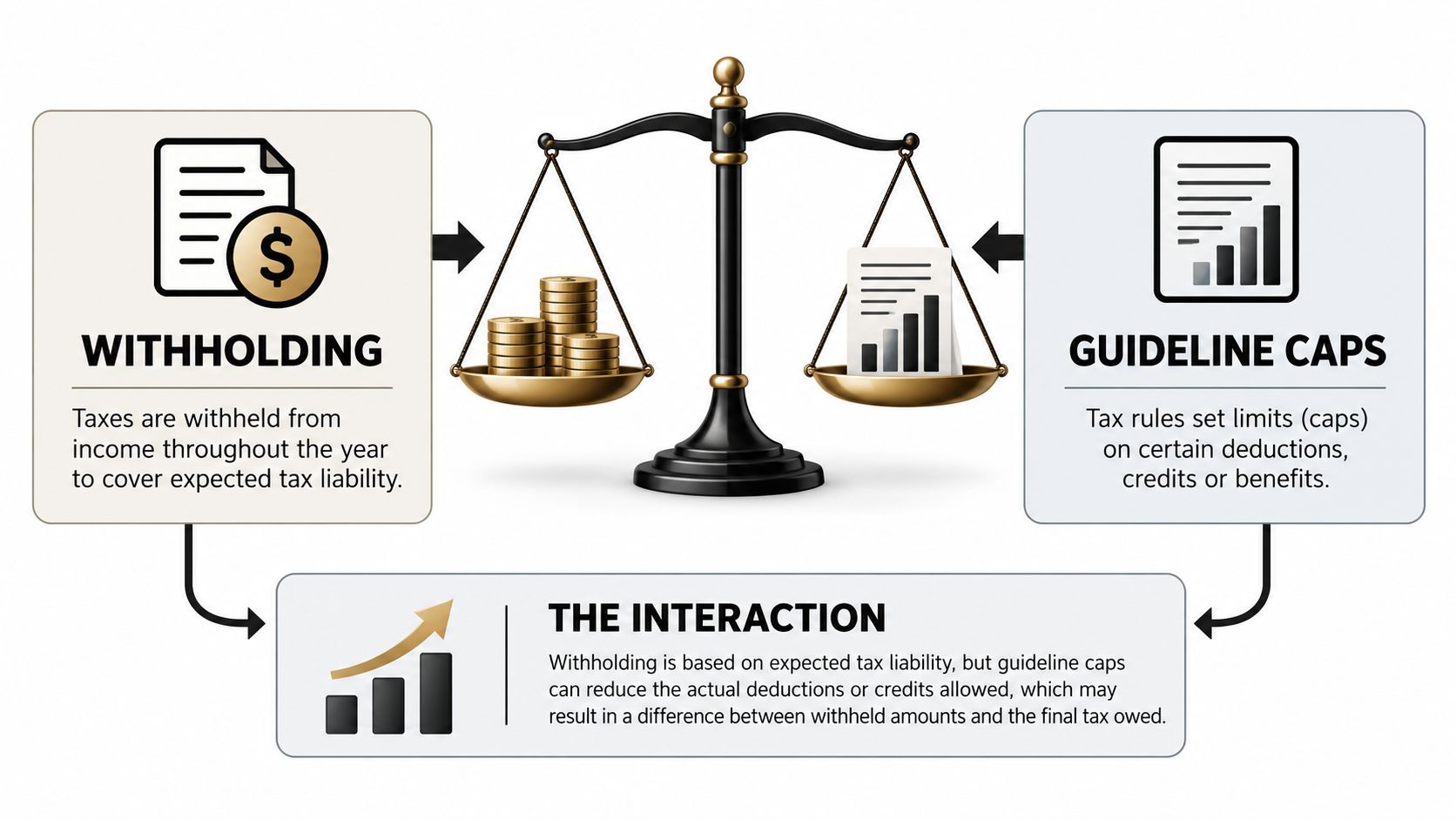
The Interaction Between Withholding and Guideline Caps
The withholding amount comes from the existing order. The guideline cap helps explain how that order may have been calculated, especially for a high-income parent. Those are related questions, but they aren't identical.
Texas Family Code §154.125 sets the guideline percentages for monthly net resources. The percentages are 20% for one child, 25% for two, 30% for three, 35% for four, and 40% for five children, with at least 40% for six or more children. Effective September 1, 2025, the monthly net-resources cap increased from $9,200 to $11,700, a 27.2% increase. The statutory update and cap are described in the Texas Register notice for the revised Texas child support guidelines.
What the new cap changes
At the $11,700 ceiling, the guideline amounts are:
| Children | Guideline percentage | Monthly amount at the cap |
|---|---|---|
| One | 20% | $2,340 |
| Two | 25% | $2,925 |
| Three | 30% | $3,510 |
| Four | 35% | $4,095 |
| Five or more | 40% | $4,680 |
Each figure is tied to the updated cap and the percentages in §154.125. The cap doesn't mean every severance payment receives one of these deductions. It means the existing order for a high-income parent may reflect the revised ceiling, and the employer then applies the order to severance using the method described above.
The distinction matters for someone whose severance covers multiple months. If a parent has an order based on one child at the capped amount, a severance payment representing two months could correspond to $4,680 in ordinary monthly support withholding before considering the statutory maximum or other order-specific issues. The payment itself doesn't automatically create an upward adjustment. The order remains the controlling document unless a court changes it.
Caps, deviations, and maximum withholding
The cap also isn't an absolute limit on every possible support order. Under Texas Family Code §154.123, a court may deviate from guideline support when the evidence shows the guideline amount is unjust or inappropriate. Texas Law Help explains that a court may use the capped guideline amount as a base and consider additional support based on proven income and the child's needs. See Texas child support calculations and deviations.
Total withholding remains subject to the statutory maximum in §158.009. A payroll department must therefore avoid two opposite mistakes: treating severance as completely exempt, or withholding without checking the statutory ceiling and the actual terms of the order. For a plain-language review of how net resources feed into the formula, How Child Support Is Calculated in Texas provides the relevant framework.
Real-World Calculation Examples for Severance
Consider a parent whose existing order requires $600 per month in child support withholding. The employer issues severance representing two months of compensation. Under §158.214, the baseline calculation is $600 multiplied by two, producing $1,200 withheld from the severance, subject to the maximum under §158.009.
The employer doesn't calculate a new monthly obligation merely because the worker was terminated. It applies the current order to the number of compensation periods represented by the severance. The employee should ask payroll for the payment-period calculation, the amount withheld, and the date the money was sent to the state disbursement system.
A high-income parent under the updated cap
Assume the order covers one child and was calculated at the updated $11,700 monthly net-resources cap. Under §154.125, the one-child percentage is 20%, producing $2,340 per month. If the severance represents two months of compensation, the ordinary-wage equivalent would be $4,680.
That figure is a calculation example, not an automatic answer for every case. The actual deduction depends on the order, the compensation period, arrears or additional obligations included in the withholding instruction, and the maximum withholding limit. A parent should compare the employer's worksheet with the signed order rather than rely on the gross severance figure alone.
What happens when arrears exist
Suppose the order requires current support and the parent also owes arrears. The employer may receive instructions addressing more than the recurring current-support amount. The severance can then produce a significant one-time withholding event because the employer applies the support obligation to a lump-sum earnings stream.
The parent receiving support should monitor the account after the employer remits the funds. The parent paying support should preserve the severance agreement, payroll statement, withholding notice, and payment confirmation. Those records matter if the account fails to credit the payment or if payroll takes an amount that doesn't match the order.
Before disputing the deduction, compare four documents: the support order, the withholding notice, the severance agreement, and the final payroll statement. Most practical disputes become clearer when those documents are read together.
Exceptions and Grounds for Contesting Withholding
The default rule is clear, but an incorrect application can still be challenged. A parent may have grounds to contest the amount when payroll misreads the order, counts the severance period incorrectly, withholds outside the statutory maximum, or treats a payment as severance when it has a different legal character.
The first remedy is often administrative clarification. Ask the employer for its calculation, then compare it with the withholding order and the payment terms. If the employer has withheld too much, a written request identifying the discrepancy is more useful than a general complaint that the payment is unfair.
Challenging the existing obligation
A dispute about the amount owed is different from a dispute about payroll execution. If the order itself is outdated because income has fallen after termination, the parent needs a modification proceeding. The parent should not tell payroll to reduce the withholding or stop paying. An informal agreement doesn't change a court order.
Texas Family Code §154.123 can also matter when a parent argues that guideline support is unjust or inappropriate because of the child's proven needs and the parent's financial circumstances. In high-income matters involving complex assets and income streams, a practical overview such as this high net worth divorce guide can help identify financial issues that may need to be addressed with counsel.
Contest versus modification
These options serve different purposes:
- Payroll dispute: Use this when the employer applied the order incorrectly or exceeded the legal limit.
- Order modification: Use this when a material and legally recognized change affects future support.
- Deviation request: Use this when evidence supports an amount different from the guideline result under §154.123.
- Enforcement response: Use this when the withholding or unpaid support has led to a court proceeding requiring a formal defense.
A modification changes future obligations. It doesn't automatically erase support that accrued before the proper filing or effective date. That distinction is critical after a job loss because delay can leave the parent with an arrearage even if the court later reduces the monthly amount.
Enforcement Steps and Modification Procedures
A custodial parent who learns that the obligor is receiving severance should act quickly, but should use the existing enforcement process rather than attempting a private interception. A parent who has lost employment should also move quickly, but should request a formal review instead of stopping payments unilaterally.
The Texas Attorney General's modification process begins with an official Request for Review for an active case. The request can be submitted online or by mail. The matter may then proceed through an in-office Child Support Review Process negotiation or a court hearing. The Texas Attorney General's support modification process explains that procedural path.
If you're seeking enforcement
Start by collecting the documents that establish both the obligation and the payment:
- Obtain the current support order and income-withholding order.
- Confirm the employer's identity and payroll contact information.
- Preserve any notice showing the severance amount and payment date.
- Ask whether the employer received the withholding order or notice.
- Track the remittance and verify that the state account credits it correctly.
- Request enforcement assistance or consult counsel if the employer fails to withhold or remit as directed.
A custodial parent shouldn't assume that a severance announcement means money has already been paid. Payroll timing matters. The employer may have processed the payment, scheduled it for a later pay date, or received the withholding notice after the payroll cutoff. Written records help establish what happened and when.
Additional enforcement tools may be available when the obligor fails to pay or conceals income. Parents can review how to enforce child support in Texas for an overview of the enforcement process.
If you've lost your job
File the Request for Review promptly and prepare complete financial information. Include the termination notice, severance agreement, final pay information, unemployment documentation if applicable, current income, recurring expenses, and evidence of other support obligations. The purpose is to show the court what changed and what payment remains realistic.
The other parent must receive service or notice through the applicable process before a court changes the order. The parties may negotiate through the CSRP, but an agreement still needs to be properly adopted or entered before it replaces the existing order. Until that happens, the current order remains enforceable.
At a hearing, present the actual change in income rather than relying on a general statement that employment ended. The court may examine the severance terms, whether the payment is temporary, available assets, efforts to find work, and the child's continuing needs. The fact that severance was withheld doesn't itself prove that the monthly support order should be reduced.
If the withholding appears excessive
Ask payroll for a written breakdown before filing an objection. Confirm whether the employer treated the severance as covering one period or multiple periods, whether arrears were included, and whether the deduction stayed within §158.009. Compare the result with the exact withholding language in the order.
If the employer's calculation is wrong, request correction in writing and preserve the response. If the dispute concerns the order rather than payroll, raise it in the modification or enforcement proceeding. A court can address the legal obligation, while payroll generally applies the order it has received.
The Texas Child Support Law Office of Bryan Fagan handles establishment, modification, enforcement, and defense of support orders, including disputes involving wage withholding, arrears, high-income calculations, and the $11,700 cap. To discuss a severance withholding or modification issue with counsel, visit Texas Child Support Law Office of Bryan Fagan and provide the order, withholding notice, and severance documents for review.
If severance is about to be paid, gather the support order, income-withholding notice, severance agreement, and payroll calculation before distribution. Texas Child Support Law Office of Bryan Fagan can help determine whether the withholding follows §158.214, whether a modification request is appropriate, and what enforcement or hearing steps should come next.


