Yes, parents can propose a $0 child support agreement in Texas, but it isn't legally binding unless a judge finds it serves the child's best interest and signs it into a court order. A private handshake, text exchange, or side agreement won't do that job.
That catches many parents off guard because the practical answer to can parents agree to no child support in Texas is not really about permission. It's about proof. Texas courts will listen to a no-support proposal, but they won't accept it just because both parents prefer it. The court wants to know how the child's needs will be met, why a deviation from guideline support makes sense, and whether the proposed order protects the child going forward.
In court, the difference between a rejected $0 proposal and an approved one usually comes down to evidence and drafting. Parents who walk in saying, "We both agreed," usually don't have enough. Parents who present a written order, financial records, possession details, expense allocations, and a clear best-interest explanation have a much better chance of getting serious consideration.
The Reality of No-Support Agreements in Texas
Texas allows parents to cooperate. It doesn't allow them to make child support disappear by private agreement.
If you and the other parent want no child support, you can present that proposal to the court. But the judge has the final say. That point controls everything else in this area. The agreement has to become part of a signed order in a SAPCR, divorce decree, modification order, or another judge-signed family court order before it has legal force.
What works and what doesn't
Some parents assume that if parenting time is equal, support should automatically be zero. That isn't how Texas courts operate. Equal possession can matter, but it doesn't override the court's duty to evaluate the child's best interest.
What usually doesn't work:
- An informal deal: Emails, texts, or verbal promises don't create an enforceable waiver.
- A fairness argument alone: "We both think this is fair" isn't enough by itself.
- A vague expense split: Judges want specifics, not assumptions.
What has a real chance of working:
- A written proposed order: The court needs something precise to approve.
- A complete financial picture: Income, household resources, and who pays which child-related costs matter.
- A best-interest explanation: The judge needs a reason to deviate from the guideline framework.
Practical rule: If you want a zero-support order, prepare it like a contested hearing even if the case is agreed.
Why parents get into trouble here
The biggest mistake is treating child support like a private debt between adults. It isn't. In practice, that means one parent may believe support was "waived" for years, only to learn later that the old order still controls or that no enforceable waiver ever existed.
A $0 order is possible in Texas. An undocumented understanding is not a strategy.
The Core Principle Child Support as the Child's Right
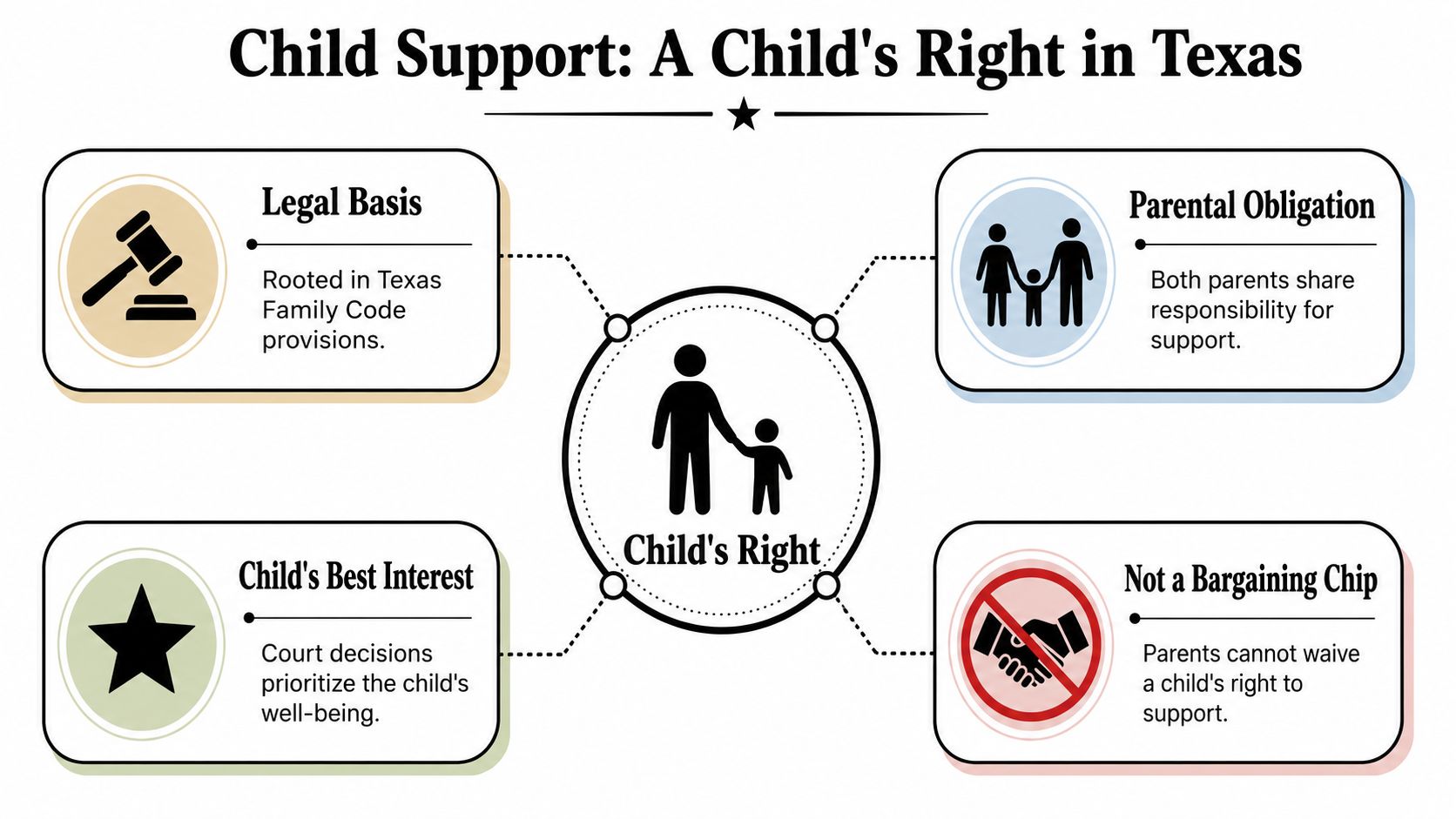
Texas family law starts from a basic idea. Child support belongs to the child, not the parents. That is why judges don't routinely rubber-stamp a no-support arrangement.
Texas Family Code §154.123 gives courts room to consider factors that may justify a variance from guideline support, and §154.125 sets the guideline structure courts start from. Those two sections matter together. The law permits deviation, but it begins from the guideline framework because guideline support is generally presumed to serve the child's best interest.
Why judges view these agreements cautiously
When parents tell a court, "We've agreed to no support," the judge isn't deciding whether the parents are cooperative. The judge is deciding whether the child will still receive adequate support without a periodic payment.
That is why the court asks questions such as:
- Who is paying day-to-day expenses
- How medical support and unreimbursed costs will be handled
- Whether one parent has substantially greater income
- Whether the proposed arrangement can hold up over time
Texas guidance also makes clear that parents can't make a no-support arrangement binding on their own, and that an informal agreement has no enforcement value unless it is included in a judge-signed order. It also notes that support generally ends when a child turns 18 or graduates from high school, which shows support is typically time-limited under Texas law rather than permanently waived by parental consent, as discussed in this Texas child support overview.
The guideline framework still matters
Even if you're asking for zero, you still need to understand what the court is deviating from. How Child Support Is Calculated in Texas gives a practical overview of the Texas guideline formula and how net resources drive the support amount.
The court's question isn't, "Did both parents agree?" The real question is, "Why should I depart from the amount the law would ordinarily require?"
Best interest is the controlling standard
Parents sometimes focus too heavily on convenience. Courts focus on stability. A judge wants to know whether the child will have predictable support, not whether the arrangement simplifies the parents' relationship.
That is why a no-support order must usually be backed by detailed facts. If the child is adequately supported through direct payment of major expenses, comparable household resources, or another stable arrangement, the court may consider it. If the proposal looks like one parent is giving up support to avoid conflict, the court is far less likely to approve it.
Judicial Review of No-Support Agreements in Texas
A proposed $0 child support order stands or falls on the proof. If the file does not show the judge exactly why zero support serves this child in this family, the agreement is easy to reject.
Texas judges do not sign off on no-support language just because both parents want it. In court, the practical question is whether the proposed deviation is supported by evidence, reflected accurately in the order, and consistent with the child's best interest under the Family Code. That review is real, and judges vary in how closely they examine agreed deviations, especially when one parent appears to have significantly greater resources.
What the judge is actually reviewing
Judges usually want more than a signed agreement and a general statement that the parents have worked it out. They want a record.
That record often includes:
Income proof for both parents
Recent pay stubs, tax returns, profit-and-loss records for self-employment, and other evidence of net resources. A court cannot evaluate a deviation intelligently without seeing the financial picture on both sides.The actual possession schedule
Equal time can help support a deviation argument, but equal time alone does not carry the day. Judges look at who has the child on school nights, who handles transportation, and whether the schedule operates the way the parents claim it does.Specific evidence about the child's expenses
General promises are weak. A better record shows who pays for health insurance, unreimbursed medical costs, tuition or tutoring, daycare, extracurricular fees, clothing, and ordinary day-to-day support.A draft order with findings that explain the deviation
If the order only says support is set at $0 by agreement, many judges will see a problem. The order should state the facts supporting the deviation and identify how the child's needs will be met despite no monthly transfer payment.
Drafting is often where these agreements fail
I see two recurring problems. The evidence is thin, or the order is drafted like a shortcut.
A workable no-support order usually includes findings on the points the court needs to justify a deviation from guideline support:
| Issue | What the court should be able to find |
|---|---|
| Relative financial strength | Whether the parents' resources are close enough to support a zero-support arrangement |
| Day-to-day expenses | Which parent pays which child-related costs, and whether that allocation is realistic |
| Health coverage | Who provides insurance and how unreimbursed expenses are split |
| Best-interest basis | Why a $0 order serves this child better than a guideline transfer payment |
| Enforceability | Clear language the court can enforce later if the arrangement breaks down |
Parents and lawyers who want a cleaner template often review examples of agreed child support orders in Texas before submitting a proposed order.
The trade-off is straightforward. The more the parents want the court to depart from the default guideline structure, the more factual detail they usually need to provide. Sparse drafting invites questions. Detailed findings give the judge something defensible to sign.
Judges can approve agreed deviations. Judges still need evidence and findings they can put in a final order.
Procedure matters as much as substance
The agreement has to be filed in the right case and presented the right way. Depending on where the family is procedurally, that may be a divorce, a SAPCR, or a modification. Service must be handled correctly unless it is validly waived. If the court requires testimony, each parent should be prepared to testify briefly and consistently about income, parenting time, expense allocation, and why the child remains adequately supported under a zero-support structure.
Courtroom reality matters here. If testimony is vague, if the parents contradict the written order, or if the judge suspects one parent agreed to zero support under pressure, approval becomes much less likely.
Understanding the Guideline Support You Are Waiving
A zero-support proposal makes more sense when you can show the court exactly what amount would otherwise apply. That starts with the Texas guideline framework in Family Code §154.125 and related net-resource provisions.
The basic calculation
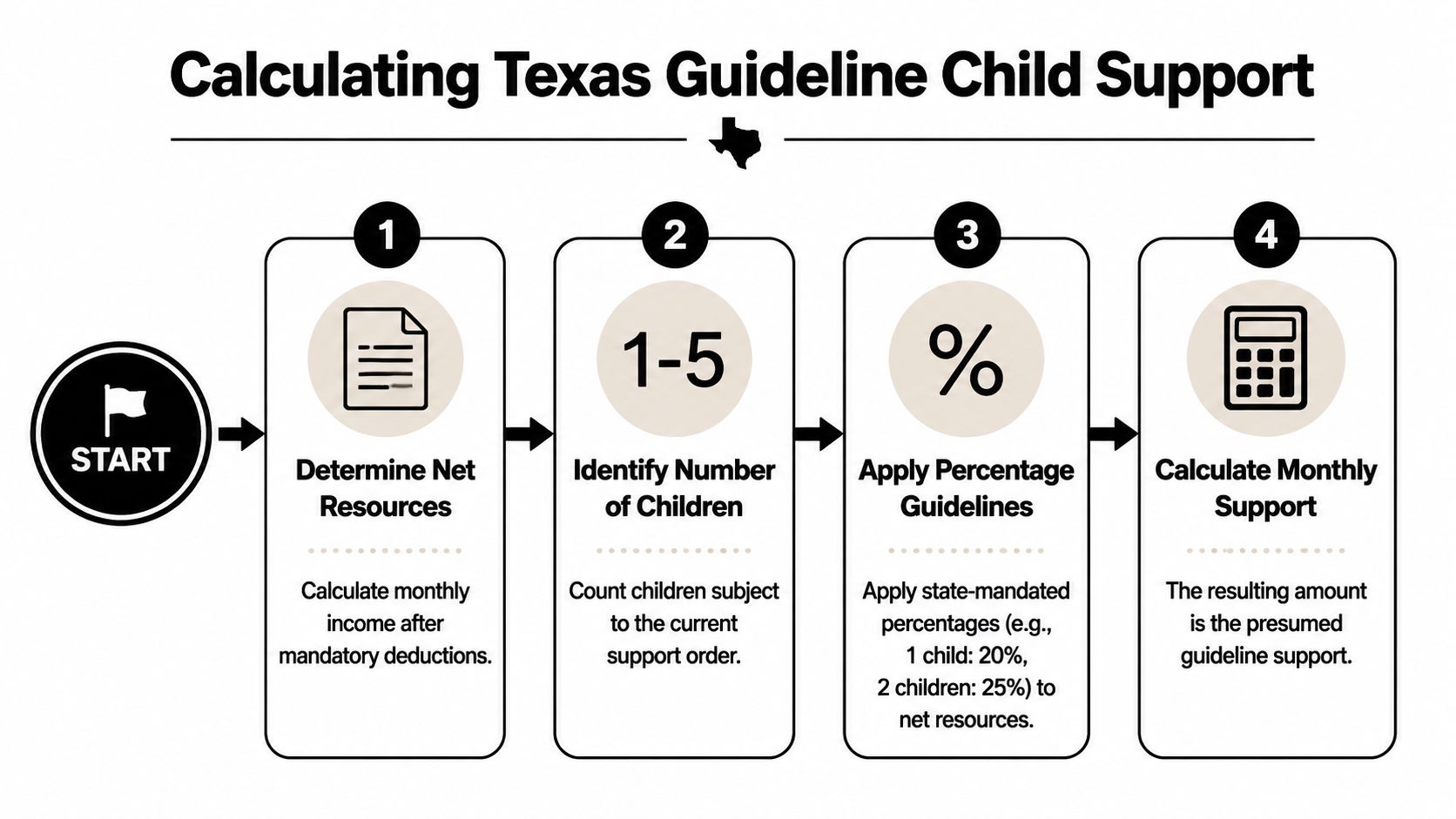
For many cases, the court works through this sequence:
- Determine the obligor's net monthly resources.
- Identify how many children are before the court.
- Apply the statutory guideline percentage.
- Decide whether there is a lawful reason to deviate.
The author's brief requires mention of the updated cap, so it's important to note that the $11,700 net monthly resource cap effective September 1, 2025 applies when discussing future guideline calculations under Texas law.
For a fuller breakdown, see Texas child support guidelines explained.
A practical example
Take a parent with $6,000 in net monthly resources and two children before the court. Under the common guideline percentages referenced in the visual above, the guideline amount would ordinarily be 25% of net resources for two children. That example matters because if you're asking the court to set support at zero, you are asking the judge to depart from an identifiable baseline.
That doesn't mean a deviation can't happen. It means you should know exactly what the court is being asked to set aside.
Here's a short explainer that helps many parents understand the overall calculation framework:
Why this matters in a no-support case
Judges are more comfortable with deviations when the numbers are transparent. If you don't know the guideline amount, you can't convincingly explain why a different result is better for the child.
A useful way to present it is this:
- Start with the guideline amount: Show that you understand the statutory default.
- Identify the offsetting facts: Equal possession, direct payment of major expenses, or similar household resources may support deviation.
- Tie the deviation to the child: Explain how the child will be supported every month without relying on ambiguity.
The strongest $0 proposals don't argue against the guidelines in the abstract. They show why this child, in this family, is protected without a transfer payment.
When Texas Courts May Approve a Zero-Support Order
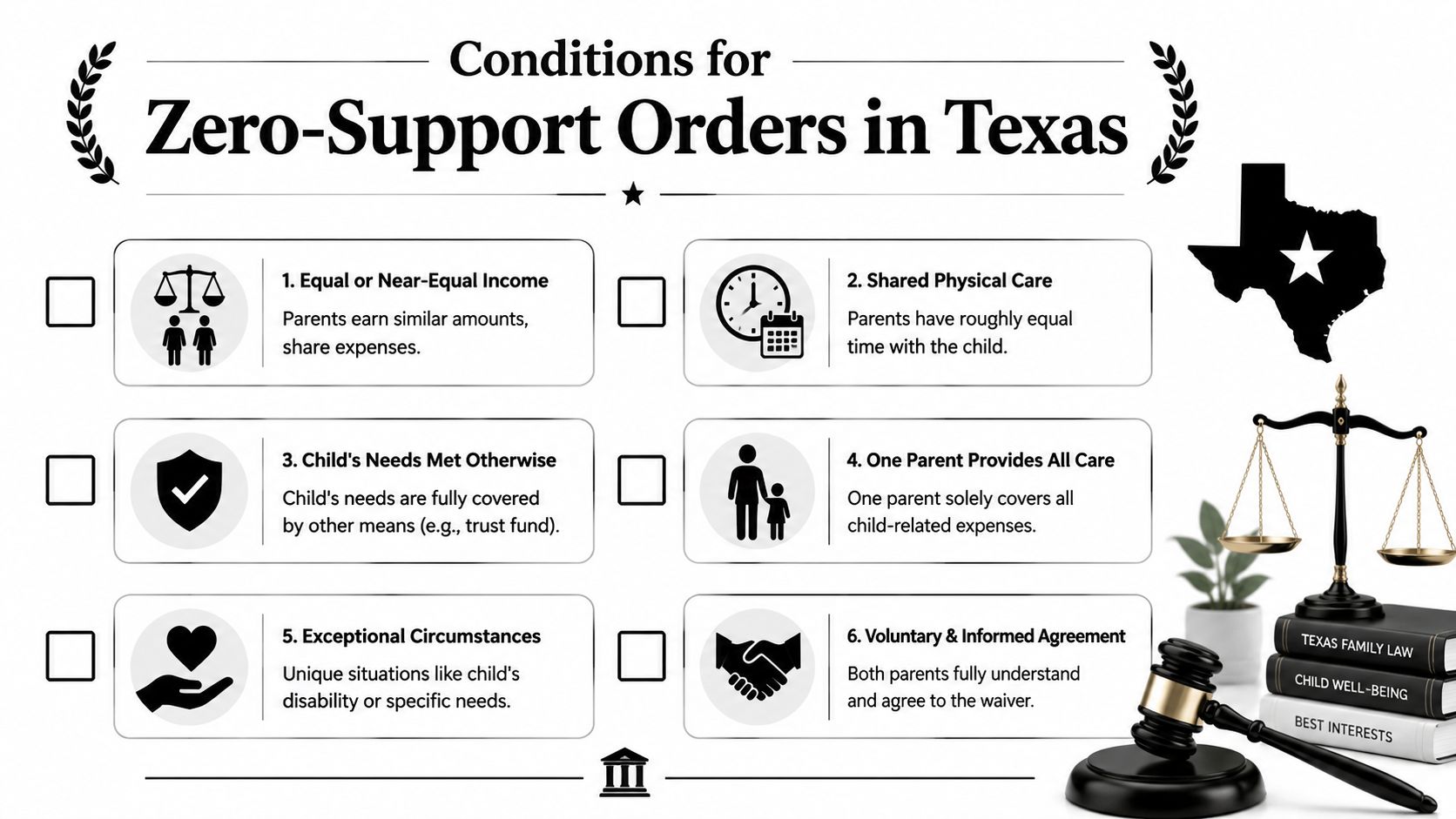
Texas judges do approve $0 child support orders, but only when the evidence shows the child will be fully supported without a monthly transfer between parents.
The question is never whether both parents agree. The question is whether the proposed order gives the court enough facts to make best-interest findings and justify a deviation from the guideline amount under Texas Family Code §154.123. In practice, judges want specifics. General promises, informal understandings, and vague claims that "we split everything" usually do not get the job done.
Situations that may support approval
A zero-support order has the best chance when the case facts are balanced and easy to prove.
One common example is a true near-equal possession schedule with parents whose incomes are close enough that neither household is carrying the child financially. Even then, I would not present the case as "50/50 means no support." I would present bank records, pay information, and a proposed order showing that both homes can consistently meet the child's needs.
Another workable fact pattern is a direct-expense structure. One parent may pay school tuition, health insurance, childcare, activity costs, or other recurring expenses that are predictable and well documented. That approach can help, but only if the order identifies those expenses with precision. Judges are far more likely to sign a $0 order when they can see exactly who is paying which bills, in what amount, and on what schedule.
A third category involves limited ability to pay combined with strong evidence that the child's needs are still covered. That may arise when one parent has very low income, disability-related limits, or unusual circumstances affecting resources. A court can consider those facts, but the request still rises or falls on proof.
Parents weighing options short of a pure $0 order should also review how child support can be negotiated in Texas before deciding what to propose.
Situations that usually do not persuade a judge
Some arguments fail because they focus on parental convenience instead of the child's support structure:
- "We get along and do not want money fights." Judges appreciate cooperation, but cooperation alone does not replace a support plan.
- "We have equal time." Equal possession does not erase an income gap or prove that expenses are being shared fairly.
- "We will handle expenses as they come up." Courts want enforceable terms, not a handshake arrangement that falls apart six months later.
- "One parent does not want support." A parent's preference is relevant, but it does not control the ruling.
The evidence that gives a $0 request a real chance
This is the part many parents miss. The strongest no-support proposals are built like trial exhibits, even if the case settles.
Include a side-by-side summary of each parent's income and recurring child-related expenses. Attach support for major items if the case posture allows it. Show the possession schedule in concrete terms. Identify who provides health insurance, who pays unreimbursed medical costs, who covers school expenses, and how extracurricular costs are handled. If one parent pays directly for major needs, say so with enough detail that the judge can convert that description into written findings.
Drafting matters just as much. The proposed order should not merely state that support is set at zero. It should state the facts that support the deviation and connect those facts to the child's day-to-day care. If the file lands on a busy associate judge's bench during a prove-up, the order should answer the obvious courtroom questions before the judge asks them.
A $0 order is most persuasive when it reads like a structured support plan with verified facts behind it, not like a waiver dressed up as an agreement.
Structuring Your Agreement and Exploring Alternatives
If you want a no-support order approved, drafting matters almost as much as the underlying facts.
The proposed order should do more than state "child support is set at $0." It should explain the best-interest basis for that result, identify how the child's needs will be met, assign responsibility for health insurance and unreimbursed medical expenses, and state enough facts to justify the court's deviation from guideline support under Family Code §154.123.
Draft like you're answering the judge's questions
A solid draft usually includes these components:
- Specific findings: State the possession schedule, the relative incomes, and the reasons a deviation is appropriate.
- Expense allocation: Spell out which parent pays recurring child costs.
- Enforcement clarity: If one parent is paying expenses directly, identify them precisely enough that future disputes are less likely.
- Modification awareness: Include language that reflects the possibility that support may need to change if circumstances materially and substantially change.
If you're evaluating negotiation options short of a pure $0 order, whether child support can be negotiated in Texas is a useful starting point.
Informal waivers are where people get burned
Texas Law Help states that informal child-support agreements are not enforceable without a court order, and that a parent who has not supported a child while not living with the child may later face retroactive support, as explained in parents' rights when no custody orders exist.
That risk is not theoretical. It shows up after reconciliations, breakups after cohabitation, and years of "we handled it ourselves." Then one parent files, and the other learns that private arrangements don't erase court authority.
Don't rely on a side deal when the issue is support. If the agreement matters, get it signed by the judge.
Alternatives that often work better
Sometimes the smarter move is not a pure no-support order.
Consider options such as:
| Approach | Why parents use it |
|---|---|
| Reduced support plus direct payments | Preserves enforceability while recognizing shared expenses |
| Agreed expense-sharing provisions | Helps with activities, school, or medical costs |
| A later modification strategy | Useful when current finances are temporary or unstable |
In some cases, parents also consult the Texas Child Support Law Office of Bryan Fagan for help drafting proposed orders, calculating guideline exposure, and preparing deviation evidence under the Texas Family Code.
Frequently Asked Questions About No-Support Agreements
Can we agree to no child support if one parent receives SSI
Possibly, but don't assume the court will enter that order automatically. Texas guidance notes that SSI recipients may seek a $0 order, while other parents still need a court-approved modification or order to change support. The key point remains the same. Get the issue in front of the court and obtain a signed order.
How do we change an existing child support order to zero
You file a modification case in the court with continuing jurisdiction, serve the other parent unless service is properly waived, and present evidence that the proposed change is justified and serves the child's best interest. A prior support order stays in effect until the judge changes it. Parents often miss that point and stop paying too early.
If we both acted like support was waived for years, can one parent still ask for support or arrears
Yes, that risk can still exist if there was no valid court order changing support. Private conduct doesn't necessarily replace the signed order. That is one reason informal no-support arrangements are so dangerous.
Does equal parenting time automatically eliminate child support
No. Texas courts may still order support in equal-possession cases when the income difference between households is substantial. Equal time and equal financial capacity are not the same thing.
Is a zero-support order permanent
Usually not in any practical sense. Child support orders can be modified when the legal standard for modification is met, and support obligations are generally time-limited under Texas law rather than permanently waived by parental agreement. If income, possession, or the child's needs change, the court can revisit support.
What gives a no-support proposal the best chance of approval
The strongest proposals usually share four features:
- A real paper trail: income proof, expense detail, and a complete proposed order
- A stable possession plan: not a loose or changing schedule
- Balanced financial facts: no major hidden disparity between households
- A child-centered explanation: the order shows how the child is protected, month after month
If you're considering a no-support agreement, get the order and the evidence right before filing. The Texas Child Support Law Office of Bryan Fagan handles establishment, modification, enforcement, and deviation issues under the Texas Family Code, including cases involving equal possession, income disputes, retroactive support, and negotiated support terms.