Your paycheck changed, or your co-parent's did. The base wages on the old order no longer match reality because overtime became part of the job. That usually means the child support number is off too.
Texas courts don't ignore overtime just because it isn't labeled “salary.” If overtime shows up often enough to be a significant part of income, judges can use it. If you're dealing with child support for overtime pay in Texas, the fight usually isn't over whether overtime counts. The primary fight is how to prove it, how to average it, and whether the current order still fits the facts.
Does Overtime Pay Factor into Texas Child Support
Yes. Overtime pay can factor into Texas child support, and in many cases it should.
If you've looked at pay stubs and seen extra hours, shift premiums, or recurring overtime that never made its way into the child support calculation, your concern is probably valid. Texas child support is based on net resources, not just base pay. That distinction matters because overtime often changes the support number even when the hourly rate stays the same.
Texas courts focus on the actual income stream available to the paying parent. If a parent regularly works extra hours, that money doesn't disappear because the employer calls it overtime. It can become part of the support calculation.
The starting point is the parent's net resources, and if you need a primer on that framework, review this guide on how Texas courts calculate net resources.
Bottom line: If overtime is real, recurring, and documented, you should expect the court to take it seriously.
That does not mean every spike in income automatically rewrites the order. A judge will still look at whether the overtime is steady enough to support a reliable monthly number. A single unusual pay period usually won't carry the day by itself. A long pattern of overtime often will.
Many parents make mistakes. They walk into court saying, “He's making more money,” or “My overtime isn't guaranteed,” but they bring no records and no clean calculation. Judges decide cases on proof, not suspicion. If you want the court to include or discount overtime, you need documents, a timeline, and a math-based explanation that fits the Family Code.
The Foundation How Texas Defines Income for Child Support
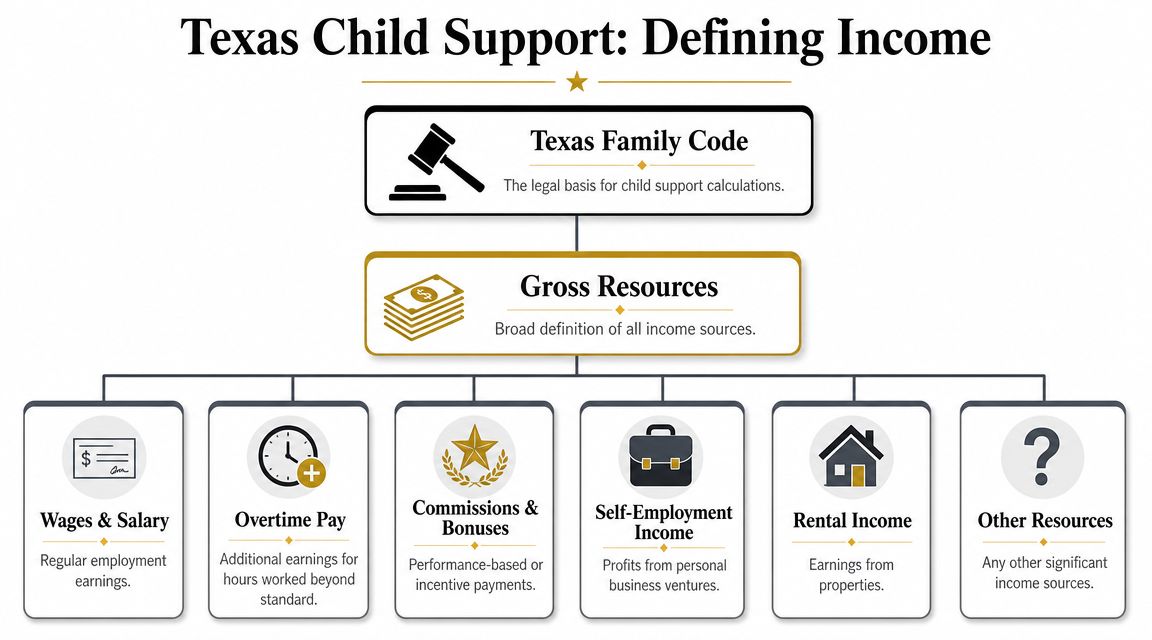
Texas law starts broad on purpose. It doesn't ask only what a parent's salary is. It asks what resources are available for child support.
Under Texas Family Code §154.062, child support is built from net resources, and the statutory definition reaches far beyond base wages. Texas guidance explains that child support is calculated from a noncustodial parent's net resources, not gross pay, and that the definition expressly includes wages, salary, commissions, overtime pay, bonuses, and other compensation for personal services, with mandatory deductions applied before guideline percentages are used, as summarized by Texas Law Help's discussion of child support and lower incomes.
“All wage and salary income and other compensation for personal services” is the language that drives these disputes.
That broad phrasing is exactly why overtime fights are usually losers for the parent trying to exclude it entirely. If the money comes from work and it shows up with enough consistency, the court has a legal basis to count it.
What goes into net resources
A clean child support analysis usually begins with gross employment income, then moves to allowed deductions. The concept is simple even when the paperwork is messy.
Legal rule: Courts calculate support from net resources, not headline earnings on a job offer or an hourly wage chart.
Here's the practical breakdown under §154.062:
- Employment pay counts. Regular wages and salary are part of the equation.
- Overtime counts too. It isn't carved out as a special exempt category.
- Commissions and bonuses may count. If they are part of the parent's compensation, they belong in the analysis.
- Mandatory deductions matter. Federal income tax, Social Security, Medicare, union dues, and qualifying health-insurance costs are used to move from gross income to net resources.
A lot of people skip that last step. They argue from gross pay because it feels larger or easier. That's a mistake. Texas courts apply the guideline percentages after the conversion to net resources.
The guideline percentages still matter
Once net resources are calculated, the court applies the guideline percentages in Texas Family Code §154.125. The standard percentages are 20% for one child, 25% for two children, 30% for three children, 35% for four children, and 40% for five or more children, as reflected in the verified Texas child support guidance linked above.
A few practical points matter here:
| Issue | What it means in court |
|---|---|
| Base salary only argument | Often too narrow if overtime is part of the regular pay history |
| Gross pay argument | Incomplete because the court works from net resources |
| Sporadic extra income | Needs context and records before a judge will treat it as stable |
| Missing documentation | Usually hurts the party making the claim |
If you're preparing for hearing, build your calculation the way a judge expects to see it. Start with all compensation for personal services. Then subtract only the deductions the law recognizes. Then apply the guideline percentage under §154.125. If you skip steps, your numbers lose credibility fast.
The Critical Distinction Regular vs Irregular Overtime
This is where most cases turn. Texas law includes overtime, but judges still have to decide whether the overtime is dependable enough to use in a monthly child support number.
The practical question is not “Was there overtime once?” The practical question is “Has overtime become part of this parent's normal earnings?” A recurring pattern is far more persuasive than a single spike tied to an emergency shift, a storm response, a shutdown, or a temporary staffing shortage.
A family law article discussing Texas overtime and child support notes that overtime may be included when those earnings are regular or reliable, and it also confirms the long-standing guideline percentages and the historical $9,200 monthly net resource cap that applied for many years under the guideline framework, as described in this discussion of Texas child support and overtime.
What regular overtime looks like
Regular overtime usually has a pattern. You can see it across pay stubs, tax records, and employer documents.
Examples that often support inclusion:
- Mandatory extra shifts. A hospital worker who is routinely scheduled beyond standard hours.
- Seasonal but predictable work. A parent in an industry where the same overtime pattern returns year after year.
- Long-running practice. A worker who has accepted overtime consistently enough that it functions like ordinary compensation.
Judges care about history. If a parent worked substantial overtime month after month and then argues, right before court, that it's “optional,” the court may not buy it.
What irregular overtime looks like
Irregular overtime is different. A parent may have one unusually strong quarter, a one-time project, temporary disaster work, or a brief period of understaffing at the employer.
Those facts don't automatically erase overtime, but they do affect how much weight the court gives it. If the income spike isn't likely to continue, the court may be more cautious about locking it into a standing order.
A good overtime case is rarely won by labels like “voluntary” or “required.” It's won by showing whether the money actually recurs.
That's also why income averaging matters so much. Courts often want a realistic picture instead of a cherry-picked month. If one side chooses the highest pay stub and the other side chooses the lowest, neither one is giving the court a stable number.
The argument parents miss
Some parents think they can avoid a higher support obligation by dropping overtime once the case starts. That strategy can backfire. If the prior history shows a strong earning pattern, the court may look beyond the sudden reduction and ask whether the parent is underreporting current capacity or strategically cutting hours.
If that issue is in play, review how courts approach imputing income in Texas child support cases. Intentional reductions in earnings are not a safe shortcut.
Use common sense when you frame the issue:
| Overtime pattern | Better court argument |
|---|---|
| Every pay period for a long stretch | It's part of ordinary earnings |
| Heavy only during a short temporary assignment | It may not reflect ongoing monthly income |
| Comes and goes but repeats in a business cycle | Average it over a meaningful period |
| Stopped suddenly before litigation | Expect scrutiny |
If you're the parent seeking more support, prove the pattern. If you're defending against inflated numbers, show why the overtime was temporary, unusual, or already gone by the time of hearing. Either way, don't make abstract arguments. Bring records.
Calculating Child Support with Overtime Pay A Practical Example
Parents often get lost because they argue about income in the abstract. Court doesn't work that way. You need an actual calculation.
The most important recent update for high-income cases is the new guideline cap. A Texas child support article reports that the cap on monthly net resources increased from $9,200 to $11,700 effective September 1, 2025, and that the guideline maximums under that cap are about $2,340 for one child, $2,925 for two children, $3,510 for three children, $4,095 for four children, and $4,680 for five or more children, using the same statutory percentages, as explained in this analysis of the Texas child support cap.
That matters in child support for overtime pay in Texas because overtime can push a parent closer to the cap or over it.
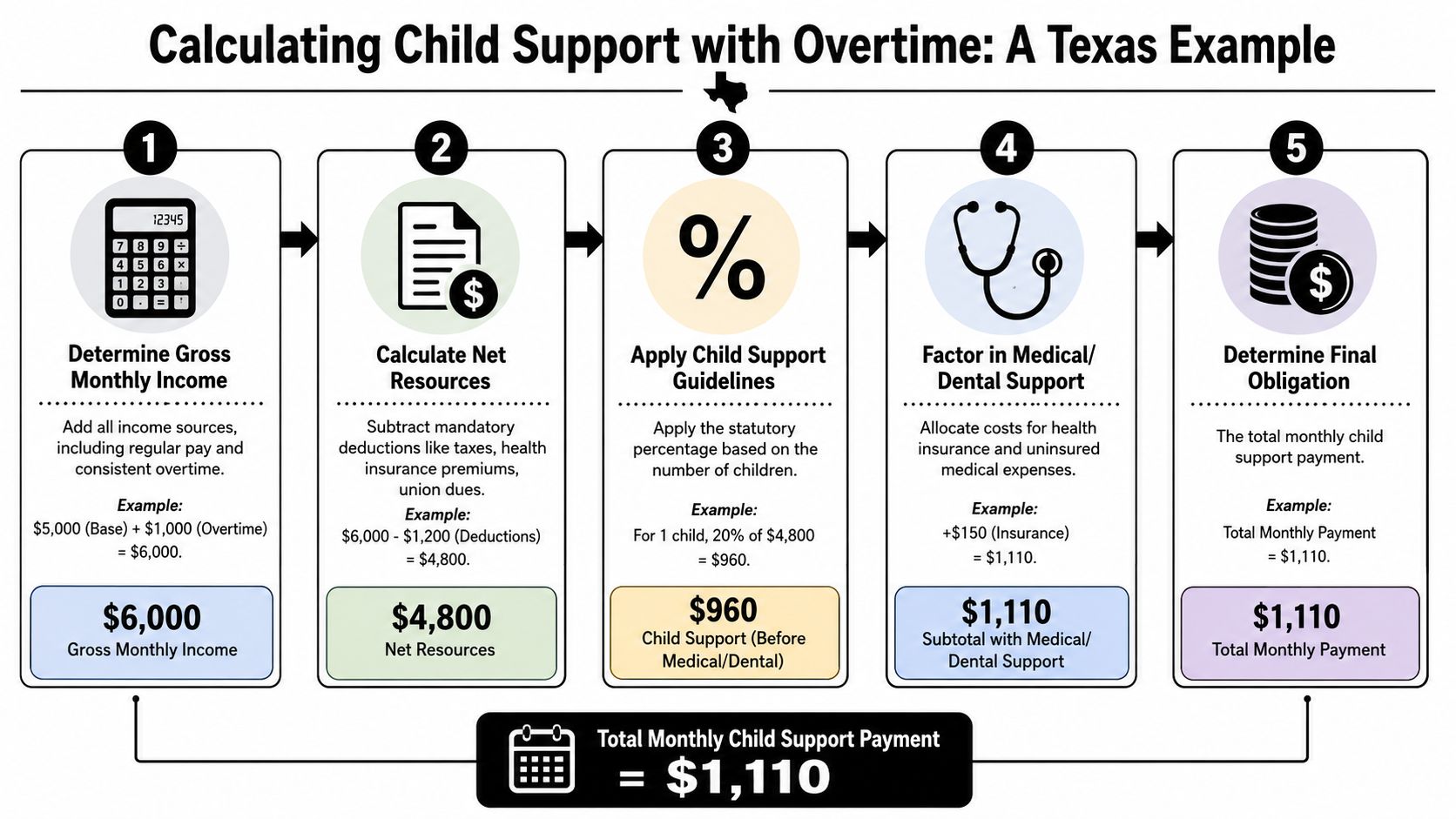
Start with the right sequence
The court's math should follow this order:
- Determine the parent's gross monthly income.
- Identify whether overtime should be included based on the earnings record.
- Subtract the allowed deductions to reach net resources.
- Apply the guideline percentage under §154.125.
- Check whether the result is limited by the statutory cap.
- Consider whether deviation is justified under §154.123.
If you start with a support percentage before you've built a defensible net-resource number, you're doing it backwards.
Sample Child Support Calculation With and Without Overtime (2 Children)
Below is a practical framework. The amounts in the table are illustrative labels rather than legal facts, except where Texas guideline percentages and the cap are stated by the verified sources above. In court, you would plug in the actual pay records, deductions, and monthly averages from your case.
| Income Component | Calculation (Base Pay Only) | Calculation (Base + Overtime) |
|---|---|---|
| Base monthly earnings | Use monthly base wages from pay records | Use the same monthly base wages |
| Overtime earnings | Excluded from this version | Add averaged overtime if the record shows it is recurring |
| Gross monthly income | Base wages only | Base wages plus averaged overtime |
| Mandatory deductions | Subtract allowed deductions under §154.062 | Subtract allowed deductions under §154.062 |
| Net monthly resources | Result after deductions | Result after deductions |
| Guideline percentage for 2 children | 25% under §154.125 | 25% under §154.125 |
| Cap check | Apply guideline formula up to the applicable cap | Apply guideline formula up to the applicable cap |
How the difference plays out
Suppose two parents have the same hourly base rate. One parent works little or no overtime. The other works overtime so consistently that it shows up throughout the pay history. Their child support numbers may be very different, because Texas uses total net monthly resources, not just the headline base wage.
That's why a side-by-side comparison matters. Without overtime, the paying parent's net resources may stay lower and the support result will track that lower number. With averaged overtime included, the support amount rises because the income base rises.
Courts don't award child support based on what a parent wishes they earned. They use the earnings stream the records actually show.
Where the 2025 cap changes strategy
Before the cap increase, some overtime-heavy earners hit the old ceiling more quickly. Effective September 1, 2025, the higher $11,700 monthly net resource cap expanded the range of income subject to the guideline calculation in those cases above.
That shift affects strategy in at least three ways:
- More overtime matters before the cap is reached. A parent who used to top out under the old ceiling may now have more income counted within the guideline range.
- Support exposure is higher for some earners. The ceiling for guideline support increased with the new cap.
- Precision matters more. In a high-income case, a sloppy overtime average can materially change the result.
If your case is near or above the cap, don't guess. Build a worksheet from documented records, identify the net-resource figure, apply §154.125, and then analyze whether a deviation argument under §154.123 is worth making. That's how you prepare a case a judge can effectively use.
Proving Overtime Income Evidence and Court Strategy
Saying “my ex works overtime” isn't evidence. Saying “my overtime dropped” isn't evidence either. Documents win these cases.

Texas law includes overtime in child-support net resources, but the difficult issue is often whether the overtime is recurring enough to support a stable calculation. That issue becomes even more important in disputes after the $11,700 cap increase effective September 1, 2025, as noted in the Texas Family Code materials at Chapter 154 of the Texas statutes.
The documents I'd want before walking into court
If I were preparing your case, I would want a record set that shows pattern, duration, and reliability. At minimum, gather:
- Recent pay stubs. Especially year-to-date stubs that show overtime separately.
- W-2s or 1099s. They help confirm whether the higher income is an outlier or part of a trend.
- Tax returns. Useful for testing whether the claimed current income lines up with reported annual income.
- Employer records. Offer letters, pay plans, union schedules, or employment verification can help explain whether overtime is routine.
- Prior court orders and worksheets. You need to compare the old assumptions with the current facts.
For a fuller breakdown of what to collect, review this checklist on evidence needed for a Texas child support case.
Discovery is how you force the issue
When the other parent won't hand over records voluntarily, use formal discovery. In a modification or enforcement case, your lawyer can serve requests for production, interrogatories, requests for disclosure, and, where appropriate, subpoenas to employers or payroll custodians.
That process matters because overtime disputes often involve selective disclosure. A parent may produce one weak pay stub and keep quiet about stronger months. Discovery lets you demand the full picture.
Bring enough records to show a pattern, not just a point.
Video can help you understand how these cases are built and presented:
Court strategy that actually works
Here's the strategy I recommend in most overtime disputes:
- Build a timeline first. Show when overtime began, how often it appeared, and whether it still exists.
- Use year-to-date numbers carefully. They can be strong evidence, but only if they reflect ordinary conditions rather than a temporary spike.
- Prepare two calculations. One that includes the averaged overtime, and one that explains why some or all of it should be discounted if it was temporary.
- Tie every claim to an exhibit. Judges don't want arguments floating in air.
- Don't exaggerate. If the overtime is mixed, say so. Credibility matters more than drama.
The Texas Child Support Law Office of Bryan Fagan handles cases involving establishment, modification, enforcement, and disputes over net-resource calculations. That can be useful when the core issue is not whether overtime exists, but how to prove it cleanly under the Family Code.
How to Modify or Enforce Your Child Support Order
A bad order doesn't fix itself. If overtime changed the actual income picture, you usually need a modification, not just a complaint.
An enforcement case and a modification case are different. Enforcement asks the court to make a parent obey the order already in place. Modification asks the court to replace the old support amount with a new one that fits current facts.
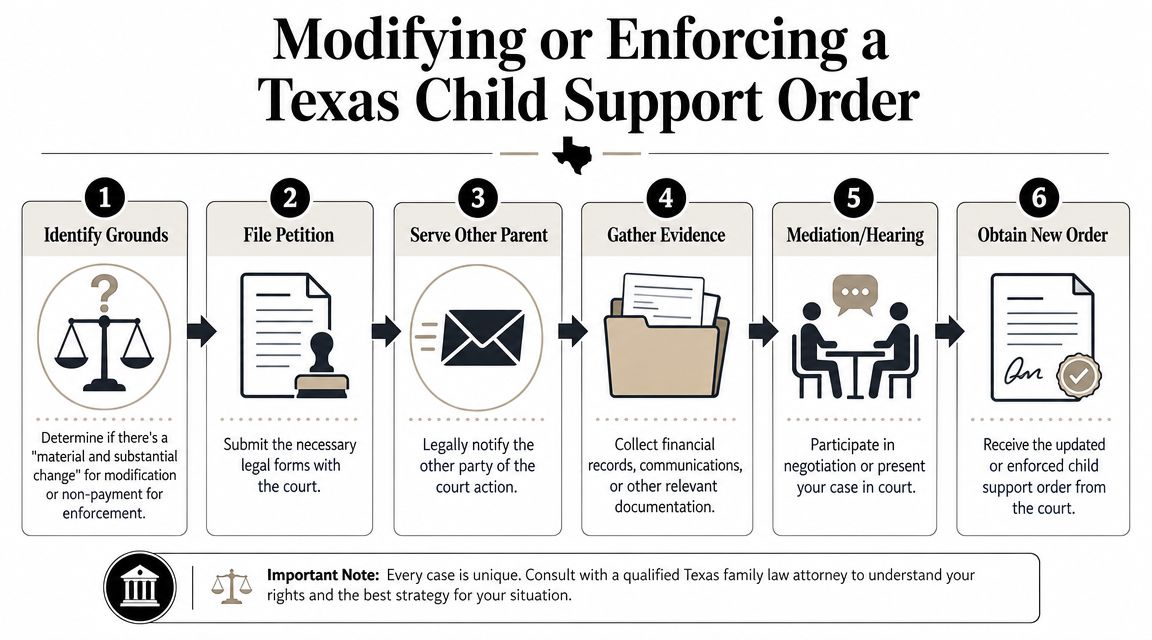
When modification makes sense
If overtime has become a steady part of income, or if it has disappeared after being used in the old order, you may have grounds to seek a change. In practice, courts often look for a material and substantial change in circumstances.
That argument is strongest when you can show a before-and-after difference in the parent's earnings pattern. A handful of unusual paychecks won't make a good modification case by themselves. A sustained earnings shift might.
The procedural steps that matter
Most parents need a straight answer on process. Here it is.
- File the petition. In most cases, that means filing a petition to modify the parent-child relationship, or an enforcement action if the issue is nonpayment under an existing order.
- Serve the other parent properly. If service is defective, your case can stall or collapse.
- Exchange financial records. Overtime cases are often won or lost here.
- Attend mediation if required or scheduled. Many courts expect serious settlement efforts before final hearing.
- Prepare for hearing with exhibits and calculations. Judges want documents, not rough estimates.
- Get a signed order. Nothing changes until the court signs a new enforceable order.
Don't confuse unpaid support with outdated support
Parents mix these up all the time.
| Problem | Correct legal tool |
|---|---|
| The parent isn't paying the ordered amount | Enforcement |
| The ordered amount no longer matches current income | Modification |
| Both are true | You may need both requests in the same case or coordinated filings |
Under §154.123, courts can also deviate from guideline support when the facts justify it. That matters in unusual income cases, shared possession cases, and high-income disputes. But don't lead with deviation unless you have to. Most judges want the guideline math first, then a specific reason to depart from it.
Frequently Asked Questions About Overtime and Child Support
Does overtime matter in a 50 50 custody case
Yes, it can.
Texas doesn't automatically erase child support because parents share possession more evenly. Courts still look at income. If one parent earns materially more, support may still be ordered so the child's needs are met across both homes. In that setting, overtime can matter because it affects the parent's net-resource picture and the court's fairness analysis under the guideline scheme and possible deviation factors in §154.123.
What if a parent suddenly stops working overtime to reduce child support
Judges look hard at timing.
If a parent worked regular overtime for a meaningful period and then cuts those hours right as litigation starts, the court may question whether the reduction is genuine or strategic. In the right case, the judge may focus on earning history and earning capacity rather than accepting the sudden drop at face value. That's especially true when the parent cannot give a believable explanation such as a schedule change, medical restriction, layoff, or employer policy shift backed by records.
If the income changed, prove why it changed. If it didn't really change, the records will show that too.
What happens if the parent's income is above the cap
The guideline formula applies up to the statutory cap, and for cases affected by the 2025 update, that cap is $11,700 in monthly net resources effective September 1, 2025, as covered earlier from the verified source. Income above that amount does not automatically increase guideline support.
But it can still matter. Under §154.123, the court may consider whether the child has proven needs that justify support above the guideline amount. That is where high-income cases become more fact-sensitive. You need evidence tied to the child's actual needs, not just proof that the paying parent earns more.
Can irregular overtime still be considered
Yes, but the argument changes.
Irregular overtime is harder to use as a fixed monthly number because the court wants stability in the order. If the overtime is seasonal, temporary, or tied to a short-term assignment, the judge may look at averaging or may give it less weight than a long-standing pattern. The strength of the case depends on the records and the explanation.
Should I file now or wait for more records
Usually, don't wait too long if the mismatch is obvious.
If support is currently too low or too high because overtime changed the actual income picture, delaying can cost you money or deepen arrears issues. But don't file blind. Before filing, make sure you have enough documentation to show pattern, duration, and present reality. A case with a clear paper trail is stronger than a case built on accusations.
If you need a clear strategy for child support for overtime pay in Texas, the Texas Child Support Law Office of Bryan Fagan works with parents on support calculations, modification petitions, enforcement actions, and disputes over net resources under the Texas Family Code. If overtime is part of the income story, get the records, run the math correctly, and prepare your case like it's going to hearing. That approach usually gets better results than arguing from frustration.