You're in Katy, your child's expenses keep arriving, and the support order no longer seems to match either parent's income or the current parenting schedule. Maybe the other parent earns bonuses or commissions that don't appear in a simple salary calculation. Maybe you share possession close to equally, or you're relying on an older order built around the former guideline cap. Hiring the right child support lawyer in Katy starts with identifying the proof problem, not choosing the first lawyer who appears in a search.
Texas child support cases turn on financial records, statutory guidelines, custody facts, and courtroom procedure. The September 1, 2025 cap change makes current analysis especially important for higher-income families. A lawyer should be able to explain the calculation, identify whether a deviation is justified, and tell you what evidence will survive a contested hearing.
What a Katy Child Support Lawyer Actually Does for You
A Katy parent usually contacts a lawyer after a specific problem appears. A payor may discover that a new order is based on an incomplete income picture. A custodial parent may be carrying medical or childcare costs while payments fall behind. Another parent may believe that equal possession should eliminate support, only to learn that Texas courts still examine income, statutory guidelines, and the children's needs.
A focused child support lawyer turns that uncertainty into a legal plan. The work may involve establishing an initial order, modifying an existing order, enforcing unpaid support, defending against an enforcement action, or presenting evidence for retroactive support. Those are different disputes. A lawyer who routinely handles only uncontested divorces may not approach a bonus-heavy income case or an arrears hearing with the same precision as a dedicated support practitioner.
The work begins with the numbers
Texas guideline support depends on monthly net resources, not the salary printed on a job offer or pay statement. Counsel should identify wages, commissions, bonuses, self-employment income, investment income, and other relevant resources, then test the deductions and records supporting the claimed amount. For a business owner, that can mean comparing personal tax filings with business financial statements. For a technology employee, it may require tracing restricted stock units or variable compensation through employer records.
The lawyer also evaluates the parenting arrangement. A 50/50 schedule doesn't automatically answer the support question. The court still needs a defensible financial analysis, and the parties may need to address insurance, childcare, travel, and unusual child-related expenses.
Strategy matters beyond the formula
Texas Family Code §154.125 governs guideline calculations, but the guideline amount isn't always the end of the case. Under Texas Family Code §154.123, a court may deviate when applying the guideline amount would be unjust or inappropriate after considering the child's and parents' circumstances. The listed factors include the child's needs and age, each parent's ability to contribute, custody arrangements, visitation travel costs, and special medical or educational needs. Texas Family Code §154.123 provides the statutory foundation for that analysis.
A Katy lawyer should also recognize the local practical stakes. Cases connected to Fort Bend and Harris County courts require organized exhibits, credible financial testimony, and filings that address the actual disputed issue. Your lawyer should tell you whether the case is primarily a calculation dispute, a modification case, an enforcement matter, or a deviation request. That diagnosis determines what you gather, what you negotiate, and what you present to the judge.
How Texas Child Support Is Calculated and Why the 2025 Cap Matters
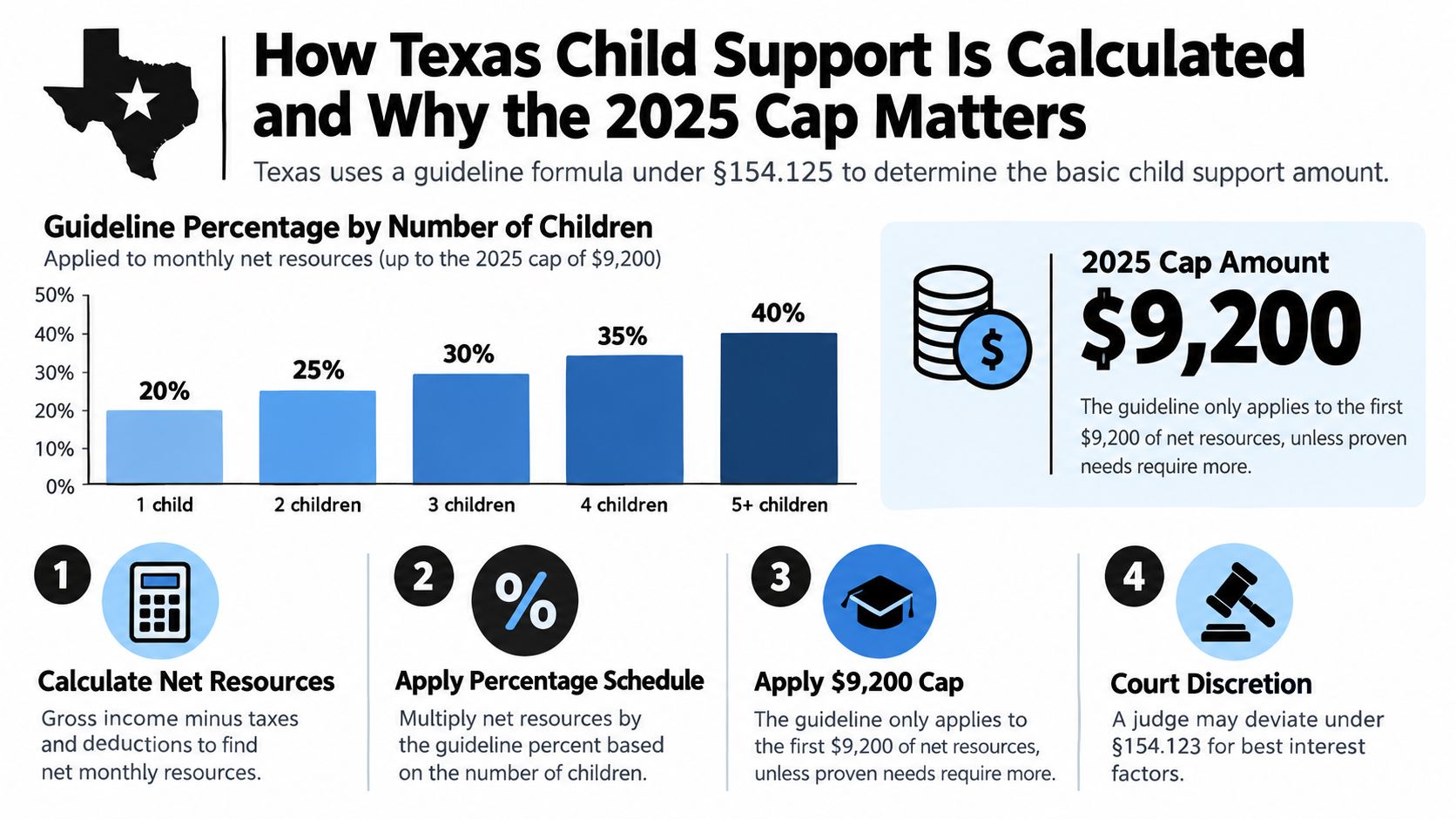
If your monthly net resources exceed the old guideline ceiling, a calculator can give you the wrong expectation before you ever enter a Katy courtroom. Texas begins with monthly net resources, applies statutory percentages based on the number of children, and then examines whether the facts justify a different result. Under Texas Family Code §154.125, the schedule uses 20% for one child, 25% for two, 30% for three, 35% for four, and 40% for five or more children. The calculation depends on documented income and legally recognized deductions, not gross pay alone.
Use this guide to how to calculate child support in Texas to understand the formula before reviewing your own records.
The major change took effect on September 1, 2025. Texas increased the monthly net-resource cap used for guideline calculations from $9,200 to $11,700. At the updated cap, the standard guideline amounts reach $2,340 for one child, $2,925 for two children, $3,510 for three children, $4,095 for four children, and $4,680 for five or more children. The 2025 Texas child support guideline increase explains the change and the corresponding amounts.
Audit the calculation before you hire counsel
Begin with four questions.
- What income exists? Review salary, overtime, commissions, bonuses, self-employment receipts, investment income, and equity compensation. A job title does not prove income. Pay records, tax documents, account statements, and employer records do.
- Which deductions are legitimate? Test each claimed deduction against reliable financial documents. The court needs a supported net-resource calculation, not an unsupported worksheet.
- Does the cap control the entire calculation? Effective September 1, 2025, the standard guideline calculation applies up to $11,700 in monthly net resources. Resources above that threshold require a separate analysis of whether additional support or a deviation is supported by the evidence. Texas guidance on the statutory cap and calculator limits addresses why online tools stop at the ceiling.
- How does the possession schedule affect the argument? Equal or near-equal possession can affect the analysis, but it does not automatically eliminate support. The court still considers the statutory framework and the children's financial needs.
A parent with $11,700 in monthly net resources applies the relevant percentage to that capped amount. A parent above the cap needs a courtroom-ready presentation because the standard calculator will not compute the amount above the ceiling. Your lawyer must identify the records, testimony, and legal basis for seeking more than the guideline amount.
Variable compensation often creates the dispute. Bonuses may be irregular, commissions may fluctuate, RSUs may vest on a schedule different from payroll, and self-employment records may mix personal and business spending. One parent may call a payment exceptional. The other may argue that it reflects a recurring income pattern. Counsel should obtain the records needed to establish consistency, expose omissions, and challenge unsupported deductions.
For a preliminary estimate, Using a Texas Child Support Calculator: What It Can and Can't Tell You is a starting point, not a final number. An online result cannot resolve disputed income, variable compensation, possession evidence, or a requested deviation.
Under §154.123, a court may depart from the guideline calculation when the evidence shows unusual circumstances. Private-school costs, special medical needs, substantial visitation travel, or obligations to children in separate households may support a different result. Your lawyer must connect each expense to admissible records and a statutory factor. A list of bills alone will not carry that argument.
How to Evaluate and Compare Child Support Lawyers in Katy
Choose counsel by testing legal judgment, not by comparing slogans. Ask each candidate to explain how they would analyze your income, possession schedule, existing order, and disputed expenses. A strong lawyer should distinguish between a routine guideline case and one involving §154.123, high income, retroactive support, or contested financial records.
A general family lawyer may be capable of handling support issues. A focused child support practice should go further by discussing how the evidence will be assembled, what the other parent is likely to challenge, and whether the case belongs in negotiation, mediation, or a contested hearing. You can also review a practical overview of how to compare a Texas child support lawyer while building your candidate list.
Compare the answers, not just the credentials
Ask whether the lawyer has handled cases involving:
- Complex compensation: Can the lawyer explain how bonuses, commissions, RSUs, and self-employment records will be presented?
- Deviation requests: Will counsel tie special expenses and custody facts to the factors listed in §154.123?
- Retroactive support: Can the lawyer explain the evidence and procedural posture required for the relief sought?
- Equal possession: Does the lawyer avoid treating 50/50 custody as an automatic answer?
- Enforcement: Can the lawyer address arrears, payment records, income withholding, and medical support?
- Local practice: Does the lawyer understand the filing, service, negotiation, and hearing process applicable to your case?
A lawyer who promises a guaranteed result is giving you the wrong kind of confidence. Courts decide disputed matters from the pleadings, evidence, testimony, and applicable law. A responsible lawyer can offer a strategy and identify risks, but can't promise what a judge will do.
Katy Child Support Lawyer Comparison Checklist
| Evaluation Criteria | What Strong Looks Like | Red Flag |
|---|---|---|
| Net-resource analysis | Requests complete income records and explains disputed deductions | Relies on gross salary or an online estimate |
| 2025 cap knowledge | Applies the $11,700 ceiling and identifies issues above the cap | Uses the former cap without addressing the effective date |
| §154.123 strategy | Connects unusual expenses to statutory factors | Treats deviations as automatic |
| 50/50 possession | Reviews both income and actual child-related costs | Promises that equal time eliminates support |
| Court preparation | Explains exhibits, testimony, service, and hearing steps | Discusses only settlement and avoids procedure |
| Fee clarity | Identifies the retainer structure and likely cost drivers | Gives a vague total without explaining assumptions |
| Communication | Sets a process for updates and document exchange | Is difficult to reach before engagement |
Your decision matrix should rank strategy clarity first, then relevant experience, communication, and fee structure. The lowest quote may be expensive if the lawyer misses income, files the wrong request, or prepares a weak evidentiary record.
What to Ask and What to Bring to Your Consultation
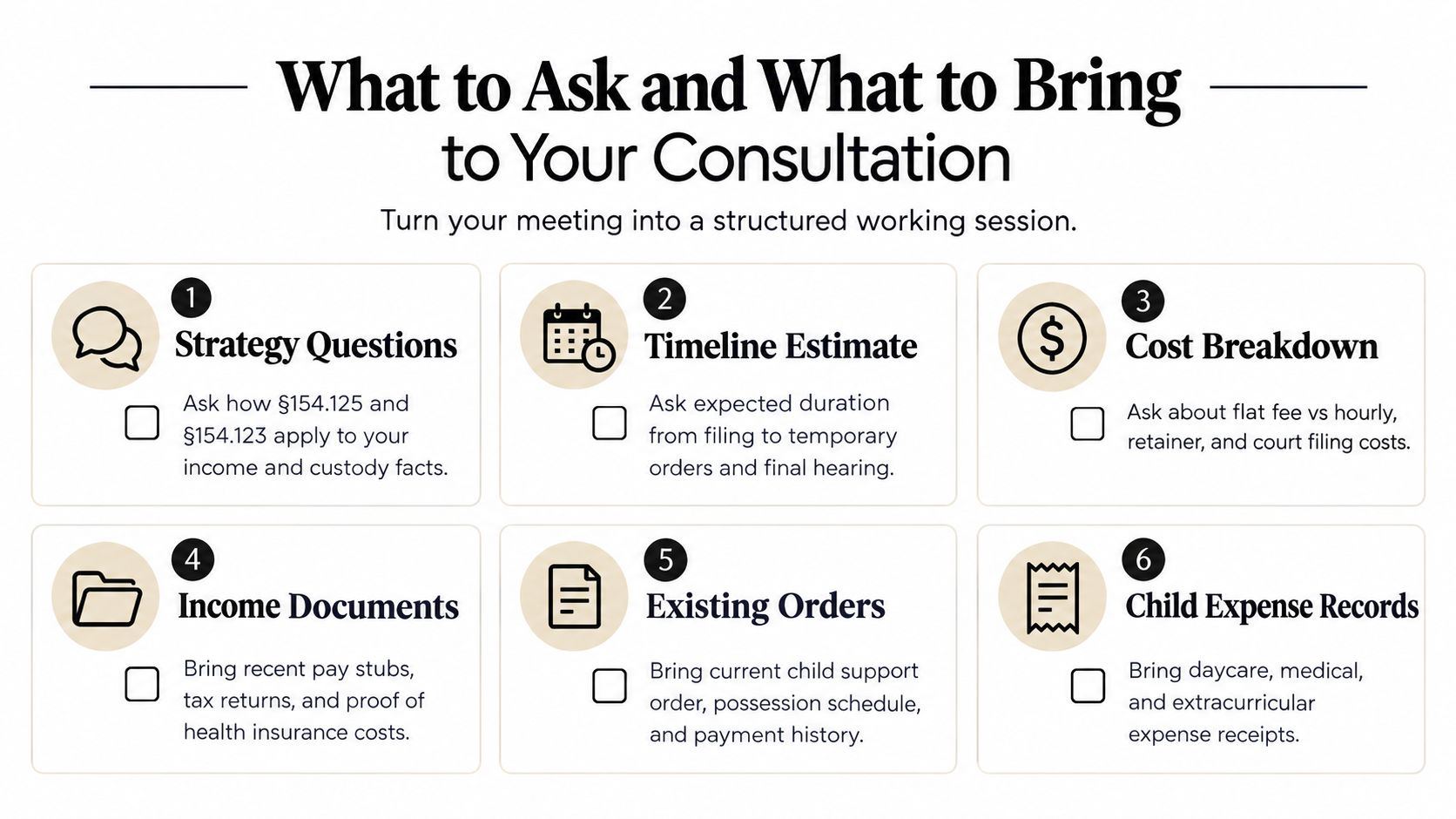
Treat the consultation as a working meeting. Bring the current order, possession schedule, payment history, and financial records even if you believe the dispute is straightforward. A lawyer can't assess a cap issue, modification ground, or enforcement strategy from a general description of your situation.
Start with questions that force a concrete answer:
- How would you calculate my net resources under Texas Family Code §154.125?
- Does the $11,700 cap apply to my facts, and what happens to compensation above it?
- Would §154.123 support a deviation based on travel, education, medical, childcare, or other expenses?
- How does the possession schedule affect the requested support amount?
- What evidence would you use to prove or challenge bonuses, commissions, RSUs, or business income?
- Is this an establishment, modification, enforcement, or retroactive-support case?
- What must be filed, how will service occur, and what happens if the other parent contests the request?
- What are the expected cost drivers, including preparation, discovery, mediation, and hearings?
Listen for reasoning, not certainty. A useful answer identifies the governing statute, the missing evidence, the likely objection, and the next procedural step. A vague response such as “the judge will just use the calculator” is inadequate in a high-income case because the calculator doesn't resolve disputed inputs or amounts above the statutory ceiling.
Assemble the proof before the meeting
Bring:
- Income records: Recent pay stubs, tax returns, W-2 or 1099 records, commission statements, bonus information, and equity-compensation records.
- Business records: Profit and loss statements, business bank information, invoices, and documentation separating business expenses from personal spending.
- Insurance and childcare proof: Health-insurance costs, childcare invoices, receipts, and records showing who pays them.
- Existing court documents: The current support order, any modification orders, possession schedule, medical-support provisions, and enforcement papers.
- Payment history: A complete record of payments, missed payments, arrears notices, and communications about disputed amounts.
- Child-need evidence: Medical, educational, and other records supporting a requested deviation or explaining increased expenses.
Organize the records by date and category. Mark unusual payments, changes in employment, and periods when possession changed. That organization helps your lawyer identify the legal theory and prevents the consultation from becoming a general discussion with no actionable next step.
Bring the record you want the judge to see, not merely the story you want the judge to hear.
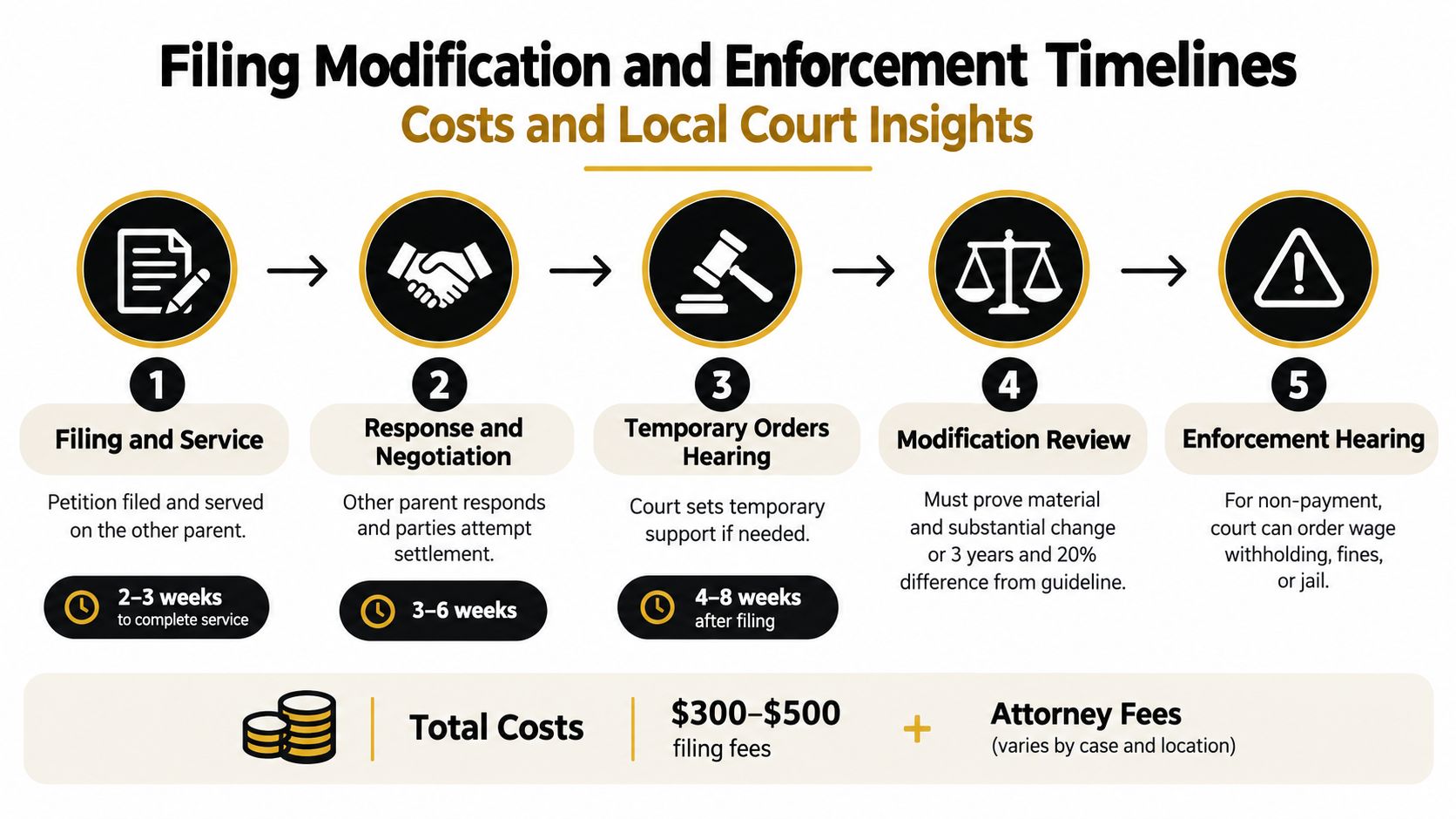
Filing Modification and Enforcement Timelines Costs and Local Court Insights
A support order doesn't change because a parent's income changes, the custody schedule shifts, or the statutory cap is updated. The parent seeking a different amount must use the proper process and prove grounds for relief.
Texas generally permits modification when there's a material and substantial change in circumstances. A separate timing test may apply after three years when the proposed guideline amount would differ from the existing order by at least 20% or $100. Qualifying changes can include income increases or decreases, additional dependent children, changes in medical insurance, or a child moving to a different household. TexasLawHelp's explanation of modification standards identifies the evidence issues that make income and household status central to the case.
The procedural path
The practical sequence is usually:
- Request review: A parent may begin with the Office of the Attorney General's review process.
- File the petition: If litigation is required, the modification petition states the existing order, changed facts, and requested relief.
- Complete service: The other parent must receive formal notice through proper service.
- Exchange and prepare evidence: Financial records, possession information, payment histories, and child-expense proof become central.
- Attend hearings or resolve the case: The parties may negotiate or mediate. If no agreement is reached, the court hears evidence and decides whether the order should change.
For enforcement, preserve every payment record and identify the exact provisions allegedly violated. The court may address unpaid support through available enforcement remedies, including income withholding and contempt proceedings where the evidence supports them. Enforcement doesn't recalculate arrears because a parent later believes the order was too high.
Cost depends on what must be done. Filing fees, service, document review, financial discovery, negotiation, mediation, temporary-orders hearings, and trial preparation can each affect the total. Ask whether the lawyer bills hourly or uses another arrangement, what the initial retainer covers, and which events require additional funding. Don't accept a fee quote that ignores the contested issues in your case.
Katy parents should also separate visitation conflict from support enforcement. A missed visit doesn't automatically justify withholding support, and unpaid support doesn't automatically justify denying possession. For practical communication and scheduling strategies, co-parenting visitation help for Texans can help parents address the parenting conflict while the legal support issue proceeds through the proper channel.
Making Your Final Choice and Preparing for Court With Confidence
Select the lawyer who gives you the clearest evidence plan, not the lawyer who gives you the most comfortable prediction. Before signing an engagement agreement, confirm that counsel understands the current cap, can apply §154.125 to your actual net resources, and has a reasoned position under §154.123 if a deviation is relevant.
You should leave the consultation knowing:
- What claim is being pursued: establishment, modification, enforcement, defense, or retroactive support.
- What must be proven: income, household status, possession, expenses, payment history, or changed circumstances.
- What happens next: document exchange, filing, service, negotiation, mediation, temporary orders, or hearing.
- How fees work: what the retainer covers and what work will increase the cost.
- What you must do: preserve records, avoid informal changes to payment obligations, and communicate through a disciplined process.
For modification, the Office of the Attorney General offers a Request for Review as an initial administrative step. The court process generally proceeds through filing, service, and a hearing if the parties don't resolve the dispute. The Texas Attorney General's support modification process confirms that a parent should not assume an income change or cap change updates an existing order automatically.
During the first several weeks after hiring counsel, gather missing records, create a payment chronology, identify disputed income, and follow the existing order unless a court changes it. If you need a lawyer familiar with Katy matters, review child support services for Katy and compare the stated approach with the questions and checklist above.
The Texas Child Support Law Office of Bryan Fagan handles establishment, modification, enforcement, and defense matters, including high-income disputes, arrears, medical support, retroactive support, and 50/50 custody calculations. Visit Texas Child Support Law Office of Bryan Fagan to arrange a strategy-focused consultation about your income records, the updated cap, disputed expenses, and the court process ahead.
Texas Child Support Law Office of Bryan Fagan can review your current order, calculate the relevant net-resource issues, and identify the evidence needed for modification, enforcement, or defense. Visit Texas Child Support Law Office of Bryan Fagan and take the next step with a focused plan for your Katy child support case.