You found out the other parent quit his job. Your first reaction was probably not legal analysis. It was fear. Rent still comes due. School costs don’t pause. Kids still need food, clothes, rides, medicine, and stability.
Here’s the direct answer. Quitting a job does not erase child support in Texas. It usually creates a legal fight over whether the parent is unable to pay or is trying to look broke on purpose. Texas judges deal with this all the time. They know the playbook.
If you’re searching for child support if father quits job texas, stop guessing and start treating this like a courtroom evidence problem. The judge won’t care much about accusations by themselves. The judge will care about documents, work history, earning ability, filing dates, and whether someone acted in good faith.
A Parent Quit Their Job What Happens to Child Support
A common scenario goes like this. Mom receives a text saying Dad “left” his job and can’t keep paying what the order requires. Sometimes the message sounds polite. Sometimes it sounds like a threat. Either way, the legal answer is the same. The court order still controls until a judge signs a new one.
That matters because many parents make the same mistake. They assume support will automatically drop if income drops. It won’t. Texas law does not let either parent rewrite a child support order by text message, side deal, or sudden unemployment.

If the job loss was real and involuntary, the paying parent may have a valid basis to seek a modification. If the parent quit to duck support, the court can use imputed income instead of actual current wages. That means the judge can calculate support based on earning capacity, not the conveniently smaller paycheck.
Practical rule: Don’t accept “I quit” as the end of the conversation. In Texas, it’s the start of a fact-specific legal analysis.
For parents receiving support, the first priority is protecting the children’s financial stability. For parents paying support, the first priority is filing the right case immediately if the income change is legitimate. Waiting usually makes everything worse.
A useful starting point is understanding how Texas handles support after real income disruption, including the filing issues discussed in Texas child support after job loss guidance. But don’t stop at general guidance. Voluntary job quitting cases turn on motive, timing, and proof.
What the court wants to know
Judges usually focus on a few practical questions:
- Why did the parent leave the job: Layoff, medical issue, business closure, or a deliberate choice?
- What can that parent still earn: Education, prior earnings, licenses, and job market matter.
- What happened next: Did the parent immediately look for comparable work, or just stop earning?
- Was a modification filed: If not, the old order remains enforceable.
That’s the core of these cases. Not drama. Not speculation. Evidence.
Voluntary Underemployment vs Legitimate Job Change
Texas courts draw a sharp line between a parent who cannot maintain prior earnings and a parent who chooses not to. That line often decides the case.
Under Texas Family Code §154.001, courts can apply the income-imputation doctrine when a parent is voluntarily unemployed or underemployed. In plain English, if a parent quits work to reduce child support, the judge can base support on what that parent could earn, not what that parent currently claims to earn. That rule is described in this discussion of Texas 2025 child support calculations and imputed income.
What counts as suspicious
A parent’s story starts looking weak when the facts line up like this:
- High earnings disappear overnight: The parent quits a stable position with no documented reason.
- No serious job search follows: There are no applications, interviews, recruiter contacts, or rejection emails.
- The new work pays far less without a solid explanation: “I wanted less stress” usually won’t carry much weight by itself.
- The timing is ugly: The quit happens right after a support dispute, enforcement threat, or modification request.
Judges are not required to pretend that a capable parent suddenly has no earning power.
What counts as legitimate
A lower-income job change is not automatically bad faith. Some changes are defensible.
A parent may lose work because of layoffs, company closure, or a serious medical event. Texas courts recognize involuntary job loss as a substantial change in circumstances under Chapter 154, and they also distinguish it from voluntary income reduction. Courts can impute income at full-time minimum wage of $7.25 per hour, approximately $290 weekly before taxes, if the unemployment or underemployment lacks valid justification, as explained in this analysis of income changes and modification in Texas.
If you had no choice, prove it. If you had a choice, expect the judge to examine why you made it and who bears the cost.
Court View of Job Changes
| Action | Likely Court Interpretation |
|---|---|
| Quits a well-paying job right before an enforcement fight | Possible voluntary underemployment |
| Is laid off because the company closes | Likely involuntary income loss |
| Leaves work due to documented medical limits | Potentially legitimate if records support it |
| Switches careers and takes a much lower salary with little explanation | Possible attempt to reduce support |
| Loses one income source but actively pursues comparable work | Better position for modification |
| Stops working and relies on vague statements about “figuring things out” | Poor credibility in court |
Intent matters, but proof matters more
Parents often obsess over motive. Judges focus on proof. The parent claiming the other side can still earn more needs to show it. The parent defending a lower-income situation needs to document the reason.
That’s why these cases are rarely won by speeches. They’re won with employment records, tax documents, medical records, recruiter messages, job postings, and testimony that makes economic sense.
Also remember two important Family Code guideposts. §154.125 contains the guideline framework courts use for support calculations, and §154.123 allows deviation from guidelines when the facts justify it. So even before you get to motive, the court is working inside a structured system.
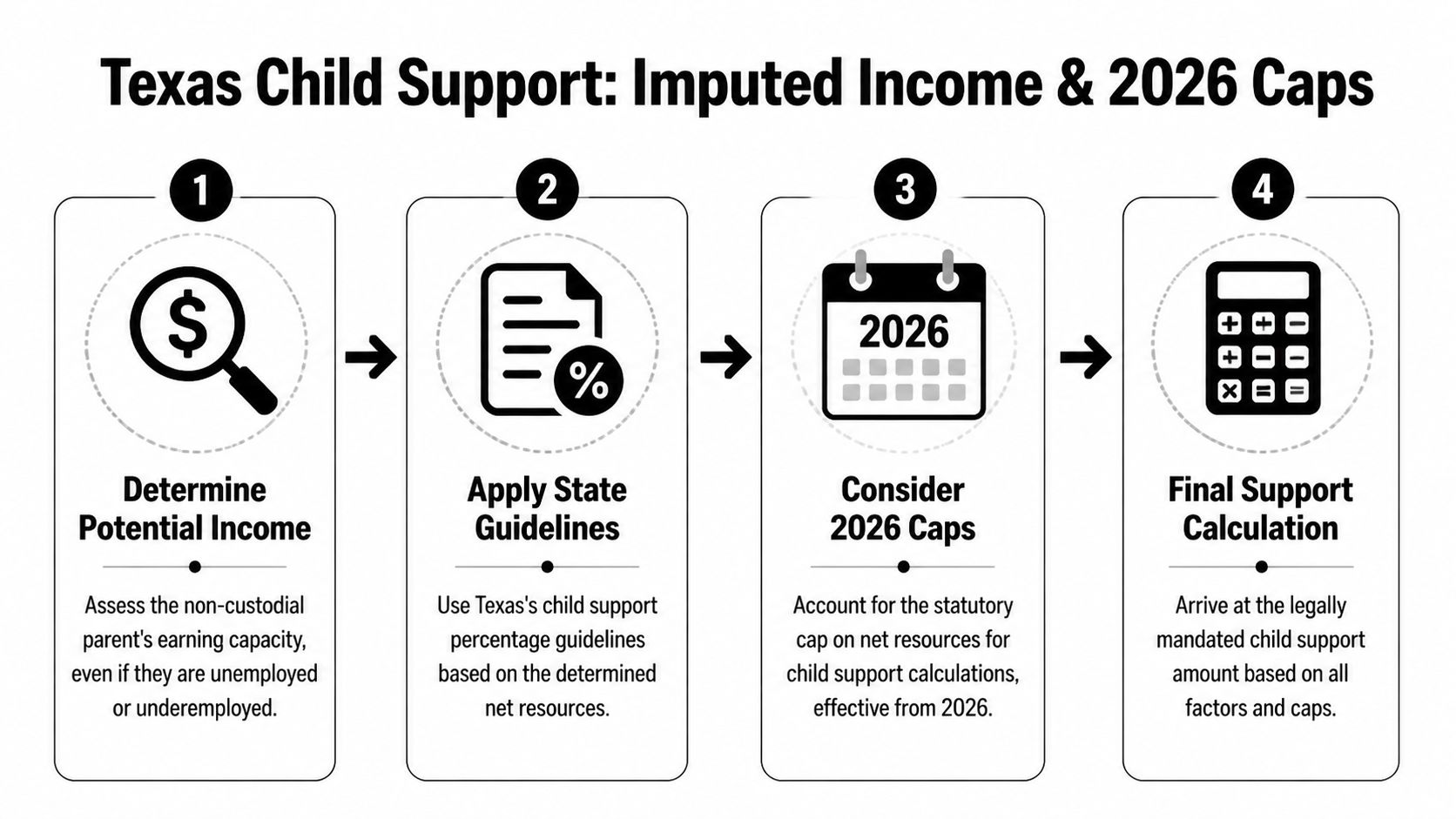
Calculating Child Support Using Imputed Income and the 2026 Caps
If a father quits a high-paying job, the issue becomes real. The court does not have to accept zero income as the new reality. The judge can determine his earning capacity and run the child support calculation from there.
As of September 1, 2025, Texas increased the child support guideline cap from $9,200 to $11,700 in monthly net resources through House Bill C.S.H.B. 2643. For two children, the maximum guideline support amount increased from $2,300 to $2,925 per month, a $625 monthly increase, according to this summary of the September 1, 2025 Texas child support cap increase.
A courtroom example
Assume a father previously earned well above the guideline cap and then quits. He tells the court he currently has no income. If the judge finds the quit was voluntary and done to avoid support, the court can impute income based on earning history and earning ability.
For two children, the guideline framework under §154.125 applies to net resources up to the cap. Because the updated cap is $11,700, the maximum guideline amount for two children is $2,925 per month under the current cap structure described in the source above.
That’s the key point. A parent can’t necessarily cut support by cutting a paycheck on paper.
Step by step calculation logic
Use this basic sequence:
Identify earning capacity
The court looks at prior wages, training, education, and available work.Determine net monthly resources
The court uses the income it finds credible. In an imputation case, that may be historical earning ability rather than current claimed earnings.Apply the guideline percentage under §154.125
For two children, guideline support is calculated using the percentage tied to two children.Apply the cap
If net monthly resources exceed the guideline cap, the guideline amount is calculated using the capped figure unless the court finds proven needs justify more.
For a more general overview of the math involved, see how child support is calculated in Texas.
When the court can go above the cap
The cap is not always the end of the story. Under Texas Family Code §154.123, a court may deviate from guideline support. In high-income cases, that matters when a child has proven needs beyond the capped guideline amount.
Courtroom insight: If you want more than guideline support above the cap, bring proof of the child’s actual needs. Judges don’t award upward deviations because one parent earns well. They award them because the evidence justifies them.
Why the cap change matters in quit-the-job cases
The updated cap increases exposure for high-income parents. It also alters the power dynamics in settlement talks. A parent who used to argue from the older cap now faces a higher baseline under current law for orders affected after the effective date.
If you represent the parent receiving support, use the new cap correctly. If you represent the parent who had a legitimate income collapse, don’t walk into court without a grounded calculation and evidence that rebuts imputation.
The Legal Process for Enforcing Support or Modifying an Order
Once a parent quits, you need to decide whether you’re enforcing the existing order or asking the court to change it. Those are different paths, and mixing them up wastes time.

If you receive support and the other parent stopped paying
You’re usually looking at an enforcement action. The theory is simple. There is already a valid order. The other parent didn’t follow it. You ask the court to enforce the order and reject the excuse if the unemployment was voluntary.
In many cases, that means filing a motion for enforcement, alleging missed payments, and preparing to show the court that the parent had earning capacity or acted in bad faith. If income was intentionally reduced, you push the imputed-income argument hard.
If you pay support and your income dropped for a legitimate reason
You need a modification case. Usually that means filing a petition to modify the parent-child relationship as it relates to support. The legal standard comes from Texas Family Code §156.401, which requires a material and substantial change in circumstances.
The filing date is critical. Under §156.401, support reduction is typically only retroactive to the date the modification petition was filed. If a father quits his job and waits 12 months to file, he can accumulate a full year of arrearages at the original higher rate, according to this explanation of retroactivity and child support modification timing in Texas.
The process in practical order
Most cases move through a sequence like this:
File the correct pleading
Enforcement if the order is being violated. Modification if circumstances legitimately changed.Serve the other parent
Proper service matters. If service is defective, hearings get delayed and advantage disappears.Exchange information
Income records, tax returns, pay stubs, termination documents, and job search evidence usually become central.Set the case for hearing or mediation
Some courts push settlement first. Others move you quickly to a temporary-orders or final hearing track.Present evidence
Voluntary underemployment cases are often won or lost based on the evidence.
A short explainer may help if you want a visual overview before court:
What judges usually look for at hearing
The judge is trying to answer a practical question. Is this a parent who can’t pay the same amount anymore, or a parent who decided not to?
Bring the hearing back to proof:
- For enforcement: Prior earnings, timing of the resignation, weak job search, lifestyle evidence, and available jobs.
- For modification: Termination paperwork, unemployment records, medical support, active job search evidence, and a clean timeline.
File first. Explain second. A parent who waits to seek relief usually walks into court already behind.
The procedural mistake I see most often is delay. Parents spend months arguing by text while arrears build. That is avoidable. If circumstances changed, get the case on file.
Gathering the Evidence to Prove Your Case in Court
These cases don’t turn on who sounds more offended. They turn on who proves the facts. If you walk into court with a strong opinion and weak documents, you’re gambling.
The evidentiary standard matters. In an imputed income case, the burden is preponderance of the evidence, meaning the party seeking imputation only needs to show it is more likely than not that the other parent could earn at the imputed level. That standard and its reliance on work history and labor market evidence are described in this discussion of proving underemployment in Texas child support cases.

If you are trying to prove voluntary underemployment
Build a file that shows earning capacity, not just past luck.
- Past income records: W-2s, tax returns, prior pay stubs, commission reports, and offer letters.
- Employment history: Resume, LinkedIn profile, professional licenses, certifications, and industry background.
- Comparable job openings: Current postings in the same field, same city, or similar market.
- Timing evidence: Texts or emails showing support disputes before the resignation.
- Lifestyle proof: Evidence the parent still lives at a level inconsistent with claimed poverty.
- Third-party proof: Recruiter communications, business records, or vocational testimony if available.
If you are defending a good-faith income drop
You need to prove the reduction was real, necessary, and not strategic.
- Termination documents: Layoff notice, closure announcement, or HR letter.
- Unemployment records: Benefits documents and agency correspondence.
- Job search records: Applications, interviews, rejection emails, networking contacts, and recruiter outreach.
- Medical proof: Records showing work restrictions if health drove the job change.
- Business justification: If you changed roles or started a business for a legitimate reason, bring a detailed plan and supporting documents.
- Credibility evidence: Show that you kept paying what you could and sought court relief promptly.
What strong evidence looks like
Strong evidence is organized, dated, and easy for a judge to follow. Don’t dump a stack of papers on counsel table and expect the court to do your work.
Use a timeline. Label exhibits clearly. Tie each document to a legal point. If your argument is “he could still earn at his prior level,” every exhibit should support that. If your argument is “my job loss was involuntary and I’ve made a good-faith effort to recover,” every exhibit should support that instead.
Judges believe paper when paper matches behavior.
Also remember that bad evidence hurts more than no evidence. Inflated claims, selective screenshots, and sloppy timelines damage credibility fast.
Serious Consequences Arrears Garnishment and Contempt
Parents sometimes treat job quitting like a pause button. It isn’t. If there is an existing order, that order keeps running until the court changes it.
In Texas, child support obligations do not automatically stop or reduce when employment ends. They continue at the ordered amount until formally modified, and even a significant involuntary income reduction such as 20% or $100 still requires a filed modification to matter legally, as noted earlier in the linked discussion of Texas modification law.
What happens when payments fall behind
The first problem is arrears. Missed support becomes a judgment-like obligation that doesn’t vanish because the parent changed jobs or stopped working.
Enforcement can reach multiple income sources and collection tools. The verified materials specifically note continued execution through systems such as the State Disbursement Unit and wage garnishment against available income sources, including unemployment benefits, workers' compensation, tax refunds, and lottery winnings in applicable situations.
If you want a broader look at enforcement exposure, review what happens if child support is not paid in Texas.
The escalation path
Texas courts and enforcement systems have several practical ways to apply pressure:
- Wage withholding: A new employer can receive withholding orders.
- Intercepted funds: Certain available funds can be captured and applied to support.
- License problems: Enforcement can reach important licenses, which creates more pressure, not less.
- Contempt risk: If the court finds willful nonpayment, the consequences become much more serious.
Contempt is where people lose control of the case
Contempt changes the atmosphere. At that point, the court is no longer just calculating support. The court is judging compliance with a prior order.
That’s why “I quit, so I paid less” is such a dangerous position. Without a signed modification order, that explanation usually sounds like self-help. Judges do not reward self-help in child support cases.
A parent with a legitimate hardship should file quickly, pay what can be paid, document everything, and show good faith. A parent who quits to reduce support often ends up with arrears, enforcement costs, and a much weaker position than before.
Frequently Asked Questions About Texas Child Support
Some questions come up in almost every consultation. Here are direct answers.
Child Support FAQs
| Question | Answer |
|---|---|
| If a father quits his job in Texas, does child support automatically stop? | No. The existing order remains in effect until the court signs a modification. Quitting a job by itself changes nothing legally. |
| Can a judge base support on what he used to earn? | Yes. If the court finds voluntary unemployment or underemployment, it can use earning capacity under Texas Family Code §154.001 instead of current claimed earnings. |
| What if the father was laid off instead of quitting? | That’s a different case. Involuntary job loss can support modification, but the parent still has to file and prove the change with documents. |
| Does 50/50 custody eliminate child support? | Not automatically. Texas courts still analyze support under the Family Code. Parenting time matters, but equal possession does not guarantee zero support. |
| Can a parent and co-parent agree to lower support without court approval? | They can agree informally, but that does not replace the court order. If the paying parent later gets accused of underpaying, the unsigned side agreement usually won’t protect them. |
| What if the parent is paid in cash or hides income? | Focus on lifestyle evidence, bank records, business activity, prior earnings, and any available proof of earning capacity. Courts can decide credibility issues and impute income when warranted. |
| Can the court order more than the guideline amount? | Yes, in some cases. Under §154.123, the court may deviate from guidelines if the evidence supports it, including proven child needs in the right case. |
| What should the paying parent do immediately after a real income collapse? | File for modification right away, gather termination or medical records, document every job search effort, and keep paying as much as possible under the existing order until the court acts. |
| What should the receiving parent do if payments suddenly drop? | Don’t rely on texts or excuses. Pull the payment record, preserve communications, gather evidence of earning capacity, and prepare enforcement. |
| Is it enough to tell the judge the other parent could earn more? | No. These cases are evidence-heavy. Bring records that show qualifications, prior earnings, and realistic jobs available in the market. |
The bottom line is simple. In child support if father quits job texas cases, the court’s job is not to reward a parent’s career choice. The court’s job is to protect the child and enforce the Family Code. Build your case around that principle and you’ll make better decisions from day one.
If you need strategic help with establishing, modifying, or enforcing child support under Texas law, contact Texas Child Support Law Office of Bryan Fagan. The firm handles income disputes, high-income cases, arrears, wage garnishment, and courtroom litigation across Texas, with a clear focus on practical strategy and results.