You're already living the part nobody talks about. The support should be showing up, the bills still come due, and every missed payment turns into another decision point, whether to wait, file, or push harder through the court.
In Texas, child support enforcement contempt of court texas is the tool that turns a paper order into pressure the other parent can't ignore. It's not the only tool, and it's not always the fastest, but when a parent is behind and won't comply, contempt is one of the clearest ways Texas courts force the issue.
Unpaid Child Support in Texas Courts: The Enforcement Landscape
A custodial parent in Houston who hasn't seen child support in six months usually isn't looking for a courtroom fight. They are trying to cover rent, groceries, school costs, and the day-to-day gap that opens when the other parent stops paying. Texas law treats that problem as an enforcement issue, and contempt is one of the court's main tools for pushing a parent back into compliance.
The scale is part of why these cases stay active in Texas courts. The Texas Judiciary reported that Title IV-D child support cases made up about 30% of nearly 274,000 family cases filed in fiscal year 2023, and the same reporting cycle showed post-judgment modification and enforcement suits fell 3% to their lowest level since at least 2011 (Texas Judiciary fiscal year 2023 report). Texas reporting has also pointed to more than $21 billion in unpaid child support statewide. That is why contempt is handled as a routine enforcement remedy, not a rare one.

Texas Family Code Chapter 157 gives courts the framework for responding when payment stops. A contempt finding can lead to jail exposure, fines, and fee shifting once enforcement succeeds. In practice, that means the case is not about venting frustration. It is about getting a court order that moves money.
Practical rule: the strongest enforcement cases start with records, not emotion. The court wants dates, amounts, and proof of what was due and what was paid.
Legal Standards and Penalties Under Texas Family Code
Texas contempt enforcement turns on proof, not frustration. Under Texas Family Code Chapter 157, a court can punish a willful failure to pay child support with up to 180 days in county jail and a fine of up to $500 per violation, and each missed payment can be treated as a separate violation (Texas Family Code Chapter 157). That structure matters in real cases. If the evidence shows repeated missed installments and the court finds each failure was willful, exposure can grow quickly because Texas treats each violation on its own.
The filing deadline can control the case before the judge ever reaches the arrears. A motion to enforce contempt must be filed in the court of continuing, exclusive jurisdiction, and contempt authority ends if the motion is not filed by the second anniversary of the child's emancipation or termination of support. If the request is filed too late, contempt may be unavailable even when the unpaid balance still exists.
How the penalties stack in real life
A parent who missed 12 monthly payments does not automatically face one contempt finding. If the court finds each missed payment was willful, each omission can be charged as a separate violation. That is why these cases often turn on evidence of payment history, notice, and the obligor's ability to comply, not on a general complaint that support was not paid.
The fee rules also change the pressure in settlement talks and in court. When enforcement succeeds, Texas law requires attorney's fees and court costs to be awarded, and fee waivers are tightly restricted if arrears reach $20,000 or more (Texas Family Code §157.167). A parent who assumes delay will make the problem go away usually learns that contempt becomes more expensive the longer the case sits.
How Child Support Is Calculated in Texas helps a parent compare the ordered amount with the support amount the court should have been using at the outset. Contempt starts after the order exists. At that point, the issues are compliance, willfulness, and proof.
Preparing and Filing a Contempt Motion in Texas
A contempt motion succeeds or fails on precision. Texas pleading rules require itemized noncompliance, which means you need to identify the exact support provisions violated, the dates each payment was missed, and the amount owed for each missed installment. General statements like “he is behind on support” usually aren't enough.
Start with the right court and the right paperwork
File in the court of continuing, exclusive jurisdiction. That is the court that keeps authority over enforcement, and if you file in the wrong place, you can lose time before the court ever reaches the merits. The motion should ask for a hearing, and if contempt is requested, the court must set one and order the respondent to personally appear and respond (Texas child support enforcement practice guide).
A clean filing usually includes:
- The original order: attach the support order or the operative decree.
- A payment ledger: list every missed date and amount, not just a total arrears number.
- Proof of service history: keep notices, agency records, or prior correspondence.
- Any wage or income records: if available, these help show what the obligor knew and could pay.
What works in court: specific dates, specific amounts, and a record that makes the nonpayment easy to follow. Vague arrears allegations create avoidable problems.
Serve the respondent correctly
Personal service matters. The respondent must be personally served with the show-cause order, and defective service can sink an otherwise good case. If the obligor was never properly brought into the contempt proceeding, the court may never get to the question of willfulness.
Build the hearing file before filing
Before you file, organize the evidence the way a judge will need to see it:
- A full payment history from the Attorney General ledger or your own records.
- A month-by-month arrears chart with exact dates.
- Copies of correspondence showing the other parent knew about the obligation.
- Any modification orders so you don't accidentally ask the court to enforce an old amount that was later changed.
The internal filing process is easier to manage when the motion is drafted with the hearing in mind, and the practical filing approach is laid out in this Texas contempt filing guide. In Texas, the motion is not just a form. It's the roadmap the judge will use to decide whether contempt is even on the table.
Combining Contempt with Other Enforcement Tools
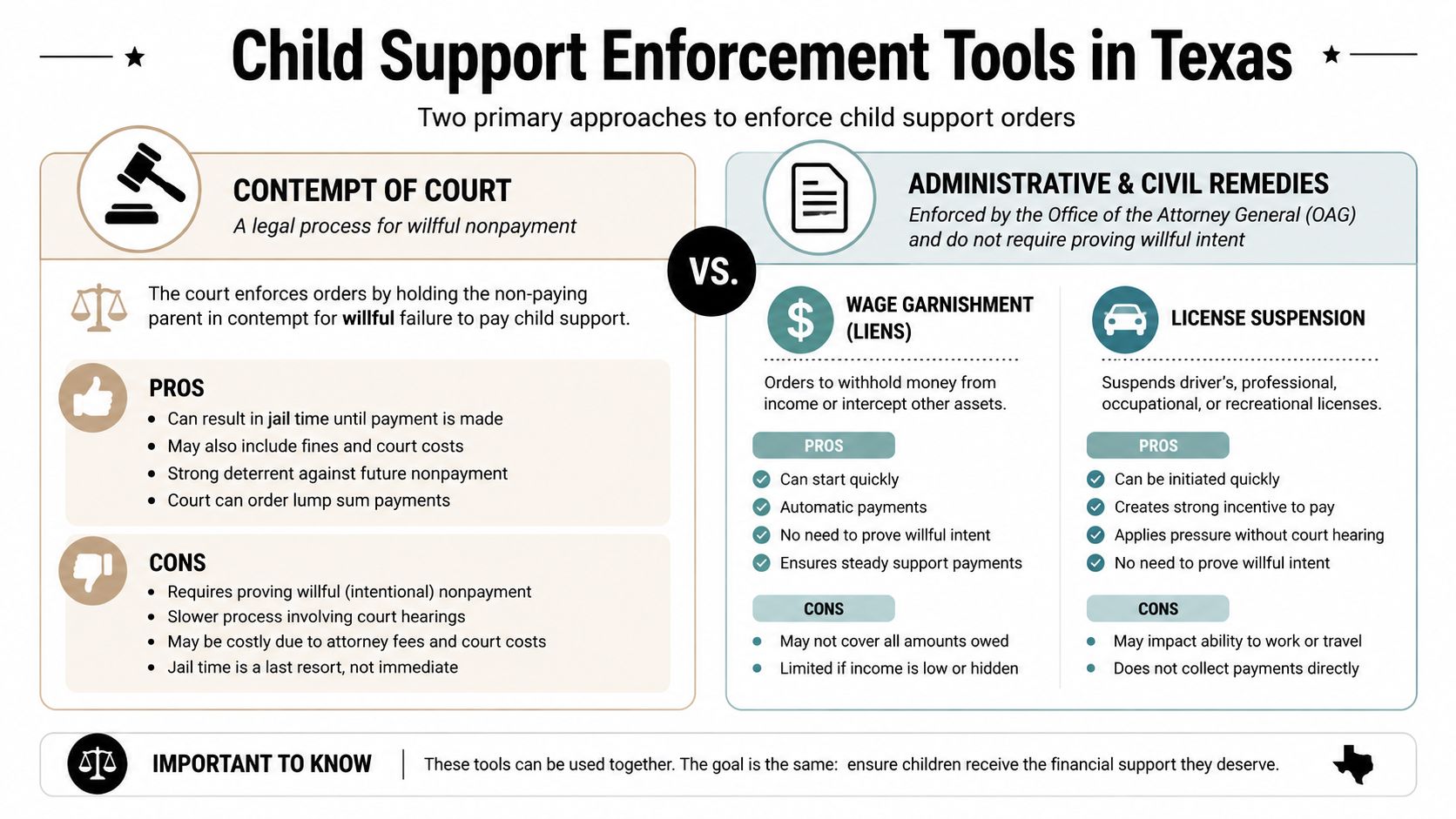
A common mistake is treating contempt as if it's the only serious remedy. Texas enforcement is multi-tool. Alongside contempt, the state recognizes wage garnishment, liens on property, license suspension, and tax intercepts as part of the broader enforcement picture (Texas child support enforcement overview). The strongest strategy often uses more than one of them at the same time.
When contempt helps most
Contempt is useful when the other parent keeps paying late, pays only part of what's due, or ignores the order altogether despite having the means to comply. It also provides a valuable tool when a parent has hidden assets or keeps moving income around in a way that makes simple collection harder. In those cases, contempt can pressure compliance while income withholding or lien activity works in the background.
The Texas Attorney General's Child Support Division can use remedies that include contempt, probation, and possible incarceration, but that doesn't mean jail is the only or even the best immediate goal. If wage withholding can reach the paycheck, and a lien can attach to property, those tools may move money faster than waiting for a contempt setting to mature. That is why a layered strategy usually beats a single-shot filing.
A practical Dallas example
A custodial parent in Dallas facing two years of unpaid support may do better by filing contempt and placing a lien on real property at the same time. The contempt motion creates courtroom pressure. The lien keeps the arrears from disappearing if the obligor tries to refinance, sell, or otherwise deal with the property.
Why fees matter here
When enforcement succeeds, Texas Family Code §157.167 requires reasonable attorney's fees and court costs to be awarded (Texas Family Code §157.167). That fee-shifting rule changes the economics of enforcement, especially in larger arrears cases. It also makes a combined strategy more rational, because the court can order support collection, contempt relief, and fees in the same case.
If you're deciding how aggressive to be, this Texas enforcement guide is a good reference point for comparing contempt with other remedies. The right choice depends on whether the obligor has wages, property, assets, or just excuses.
Key Defenses and the Current-Payment Rule
Contempt turns on willfulness, and that's where many cases change direction. Texas courts generally use contempt to address a parent who can pay but refuses to do so, not a parent who is unable to comply because of unemployment, disability, irregular self-employment income, or other documented inability. The distinction matters because the courtroom question is not just whether money is owed, it's why the payment stopped.
The Texas Supreme Court's decision in Ex parte Rocha is especially important. The court interpreted Texas Family Code §157.162(d) to mean contempt may not be found if the respondent appears current on the child-support obligations due at the time of the hearing (Ex parte Rocha). That means a parent who rushes to pay the live obligation before the hearing may avoid contempt for the amounts then due, even though earlier arrears can still be pursued through other enforcement methods.
What obligors use as defenses
The most common defense patterns are not complicated, but they can work if the records support them:
- Current payment proof: receipts, account statements, or the Attorney General payment ledger.
- Inability to pay evidence: job loss records, disability documentation, or inconsistent income records.
- Procedural defects: improper service or a vague motion that doesn't identify missed payments clearly.
A hearing often turns on whether the obligor can show the judge a clean payment record for the amounts due that day.
How custodial parents should respond
Keep your own ledger. Don't rely on memory, and don't assume the state's record will automatically tell the whole story. If the other parent claims they're current, you want the hearing file to show the exact opposite if the claim is false.
The hearing process itself can be technical, so a parent preparing to defend or oppose contempt should review child support contempt hearing procedures in Texas before they walk into court. The key point is simple. The obligor's documentary proof matters as much as the arrears claim, because Texas courts look closely at current status and payment history when deciding whether contempt and purge terms are appropriate.
Contempt in High-Income and 50/50 Custody Cases
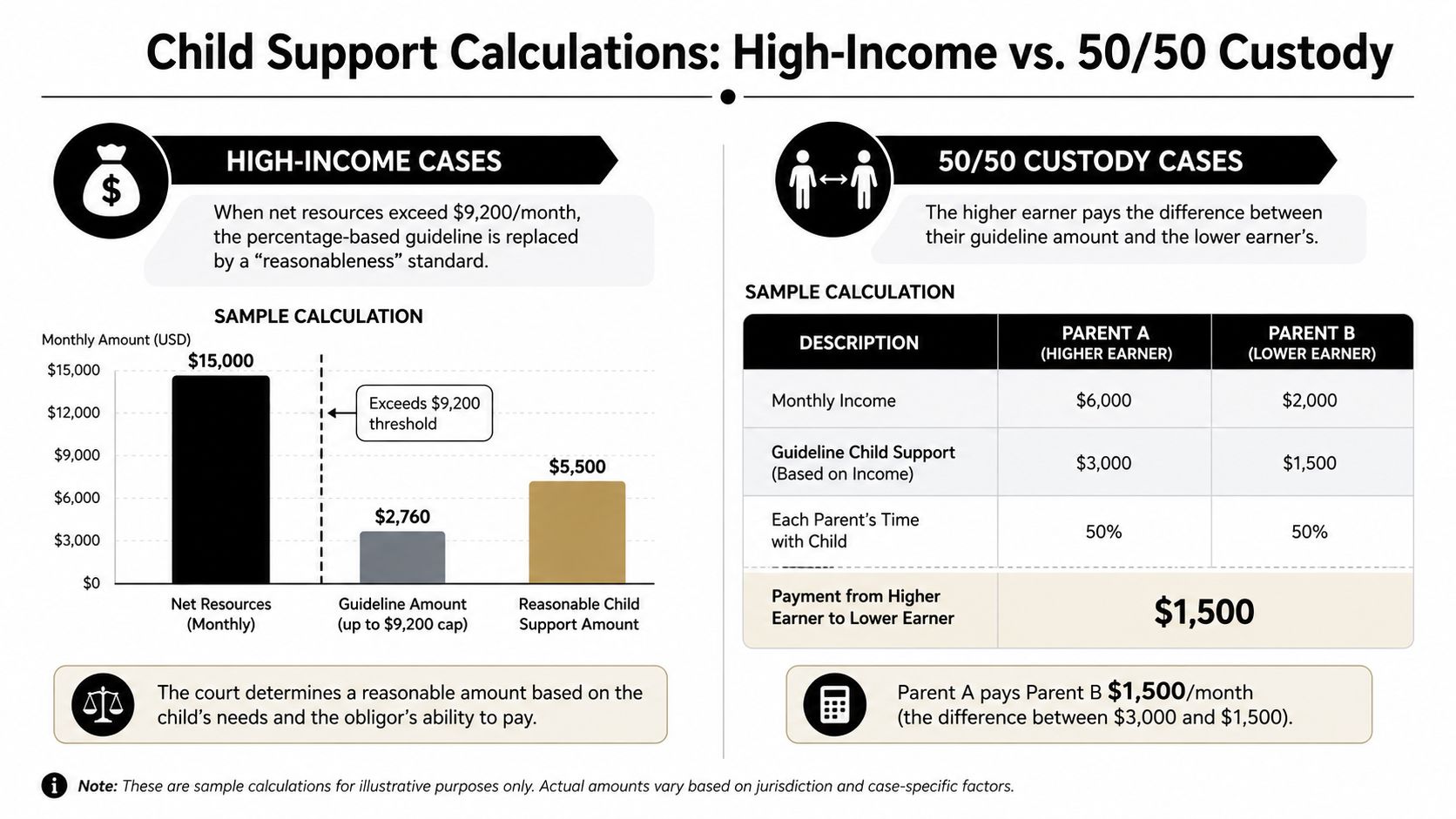
High-income cases and shared-custody cases create a different kind of child support dispute. The calculation still starts with Texas Family Code §154.125, which uses a percentage of net resources, 20% for one child, 25% for two, 30% for three, 35% for four, 40% for five, and at least 40% for six or more (Texas Attorney General child support guidance). The updated $11,700 net monthly resources cap effective September 1, 2025 sets the ceiling for applying those percentages in high-income cases.
How the guideline math works
If a parent has $11,700 in net monthly resources and one child before the court, the guideline amount is 20%, or $2,340 per month. With three children, the guideline amount is 30%, or $3,510 per month. Those figures are the starting point, not the final answer, because §154.123 allows deviation when the facts justify it.
When deviations become relevant
Deviations can matter in high-income cases, 50/50 custody arrangements, and cases involving special needs. The court can look beyond the guideline number if the strict percentage does not fit the child's actual needs or the parents' shared arrangement. That does not eliminate contempt exposure. If the court orders support and the parent fails to pay, contempt remains available for noncompliance.
Why documentation matters more in these cases
High earners often have compensation that is not as simple as a weekly paycheck. That makes net-resource documentation central. The dispute may involve bonus income, self-employment receipts, or other income sources, and the court needs a clean record before it can decide whether the amount due was missed.
In shared-custody and high-income disputes, the analysis often turns on whether the guideline amount, a deviation, or contempt enforcement fits the case best. The work done through Texas Child Support Law Office of Bryan Fagan fits into that conversation because these matters usually require both calculation analysis and enforcement planning.
Your Action Plan and When to Hire an Attorney
A contempt case is easiest to manage when you treat it like a file, not a feeling. Start by verifying that the court has jurisdiction, then calculate the arrears carefully, gather payment records, and draft a motion that lists each missed payment with specific dates and amounts. After that, make sure service is clean and the hearing packet is ready.
A practical pre-filing checklist
- Confirm the right court: file in the court of continuing, exclusive jurisdiction.
- Audit the arrears: match the order against the actual payment history.
- Assemble proof: ledgers, receipts, correspondence, and any income records you have.
- Draft with precision: itemize every missed installment.
- Serve properly: personal service and a show-cause order matter.
- Prepare for the hearing: bring copies for the court and for your own use.
Timelines vary by court, but the filing-to-resolution path moves faster when the motion is specific and the service is done right. If the motion is vague, the hearing date can become a delay instead of a solution. And if the contempt request is untimely, the deadline in Chapter 157 can end that remedy altogether.
When to bring in a lawyer
Some cases are built for attorney involvement from the start. That includes complex income disputes, high-income cases, interstate enforcement, and cases where the obligor has a serious defense such as inability to pay or current-payment proof. It's also smart to get counsel involved when arrears are large or the case could involve jail exposure.
Texas contempt practice is technical, and the hearing can turn on one document, one date, or one service defect. If you're behind on filing, dealing with a disputed ledger, or trying to enforce a large arrears balance, legal strategy matters as much as the order itself. The goal is not just to file. The goal is to file in a way the court can enforce.
If you're trying to enforce unpaid support, Texas Child Support Law Office of Bryan Fagan can review the order, compare the payment history, and help you decide whether contempt, wage withholding, liens, or a combined approach makes the most sense. Visit Texas Child Support Law Office of Bryan Fagan to take the next step with a strategy built around your court order and your records.