 Skip to content
A veteran in San Antonio opens the mail and finds a proposed child support order treating VA disability compensation like an ordinary paycheck. He's 38, has a 70% VA disability rating, receives monthly compensation, and works limited hours because of his service-connected condition. His immediate questions are practical: How much can the court order? Can the VA withhold the money? Can the court divert the benefit directly to the other parent?
Those questions involve two different systems. Federal law protects VA compensation from many forms of direct collection, while Texas law generally treats service-connected VA disability compensation as part of a parent's net resources for calculating child support under Texas Family Code §154.062. Texas Law Help explains the distinction between counting VA benefits as income and directly garnishing those benefits.
The answers now depend on four issues: what counts as income, how the $11,700 monthly net-resource cap affects guideline support, what changed when the VA limited new need-based apportionments in 2026, and what procedure is available to challenge or modify an order. The starting point is §154.062, which places qualifying VA disability compensation inside the Texas net-resource calculation even when the benefit isn't wages.
A Texas Veteran's First Question About Disability Pay and Child Support Texas
The San Antonio veteran described above may feel that his disability compensation should be treated differently from a salary because it compensates him for a service-connected medical condition. That argument has emotional force, but it doesn't answer the Texas guideline question. The court generally looks at whether the payment belongs in the statutory definition of net resources, not whether the payment came from an employer.
That distinction matters at the hearing. The judge may use the veteran's VA compensation, military retirement, and other qualifying resources to calculate guideline support. The court may then consider allowed deductions, benefits paid for the child, the number of children, and any request to depart from the guideline amount. A veteran whose only recurring income is VA disability compensation may still face a support order because Texas law isn't limited to wages.
The second question is collection. Federal law can restrict direct garnishment or assignment of VA disability benefits in some circumstances. That protection doesn't automatically remove the benefit from the Texas calculation. A protected payment can still be treated as an income source for setting support, even when a state agency can't seize the payment in the same way it would with ordinary wages.
Practical rule: Don't walk into court arguing only that VA compensation is protected. Separate the calculation issue from the collection issue.
The 2026 VA apportionment change makes that separation more important. A custodial parent who once viewed VA apportionment as a routine path may now need to rely primarily on a Texas support order and Texas enforcement tools. The court, not the VA, is usually the forum for deciding the family's support obligation.
Texas Family Code §154.062 supplies the framework by identifying which resources enter the calculation and which deductions or exclusions may affect the final amount.
How Texas Counts VA Disability Under §154.062
Texas Family Code §154.062 treats qualifying VA disability benefits as part of a parent's net resources. The statute excludes non-service-connected disability pension benefits, but service-connected VA disability compensation generally belongs in the guideline analysis. The statutory text of §154.062 identifies VA disability benefits within net resources and distinguishes them from non-service-connected pension benefits.
The practical review should begin with the veteran's VA award letter, not a bank deposit alone. Identify the recurring disability compensation, the rating-related payment structure, and any amounts connected to dependents. A veteran rated at least 30% may receive additional allowances for eligible dependents, including minor children and certain adult children, and VA disability compensation is tax-free and paid monthly. The Texas Veterans Commission describes dependent allowances and the monthly compensation structure.
Payments that require careful classification
Gross monthly service-connected disability compensation generally enters the resource picture. Special monthly compensation and a clothing allowance may require closer review because the purpose and statutory treatment of the payment matter. Aid-and-attendance or housebound amounts, and unreimbursed medical expenses, may involve separate health-care treatment or deductions rather than simple wage-like income treatment. VA pension payments also follow separate rules, so the award letter should be read carefully instead of applying a blanket label to every VA deposit.
Military retirement pay is different from VA disability compensation, but both can affect the support analysis. Retirement pay is ordinarily considered a resource. VA compensation is also counted under modern Texas guidance, while its protected status can remain relevant when the court considers enforcement or a requested deviation.
The older case most often raised in this area is Veterans Administration v. Kee, the Texas Supreme Court's 1986 decision. The court held that disability benefits received after a veteran waived retirement pay weren't subject to garnishment for child support and alimony under the federal law then in effect. That historical rule still matters because it explains why older advice may say VA disability is untouchable. Later Texas statutory guidance expressly includes qualifying VA disability benefits in net resources.
| What Texas Counts and Excludes Under §154.062 | Counted as Net Resource? | Authority / Notes |
|---|---|---|
| Service-connected VA disability compensation | Generally yes | Included in net resources under §154.062, even when it isn't wages |
| Additional compensation connected to eligible dependents | Requires review | The veteran's award letter should identify the dependent-related amount and whether benefits are paid for or to a child |
| Non-service-connected disability pension | Generally excluded from this category | Texas guidance distinguishes pension benefits from service-connected disability compensation |
| Military retirement pay | Generally yes | Retirement pay is a separate income source and should be disclosed |
| Aid-and-attendance or housebound-related amounts | Requires classification | Purpose, award language, and allowed health-care treatment can affect the analysis |
| Child-related VA benefits or apportionments | May be offset or treated as the child's resource | Texas guidance recognizes a netting issue when benefits are paid to or for the child |
For a separate discussion of military income in Texas support calculations, review child support and military pay in Texas. The key point is that §154.062 asks what resources exist, while federal law may affect how those resources can be collected.
Applying the Guideline Cap With the $11,700 Net Resource Limit
Texas Family Code §154.125 applies guideline percentages to monthly net resources, but the guideline base is capped. For cases filed on or after September 1, 2025, the cap is $11,700 in monthly net resources, as reflected in the Texas legislative update to the statutory framework. The Texas Legislature's bill text addresses the updated net-resource cap effective September 1, 2025.
Consider an illustrative calculation for the same 70%-rated veteran. Assume the worksheet lists about $1,663 in gross VA compensation, $2,400 in military retirement, and $800 in post-tax take-home wages from part-time employment. After the stated $260 in children's health insurance premiums, $150 in other ordered support, and $256 in taxes, the example produces net resources near $4,197.
For two children, a 25% guideline calculation would produce roughly $1,049 per month, which is below the statutory cap. The number is an illustration of the calculation method, not a prediction of the order in a particular case. The actual worksheet may differ if the court treats a payment differently, verifies the deductions, considers benefits paid for a child, or finds grounds for deviation under §154.123.
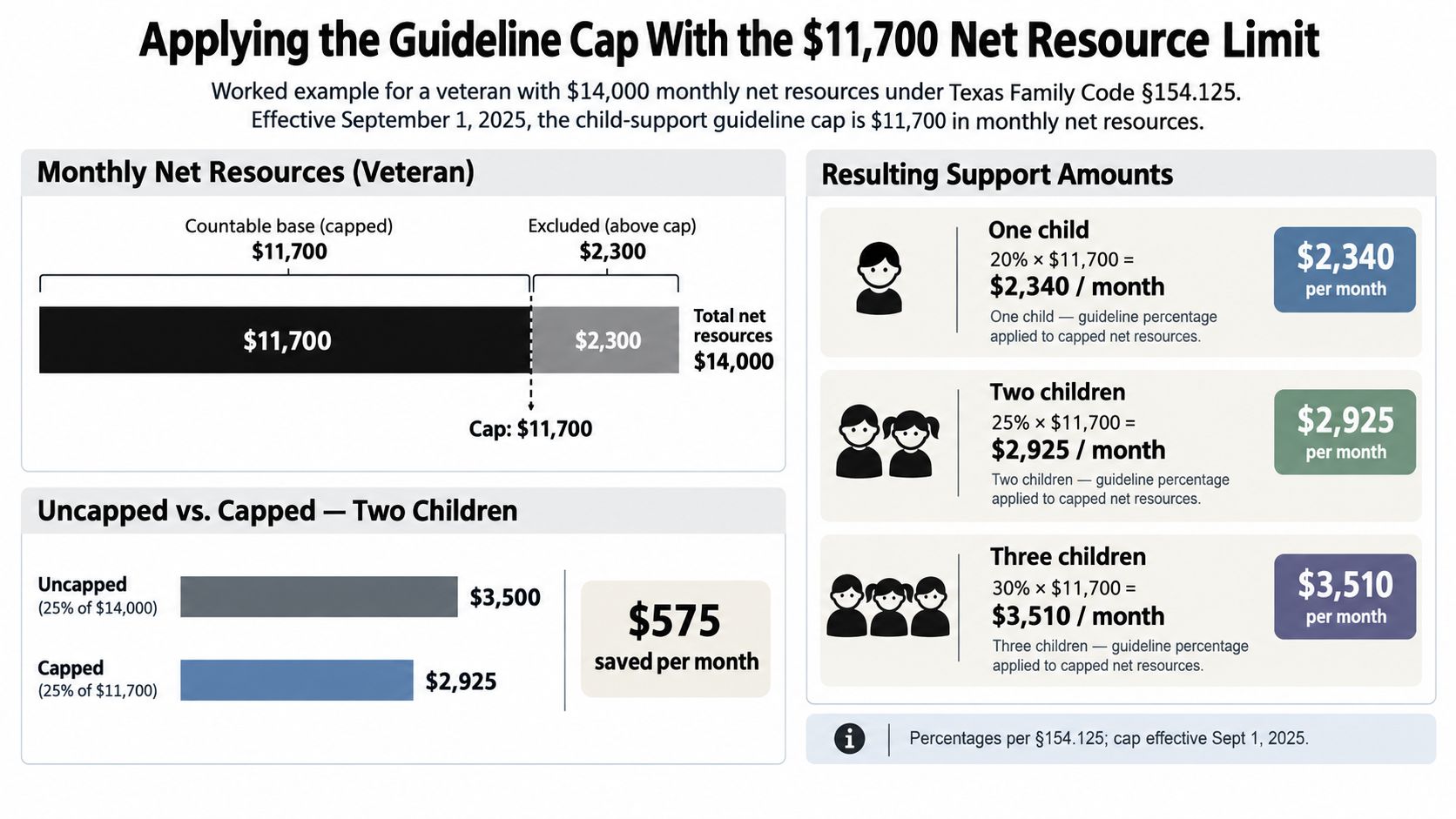
The cap becomes more visible in a high-resource example. If net resources are $13,500 per month, the two-child guideline percentage still applies, but the presumptive calculation uses no more than $11,700. At 25%, that produces $2,925 per month, rather than applying 25% to the full $13,500. This is the effect of the statutory ceiling, not a discretionary reduction by the judge.
A veteran reviewing an online explanation of How Child Support Is Calculated in Texas should confirm that the worksheet uses the current cap and includes only legally permitted deductions. The calculation starts with net resources, not just the amount deposited by the VA.
The 2026 VA Apportionment Rule Change and What It Means for Texas Families
Before the 2026 change, a dependent could seek a direct VA apportionment in qualifying need-based circumstances. That route was separate from a Texas court's authority to establish support. Beginning February 9, 2026, the VA announced that it generally won't grant new need-based apportionments of compensation, pension, and DIC, subject to limited exceptions. The VA's January 2026 announcement explains the change and its effective date.
The practical shift is substantial. Older explainers may describe VA apportionment as though a custodial parent can routinely ask the VA to redirect part of a veteran's disability check. That advice is now incomplete for a new need-based request. Texas family courts have access to the parties' financial records, support history, and family circumstances, so the state-court order is generally the more important collection instrument.
| VA Apportionment Path Before vs. After February 2, 2026 | Pre-2026 Rule | 2026 Rule |
|---|---|---|
| New need-based request | Could be considered by the VA in qualifying circumstances | Generally unavailable for new claims beginning February 9, 2026 |
| Existing apportionment | Continued under the applicable order or VA determination | Existing payments are generally not affected by the change |
| Incarcerated beneficiary | Apportionment could be available | Limited exception remains |
| Institutionalized, incompetent veteran without a fiduciary | Apportionment could be available | Limited exception remains |
| Texas support order | Available as a state-law remedy | Becomes the primary practical route for new support disputes |
The change doesn't make VA disability irrelevant to Texas support. The court can still use the compensation as a resource when setting support, and Texas enforcement mechanisms may apply to the resulting order. It does mean that a parent shouldn't assume the VA will act as a substitute for filing, service, discovery, and a Texas hearing.
A dependent seeking one of the remaining exceptions should review the VA's required process and forms. In ordinary support litigation, however, the stronger strategy is usually to establish or modify the Texas order and address collection through the Texas Office of the Attorney General or private enforcement counsel.
Modifying and Enforcing Child Support Orders in Texas
A support order doesn't change because the parents privately agree that the veteran's disability payment has changed. The Texas Attorney General explains that an existing order can be changed through an in-office Child Support Review Process agreement or a court hearing, and an informal agreement alone doesn't replace the signed order. The Attorney General describes the Texas support modification process and its two formal routes.
Modification procedure
A parent seeking modification generally files a Petition to Modify with the court of continuing exclusive jurisdiction under Texas Family Code §155.001. The moving party must establish a qualifying material and substantial change under §156.401, which may involve a significant change in income, changed needs, or another recognized basis. In OAG-administered cases, recalculation rules may also affect whether the agency will pursue a review.
The filing must be served on the other parent unless service is waived or another lawful procedure applies. The responding parent should file a timely answer, gather current financial records, and appear at the hearing. If paternity remains contested, a party should raise genetic testing under the applicable Family Code procedures, including §160.751 where appropriate.
Enforcement procedure
For enforcement, preserve the payment history and identify each alleged violation. The pleadings should state the order provision, the missed or short payment, the date, and the amount claimed. Depending on the facts, remedies may include income withholding under §158.106, an administrative writ of withholding under §158.301, license suspension under §232.002, contempt under §157.008, and a judgment for arrears. The State Disbursement Unit processes support payments under the statutory framework addressed in §234.001.
A self-represented parent can start with the OAG's interactive child support worksheet, eFileTexas, and the local Title IV-D office. Counsel becomes especially valuable when the case involves UIFSA and another state, a contested disability rating, bankruptcy overlap, or possible criminal contempt exposure.

Bring the signed order, payment record, VA documents, and a current income worksheet to the hearing. Until a judge signs a new order, the existing amount remains enforceable, even if the veteran's circumstances have changed.
Netting Dependency Allowances and Deviation Arguments Under §154.123
A veteran should build the worksheet in layers rather than starting with the VA deposit and guessing at the result.
First, collect gross monthly resources from VA award letters, retirement statements, pay stubs, and other reliable records. Then identify the deductions Texas law permits under §154.062, which can include applicable Social Security taxes, federal income tax treatment, the child's health insurance cost, union dues, and court-ordered support for other children. Medicare isn't the same deduction as FICA-S OASDI, so the worksheet should identify each item precisely.
Benefits paid to or for the child create a separate netting issue. Texas guidance recognizes that a court may offset benefits paid because of the veteran's disability, and dependent benefits may be treated as income to the child. Don't assume that every dependent allowance belongs entirely in the veteran's available income or entirely outside the calculation. The award letter and payment destination matter.
When a deviation deserves attention
Section 154.123 allows a court to depart from the presumptive guideline amount when the evidence supports a different result. Relevant facts may include:
- Extraordinary expenses: Medical, dental, or psychological costs for the child may justify a different allocation.
- Educational or special-needs costs: A child's unusual needs can affect the guideline analysis.
- Possession-related travel: Significant travel costs tied to exercising possession may be relevant.
- Other support obligations: Support owed for other children can support a hardship argument.
- Structured obligations: A court may examine whether an obligation is paid monthly or merely appears on paper.
A simple illustration helps. Suppose a worksheet begins with $4,100 in gross VA income and then combines the veteran's other qualifying resources and permitted deductions. The court applies the resulting net-resource figure under §154.062, subject to the $11,700 cap, before applying the applicable guideline percentage under §154.125. A veteran should compare each line of the proposed worksheet against the actual award letter and payment records. A discussion of dependent benefits and offsets is also available in Social Security dependent benefits and child support in Texas.
Documentation and Evidence Veterans Should Gather Before Court
The best defense to an inaccurate worksheet is organized evidence. A veteran should assemble records before filing an answer, modification petition, or response to an enforcement action.
Start with the VA award letter and current rating decision. These documents show the disability classification, monthly compensation, and listed dependents. Add recent VA payment records and bank statements that identify the deposits. If the veteran has civilian employment, include pay stubs, W-2 records, and any documentation showing reduced or irregular work caused by the disability.
The evidence folder should also contain:
- VA correspondence: Include any notice about an apportionment request, denial, pending claim, or existing payment.
- Family records: Gather birth certificates, school records when relevant, and proof of the child's health insurance cost.
- Support history: Include the existing order, payment receipts, OAG account history, and any arrearage calculation.
- Financial disclosure: Complete the §154.062 net-resource schedule and prepare a sworn income-and-expense declaration.
- Tax records: Keep the requested tax returns and supporting schedules available for review.
- Expense proof: Preserve receipts, invoices, insurance statements, and records for childcare or extraordinary medical expenses.

The OAG's child support division uses financial information during its intake and review process, but the agency's worksheet isn't a substitute for a court presentation. If the issue is a contested rating, unusual VA payment, or disputed deduction, label the relevant document and explain the line item in a written summary.
Serve financial materials as required, but redact unnecessary account numbers, Social Security numbers, and unrelated private information. Don't redact the payment amounts, dates, dependent information, or facts needed to test the proposed net-resource calculation. For a focused income checklist, review how to prove income for child support in Texas.
Common Scenarios FAQs and the Path Forward for Texas Veterans
A disability rating increase can change the monthly resource picture and may support a modification request, but the veteran still needs a signed Texas order before the obligation changes. A rating connected to dependent allowances can also require a closer review of whether a child receives a benefit directly or whether the payment remains part of the veteran's compensation. A new spouse's income ordinarily isn't substituted for the veteran's resources, but household circumstances may become relevant to a deviation argument when the evidence shows a genuine effect on the child's needs or the veteran's ability to pay.
Is VA disability compensation shielded from garnishment?
Federal law may restrict direct garnishment of VA disability compensation, but that doesn't prevent Texas from considering qualifying compensation as net resources under §154.062. The court can set support from that income stream even when collection from the VA itself is limited.
Does the $11,700 cap exclude military retirement?
No. The cap limits the monthly net-resource amount to which the guideline percentage applies in covered cases. The court first identifies qualifying resources, including military retirement and VA compensation, then applies permitted deductions and the statutory ceiling. It doesn't mean the retirement payment disappears from the financial picture.
When should a veteran request a §154.123 deviation?
Raise the issue when the guideline result doesn't fairly reflect documented medical, educational, special-needs, travel, or other support obligations. A deviation requires evidence, not a statement that disability compensation feels different from wages. Bring the records that show the expense, obligation, or hardship and explain how it affects the child and both parents.
Does an existing VA apportionment automatically end?
The 2026 change concerns new need-based apportionments in most circumstances. A parent with an existing apportionment should review the VA notice and the facts affecting that payment rather than assuming it automatically ends or continues indefinitely.
The practical sequence is direct: update the VA file, collect the current award and payment records, review the §154.062 worksheet, file a modification request if the existing order no longer reflects current resources, and request a §154.123 deviation hearing when the evidence supports one. If enforcement is pending, respond to the specific alleged violations and don't wait for a VA decision to address a Texas court deadline.
Texas Child Support Law Office of Bryan Fagan handles establishment, modification, enforcement, and defense of Texas child support orders, including disputes involving VA disability compensation, military retirement, guideline caps, and §154.123 deviations. Visit Texas Child Support Law Office of Bryan Fagan to discuss your records, the current order, and the procedural steps for your Texas support matter.


