Family District Courts at the George L. Allen Sr. Courts Building, 600 Commerce Street, Dallas, handle child support matters in one centralized courthouse complex, and the office is open Monday through Friday, 8 a.m. to 4:30 p.m. If you're walking in for child support court Dallas County for the first time, that's the place where the filing, the hearing, and the order management all start.
The first visit feels more intimidating than it should. Parents usually arrive with one question, how much will I pay, or how much will the other parent pay, and quickly learn that the court cares just as much about service, documents, and whether the case is a new SAPCR or a modification. Dallas County runs child support through the same family-law framework that handles custody, paternity, enforcement, and support together, so one case can affect several moving parts at once.
Where to File Your Child Support Case in Dallas County
If you are walking into the George L. Allen Sr. Courts Building for the first time, head to 600 Commerce Street, Dallas and find the family court filing area. Dallas County's family district courts and the county child support office work inside the same courthouse complex, so you are dealing with one court system instead of separate offices scattered around the county. TexasLawHelp's a guide to Dallas County family district courts, including scheduling and directions confirms the setup and the courthouse hours, Monday through Friday, 8 a.m. to 4:30 p.m.
That matters once you are standing at the counter with a real case. Filing, service, temporary orders, enforcement, and later modification requests all move through the same local court structure, so the clerk's office is the first stop, not the child support office alone. If you bring the wrong packet, assume the wrong venue, or do not know whether your case is a SAPCR or a modification, you can spend the day correcting paperwork instead of getting the case filed.
Practical rule: bring the petition you intend to file, not just notes about what you want the judge to do. The clerk files documents, the court hears the case, and the support office handles administrative support functions.
Before you go, use the Dallas office visit planner to check the trip details and avoid a wasted courthouse visit.
If the issue is a change to an existing order, The Step-by-Step Child Support Modification Process gives a plain-language overview of what comes next. It is easier to walk into Dallas County court when you already know whether you are asking for a new order or a revised one.
How to File a Child Support Petition in Dallas County
Filing starts with choosing the right case type. If you're establishing support for the first time, you usually file a Suit Affecting the Parent-Child Relationship, or SAPCR, because that case can set conservatorship and support in the same proceeding. If there's already an order in place and the facts have changed, you file to modify that existing order instead, which is a different legal posture and a different request to the court.
The filing itself is only the first step. You submit the petition to the district clerk, pay the fee unless a fee waiver applies, and then arrange service on the other parent through a process server, sheriff, or a signed waiver of service. Dallas County judges and clerks take service seriously because a case can't move cleanly if the other parent wasn't properly notified.
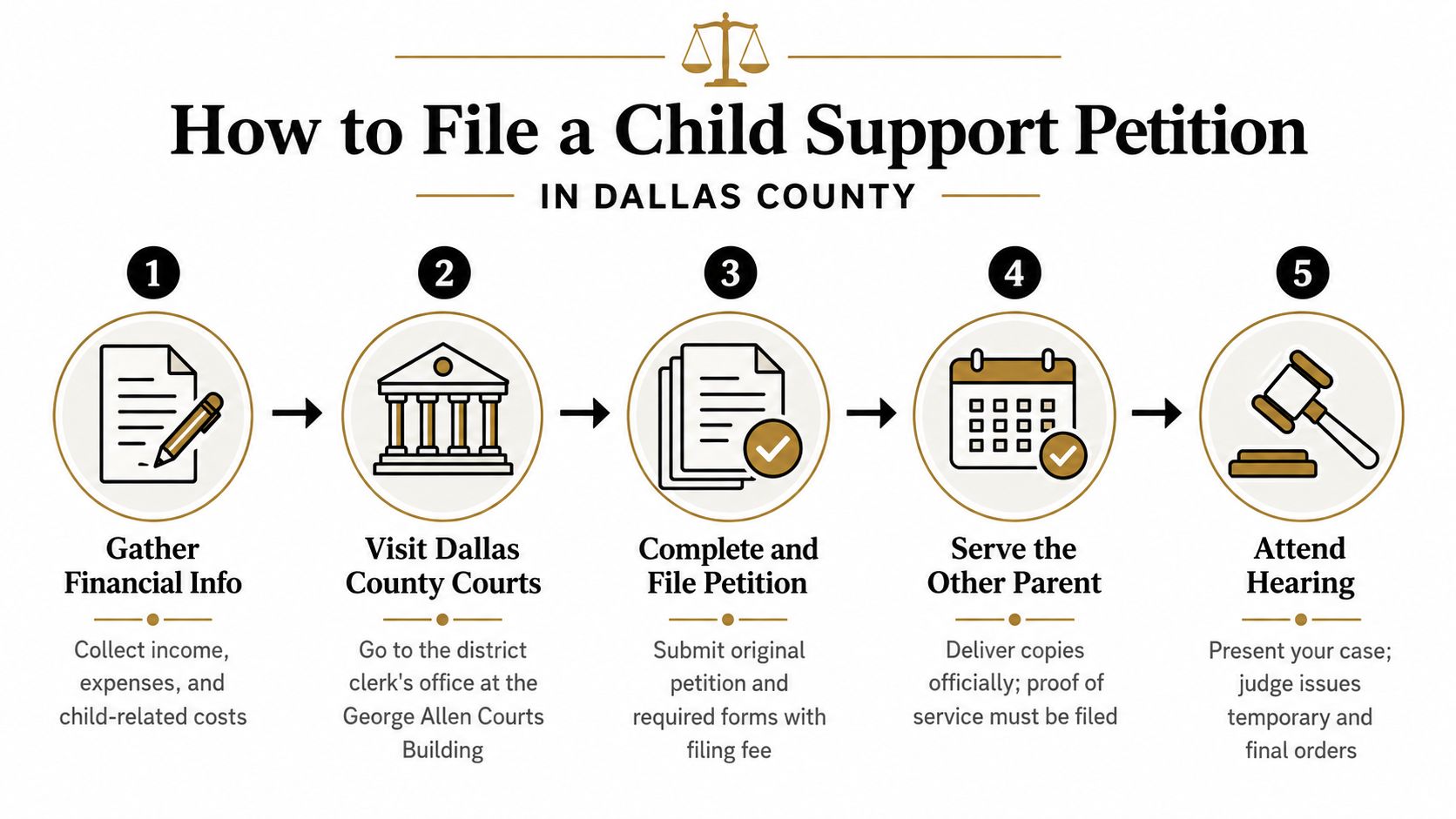
The next step is what many parents underestimate, the paperwork has to tell a coherent financial story. That includes income information, prior order details if there is one, and whatever evidence supports the amount you're asking the court to set. A parent who files cleanly, serves properly, and brings organized financial information usually gets to a hearing faster than someone who submits incomplete forms and tries to fix service later.
Texas Supreme Court forms are commonly used for these filings, and the clerk's office can point you to the right packet. If you want to see the broader filing structure in one place, How Child Support Is Calculated in Texas is the relevant background when the dispute turns to numbers rather than just procedure.
The filing is not the hard part. The hard part is proving the court can trust the numbers you put in the petition.
What to Bring to Your Dallas County Child Support Hearing
A hearing in Dallas County goes better when your documents tell the story before you do. In a child support case, judges are watching for consistency, not drama, so organized records matter more than polished arguments. If you're asking for a new order or a change to an old one, bring the papers that show income, payments, and child-related expenses in a way the judge can verify.
A good example is a parent who has reduced work hours and needs the court to review support again. That parent should walk in with the existing order, recent pay stubs, proof of health insurance premiums for the child, childcare records, and any documentation that shows why the current amount no longer fits the circumstances. If the other parent has been inconsistent with payment, bring a payment history or bank records that show the pattern rather than relying on memory.
The Dallas County judge can ask you to swear that your financial information is accurate, and that oath is not cosmetic. If a document later contradicts what you told the court, the credibility hit can matter more than the missing form ever would have.
Here's the kind of packet that usually helps most:
- Prior orders: certified copies of any current or prior child support order.
- Income proof: recent pay stubs, tax returns, or a current income statement.
- Child costs: records for health insurance, childcare, school, or special medical needs.
- Other parent information: anything showing the other parent's income if you can lawfully obtain it.
- Expense support: invoices, enrollment letters, or physician statements when you're asking for extra amounts based on special needs.
If your evidence feels thin, that's usually the warning sign to slow down and fix the record before court, not after. The general evidence checklist in Evidence Needed for a Child Support Case in Texas fits that approach, and it's especially useful if you're trying to figure out what the judge will care about.
The video below is helpful for visualizing the hearing rhythm and the document flow.
How Dallas County Judges Calculate Child Support Payments
Texas child support starts with Texas Family Code §154.125, which gives the percentage formula the judge applies to the paying parent's net resources. The percentages are straightforward, 20% for one child, 25% for two, 30% for three, 35% for four, 40% for five, and not less than 40% for six or more children. In Dallas County, the judge doesn't invent a different formula, the court applies the Texas statute to the facts in front of it.
The first task is figuring out net resources. That means the court looks at gross income and subtracts mandatory items such as federal taxes, Social Security, Medicare, union dues, and the parent's own health insurance premiums for the child. Once the court has that number, the guideline percentage applies up to the monthly cap, unless a deviation is proven under §154.123.
The current cap is the key change many parents miss. Effective September 1, 2025, the monthly net-resource cap is $11,700, replacing the prior $9,200 ceiling. At that cap, the guideline amount for one child is $2,340, for two children $2,925, and for three children $3,510. Those figures come straight from the statutory percentage formula applied to the cap.
| Texas Child Support Guideline Table | Guideline Percentage | Monthly Support at Cap |
|---|---|---|
| One child | 20% | $2,340 |
| Two children | 25% | $2,925 |
| Three children | 30% | $3,510 |
A simple example makes the math easier. If a parent's net resources are at the cap and there's one child, the court starts at 20% of $11,700, which is $2,340. With two children, the percentage rises to 25%, and with three children it reaches 30%, which produces $3,510 at the cap. That's why parents with higher incomes often need a careful calculation, not a guess.
Under §154.123, the court can deviate from the guideline amount if evidence rebuts the presumption that the guideline number is in the child's best interest. The statute points to factors like the child's age and needs, the parents' ability to contribute, work-related childcare costs, education expenses, and travel costs for visitation. So the guideline amount is the starting point, but a judge can move off it when the evidence justifies it.
If you're trying to understand how those calculations work on paper, the formula itself is easier to follow than most parents expect. The harder part is proving the right income number, especially when the paying parent's compensation changes or includes nontraditional income.
Modifying and Enforcing Child Support Orders in Dallas County
A child support order can change, but only if the legal standard is met. Under Texas Family Code §156.401, the court may modify support when there's a material and substantial change in the circumstances of the child or a person affected by the order, or when at least three years have passed since the order was rendered or last modified and the guideline amount would differ from the current order by 20% or $100. That's the threshold Dallas County judges use before they even recalculate the amount.
A job loss is the clearest example of a material change, but it's not the only one. A major raise, a shift into self-employment, increased medical needs for the child, or a significant change in parenting-time logistics can also support a modification request if the facts are documented. The court is not looking for a minor annoyance, it wants a change that alters the economics of the order.
Practical insight: if the facts changed but you never filed, the old order usually keeps controlling until a new order is signed.
Enforcement works differently. If the other parent isn't paying, Dallas County cases can move through the statewide enforcement system run with the Texas Office of the Attorney General. The agency reported $4,450.0 million in Title IV-D child support collections for FY2022, and the state's enforcement tools include wage withholding, liens, license suspensions, and contempt proceedings (Texas Office of the Attorney General FY2022 budget materials).
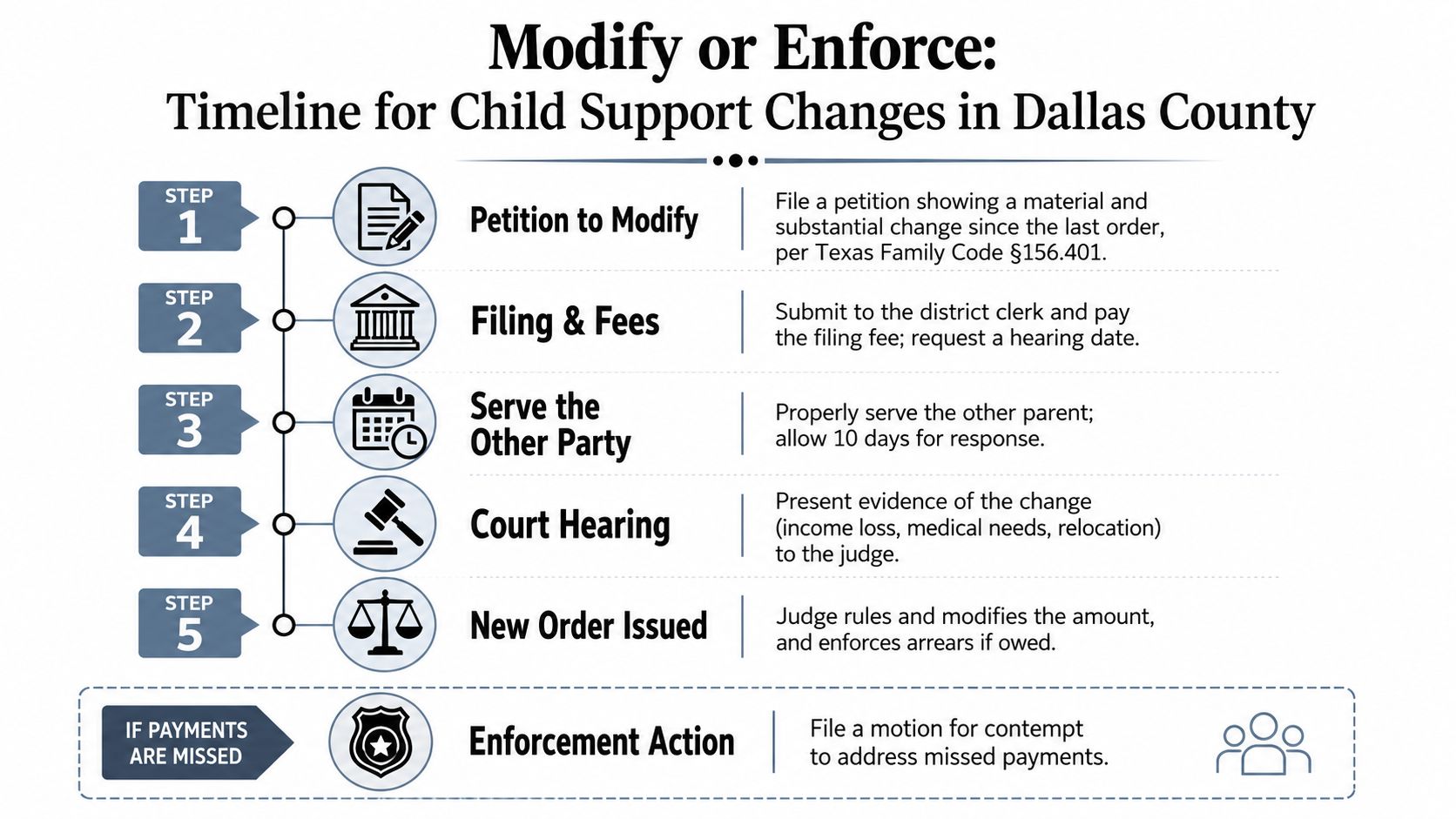
The procedural path is usually direct. You file the modification or enforcement motion, serve the other parent, exchange the financial information the court will need, and then present the evidence at hearing. If you're trying to enforce arrears, the court can use contempt and withholding tools to address missed payments, while a modification case focuses on whether the amount should change going forward.
For parents who need a plain step list, the modification process in Dallas County is usually easier to manage when the paperwork is organized before the filing date, not after. That's true whether the issue is lower income, higher expenses, or unpaid support.
Common Dallas County Child Support Disputes and How They Play Out
The first recurring dispute is 50/50 custody. Many parents assume equal possession means no support, but Texas doesn't treat equal time as an automatic zero on the guideline calculation. The court still starts with the paying parent's net resources, then considers whether the actual expense allocation justifies a different result under the deviation rules.
The second issue is retroactive support. In some cases, a parent can seek support going back years if support wasn't previously requested through the Attorney General's office, but the court still looks carefully at timing, need, and the evidence supporting the request. Retroactive claims are fact-sensitive, which is why a clean timeline matters more than a general complaint.
The third issue comes from the September 2025 cap change. Parents with higher income often expect the old ceiling to control, but cases tied to orders effective on or after September 1, 2025 use the $11,700 cap for guideline calculations. That can materially affect a modification analysis, especially when the old order was built around the prior $9,200 ceiling.
| Dispute Type | What the Court Looks At | Common Outcome |
|---|---|---|
| 50/50 possession | Net resources, actual expense split, deviation evidence | Support may still be ordered |
| Retroactive support | Timing, prior request history, proof of need | Back support may be limited by the facts |
| High-income cap dispute | Updated cap, net resources, deviation factors | Guideline amount may change after modification |
Each of these disputes turns on proof, not assumptions. A 50/50 schedule doesn't automatically erase support, retroactive claims depend on timing and records, and high-income cases often rise or fall on whether the financial evidence is detailed enough to support a modification or deviation request. The parents who do best are usually the ones who stop arguing the principle and start proving the numbers.
If the dispute is about the amount, the court wants math. If the dispute is about enforcement, the court wants records.
When to Hire a Dallas County Child Support Attorney
Self-representation can work when the numbers are clean and both parents agree on the basic facts. It gets risky the moment income is disputed, one parent has irregular earnings, a modification depends on the three-year rule, or the case involves a high earner whose resources exceed the guideline cap. Those are the cases where small mistakes create expensive delays.
A Dallas County child support attorney adds value in three ways. First, the lawyer knows how the Family District Court bench tends to handle deviations under §154.123. Second, the lawyer understands the local filing and service details that can slow a case if they're handled carelessly. Third, the lawyer can organize financial evidence into a format the judge can follow quickly.
That's especially useful in cases involving retroactive support, wage withholding disputes, arrears, or major income changes. The firm's Dallas child support work includes net-resource calculations, guideline-cap issues, and courtroom advocacy for parents who need structure before stepping into court. The Texas Child Support Law Office of Bryan Fagan is one option for parents who want that kind of support from filing through hearing.
Choose representation when the facts are messy, the other side is already playing hardball, or the situation involves significant financial implications. Choose self-representation only when you can explain the numbers, prove the numbers, and live with the result if the court asks a question you didn't expect.
If you need help with a Dallas County child support filing, modification, or enforcement issue, the Texas Child Support Law Office of Bryan Fagan works with parents on net-resource calculations, court filings, and hearing preparation. Visit Texas Child Support Law Office of Bryan Fagan to get practical guidance for your case and take the next step with a clearer plan.