In Texas, court-ordered child support does not cover college expenses, and a judge can't force a parent to pay them. Child support generally ends when the child turns 18 or graduates from high school, whichever happens later, unless the parents signed a separate written agreement that makes college funding legally enforceable.
That answer usually lands at the worst possible moment. A child gets accepted to college, everyone is proud, and then the practical question hits: who is paying tuition, housing, books, and everything else? Many divorced parents assume the existing child support order will continue, or that a court can extend support because college is expensive. In Texas, that assumption creates problems fast.
The primary issue in child support and college expenses Texas cases is the difference between statutory support and a contractual promise. One is created and limited by the Texas Family Code. The other exists because the parents chose to create it, usually in a divorce decree, mediated settlement agreement, or later written contract. That distinction controls strategy.
If you're planning ahead, the goal is to negotiate terms a court can enforce. If you're already in a dispute, the first step is figuring out whether you have a true college support agreement or only an informal understanding that won't hold up in court.
The Reality of College Costs and Texas Child Support
A lot of parents arrive at this issue thinking in practical terms, not legal ones. Their child has done the hard part, applied, been accepted, and is ready to move forward. The parents then look at the divorce decree and expect to find a clear answer. Often, it isn't there.
Texas law separates ordinary child support from post-secondary education expenses. That means the monthly support order that helped cover housing, food, and health care during high school doesn't automatically become a college funding order when the child enrolls after graduation. If the decree is silent, silence matters.
Why parents get tripped up
The confusion usually comes from two places:
- Support feels ongoing: Parents naturally think support should continue while a child is still financially dependent.
- College feels like a need: From a family perspective, it may be. From a Texas statutory standpoint, that doesn't mean a judge can order it as routine child support.
That difference is why so many preventable disputes start late. One parent assumes contribution is obvious. The other parent assumes the legal duty ended with high school. By the time tuition deadlines arrive, both sides are arguing from different rules.
Practical rule: If college support matters to your family, treat it as a contract issue early, not as something a court will fix later under a standard child support order.
The strategic question to ask now
Don't start with, "Can the judge make my ex pay?" Start with, "Do we already have a binding written agreement, and if not, how do we create one?" That shift changes the entire approach.
A workable plan usually includes identifying exactly which expenses matter, deciding whether parents will share them equally or unequally, and putting those obligations in writing with terms detailed enough to enforce. Vague promises cause more litigation than they prevent.
The Bright-Line Rule Under the Texas Family Code
Texas is a bright-line state on this issue. The starting point is Texas Family Code §154.002, which ends the ordinary child support obligation at a defined legal point. Once you understand that statute, you stop wasting time on arguments Texas courts don't have authority to grant.
Under the Texas Family Code, specifically Section 154.002, court-ordered child support obligations legally terminate when a child reaches the age of 18 or graduates from high school, whichever event occurs later, with no statutory mandate requiring parents to fund college expenses. Unlike states such as New Jersey, Illinois, or Washington where courts possess independent authority to order parental contributions for post-secondary education, Texas courts lack the statutory power to compel a parent to pay for tuition, housing, or textbooks unless the parents have voluntarily entered into a separate, written binding agreement. Texas college support discussion
That rule matters because family courts only have the power the statute gives them. Judges can't create a new post-secondary support duty just because college is expensive or because one parent has the ability to contribute. If the legal authority isn't in the Family Code, the court doesn't get to improvise.
What §154.002 means in real life
If your order says standard child support and nothing more, the support obligation ends at the later of those two events under §154.002. It doesn't roll forward because the child is moving into a dorm, taking freshman classes, or still dependent on a parent financially.
That doesn't mean college funding is impossible. It means the path is different.
A Texas court can enforce a valid written promise between parents. It just can't impose that promise on its own as if it were mandatory statutory support. Parents often miss that distinction and spend money litigating the wrong issue.
How this differs from guideline support
Routine support is calculated under the guideline structure. If you want a quick breakdown of the Texas guideline formula and how net resources affect the amount, How Child Support Is Calculated in Texas gives the basic framework. But that formula answers the monthly support question, not the college funding question.
Here is the practical dividing line:
| Issue | Texas legal source | Court can order it without agreement |
|---|---|---|
| Ongoing child support for a minor child | Family Code child support statutes | Yes |
| College tuition, housing, books after majority | Separate written agreement | No |
A judge can enforce the law that exists. A judge can't fill in a missing college clause because it seems fair.
Clients often ask whether a court can "extend" support if the child is still in school. In Texas, for college, that's the wrong framing. Extension suggests the same legal obligation continues. It doesn't. A post-secondary obligation has to stand on its own written terms.
Negotiating an Enforceable College Support Agreement
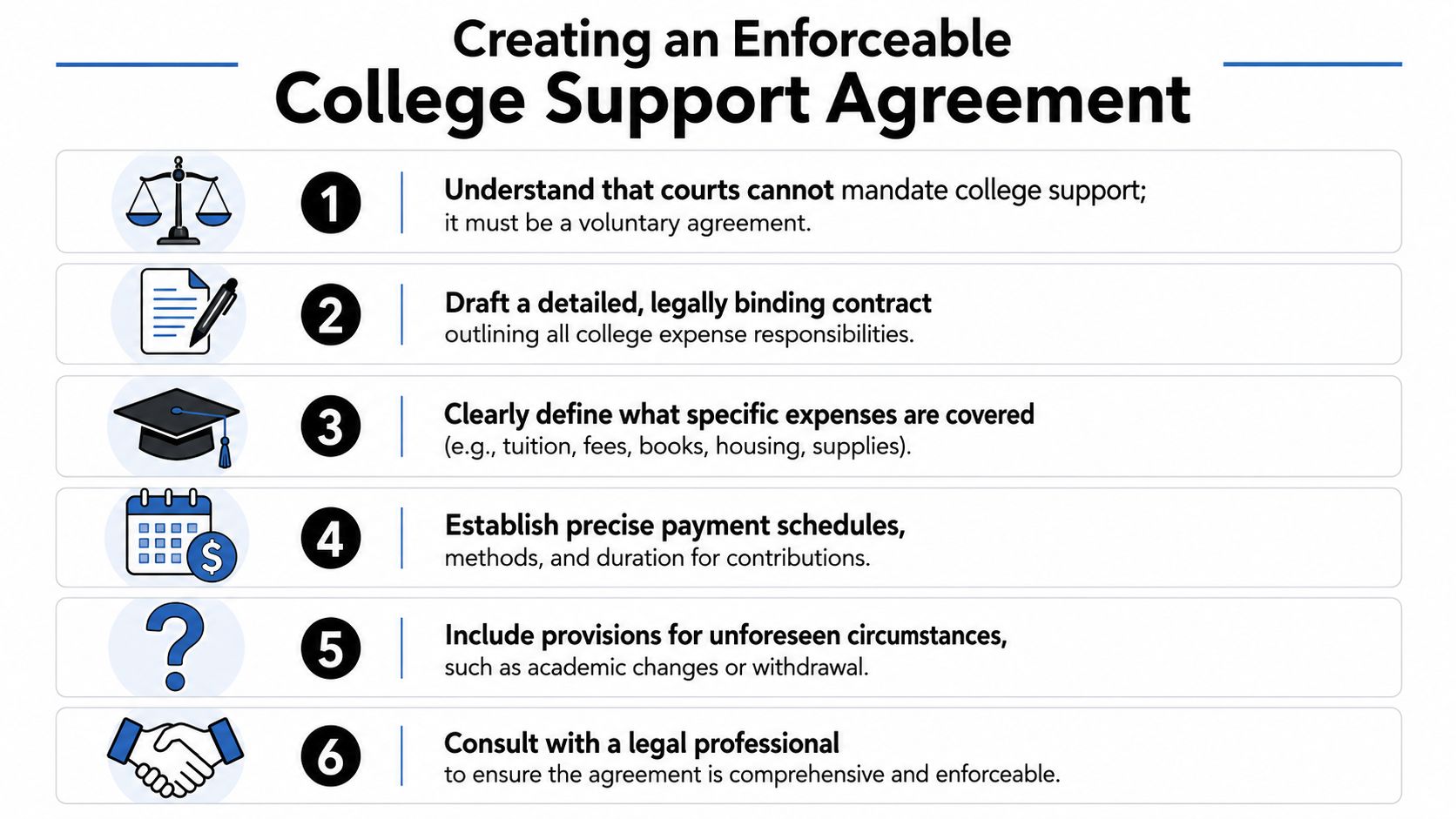
If you want college expenses covered, the answer is drafting. Not hoping. Not relying on a hallway promise after mediation. Not assuming everyone will stay cooperative when invoices arrive.
Texas courts will enforce voluntary agreements for college expenses as contracts. They won't create them for you. As one Texas family law discussion explains, courts enforce marital settlement agreements or post-nuptial contracts that allocate college expenses because the obligation comes from the parties' agreement, not from the Family Code's child support provisions. Texas divorce college expense agreements
A strong agreement starts with detail.
What the agreement should say
You need more than "each parent will help with college." That sentence creates arguments, not clarity. A usable agreement usually addresses these points:
- Covered expenses: State whether the obligation includes tuition, mandatory fees, books, housing, meal plans, transportation, supplies, or other defined costs.
- Allocation formula: Decide who pays what share. Some families choose equal responsibility. Others tie each parent's share to income or assign specific categories to each parent.
- Payment mechanics: Say whether payment goes directly to the school, to the other parent, or to the child after proof of the charge.
- Duration: Define how long the duty lasts, such as a set period of enrollment, a degree track, or another clearly stated endpoint.
- Academic conditions: Require enrollment status, grade reporting, or minimum performance if that matters to both parents.
- Default and remedies: Spell out late-payment consequences, notice requirements, and what happens if one parent advances the other's share.
Terms that usually work better than vague language
The strongest provisions answer future disputes before they happen. A few examples of useful drafting choices:
- Limit school choice carefully: A cap tied to a defined benchmark can prevent one parent from being forced into an open-ended expense.
- Address scholarships and aid: Decide whether grants reduce both parents' shares before any out-of-pocket payment is calculated.
- Plan for interruptions: Withdrawals, transfers, gap semesters, and part-time enrollment should all be covered.
For parents trying to structure settlement terms, guidance on whether child support can be negotiated in Texas is useful because it frames where negotiated terms fit and where statutory limits still control.
This visual lays out the drafting logic clearly.
What doesn't work
Verbal promises don't age well. Neither do texts that say, "We'll figure it out later."
If the agreement doesn't identify the expense, the payment method, and the triggering conditions, enforcement gets much harder.
The families who avoid expensive post-divorce litigation usually do one thing right. They reduce the college issue to precise contract terms before the child starts school.
Child Support Calculations and High-Income Considerations
A parent with a strong income often walks into mediation assuming one of two things: the regular child support number will cover college later, or a judge can order college payments because the parent can afford them. In Texas, both assumptions create problems.
Texas child support and college funding run on different tracks. Guideline support is a statutory duty tied to a child's current support needs while the child is a minor, or otherwise entitled to support under the Family Code. A promise to pay tuition, housing, books, or fees after high school is usually enforceable only if the parents put that promise into a binding agreement. That distinction matters even more in high-income cases, where parties have the ability to fund college but the court's power still has limits.
How courts calculate the base amount
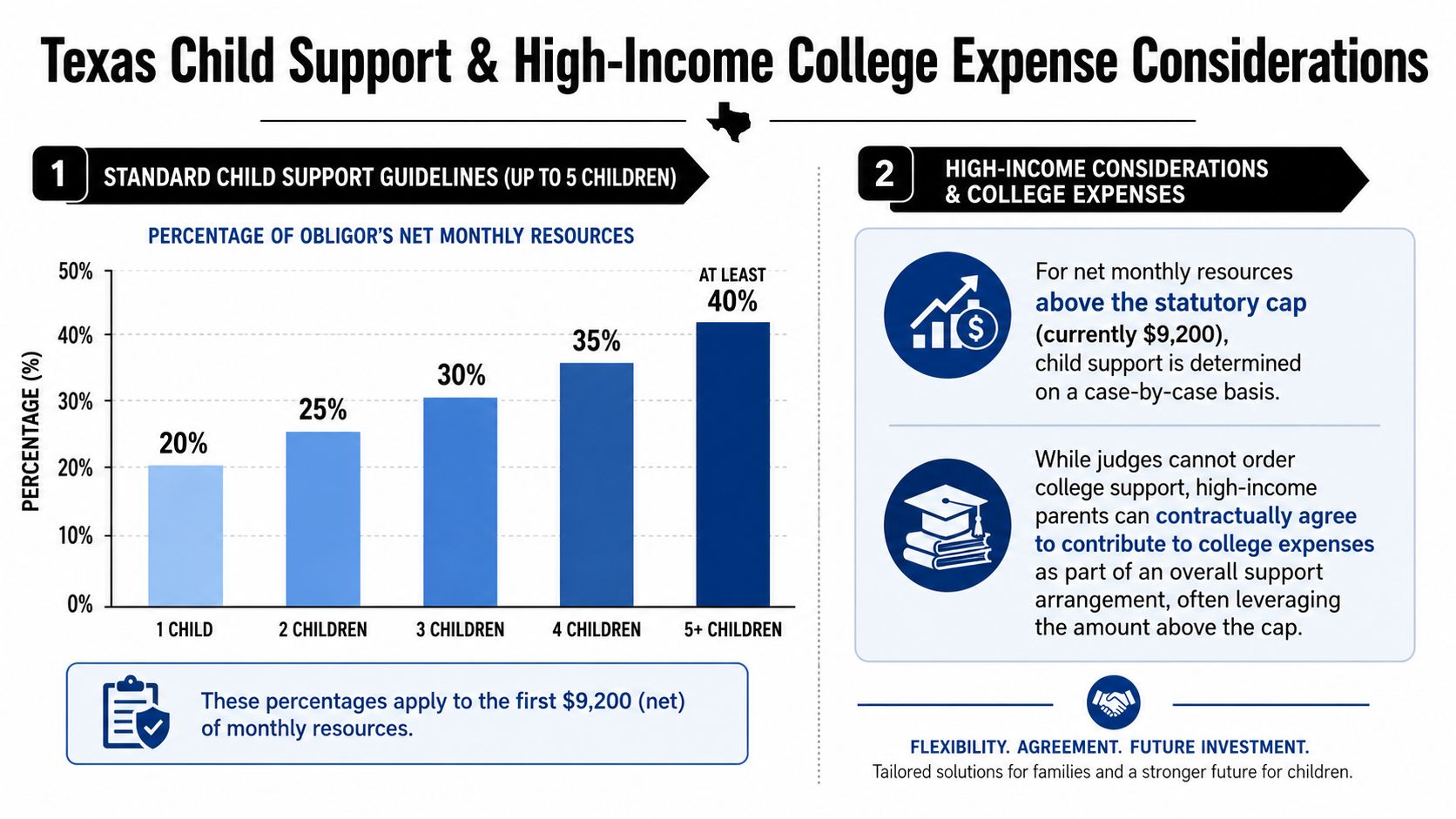
Texas courts start with the obligor's net resources and apply the guideline percentage assigned to the number of children before the court. For one child, the guideline is 20 percent. For two children, it is 25 percent. The calculation itself is usually the easy part.
The harder fight is whether the court should go above the guideline amount, especially when the obligor's income exceeds the statutory cap on monthly net resources used for the standard calculation. Above that level, the court does not automatically keep applying the same percentage to all additional income. The parent asking for more support must prove the child has proven needs that justify an above-guideline award under the Family Code.
That is a present-needs analysis. It is not a back door to force future college funding.
Why high-income cases require a different strategy
High-income parents often waste time arguing past each other. One parent treats the statutory cap as a complete shield. The other treats substantial income as automatic authority for the court to require tuition support later. Neither position reflects how these cases are decided.
A court can consider factors that may justify a deviation from the guidelines, including education-related expenses for the child while support is still legally owed. But that does not convert ordinary child support into a standing college fund. The practical point is simple. If the goal is to secure money for college after the child ages out of support, the safer path is a written agreement with specific terms, not an argument that guideline child support should somehow expand to cover future tuition.
For parents dealing with income above the guideline threshold, this overview of high-income child support in Texas gives useful context on how courts treat above-cap earnings and additional-needs claims.
A practical way to frame settlement positions
In settlement talks, I usually separate these issues early because combining them creates drafting mistakes.
- Issue one: current child support. Calculate guideline support, then evaluate whether the evidence supports more based on the child's proven needs.
- Issue two: college funding. Negotiate it as a contract with clear triggers, limits, documentation requirements, and payment mechanics.
That separation protects both sides. The parent paying support avoids an open-ended argument that every future education expense should be folded into monthly support. The parent seeking college contributions gets something much more valuable than a vague expectation. A binding obligation that can be enforced on its own terms.
Example from a one-child case
Assume one child, substantial parental income, and a teenager who plans to attend a four-year university. The court can set child support based on the statutory framework for current support. If a parent wants more than the guideline amount, that parent needs evidence of the child's actual needs now.
If the parents also want college covered, they should address that separately in the settlement documents. The agreement might allocate tuition and mandatory fees by percentage, cap housing at a defined amount, require the child to maintain a stated GPA, and specify how scholarships are credited before either parent pays. That structure gives the court something concrete to enforce later. A bare request for "extra support because college is coming" usually does not.
Case strategy: Treat court-ordered child support and college funding as separate obligations. Litigate support under the Family Code. Draft college payments as a precise contractual commitment if you want them to survive beyond the normal end of support.
Enforcing or Modifying a College Support Agreement
Once a parent signs a valid college expense agreement, the central question becomes enforcement. At this stage, many people use the wrong procedure.
A standard child support enforcement case is built around violation of a court-ordered child support duty. A college support dispute is usually different because the enforceable right comes from a contract. That changes the pleading, the evidence, and often the remedies you pursue.

Enforcement is not the same lawsuit
If a parent fails to pay guideline child support, the usual path is an enforcement action in the family court handling the support order. If a parent fails to pay a contractual college obligation, the remedy often looks more like a breach of contract claim based on the written agreement incorporated into or related to the decree.
That distinction matters because the court will want to know exactly what was promised, when payment became due, and how the other party failed to perform. Judges don't enforce broad expectations. They enforce written terms.
| Issue | Child support order | College expense agreement |
|---|---|---|
| Legal basis | Statutory duty | Contractual duty |
| Key question | Was ordered support paid | Was the agreement breached |
| Core evidence | Payment record and order | Signed agreement, invoices, proof of breach |
Modification works differently too
Regular child support can be modified when the legal standard for modification is met. Contract obligations don't work that way unless the agreement itself allows for future adjustment or both parties consent to change it in writing.
That's why drafting matters so much on the front end. If parents want flexibility for changed finances, school transfers, medical crises, or scholarship offsets, they should build those contingencies into the contract. If they don't, a court may enforce the agreement as written even when the result feels harsh.
A college support agreement should be drafted as if enforcement will happen, not as if cooperation will last forever.
Before filing anything, review the exact language in the decree, settlement agreement, or later contract. One phrase can determine whether you have a clear payment obligation or a vague statement of intent.
Pleading and Evidence Strategy for Texas Courts
Prepared cases usually win the credibility battle before the hearing starts. In Harris, Dallas, Travis, Tarrant, and other Texas counties, judges expect the pleadings to identify the legal theory cleanly and the exhibits to line up with the agreement.
What to plead
If you're enforcing a college expense agreement, the petition should do several things clearly:
- Attach the operative document: Include the signed decree, settlement agreement, or later written contract that created the college obligation.
- State the specific breach: Identify the expense, the due date, the amount demanded under the contract terms, and the failure to pay.
- Request defined relief: Ask for the unpaid amount owed under the agreement and any other contract-based remedies supported by the pleadings.
If your case also involves ordinary support issues, keep the causes of action distinct. Mixing statutory enforcement with contract allegations in a vague way makes hearings harder than they need to be.
What evidence moves the case
Judges don't want a family history. They want proof tied to contract language. Bring organized evidence that answers each required point.
- The signed agreement: This is the anchor exhibit. If the duty isn't in writing, the case gets much harder immediately.
- School billing records: Tuition statements, fee summaries, bookstore charges, and housing invoices show the expense exists.
- Proof of payment or nonpayment: Canceled checks, account statements, and payment receipts establish what each parent did or didn't do.
- Academic records if required by the contract: If payment depends on enrollment or GPA, bring official records showing compliance.
- Demand communications: Emails or letters requesting payment can help prove notice and timing.
For parents preparing a file, evidence needed for a child support case in Texas is a useful practical checklist because many of the same habits apply. Organize documents, match each exhibit to an element you must prove, and don't assume the judge will infer missing facts.
Courtroom preparation is often the difference between "we had an agreement" and "we proved the breach."
Service, hearing settings, and local filing rules still matter. A strong claim can stall if service is defective or exhibits are incomplete. Procedure isn't a technicality. It's part of the proof.
Frequently Asked Questions About College Costs
Can I use a 529 plan to satisfy my obligation
Only if the agreement says you can.
I see this dispute often. One parent assumes a 529 distribution counts toward that parent's share. The other parent says the contract requires direct payment of tuition, housing, or books. The answer usually turns on the exact verbs in the agreement. Terms like "pay," "contribute," "fund," and "reimburse" can lead to different results in court.
If parents want 529 funds to count, the agreement should say who controls the account, what expenses qualify, when distributions must be made, and whether a distribution reduces that parent's future obligation.
What if my child stops attending college or their grades fall
The written agreement controls. That is the practical answer.
A well-drafted provision usually ties payment to measurable conditions such as full-time enrollment, minimum academic standing, deadlines for providing grade reports, or limits on the number of covered semesters. If those conditions are missing, a parent may still be bound to pay because Texas courts enforce the deal the parties made, not the deal one parent later wishes they had written.
This is why college funding terms should read like a contract, not a promise made during mediation to keep the peace.
Can an agreement cover trade school or vocational programs
Yes, and many parents should consider it.
If the goal is to help a child launch into adult life, limiting the agreement to a four-year university can create an avoidable fight later. I often recommend defining covered education broadly enough to include accredited trade schools, community colleges, technical programs, and licensing programs, then setting cost limits so the obligation stays predictable.
Flexibility matters. So do guardrails.
We're on good terms. Do we really need a formal written agreement
Yes.
Texas child support has a bright stopping point under the Family Code. A college expense promise does not become enforceable just because both parents discussed it, intended it, or repeated it for years. If you want a duty that survives conflict, remarriage, job loss, or a change in relationships, put it in a signed written agreement with specific terms.
Good intentions help families cooperate. Clear drafting helps them avoid court.
Does ordinary child support already account for education
Ordinary child support and college funding are different obligations.
As noted earlier, guideline child support is calculated under the Texas Family Code and is aimed at supporting the child while support is legally due. It does not automatically create a duty to pay post-secondary tuition, room and board, fees, or books after the statutory support obligation ends. Parents who want that result need a separate enforceable agreement.
That difference is the strategic point for settlement. Court-ordered child support ends. A contract to fund college can continue, if it is written clearly enough to enforce.
What are the basic court steps if support or an agreement is disputed
Start by identifying the claim correctly.
If the dispute involves ordinary child support, the case usually proceeds under the Family Code through enforcement or modification procedures. If the dispute involves college expenses promised in a decree, mediated settlement agreement, or separate contract, the court will focus on the wording of that agreement, whether the triggering conditions occurred, and whether one parent failed to perform.
That distinction affects everything. Pleadings, evidence, defenses, and remedies all change depending on whether you are enforcing a statutory child support duty or a contractual college funding duty.
If you're dealing with child support and college expenses in Texas, the useful first move is to review the decree and identify whether you're working with a statutory support issue, a contract issue, or both. Texas Child Support Law Office of Bryan Fagan handles establishment, modification, enforcement, and high-income child support matters under the Texas Family Code, including disputes involving guideline calculations, deviations, and the updated net resource cap.