If you're reading this, you're probably in one of two positions. You've been covering your child's housing, food, school costs, and medical needs without consistent help from the other parent, or you have a court order already and the payments never arrived the way they should have.
Texas law gives you tools in both situations, but the first question is always the same: Are you asking for retroactive child support, or are you trying to collect arrears? Those are not the same claim, and treating them like they are is where many cases go off track. In child support back pay Texas cases, getting the label right changes the pleading you file, the proof you need, and the defenses you'll face in court.
Understanding Retroactive Child Support Versus Arrears
A common situation looks like this. Parents separate. No child support order gets entered. One parent becomes the day-to-day caregiver and pays for everything while the other parent contributes little or nothing. Years later, the caregiver finally decides to file.
That parent usually says, “I need back child support.” Fair enough in everyday language. In court, though, Texas law splits that idea into two very different categories.

Retroactive support means no prior order existed
Retroactive child support applies to a period before a court entered a support order. The legal basis appears in Texas Family Code § 154.009. This is the claim you raise when there was no order in place, but the other parent should have been helping support the child.
Judges don't award retroactive support just because one parent asks for it. They look at parentage, prior support, the history between the parties, and the paying parent's financial ability during the relevant period. If paternity hasn't been established yet, that issue has to be handled first or alongside the support claim.
Arrears means an order existed and payments were missed
Arrears are unpaid amounts owed under an existing child support order. Once a judge signs an order, each missed payment becomes enforceable debt. That debt doesn't disappear because the child got older, the obligor changed jobs, or the parent assumed informal arrangements were “good enough.”
Practical rule: Before you file anything, identify the date the first enforceable support order began. That single date usually determines whether you're litigating retroactive support, arrears, or both.
Texas families are dealing with this on a massive scale. As of April 2025, Texas parents owe about $19 billion in unpaid child support arrears, the largest total backlog in the country, and those arrears remain legally binding until paid, according to Texas child support arrears data summarized here.
Why this distinction matters in court
The difference affects almost everything:
- Your pleading: A suit to establish support isn't the same as an enforcement action.
- Your proof: Retroactive support focuses on historical income and whether support should have existed. Arrears focuses on the order, payment record, and balance due.
- Your remedies: Enforcement tools under Chapter 157 of the Family Code apply when an existing order has been violated.
- Your defenses: Informal payments may matter differently depending on whether you're proving prior support versus noncompliance with an order.
When clients ask about child support back pay Texas rules, I begin by explaining this distinction. If you don't sort out retroactive support versus arrears at the beginning, you can spend time and money pursuing the wrong remedy.
Eligibility for Retroactive Support The Four-Year Rule
The starting point is Texas Family Code § 154.009. That statute allows a court to order retroactive child support, but it builds in a strong presumption about how far back the court should go.
The general rule is four years. A court may exceed that period only if the noncustodial parent intentionally avoided the duty to support the child, as explained in this discussion of Texas Family Code § 154.009 and retroactive support limits.
What the four-year rule looks like in real life
Suppose you file in 2026 and there has never been a support order. The court will usually treat the prior four years as the reasonable retroactive period. That doesn't mean you're automatically awarded the full amount for those years. It means that's the presumptive lookback period the judge starts from.
If you're trying to understand older claims, this guide on how far back child support can be enforced in Texas helps frame the timing issues.
What you still have to prove
The four-year rule isn't a blank check. Judges still look at the facts. In practice, these issues matter most:
- Knowledge of parentage: The court will want to know whether the other parent knew, or reasonably should have known, the child was theirs.
- Financial ability: You need evidence that the parent had the ability to pay support during the period you're targeting.
- Prior support history: If the parent made direct payments or covered certain expenses, the court may consider that.
- Delay by the requesting parent: Waiting years to file can create proof problems and can affect how a judge views fairness.
The parent asking for retroactive support needs evidence, not frustration. Judges award money on records, dates, and credible testimony.
When courts go beyond four years
You can ask for more than four years, but the exception is narrow. The key phrase is intentional avoidance. That usually means more than passivity or bad communication. You need facts showing the other parent actively avoided the obligation, such as concealing whereabouts, evading legal proceedings, or hiding income in a way tied to support avoidance.
That is a high bar. Courts don't infer intentional avoidance lightly.
A related enforcement framework appears in Enforcing Child Support Under §157.001, which addresses the legal tools available when a parent fails to pay child support. It becomes especially important once an order exists and the case shifts from establishment to enforcement.
What doesn't work well
Several approaches usually weaken these claims:
- General accusations without documents
- Relying only on text messages
- Assuming the judge will estimate income for years in the past without records
- Waiting until the hearing to organize proof
If retroactive support is on the table, build the file early. Employment records, tax returns, bank records, benefit statements, proof of residence, and communications about the child often matter more than dramatic testimony.
Calculating How Much Back Child Support Is Owed
A lot of parents use "back child support" to mean two different things. Texas law does not. If no prior child support order exists, the court is calculating retroactive support under Texas Family Code § 154.009. If an order already exists and payments were missed, the court is calculating arrears under the existing order. The math and the proof overlap, but they are not the same claim.
For retroactive support, the court usually starts with the child support guidelines in Texas Family Code § 154.125 and the parent's net resources during the months at issue. If a parent earned wages, commissions, overtime, self-employment income, or cash income, those numbers have to be reconstructed month by month or year by year. In practice, that often decides the case.
For a standard guideline case, the percentages are familiar. 20% for one child, then 5% more for each additional child, up to 40% for five or more children under § 154.125. If the facts support a different number, the court can depart from the guidelines under § 154.123, but judges want a reason tied to evidence, not a general claim that the result feels unfair.
How judges actually calculate the number
The cleanest cases involve a parent with regular payroll records. The harder cases involve self-employment, side work, cash payments, or missing tax returns. In those files, the court may have to piece income together from several sources.
Common proof includes:
- Federal tax returns
- Pay stubs
- W-2s and 1099s
- Bank statements showing deposits
- Profit and loss statements
- Business ledgers and invoices
- Employment records produced in discovery
Courts work from historical income for retroactive support. A parent's current salary may matter for current support, but it does not automatically answer what should have been paid three years ago.
The new $11,700 cap changes the math in higher-income cases
Effective September 1, 2025, Texas Family Code § 154.125(a-1) raises the monthly net resource cap used for guideline child support from $9,200 to $11,700. That matters immediately in higher-income cases.
For one child, the guideline amount at the cap changes like this:
| Metric | Old Cap (Until Aug 31, 2025) | New Cap (From Sep 1, 2025) |
|---|---|---|
| Net resource cap used for guideline calculation | $9,200 | $11,700 |
| Guideline percentage for 1 child under § 154.125 | 20% | 20% |
| Guideline amount | $1,840 | $2,340 |
| Difference | $500 higher |
That $500 monthly difference adds up fast. Over 24 months, it is $12,000. Over 48 months, it is $24,000.
The timing matters. If the dispute is about retroactive support, the court has to match the calculation to the law and facts for the period being examined. If the dispute is about arrears, the court usually enforces the amount that was already ordered, plus interest and any proper credits. For a broader explanation of the guideline formula, see how Texas child support is calculated under the current statute.
A practical example
Assume there is one child and no prior support order. The other parent had net monthly resources above the applicable cap throughout the period in question.
If the relevant period falls under the old cap, the guideline figure is $1,840 per month. If the relevant period falls under the new cap, the guideline figure is $2,340 per month.
Now add a real-world complication. Suppose the parent changed jobs twice, had one year with large bonus income, and later claimed reduced earnings after starting a closely held business. That file is not solved by plugging one number into a calculator. It requires tracing income by period and deciding whether the records are credible. That is where cases are won or lost.
Credits, disputes, and the mistakes that change the total
The final number often turns on a few recurring fights:
- Whether the income records are complete
- Whether the paying parent gets credit for direct payments
- Whether some payments were gifts instead of support
- Whether guideline support should be adjusted under § 154.123
- Whether the case involves retroactive support or arrears, because the legal framework differs
Direct payments are a common flashpoint. A parent may say, "I paid rent," "I bought diapers," or "I sent money through Cash App." Sometimes that evidence helps. Sometimes it does not. Texas courts do not automatically treat every transfer or purchase as child support credit, especially when the proof is incomplete or the payments were irregular.
My advice is simple. Bring records that show what was earned during the period the court is examining, and bring proof of any payments you want credited. Judges can work with imperfect records, but they punish vague math.
The Legal Process From Filing a Petition to Court Order
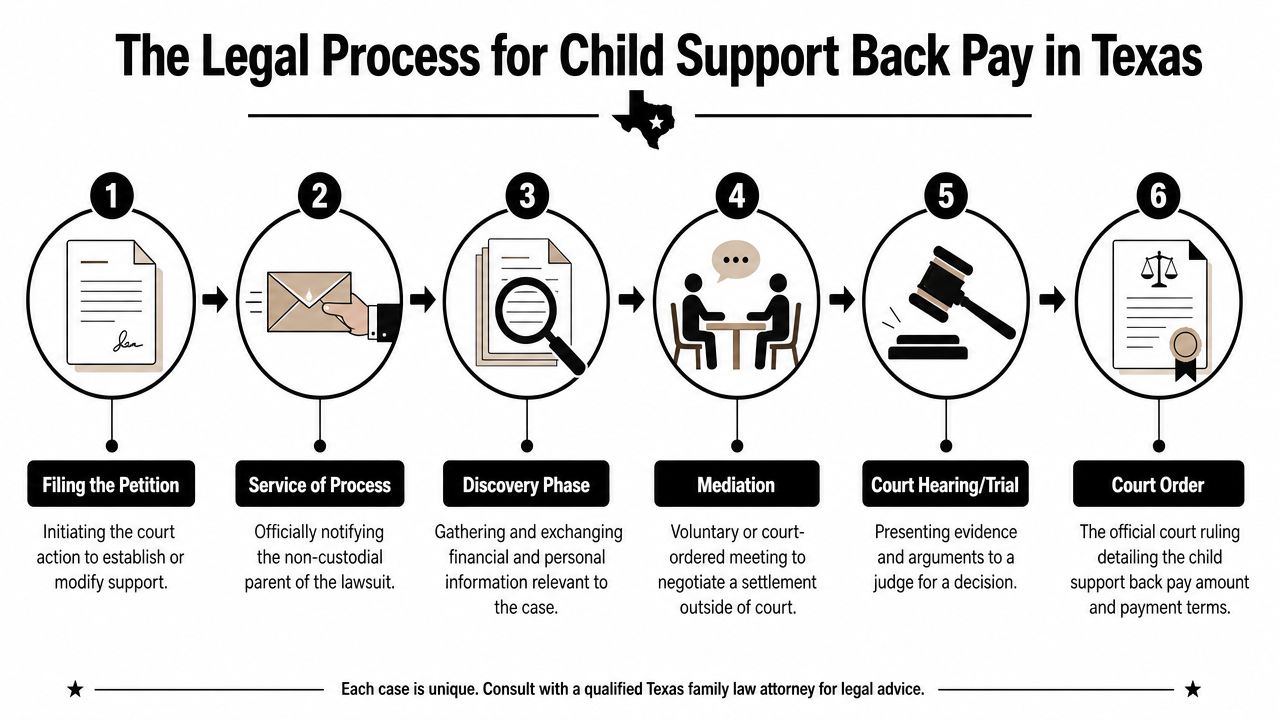
The process feels less intimidating when you break it into stages. Most child support back pay Texas cases follow a sequence, but the exact pleading depends on whether you're establishing support, enforcing an existing order, or doing both.
Early in the case, the paperwork matters as much as the hearing. Filing the wrong petition can slow down relief and give the other side room to object.
Filing and service
If no order exists, the case often begins with a petition affecting the parent-child relationship or a petition to establish parentage and support. The pleading needs to request the right relief, including retroactive support if appropriate.
After filing, the other parent must be formally served unless service is properly waived. Service isn't a technical side issue. If service is defective, the court can lose momentum or refuse to proceed.
Discovery and temporary issues
Once the case is on file, discovery begins. During this phase, attorneys request financial records, employment information, tax documents, health insurance information, and other materials needed to prove income and support history.
Common discovery tools include:
- Requests for disclosure
- Interrogatories
- Requests for production
- Subpoenas to employers or banks when needed
Mediation may happen before trial, either voluntarily or because the court orders it. If the case can be resolved, mediation can save time and narrow disputes over dates, credits, and calculation method.
This overview is useful before you watch the next step unfold in practice.
Hearings and the final order
Temporary hearings can address immediate issues, but final relief usually comes at trial or by agreement. At the final hearing, the judge wants organized proof. That means a clear payment history, income evidence, exhibits tied to dates, and a proposed calculation the court can follow.
Expect the judge to focus on:
- When the duty to support should have been recognized
- What the obligor's net resources were
- Whether any credits apply
- Whether guideline support should control
- What enforcement language belongs in the final order
Court is easier when the story and the spreadsheet match. If your testimony says one thing and your exhibits say another, the exhibits usually win.
A good final order needs more than a dollar figure. It should address payment terms, withholding if appropriate, medical support issues when relevant, and language precise enough to enforce later if payments stop.
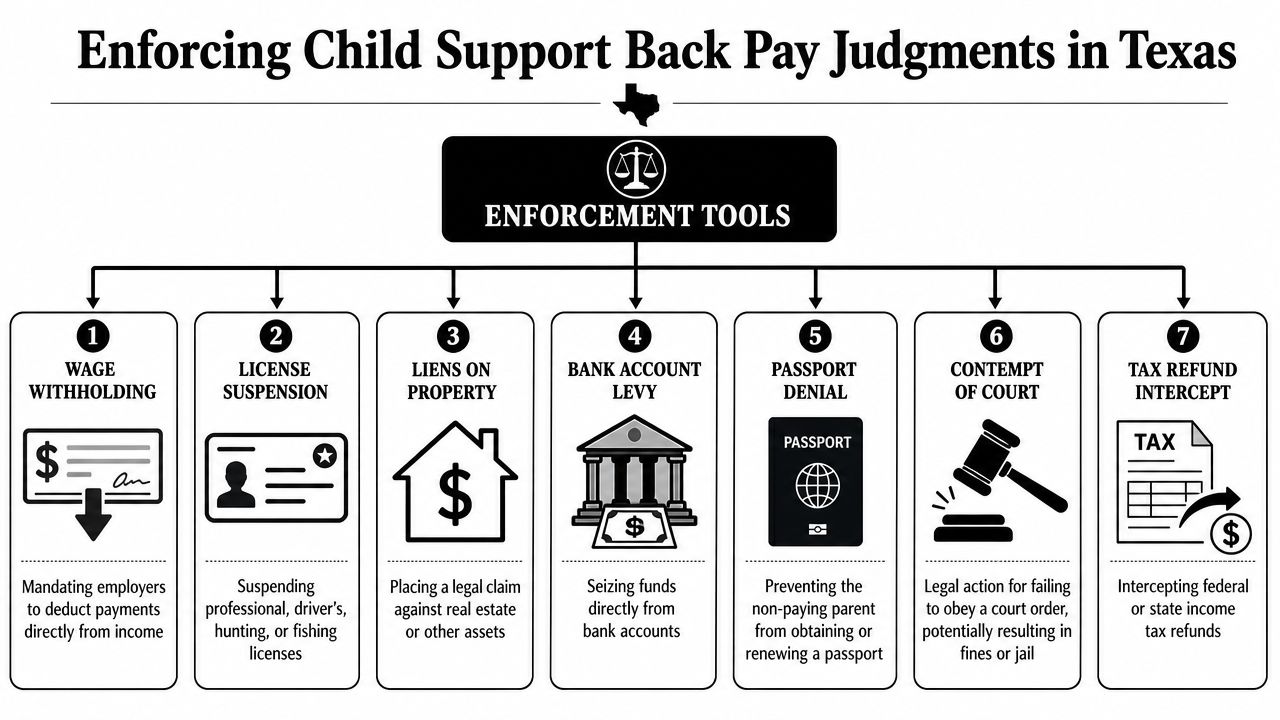
Enforcement Powerful Tools for Collecting a Judgment
Winning the order is only step one. Collection is the part clients care about most, because paper doesn't buy groceries.
Texas gives the Office of the Attorney General and the courts several ways to enforce unpaid support. The most effective tool is often income withholding. According to this summary of Texas arrears enforcement tools, wage withholding accounts for over 80% of collections, and unpaid child support accrues 6% simple interest annually on delinquent amounts until confirmed as a money judgment.
The tools that usually work first
When an obligor has regular employment, withholding wages is usually the cleanest path. The money is deducted before the parent can decide whether to pay.
Other enforcement mechanisms can include:
- Liens on assets, including certain property interests
- Federal tax intercepts
- Social Security garnishment in qualifying circumstances
- Civil settlement interception
If you need a practical collection overview, how to collect back child support explains the enforcement side in more detail.
Why interest changes the conversation
The 6% simple interest rule matters because old balances become more expensive to ignore. Clients often focus on principal and forget that the unpaid portion of support keeps generating added liability under Texas law.
That affects negotiation strategy. A parent who can pay something now may be better off addressing the issue before interest increases the total further and before stronger enforcement remedies are triggered.
A delinquent support balance rarely gets easier to fix by waiting. It usually gets harder to defend and more expensive to resolve.
Stronger remedies when payment still doesn't happen
If withholding and administrative tools aren't enough, the court can step in more aggressively. Depending on the facts, the court may consider contempt remedies for willful nonpayment of an existing order. That is serious litigation. It requires precise pleading and proof, but it can move a case when softer measures have failed.
Not every case should begin with the harshest option. Good enforcement strategy usually starts with the method most likely to produce actual payment, then escalates when the other parent keeps choosing noncompliance.
Common Defenses and Why You Need an Attorney
Most retroactive support and arrears cases don't turn on one dramatic issue. They turn on a cluster of smaller disputes the other side raises to reduce the number, delay the case, or create enough confusion that the judge hesitates.
Common defenses include claims that direct cash payments were made, arguments that paternity was uncertain, disputes over historical income, and complaints about possession or access. The last one is especially common. A parent who wasn't given court-ordered time with the child may be angry, but that usually doesn't erase a support duty.
Defenses that show up often
Here are the arguments I see most often in practice:
- Informal payment claims: “I paid cash,” “I covered rent,” or “I bought what the child needed.” Some credits may matter, but unsupported claims usually don't carry much weight.
- Income minimization: Self-employed parents sometimes present incomplete records or try to frame personal spending as business expense.
- Delay attacks: The other side argues the requesting parent waited too long and can't prove what happened years ago.
- Paternity disputes: If parentage wasn't established early, this can affect timing and proof.
The answer to these defenses is usually documentation. Text messages alone rarely do the whole job. You need records, subpoenas where appropriate, and a calculation that holds up under questioning.
Why self-representation goes wrong
Retroactive support cases are procedurally strict. In 2024, Texas courts denied nearly 35% of retroactive support petitions due to procedural delays or insufficient proof of financial ability, according to this review of Texas retroactive support petition outcomes.
That statistic tracks what attorneys see in court. People often file a case that sounds right in plain English, but they don't line up the evidence with the statute. They miss service issues, fail to authenticate records, ask for more time than the law supports, or show up without a reliable income reconstruction.
What legal counsel actually changes
An attorney doesn't just “handle paperwork.” Counsel can:
- Pin down whether the claim is retroactive support, arrears, or both.
- Use § 154.125 correctly for guideline calculations and raise § 154.123 when deviation is justified.
- Obtain records through discovery instead of relying on voluntary disclosure.
- Present a court-ready damages model with dates, credits, and supporting exhibits.
- Draft an enforceable final order that can be collected later.
One available option for parents dealing with these issues is Texas Child Support Law Office of Bryan Fagan, which handles establishment, modification, enforcement, and defense of child support orders under the Texas Family Code.
If you're preparing for court, don't treat “back child support” as a single concept and hope the judge sorts it out for you. The legal difference between retroactive support and arrears controls the entire case. Texas Child Support Law Office of Bryan Fagan works with Texas parents on establishing support, calculating back pay under the Family Code, and enforcing unpaid obligations through court orders and collection tools.