A Notice of Hearing usually arrives at the worst time. You open the envelope, see a court name, a cause number, a hearing date, and your stomach drops. If the case involves child support, your next question is usually the right one: What do I need to do right now?
In Texas family court, the notice of hearing is not a courtesy reminder. It is the starting gun. It tells you that a judge may soon address child support, arrears, wage withholding, modification, or enforcement. From that moment forward, every day matters. Documents matter. Timing matters. What you do before the hearing often matters more than what you say once you're in the courtroom.
If you're dealing with child support in Texas, your response should be strategic, not emotional. Read the notice carefully. Match it to the petition or motion on file. Identify what the other side is asking for. Then start building your evidence around the Texas Family Code, especially the support guidelines in §154.125 and the deviation factors in §154.123.
You Received a Notice of Hearing What It Means
A Notice of Hearing means the court has set a date and time for a judge, associate judge, or other judicial officer to consider a request in your case. In child support litigation, that request might involve setting support, changing support, enforcing unpaid support, confirming arrears, or entering an income withholding order.
Treat it as a formal legal command to act.
A lot of parents make the same mistake. They assume the notice is only a scheduling document and that the actual fight happens later. That is wrong. Modern hearing notices are part of the due process system. They are designed to reduce surprise, ensure participation, and make decisions more reliable, as described in this discussion of notice-and-opportunity-to-be-heard protections.
What the notice is really telling you
The notice tells you more than when to appear. It tells you that the other side has moved the case into a decision phase. In practical terms, that means:
- A judge may make support-related rulings soon
- Your financial records need to be ready now
- Any service defect or scheduling problem needs to be raised quickly
- If you need a continuance, waiting will hurt you
If the case is about child support, the hearing often centers on a few predictable questions. What are the paying parent's net resources? Does the guideline amount under Texas Family Code §154.125 apply? Is there a reason to vary from guideline support under §154.123? Is there unpaid support? Should wage withholding be ordered?
Practical rule: When you receive a notice of hearing, stop thinking of the case as background stress. Start treating it as active litigation.
The first decision you need to make
Your first decision is simple. Are you preparing to proceed on the hearing date, or do you have a valid basis to ask the court for more time?
That decision should happen immediately, not the week before court. In Texas child support cases, compressed hearing schedules can leave very little room to gather payroll records, tax returns, daycare proof, insurance documents, and evidence about changed circumstances. If you received the notice and did nothing yet, start today.
Anatomy of a Texas Notice of Hearing
Most Texas notices of hearing look dry and technical. They aren't. Every line on that page carries legal significance.
What to locate on the first read
Start with the top of the document.
Look for the case caption. That identifies the parties and usually tells you whether the case is an original SAPCR, a modification, or an enforcement matter. Then find the cause number. That is the court's file number, and it must match every pleading you file.
Next, identify the court and county. Child support practice is local in important ways. The same Family Code applies statewide, but dockets, associate judge practice, standing orders, and hearing logistics differ from county to county.
Then find the critical line: the hearing date, time, and place. If the setting is remote, the notice may also include appearance instructions. Read every word of that section. A parent who appears at the wrong courthouse, logs in late, or misses a remote hearing link can lose ground fast.
The part most people skip
The most important text is often the part labeled subject matter, on the motion of, or re. That language tells you what the court will hear.
Here's a quick guide:
| Notice language | What it usually means |
|---|---|
| Petition to Modify the Parent-Child Relationship | Someone wants to change an existing order, often support or conservatorship terms |
| Motion to Modify Child Support | The requested change focuses on support amount, medical support, or related obligations |
| Motion for Enforcement | The other side claims an order was violated, often through missed payments |
| Motion to Confirm Arrearage | The court may determine unpaid child support and enter a judgment |
| Request for Income Withholding | The court may order support collection through wages |
If wage withholding is part of the dispute, it helps to understand how Wage Withholding for Child Support in Texas works because the hearing may lead directly to an order sent to an employer.
What works and what does not
What works is reading the notice together with the underlying motion or petition. The notice tells you when the court will act. The pleading tells you what relief the other side wants and why.
What does not work is showing up with only your side of the story. Judges decide child support issues based on pleadings, proof, and legal standards. If the notice says “motion to modify child support,” you should already be asking whether the evidence supports guideline support under §154.125 or a deviation under §154.123.
Critical Deadlines Service and Timing Rules
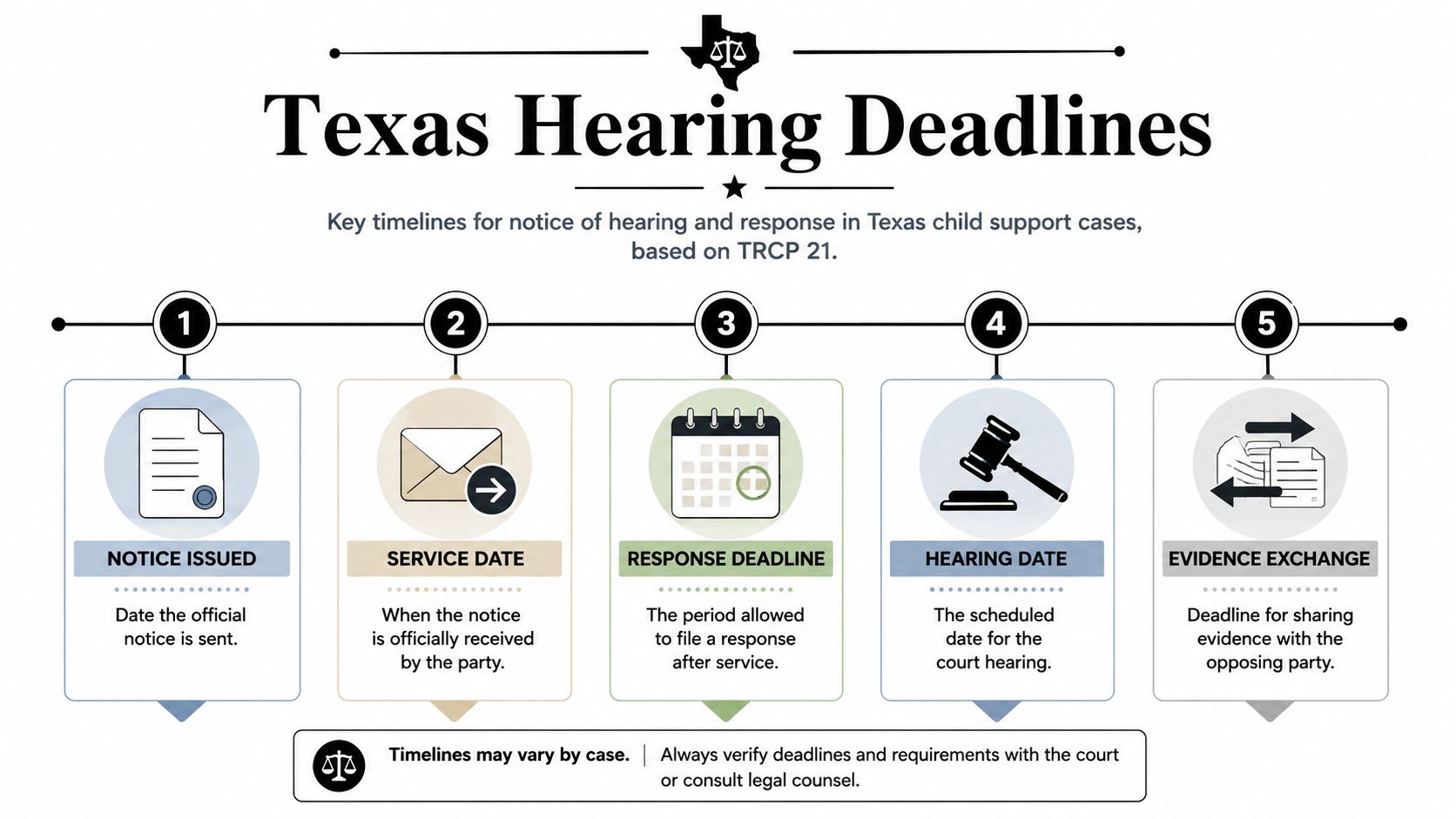
Texas practice moves quickly. Under Texas Rule 21 hearing notice requirements, an application and notice of any hearing must be served on all other parties not less than three days before the hearing unless another rule or a court order provides otherwise.
That short timeline matters. In a child support case, even a brief service delay can interfere with your ability to gather income proof, review arrears claims, or challenge the other side's numbers.
What service means in real life
Service is not just “I heard about it” or “someone texted me a screenshot.” The question is whether notice was served in a way the rules and the court accept.
In practice, you need to evaluate:
- Who sent it. Was it sent by the other party, their lawyer, or the court?
- How it was sent. Mail, e-service, personal delivery, and other methods may be treated differently depending on the case posture.
- When it was sent. Count backward from the hearing date immediately.
- What exactly was served. Sometimes a party sends a notice without the motion, or a motion without the notice. That can create problems.
If you're facing a hearing on missed support, contempt-related requests, or arrears, this guide on what happens if you miss child support court in Texas gives useful context on why timing and appearance issues can become serious quickly.
The strategic use of timing objections
A late-served notice does not automatically end the hearing. But it may give you a basis to object, request a continuance, or preserve error depending on the circumstances.
That turns on specifics. Courts often want to know:
- When did you receive notice
- What prejudice did the short notice cause
- What evidence were you unable to prepare
- Whether you acted promptly after learning of the setting
If you believe service was defective, raise it early and specifically. A vague complaint that “I didn't have enough time” usually isn't enough.
A quick decision framework
Use this simple framework when the notice lands:
- More than enough time and complete records available. Prepare to proceed.
- Short notice but manageable issue. Gather core evidence and decide whether limited objections make sense.
- Short notice plus missing records or unavailable witness. Consider a continuance request tied to concrete prejudice.
- Serious service problem. Prepare an objection supported by dates, method of service, and what was missing.
What does not work is staying silent, skipping court, and hoping the judge resets the matter on their own. Texas courts expect parties to protect their position actively.
Developing Your Strategic Response
Once you know the hearing date and the issue being set, you need a response plan. A child support hearing is rarely won by merely appearing and explaining that you're trying your best. You need to decide what procedural move gives you the strongest position.
A notice of hearing also carries a practical warning. Courts often treat it as the point at which a judge may rule on the existing record if a party doesn't prepare or doesn't appear, a risk reflected in this court guidance on hearing participation and orders. In Texas family court, that risk is real.
Your main options
The right move depends on the case, but most parents are choosing among four paths.
File or review your answer
If you have not filed an answer, fix that immediately. In many cases, the hearing notice arrives after the case has already been pending, and a parent has done nothing but read the mail and worry. That is not a strategy.
Your answer protects your ability to appear and contest relief. If the case is an initial support matter, it also gives you a platform to challenge the other side's income claims, request proper guideline treatment under §154.125, and ask the court to consider §154.123 factors if guideline support would be unjust or inappropriate.
For parents dealing with a first-time support case, Establishing a Child Support Order in Texas explains how an initial order can be put in place through court proceedings or the Attorney General process.
Request a continuance if you have a real reason
Continuances can help, but only when grounded in facts. Good reasons usually involve missing financial records, recent service, unavailable key evidence, or a scheduling conflict that you can document.
Bad reasons include general anxiety, incomplete preparation caused by delay, or hoping more time will make the problem disappear.
What a strong response looks like
A strong response is specific. It might sound like this:
“I received notice shortly before the hearing, I have requested payroll records and tax returns that are necessary to address net resources, and I need a brief reset to prepare evidence relevant to guideline support and any requested deviation.”
That is very different from saying, “I'm not ready.”
Countermoves matter too
Sometimes the best response is not defensive. If the other side set a hearing to increase support and ignored your evidence that the child now spends substantially different time with you, or that health insurance and childcare have changed, you may need to file your own request for relief.
In modification litigation, strategy often turns on who frames the issue first. If you let the case remain “other parent wants more money,” you are already behind. The better frame may be “the court needs a full and accurate record of net resources, insurance costs, and possession realities before any support decision is made.”
What does not work
A few things consistently hurt parents at this stage:
- Waiting for the hearing to explain everything orally
- Assuming the judge will gather missing facts for you
- Treating text messages as a substitute for filed pleadings
- Showing up without income proof
- Ignoring a notice because you think the claim is unfair
If you need help evaluating whether to answer, object, negotiate, or seek a continuance, one option is the Texas Child Support Law Office of Bryan Fagan, which handles establishment, modification, enforcement, and defense of child support orders under the Texas Family Code.
Preparing Evidence for Your Child Support Hearing
The hearing notice tells you when the fight happens. Your evidence decides how strong your position is when it does.
In Texas, child support usually starts with the guideline framework in Texas Family Code §154.125. Courts look at the obligor's net resources, then apply the guideline percentage unless a different amount is justified under §154.123. Your documents need to prove the numbers the court should use.
For a practical walkthrough before court, review how to prepare for child support court in Texas.
What to gather before the hearing
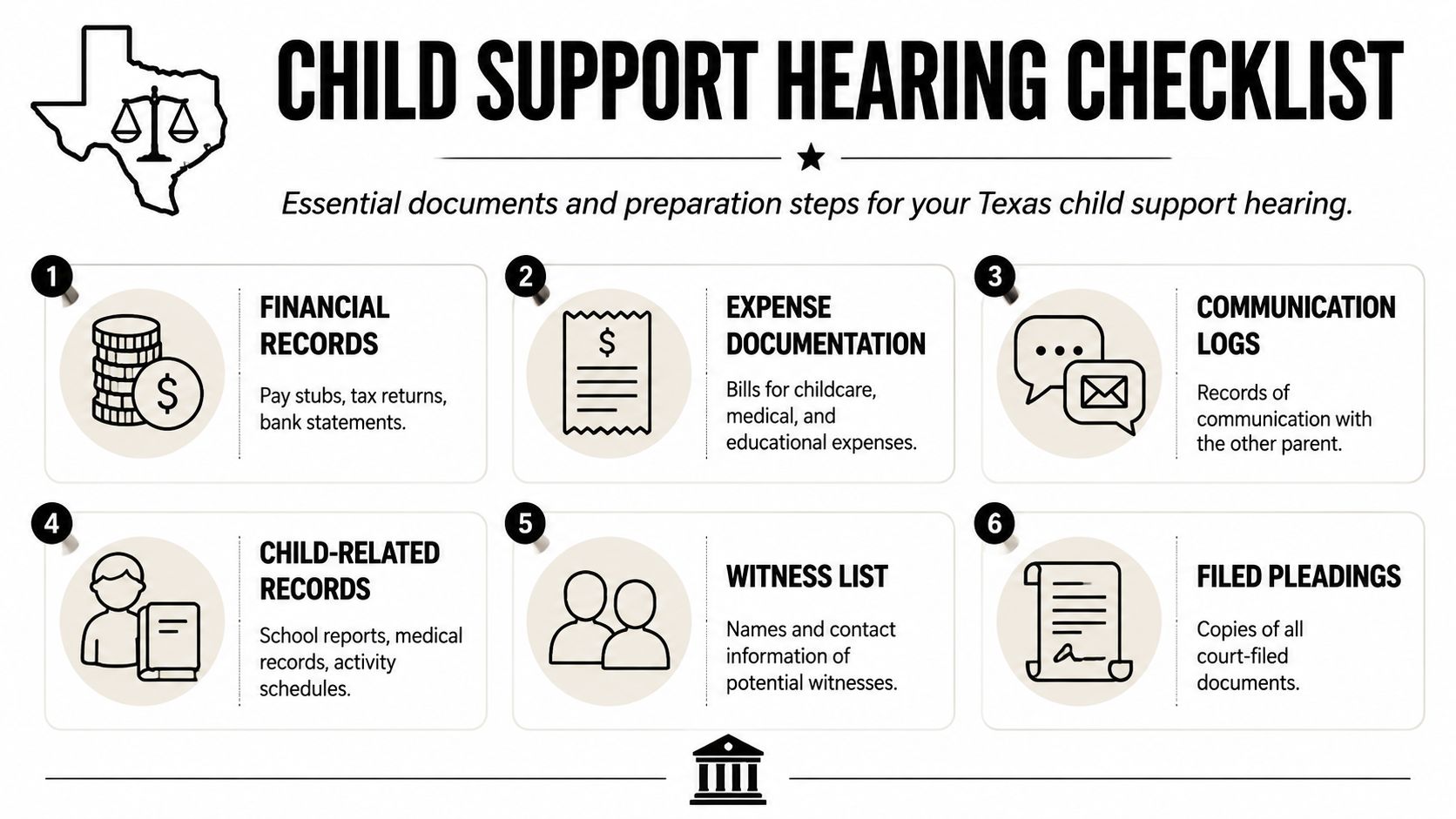
Bring organized, labeled copies of the documents that support your position.
- Income proof. Recent pay stubs, W-2s, tax returns, and other records showing wages, salary, overtime, commissions, or self-employment income.
- Health insurance records. Proof of who carries the child, what the premium is for the child's portion, and whether reimbursement is at issue.
- Childcare proof. Receipts, contracts, or account statements if work-related childcare costs matter to the broader case posture.
- Existing orders. The current child support order, any prior modification orders, and any income withholding order already in place.
- Payment history. If enforcement or arrears are in dispute, gather support payment records, bank statements, registry records, and employer withholding proof.
- Communications and case documents. Relevant emails, notices, discovery responses, and filed motions.
A short video can help you think through courtroom preparation before the setting:
How courts use the guideline formula
Under §154.125, the judge generally begins with net monthly resources and then applies the guideline percentage associated with the number of children before the court. If a party asks for a different amount, §154.123 gives the court a list of factors it may consider in deciding whether guideline support would be unjust or inappropriate.
The author's brief requires discussion of the updated cap. For cases affected by the future change, the $11,700 net monthly resource cap effective September 1, 2025 should be treated as the operative cap from that effective date forward. That matters most in higher-income cases because it shapes how far guideline support reaches before a party argues for additional support beyond the cap under the Family Code.
A practical calculation example
Assume a parent's proven net monthly resources are $8,000. If the case involves one child before the court, the guideline analysis under §154.125 typically starts with 20% of net resources. In that example, the guideline amount would start at $1,600 per month.
If the same parent had proven net monthly resources above the future $11,700 cap effective September 1, 2025, the guideline analysis would first focus on the capped amount for guideline purposes, then shift to whether the evidence supports additional support based on the child's proven needs and any other relevant factors under the Code.
Here is a simple reference point:
| Scenario | Guideline starting point |
|---|---|
| One child, net resources of $8,000 | $1,600 |
| One child, net resources above the future cap effective September 1, 2025 | Start with the capped amount, then analyze whether additional support is justified |
When guideline support may not end the analysis
Guideline support is the starting point, not always the finish line. Courts may deviate under §154.123 when the facts support it.
Examples that often matter include:
- Possession arrangements. A near-equal or unusual schedule can become relevant, although equal time does not automatically erase child support.
- Actual child-related costs. Insurance, educational issues, or special expenses can affect the court's analysis.
- Income disputes. If a parent is self-employed, paid in cash, underemployed, or mixing business and personal expenses, the court may need a closer look at what the actual income is.
- Other children. The legal framework may change when the obligor supports other children.
Bring documents that let the judge do the math from paper, not memory. If the court can't verify it, the court may not use it.
Understanding Potential Hearing Outcomes
Many parents walk into a child support hearing thinking the judge will either “rule for me” or “rule against me.” Family court is usually more complicated than that.
A hearing may end with temporary relief, a reset for more evidence, a final order, or a ruling on only part of the dispute. The result depends not just on the facts, but on whether notice, service, and access issues were handled correctly from the start. That matters because missed or defective notice can affect whether an order is enforceable, as reflected in this discussion of service logistics and accommodations in hearing processes.
What the judge may do that day
A Texas court in a child support case may:
- Set support in an original case
- Modify support up or down based on the evidence
- Confirm arrears and reduce unpaid support to judgment
- Order wage withholding
- Enter temporary orders while the case continues
- Reset the case for additional proof or drafting issues
Sometimes the hearing is short because the dispute is narrow. Other times the court hears a modification issue but leaves enforcement or arrears for another day.
Common outcomes by case type
| Case type | Likely result at hearing |
|---|---|
| Initial child support case | Order setting current support, medical support, and withholding |
| Modification case | Increase, decrease, or denial of requested change |
| Enforcement case | Findings on violations, arrears, compliance terms, or withholding-related relief |
| Arrears dispute | Confirmation of amounts owed and entry of judgment |
What happens after the ruling
The ruling from the bench is important, but the written order is what gets enforced. That order must be drafted, reviewed, signed, and entered. If wage withholding is ordered, follow-through matters. If arrears are confirmed, the judgment language matters. If the judge resets the case, the new setting and interim obligations matter.
Courtroom success is not only getting a favorable ruling. It is getting a clear, enforceable written order that matches what the judge actually decided.
What hurts parents here is leaving court without understanding what was ordered, who drafts the paperwork, and whether another hearing is coming. Always pin those details down before the day ends.
Frequently Asked Questions About Hearings

What if my ex is self-employed or hiding income
That issue comes up often. In court, suspicion alone won't carry the day. You need records that let the judge infer actual income. Tax returns, bank deposits, business account statements, invoices, payment app history, 1099s, and evidence of personal expenses paid by a business can all matter.
When self-employment income is unclear, the court may look beyond a claimed salary figure. The goal is to show the actual stream of money available for support under the net-resources analysis in §154.125.
Does a 50 50 possession schedule eliminate child support
No. A 50/50 schedule does not automatically cancel support in Texas.
The court still starts with the Code. Guideline support under §154.125 remains the anchor, and the judge may then consider whether a different amount is justified under §154.123 based on the actual circumstances. Equal parenting time is relevant. It is not a magic formula.
Can child support be changed without a formal hearing
Sometimes parents reach agreement and submit an agreed order. But if there is no signed agreement and no approved order, you should assume a formal court process is required. Until the court signs a new order, the existing one controls.
That is where many parents get in trouble. They rely on side agreements, reduced payments, or informal understandings that never become enforceable court orders.
I lost my job. How quickly can I get relief
You should act immediately. File for modification as soon as the change happens and start collecting proof of the job loss, severance if any, unemployment benefits if any, and your job search efforts.
The court will want evidence, not just a statement that money is tight. A prompt filing also matters because support does not generally rewrite itself just because your circumstances changed.
What if I already pay directly and the other parent says I owe arrears
Bring proof. Bank records, payment logs, receipts, registry statements, and employer withholding records can all matter. The court needs a documented payment history.
If you made informal payments outside the state system, expect scrutiny. Some payments are easier to credit than others depending on the records and the order language.
Do I need witnesses at a child support hearing
Sometimes. Many child support hearings turn mainly on documents and testimony from the parents. But witnesses can help when the dispute involves employment, childcare arrangements, business income, or authenticity of records.
Use witnesses carefully. One credible witness with firsthand knowledge is worth more than several people who only know what you told them.
Why You Need an Attorney for Your Hearing
A Texas child support hearing looks straightforward until you're in it. Then the case turns on service rules, local procedure, income proof, drafting language, objections, and whether the judge sees your issue as a guideline case under §154.125 or a deviation case under §154.123.
Procedural variation makes this harder than people expect. In Washington, for example, notice generally must be served at least 14 days before the hearing and be in at least 16-point font, while Texas Rule 21 uses a much shorter timeline. That contrast in state notice requirements shows how quickly someone can make the wrong assumption if they are not working from Texas-specific practice.
An attorney helps by doing more than appearing in court. Counsel can test service, frame the issue correctly, calculate support under the Code, organize evidence, push back on bad numbers, and make sure the written order says what the judge ordered. If you're deciding whether representation makes sense for your case, review whether you need a lawyer for child support in Texas.
If you received a notice of hearing in a Texas child support case, act before the deadline closes in on you. The Texas Child Support Law Office of Bryan Fagan handles child support establishment, modification, enforcement, arrears disputes, wage withholding, and contested income issues under the Texas Family Code. If you need a clear strategy for your hearing, now is the time to get one.