You look at the calendar, your stomach drops, and then you check the notice again. The hearing was this morning. You missed child support court in Texas, and now you're trying to figure out whether the damage is done.
It's serious. It is not hopeless.
If you're searching for what happens if you miss child support court Texas, the first thing you need to understand is that Texas courts don't assume you'll get another chance automatically. The case can move forward without you. Orders can be signed without your evidence. Enforcement can start before you feel ready.
What matters now is speed, accuracy, and discipline. Stop guessing. Start triage.
The Moment of Panic After a Missed Court Date
By the time most parents realize they missed court, they've already cycled through the same reactions. Maybe you had the date wrong. Maybe work ran over. Maybe you never saw the notice in time. Maybe transportation fell apart. None of that changes the basic problem. The court was scheduled to hear your case, and you weren't there.

I've represented enough Texas parents to know what happens next emotionally. People freeze. They avoid the mailbox. They stop answering unknown numbers. They tell themselves they'll deal with it next week after payday, after work settles down, after they calm down.
That's the wrong move.
What the court assumes when you don't show up
A missed child support hearing is not treated like a scheduling inconvenience. It signals to the court that the hearing can proceed without your side unless your lawyer has already handled the problem properly. In practical terms, your absence can hand control of the hearing to the other side.
That matters because child support orders don't run on your private understanding of what's fair. They run on signed orders, filed evidence, and courtroom procedure.
Practical rule: The clock starts running the moment you miss court, not the moment you decide to deal with it.
What you should focus on right now
Your job today is not to relive why this happened. Your job is to answer three questions:
- Was an order signed: You need to know whether the judge entered anything in your absence.
- What hearing did you miss: An establishment case, a modification case, and an enforcement case create different risks.
- Did the court set another date: Some missed appearances trigger another setting. Others produce immediate consequences.
If this was a child support enforcement matter, the risk is sharper because Texas treats support as a court-ordered obligation. Texas Law Help explains that a judge can require payment of past-due support with interest, hold a parent in contempt, and impose penalties that can include jail, fines, license suspension, tax-refund interception, and property liens under Texas child support enforcement rules.
Your panic is understandable. Your next step needs to be deliberate.
The Immediate Consequence The Default Judgment
The first thing I worry about when a client misses child support court is default judgment. That's usually the first real hit.
If you don't appear, the judge can hear the other side's evidence and treat it as unopposed. In plain English, you forfeited the chance to challenge what was presented. A Texas family-law source explains that when a parent misses a hearing, the court can enter a default judgment and accept the other party's position as true, which can change the support outcome without the absent parent's evidence being heard, as discussed in this explanation of a Texas default judgment in child support cases.
What default really means
This is a loss incurred by absence, not by presenting a weak argument. The court isn't weighing both versions if only one version is in the room.
That means the judge may never hear about:
- your actual income,
- your recent job loss,
- your health insurance cost for the child,
- your parenting schedule,
- your existing support obligations,
- or documents that would have changed the calculation.
Why this can get expensive fast
In a default setting, your side of the financial picture can effectively disappear from the hearing. If the other side presents a version of your income that's incomplete or exaggerated, you may end up with an order built on that record instead of reality. Wage withholding can follow from the order, and if the case involved requests beyond guideline support, you've lost the chance to push back in the moment.
Texas courts use guideline child support under the Family Code, but judges also look at evidence presented in the case. If you're absent, you don't get credit for evidence you never offered.
Missing court doesn't just mean silence. It means the court may move forward as though the other side's account is the only account that matters.
It can spill into custody-related consequences
Failure to appear can also trigger contempt, monetary sanctions, and even temporary suspension or termination of visitation rights until the dispute is resolved, according to this Texas hearing-miss overview. That does not happen in every case, but it happens often enough that you should take the risk seriously.
If a default was entered, don't waste energy arguing with the other parent by text. Start getting the paperwork and preparing to attack the order through proper procedure.
The Cascade of Enforcement Actions What Happens Next
You missed court. The judge may have signed an order without hearing your side. From that point on, the pressure usually builds in a predictable sequence, and the first hit is usually money, not handcuffs.
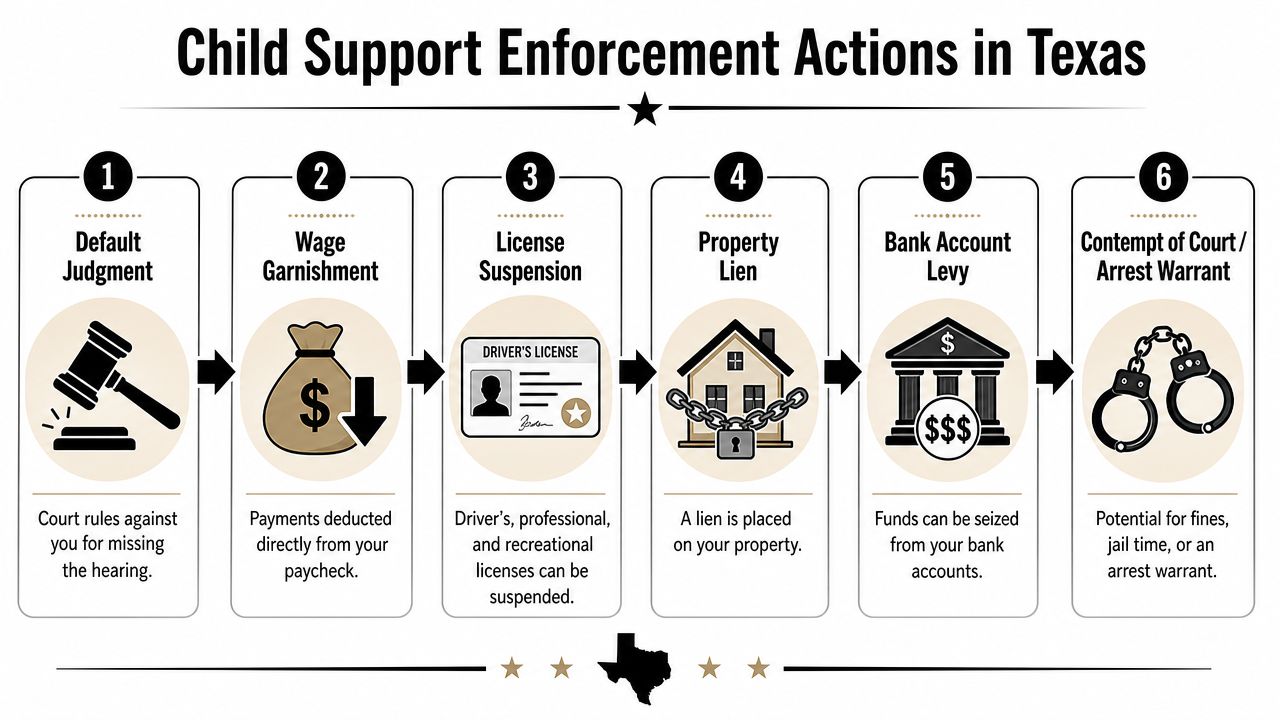
Start by understanding the order of danger. A default order often lands first. Then collection tools start attaching to that order. If you do nothing, the case can grow from a bad hearing result into an enforcement case with real financial and legal consequences.
The usual order of trouble
In many cases, the signed order is the first serious problem. After that, enforcement shifts from courtroom risk to payroll deductions, growing arrears, and formal collection efforts.
| Stage | What it means for you |
|---|---|
| Default order | The judge rules without your evidence. |
| Income withholding | Support can be taken directly from wages under the order. |
| Arrears growth | Unpaid support keeps adding up under the existing order. |
| Administrative penalties | State agencies can begin license-related enforcement if the arrears grow. |
| Collection remedies | Liens and other collection tools can be used against property or funds. |
| Contempt pressure | The court can impose sanctions if violations continue. |
For a broader look at unpaid support consequences, see what happens when child support is not paid in Texas.
Which penalty tends to hit first
A common question is whether an arrest is imminent. Usually, the first damage is procedural and financial. The court signs an order, the support obligation continues, and collection activity starts building around that signed order.
That matters because people often waste time worrying about the last step in the chain instead of the first three. If wage withholding is authorized, your paycheck can be affected before you ever see a dramatic enforcement hearing. If the amount ordered is too high, arrears start growing from that number, not from what you believe is fair.
A separate Texas source explains that missed payments can trigger enforcement and that arrears can continue to grow with interest. It also explains why quick action matters after a missed date in this discussion of missed child support payments in Texas.
What tends to come before a warrant
Texas enforcement usually escalates. It does not usually start at the maximum penalty.
That means you are more likely to see one or more of these first:
- Wage withholding
- Past-due support balances increasing
- Notices from the Office of the Attorney General
- License suspension efforts if the delinquency continues
- Liens or other collection measures
- A later enforcement or contempt setting
By the time a capias warrant or arrest risk becomes serious, the case has usually already moved through several earlier stages. Do not take comfort from that. Those earlier stages can wreck your finances, damage your job stability, and make the next hearing harder to win.
License problems and state enforcement pressure
License suspension is one of the most disruptive tools in these cases. Once your arrears are high enough, the state can use your driver's license and professional licenses as pressure points. That can interfere with work, commuting, and your ability to earn the money needed to catch up.
Other enforcement tools can stack on top of that:
- Property liens
- Intercepted funds
- Credit and collection pressure
- Contempt exposure for violating the order
Once enforcement starts, the state has momentum. You need to interrupt that momentum fast.
What missed payment does not change
Many parents make a second mistake after missing support court. They start treating child support and parenting time as if one cancels the other out.
Texas law treats those as separate duties. If support is overdue, the possession order still stands unless a judge changes it. If the other parent is blocking visitation, your support duty still stands unless a judge changes it. Retaliating by withholding money or withholding the child usually makes your position worse, not better.
Your First 48 Hours An Emergency Action Plan
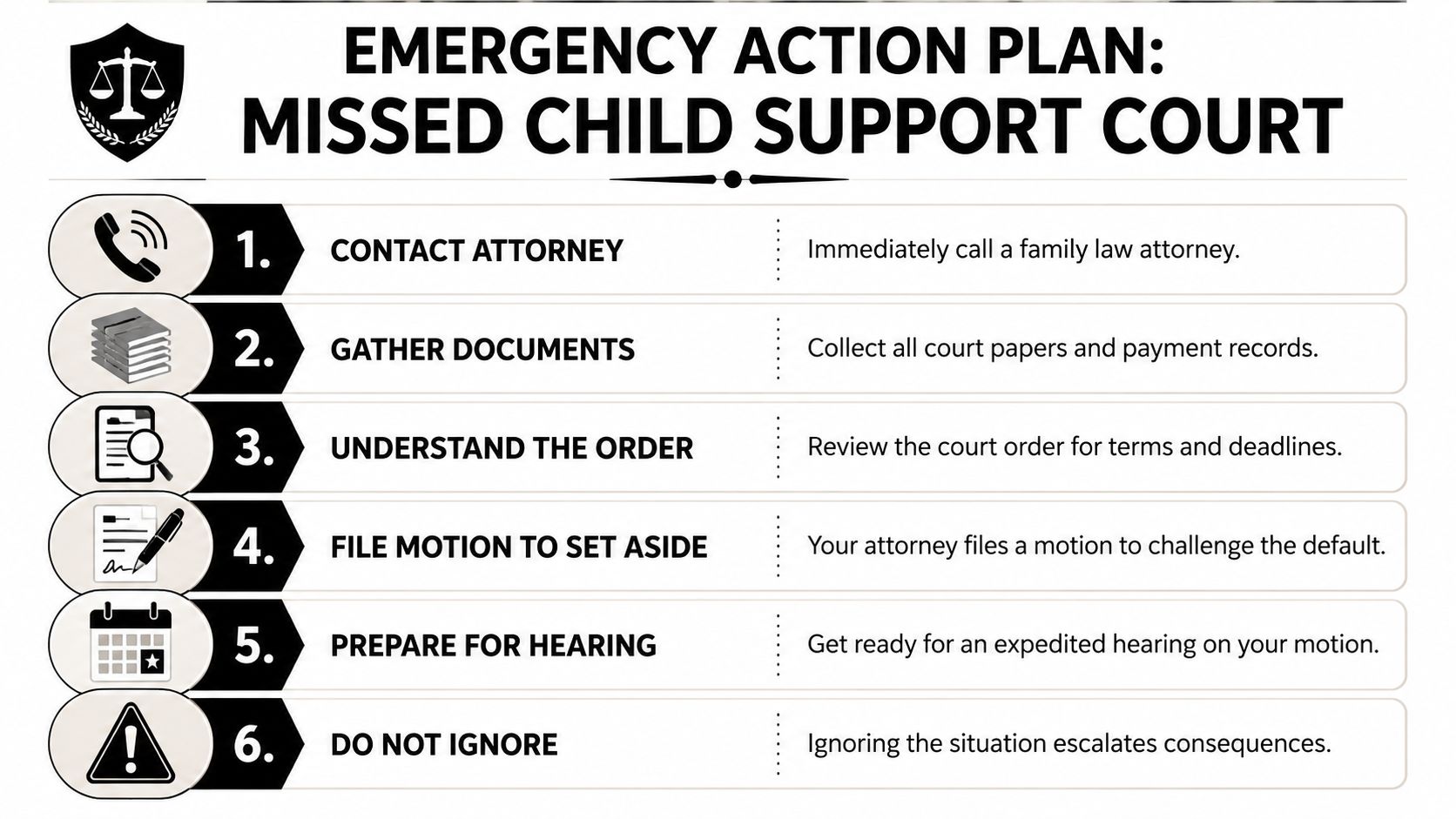
Now, stop reacting and start working. The first two days after a missed hearing matter more than is commonly understood.
What to do today
Start with these moves, in this order:
Call a Texas family law attorney
If you missed a child support hearing, this is not the time for internet improvisation. You need someone who can identify whether an order was signed, whether a motion needs to be filed immediately, and whether the missed setting involved enforcement risk. One available resource is guidance on what to do after a Texas child support hearing. You can also contact private counsel, including the Texas Child Support Law Office of Bryan Fagan, if you need representation on establishment, modification, or enforcement issues under the Texas Family Code.
Call the court clerk
Ask whether the hearing went forward, whether any order was signed, and how you can obtain a copy quickly. Get names, dates, and cause numbers correct.
Gather every document
Pull together notices, prior orders, payment records, pay stubs, tax returns, health insurance information, and messages relevant to notice or attendance problems.
Time-sensitive advice: Don't wait for the signed order to show up in the mail before you act.
What to do in the next day
Once you know what happened in court, move to damage control.
- Review the signed paperwork carefully: Deadlines often run from signing dates, not from when you finally open the envelope.
- Document why you missed court: Traffic excuses won't help much. Medical emergencies, notice defects, work records, transportation records, and similar proof may matter.
- Keep paying what you can if support is due: Don't treat the missed hearing as a pause button.
- Stop sending angry messages: Every ugly text becomes potential evidence.
This short video covers the urgency well:
What not to do
Parents in panic usually make one of these mistakes:
- They disappear: That invites more enforcement.
- They rely on verbal side deals: Those don't rewrite court orders.
- They assume one missed date isn't serious: Texas practice proves otherwise.
- They wait until wages are hit or a suspension notice arrives: By then, your options may be narrower.
A Texas source notes that even a single missed payment can trigger enforcement and that license-related remedies may apply when a parent is more than three months overdue, which is why immediate response matters after a missed hearing.
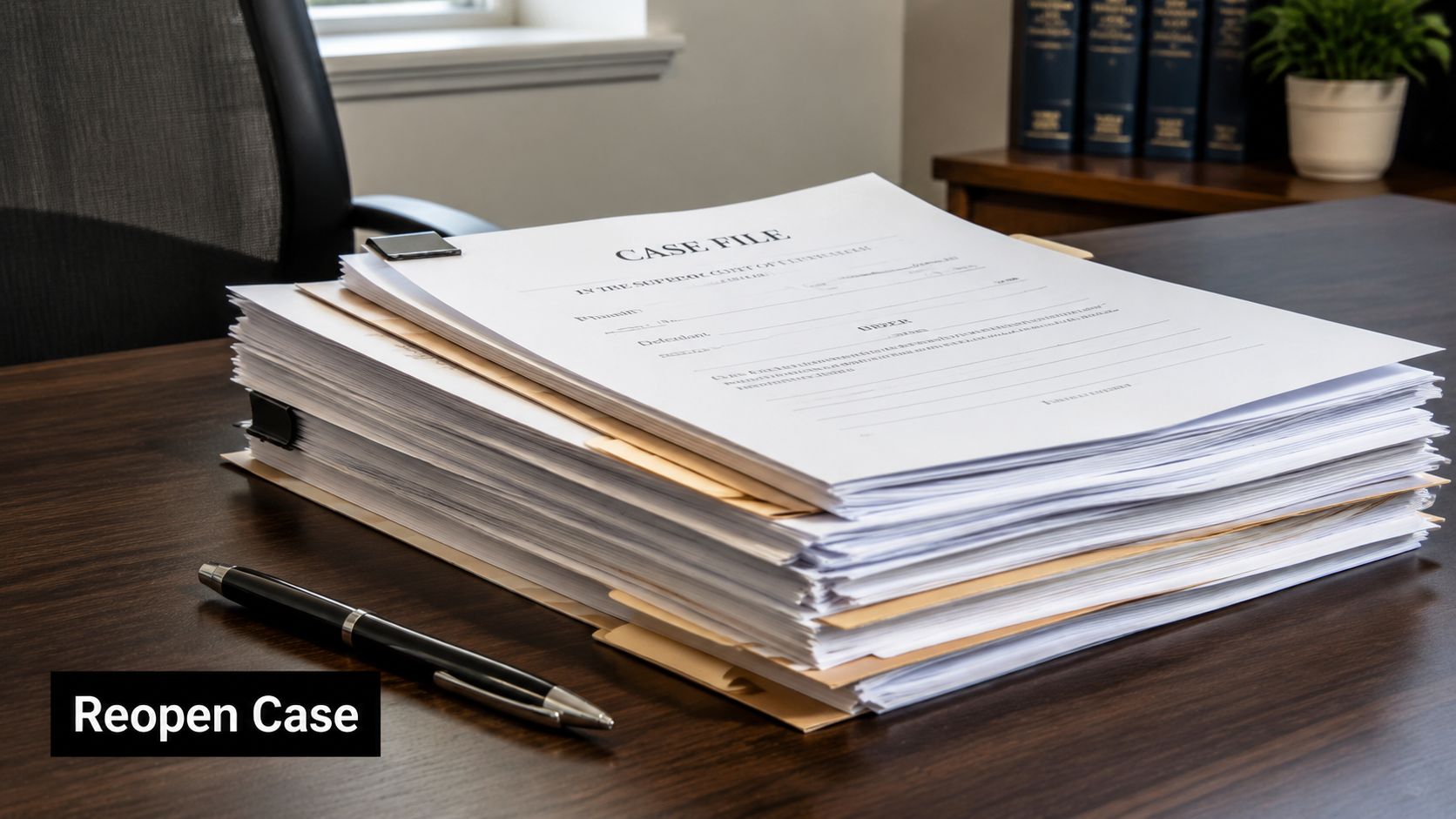
Undoing the Damage How to Reopen Your Case
If a default order was signed, the question becomes whether you can reopen the case. Sometimes you can. But you need to move fast and do it correctly.
The first remedy most lawyers consider
In many default situations, the first tool is a motion for new trial. The core idea is simple. You ask the court to set aside the default result and give you a new hearing where both sides can be heard.
Texas procedure is strict. If you sit on your rights, you make your own argument weaker.
The court will want to know things such as:
- Why you missed the hearing
- Whether your failure to appear was accidental or due to mistake
- Whether you have a real defense or missing evidence that could change the result
- Whether reopening the case would unfairly harm the other side
Those are not casual talking points. They need facts and proof.
What a strong reopening effort usually includes
A proper filing is often built with supporting material, not just excuses. That may include:
| Needed item | Why it matters |
|---|---|
| Affidavit from you | Explains the missed appearance clearly and under oath |
| Notice records | Helps show whether you received correct notice |
| Income documents | Shows the support number may be wrong |
| Payment history | Helps establish good faith or challenge arrears claims |
| Medical or work records | Supports the reason for missing court when applicable |
Courts are more willing to listen when the paperwork shows a real problem, not just regret.
Modification is not the same as undoing a default
Clients confuse these constantly. A motion to reopen attacks what happened because you missed court. A modification asks the court to change support because circumstances changed.
Those are different procedural tracks.
Under Texas Family Code § 156.401, support can be modified when the legal standard is met. If your income dropped, your employment changed, or the order no longer reflects reality, modification may be part of the long-term fix. But if a bad order was just signed because you didn't appear, your first question is often whether you can set it aside, not whether you should merely live with it and seek future changes.
Where guideline law still matters
Even in a reopening fight, the judge will care whether the original number was likely wrong under Texas support law. That's where Texas Family Code § 154.125 and § 154.123 come into play. Section 154.125 covers the guideline framework, and § 154.123 addresses factors a court may consider when deviating from guidelines.
If the missed hearing produced a support amount untethered to your actual resources or ignored facts that could support a different figure, that strengthens the practical case for getting back in front of the court with real evidence.
How Texas Child Support Is Actually Calculated
If you missed court, you also missed the chance to make the judge use the right math.
Texas child support starts with net monthly resources under Texas Family Code § 154.062. That statute covers what income counts and what deductions apply. The court identifies the obligor's net resources, applies the guideline percentages in § 154.125, and then considers whether a deviation is appropriate under § 154.123.
The guideline framework
For many cases, the guideline percentages are:
- One child: 20%
- Two children: 25%
- Three children: 30%
- Four children: 35%
- Five children: 40%
The author's brief requires mention of the updated cap, so here it is carefully and accurately: the $11,700 net monthly resource cap effective September 1, 2025 applies when discussing guideline calculations for new and modified orders finalized on or after that date.
What goes into the calculation
A proper support calculation usually requires evidence of items like:
- wages or salary,
- commissions or bonuses,
- self-employment income,
- health insurance for the child,
- and other deductions allowed by § 154.062.
If you aren't in court with reliable documents, the judge may make findings from incomplete evidence. That's how bad numbers get into good orders.
A practical example without fake math
Here's an example of the difference. Suppose the other parent tells the court you earn far more than you do, and you aren't there with pay stubs, tax returns, or proof of current employment status. The judge may sign an order based on the evidence available. If you had appeared, your lawyer could have walked the court through your net resources, the proper deductions, and whether the guideline amount should control or whether facts under § 154.123 support a deviation.
The same problem appears in modification cases. If your income dropped but you never filed the right paperwork and then missed court, the old assumptions can stay in place while the wrong support number keeps operating against you.
That's why procedure matters as much as sympathy. Courts can only calculate accurately from the evidence put in front of them.
Frequently Asked Questions About Child Support Court
Can I be arrested at work for a child support warrant
It can happen if the court has issued the proper enforcement process in your case. Don't assume you'll get a courtesy warning first. If enforcement has reached that level, your lawyer needs to know immediately and you need a plan before you walk into court casually.
If I start paying now, will the contempt issue disappear
Not automatically. Paying now helps. It shows effort and may reduce the amount in dispute. But it does not automatically erase prior violations or guarantee that a pending enforcement claim goes away.
Does missing a court date automatically mean I lose visitation
No. It does not automatically end your visitation rights. But missing court can create serious procedural problems, and some cases can involve temporary restrictions until the dispute is addressed. Also remember that support and possession are legally separate, so don't retaliate by withholding the child or withholding payments.
Can I just call and reschedule after I miss the hearing
Usually, no. Once the hearing has passed, you're dealing with the consequences of a missed setting, not a simple scheduling change. Before a hearing, your lawyer may be able to seek a continuance. After a missed hearing, you often need to evaluate whether an order was signed and what motion must be filed.
What if I never got proper notice
That can matter a lot, but you need evidence. Keep envelopes, screenshots, returned mail, address records, and anything showing where notices were sent. Don't just say you didn't know. Prove the notice problem.
Can the amount be changed later if I lost my job
Possibly, but not by wishful thinking. You may need a modification under Texas Family Code § 156.401 if circumstances materially and substantially changed. Until a judge signs a new order, the existing order usually remains in force.
What is the smartest move if I missed court this morning
Get the court information today. Get the signed paperwork today if possible. Get a lawyer involved today. That sequence gives you the best chance to contain the problem before it hardens into a long enforcement fight.
If you missed child support court in Texas, don't wait for the next letter and hope the problem fixes itself. The Texas Child Support Law Office of Bryan Fagan helps parents establish, modify, enforce, and defend child support orders under the Texas Family Code. If you need to find out what order was signed, whether a default can be challenged, or how to respond before enforcement escalates, contact the firm and get a concrete legal plan in place quickly.