You're sitting in a Texas courtroom for your first child support hearing. The other parent has primary physical custody, and the paperwork repeatedly calls you the “non-custodial parent.” You may wonder whether that label means you've lost authority, access to records, or a meaningful role in your child's life. It doesn't.
Texas law separates parenting time, decision-making, information access, and child support. A parent may owe support while retaining possession rights, access to school and medical information, and other parental protections. The practical challenge is knowing what your order says, what the Texas Family Code provides, and what evidence you need when the other parent or a provider refuses to cooperate.
Understanding Your Rights as a Non-Custodial Parent
A parent can leave a first hearing believing that “non-custodial” means legally sidelined. That misunderstanding causes real problems. A father might pay support every month but still get no notice of a school meeting. A mother might follow a possession schedule but be told she can't speak with the child's doctor. In Texas, those outcomes don't automatically follow from primary custody.
Texas guidance recognizes that both parents, unless a court order restricts them, may receive information about a child's health, education, and welfare. The guidance also identifies access to medical, dental, psychological, and educational records, consultation with providers and school officials, attendance at school activities, and consent to emergency treatment as rights that can remain available to both parents. See the practical explanation from Texas Access.

What the label does and does not mean
“Non-custodial parent” generally describes the parent who doesn't have primary physical custody. It doesn't erase the parent-child relationship, and it doesn't decide every question about authority. The court's order controls the details, including possession dates, exchange terms, decision-making provisions, and restrictions.
Suppose your child's school schedules a conference during the other parent's week. If the order doesn't restrict your involvement, you may be able to attend and communicate with school personnel directly. If your child needs urgent medical treatment, official Texas guidance recognizes that both parents may have emergency-treatment rights unless the court has limited them.
Practical rule: Read the signed order, not just the labels used by the parties. The rights you can enforce come from the order and applicable Texas law.
Texas' child support system also demonstrates that noncustodial parents aren't merely subjects of enforcement. Federal program materials state that a noncustodial parent may apply for child support services when the case isn't already being enforced through the child support program. The federal system served 15.8 million child support cases and collected $27.3 billion in fiscal year 2011, with about 93% of collections going directly to families, according to the Congressional Research Service report. Those figures show the public scale of child support administration, but they don't change the basic rule that financial obligations and parental participation are separate legal questions.
Custody vs Visitation and Possession Rights
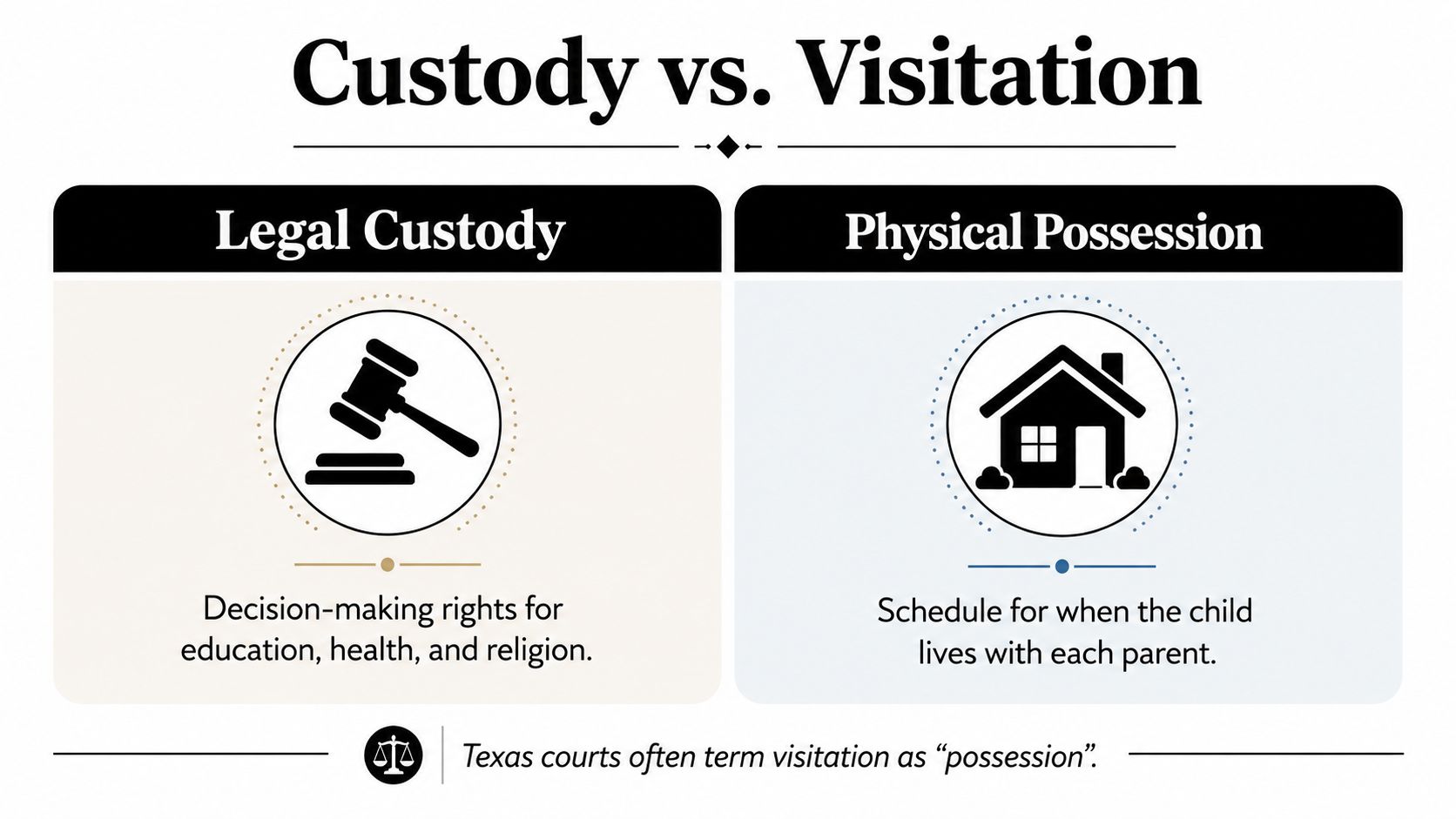
Texas family law uses terms that can confuse parents. Conservatorship addresses parental status and decision-making authority. Possession and access addresses when a parent spends time with the child. “Visitation” is commonly used in everyday speech, but Texas orders often use “possession.”
A parent can be a joint managing conservator without having equal physical time. Conversely, a parent can have substantial possession while the other parent retains a particular exclusive decision-making right. The order may assign decisions about education, medical care, or residence in different ways, so you need to examine each provision rather than assume that one label answers every question.
Possession is a schedule, not a payment reward
A possession schedule determines exchanges, weekends, holidays, school breaks, and other parenting periods. Many Texas orders use a Standard Possession Order, but the court may approve or order a different schedule when the facts support it. The governing order may include expanded periods, geographic conditions, supervised possession, or special exchange instructions.
That distinction matters because support and possession are separate. Texas official guidance states that a noncustodial parent may owe child support while retaining access, school, medical, and emergency-contact rights unless a court order limits them. The other parent generally can't cancel possession just because support is unpaid, and the paying parent generally can't stop support because a visit was denied. Each problem requires the remedy designed for that problem.
Consider a parent whose order provides alternating holiday periods and regular weekend possession. If the other parent refuses an exchange, the appropriate response is to preserve messages, document the missed period, and evaluate enforcement. Showing up at the other parent's home, withholding support, or confronting school staff usually creates new problems instead of fixing the original violation.
For parents still establishing an initial order, Establishing a Child Support Order in Texas describes the basic routes through a court or the Attorney General. That process concerns support establishment, while possession and conservatorship provisions must be addressed through the applicable family-court pleadings and orders.
Look beyond the calendar
Possession affects more than overnight counts. It can determine transportation responsibilities, holiday logistics, school participation, child-care needs, and the parent's ability to handle ordinary medical or educational decisions during that parent's time. A workable order should state enough detail that neither parent has to renegotiate every exchange.
If a schedule has become impractical, seek a modification rather than relying indefinitely on informal text-message arrangements. Informal flexibility can work while both parents cooperate. It becomes weak protection when one parent changes position or denies the agreement.
Parental Decision-Making and Access to Records
A noncustodial parent's most useful first step is often not filing a motion. It's contacting the school, doctor, dentist, therapist, or other provider directly and supplying the documents needed to confirm parental status. Texas Family Code §153.073 addresses a parent's rights and duties, while the specific order may allocate exclusive or joint authority over particular decisions.
Access to information isn't identical to the power to make the final decision. You may be entitled to review medical or educational records even when the order gives the other parent the exclusive right to make a particular decision. That distinction lets you stay informed without misrepresenting your authority to a provider.
A practical records process
Use a written request and keep the communication professional. Identify yourself, identify the child, request the specific information, and attach the relevant order if the institution asks for it.
- Schools: Ask to receive report cards, notices, attendance information, and activity communications directly where permitted by the order and Texas law.
- Medical providers: Contact the office for appointment information and records, and ask what documentation the office requires.
- Therapists and psychologists: Review the order carefully because treatment information and decision-making provisions can be fact-specific.
- Emergency information: Confirm that the school or provider has your current phone number and emergency-contact details.
Texas guidance states that both parents may access health, education, and welfare information and may consult providers and school officials unless a court order restricts those rights. If a provider refuses access, ask the provider to identify the written restriction it relies on. A refusal based only on the other parent's instruction may require court enforcement, but an order-based restriction changes the analysis.
Decision-making requires restraint
A parent with information rights shouldn't use those rights to harass the other parent or overwhelm a provider with repetitive demands. Send focused requests, attend scheduled meetings, and direct disagreements through the parenting process or court when necessary. Judges tend to respond better to a documented pattern of reasonable involvement than to angry accusations unsupported by dates and records.
If the order grants you a specific decision-making role, exercise it in the way the order requires. If the other parent makes a decision assigned to you, preserve the notice and supporting records. The remedy may be enforcement, clarification, or modification, depending on the facts.
Child Support Obligations and the 2025 Guideline Cap
Texas calculates guideline support under Texas Family Code §154.125, using percentages applied to the obligor's monthly net resources. Effective September 1, 2025, the statutory net-resource cap increased from $9,200 to $11,700, as described in this Texas guideline explanation.
At the cap, the basic guideline math is straightforward. The calculation applies the percentage for the number of children to $11,700, unless the court enters a different amount under the applicable statutory analysis.
Texas Child Support Guidelines at the 2025 Cap
| Number of Children | Percentage | Monthly Amount |
|---|---|---|
| One child | 20% | $2,340 |
| Two children | 25% | $2,925 |
| Three children | 30% | $3,510 |
| Four children | 35% | $4,095 |
For example, if the guideline calculation concerns one child and the obligor's monthly net resources meet or exceed the cap, the baseline calculation is 20% of $11,700, or $2,340 per month. Income above the cap isn't automatically irrelevant, but the guideline calculation itself stops at the cap unless the court makes an additional finding under Texas law.
The court doesn't calculate support from gross salary alone. Net-resource evidence can include income records and documentation of deductions recognized by the statutory framework. Bring complete, organized records rather than expecting the judge to reconstruct income from incomplete bank statements or informal estimates.
Guideline support isn't always the final order
Texas Family Code §154.123 permits a deviation only when applying the guideline amount would be unjust or inappropriate. The court must consider listed factors, including the child's needs, possession and access time, each parent's net resources, child-care expenses, and whether either party has other children in the household. The statutory standard and factor analysis are discussed in this Texas deviation overview.
A parent seeking a different amount must connect the requested change to evidence. A claim that “we have equal time” is not enough by itself. The court needs a clear possession schedule, proof of direct child expenses, reliable income information, and an explanation of why the guideline result would be unjust or inappropriate.
Enforcement and Modification Procedures
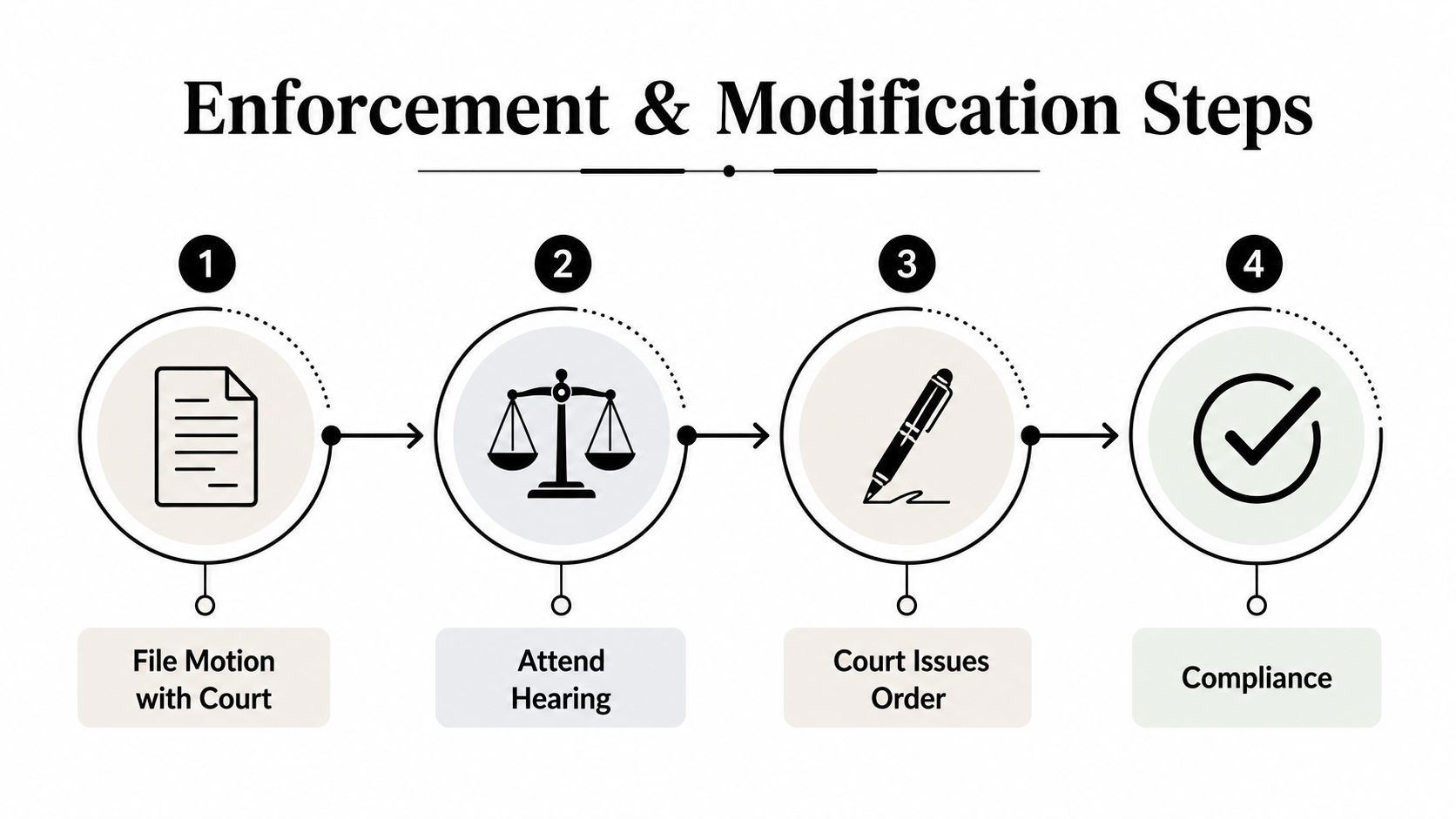
A Texas support case normally moves through identifiable procedural stages. Whether you're seeking an initial order, enforcement, or modification, the court needs a proper pleading, notice to the other party, and admissible evidence.
Filing and service
A parent seeking support or a modification generally files a petition or motion in the proper family court. The filing should identify the existing order, the relief requested, and the legal basis for that relief. The other party must receive legally sufficient service or otherwise make a valid appearance before the court can proceed in the ordinary way.
For modification, asking for a lower payment because your finances changed isn't enough. The moving party must establish a material and substantial change or another statutory basis for modification, then provide records that allow the court to recalculate support or assess a requested deviation.
Bring:
- Income documentation, including pay information and records relevant to net resources.
- Possession evidence, including the actual schedule and documented deviations from it.
- Child-related expenses, such as qualifying child-care or extraordinary costs.
- The current order, plus a clear list of provisions the requested order would change.
- Communication records, particularly when enforcement concerns missed payments or denied rights.
Hearing, order, and compliance
At the hearing, the judge considers testimony, exhibits, and the statutory standards. The court may enter an enforcement order, modify support, deny the requested change, or require additional action depending on the evidence.
Support enforcement can involve tools such as income withholding, liens, and contempt proceedings. The exact remedy depends on the order, the arrearage, notice, ability to comply, and the legal requirements for the remedy requested. A parent who is owed support can review how to collect back child support before choosing a course of action.
For a modification, keep paying the existing ordered amount unless a new order changes it. Filing a motion doesn't itself suspend the current obligation. This video can provide general procedural context:
High-Income and Shared-Parenting Nuances
The traditional picture of one custodial parent and one noncustodial parent doesn't fit many Texas families. Parents may share substantial parenting time, divide transportation, pay expenses directly, and still have different incomes. A support order must account for those facts without treating a shared schedule as an automatic cancellation of support.
Independent research cited in the Wisconsin guideline review reports that the share of children in shared placement rose from 10% in the early 2000s to 30%, making the older custodial/noncustodial framing less useful in close-placement cases. See the Wisconsin child support guideline review.

Shared possession changes the evidence
In a Texas-style 50/50 dispute, the question often isn't whether one parent is “non-custodial.” It's how the parents' income, overnights, direct expenses, and childcare responsibilities interact.
A court applying §154.123 may consider:
- Possession and access: The actual schedule, not an informal intention to share time.
- Net resources: Each parent's reliable income and allowable financial information.
- Child-care costs: Which parent pays, when the cost arises, and whether it supports the child's care.
- Other children: Household obligations that the statute identifies as relevant.
- The child's needs: Recurring and unusual expenses supported by records.
A parent with equal or near-equal possession may still owe support if income disparity means the guideline amount better serves the child's needs. Another case may justify a deviation because both parents directly cover substantial expenses and the standard calculation would be unjust or inappropriate. Neither result should be assumed before the evidence is assembled.
Income above the cap needs careful presentation
The guideline calculation stops at the statutory cap, but that doesn't mean every high-income case ends there. The court may consider the statutory framework and make additional findings where Texas law permits. High-income parents should prepare complete income and expense evidence rather than argue only from the headline salary.
For a focused discussion of these disputes, review high-income child support in Texas. The strongest presentation usually compares the guideline result with the child's demonstrated needs, the possession schedule, and each parent's resources.
Asserting and Defending Your Rights in Court
A persuasive case starts with records. Keep the signed order, payment history, possession calendar, school notices, medical communications, and relevant messages in one organized file. A court can act on specific evidence showing what the order required, what happened, and what remedy is legally available.
Prepare a hearing summary that answers three questions:
- What does the order say?
- What event violated or changed it?
- What exact relief are you requesting?
Don't argue that you deserve more time simply because you're frustrated. Show missed exchanges by date, explain the effect on the child, and identify the order provision involved. Don't ask for a support reduction merely because your schedule feels equal. Present the actual overnights, income evidence, direct expenses, and the §154.123 factors that support a deviation.
Courts can't resolve a vague conflict as efficiently as a documented violation with a specific requested remedy.
If the other parent interferes with your relationship, distinguish ordinary co-parenting friction from conduct that may support a legal claim. Preserve communications and avoid retaliatory conduct. Information about parental alienation in Texas may help you identify issues that require prompt legal evaluation, but the court will focus on evidence and the child's best interests.
A consultation with counsel can be especially useful when the case involves high income, shared possession, arrears, or competing enforcement motions. The Texas Child Support Law Office of Bryan Fagan handles establishing, modifying, enforcing, and defending child support orders, including disputes involving net-resource calculations, guideline deviations, wage withholding, arrears, medical support, and 50/50 parenting arrangements.
Texas Child Support Law Office of Bryan Fagan helps parents evaluate noncustodial-parent rights, support calculations, possession schedules, enforcement issues, and modification evidence under the Texas Family Code. Visit Texas Child Support Law Office of Bryan Fagan to discuss your records, court order, and next procedural step with a Texas child support attorney.