You open the mail, see Motion for Enforcement, and your stomach drops. Most parents read only one thing at first: jail might be on the table. That reaction is normal. A Texas child support contempt case is not routine motion practice. It sits in the space between family court and punishment, which means the paperwork, the timing, and the proof all matter.
A child support contempt hearing texas case can arise fast or build over time. Sometimes the parent owed support files directly. Sometimes the Office of the Attorney General is already involved through wage withholding, arrears tracking, license pressure, or other enforcement tools. Either way, the hearing is about one question with serious consequences: did a parent violate a prior court order, and if so, was that failure willful?
The biggest mistake on either side is treating contempt like a normal disagreement about money. It isn't. If you're filing, vague accusations usually fail. If you're responding, excuses without documents usually fail. Texas courts want a precise order, precise payment history, proper notice, and proof that holds up under questioning.
The Contempt Notice Arrives Your Next Steps
The first day matters. If you've been served, don't fire off angry texts, don't promise terms you can't meet, and don't assume the hearing is just about “catching up later.” If you're the parent filing, don't assume unpaid support speaks for itself. In contempt work, the side with the better paperwork usually controls the hearing.

What the notice usually means
A contempt action is an enforcement proceeding based on an existing child support order. The court is not recalculating support from scratch at that hearing. The court is asking whether a parent failed to do what an order already required.
For the responding parent, that distinction is critical. Saying the original amount was unfair usually doesn't solve the contempt problem. Until the order is changed, the order controls.
Practical rule: Treat service of an enforcement motion like a countdown, not a warning.
What to do in the first two days
Start with documents. Pull every order, modification, payment confirmation, bank record, wage withholding stub, and communication about support. Put them in date order. If you paid in cash and have no receipt, say that to your lawyer immediately because undocumented payment claims are hard to prove.
Then separate strategy by role:
- If you filed the motion: build a clean ledger showing each missed payment by date and amount required under the order.
- If you were served: identify whether the payment was missed, partially paid, paid through another channel, or blocked by circumstances outside your control.
- For either side: stop arguing by text. Those messages often become exhibits.
- For the respondent: gather proof of income changes, job loss, illness, or payment processing errors before the hearing date is close.
What works and what does not
What works is discipline. Judges respond well to parents who show up organized, concise, and realistic about a cure plan. What doesn't work is showing up with a story but no records.
I've seen parents hurt themselves by focusing on visitation fights. In contempt court, that usually distracts from the issue in front of the judge. Child support and possession disputes may exist in the same family, but they are not the same claim.
The Legal Framework for Texas Child Support Enforcement
A contempt case in Texas usually turns on a narrow question with serious consequences. Did the order clearly require a payment on a specific date, and can the movant prove the respondent failed to comply with that command? If the answer is yes, the court has enforcement tools under Chapter 157 of the Texas Family Code. If the order is vague, the contempt request can fail even when support is owed.
What the court is actually enforcing
Texas courts do not enforce a general moral duty to support a child through contempt. They enforce the signed order. That distinction matters to both sides. For the parent filing, the order must state the amount due, the payment terms, and the dates with enough precision to support contempt. For the parent responding, the first defensive question is often whether the alleged violation matches the actual wording of the order.
Chapter 157 sets the enforcement framework, but contempt also carries due process limits because jail is a possible outcome. A judge cannot hold someone in contempt based on guesswork, rounded numbers, or a duty phrased too loosely to enforce.
The elements that shape both filing and defense strategy
In practice, the movant needs proof of three things: an enforceable order, notice of that order, and a failure to comply with a specific obligation in the order. Those points drive both offensive and defensive preparation.
For the movant, that means building the case around exact missed payments, not a broad claim that support was not paid. For the respondent, it means testing each alleged violation line by line. Was the order the controlling order? Was the payment due on that date? Was any part paid through wage withholding, the state disbursement unit, or another traceable channel? Good contempt work is detailed work.
Section 157.002 requires enforcement allegations to identify the provision violated and the manner of noncompliance. That pleading rule is not technical fluff. It often decides whether the case is ready for contempt relief at all.
Willfulness is often the critical point
Many hearings come down to ability to pay during the period of noncompliance. Judges hear hardship claims every week. What persuades the court is proof tied to the missed-payment period: payroll records, bank statements, termination documents, medical records, disability paperwork, or evidence that a payment failed because of a third-party processing problem.
Saying "I was struggling" rarely gets far.
Texas law has long recognized limits on jailing a parent for ordinary debt when the parent lacked the ability to comply. In a child support contempt hearing, that principle becomes a proof problem. The movant tries to show the parent had the means and did not pay. The respondent tries to show the failure was not deliberate and that reasonable efforts were made under the circumstances.
Recent statutory changes affect courtroom strategy
Texas Family Code §157.162 now matters more in day-to-day enforcement practice than many parents realize. Under §157.162(d), effective September 1, 2025, a court may not hold a respondent in contempt for failure to pay child support if the respondent appears at the hearing, proves that current support is being paid or that a payment arrangement has been made, and proves the prior nonpayment was not intentional and resulted from an inability to pay or another statutory basis, including a third-party error.
That changes strategy on both sides. A parent seeking enforcement should be prepared for a late cure effort supported by documents. A responding parent should not come to court hoping for sympathy alone. The statute rewards preparation. Bring proof of current compliance, proof of the payment plan if one exists, and records that connect the missed payments to a specific non-willful cause.
Guideline law still matters, even in an enforcement case
Contempt enforces an existing order. It does not recalculate support on the spot. Still, guideline support rules often shape the case around the edges, especially when one side argues that the existing amount no longer reflects actual earnings or when a parallel modification should be considered. Texas Family Code §154.125 governs guideline child support, and §154.123 addresses deviations. This overview of the Texas Family Code child support rules gives the larger statutory context.
The new $11,700 net monthly resource cap, effective September 1, 2025, matters most in higher-income cases. It will not excuse missing payments under an existing order, but it can affect the next strategic decision. File only for enforcement, or pair the defense with a modification request if the numbers support it. That split matters. A parent can lose the contempt issue because the old order controlled during the missed-payment period and still have a valid basis to seek a different support amount going forward.
Initiating Enforcement How to File a Contempt Motion
If you're owed support, filing a contempt motion is not the place for rough estimates. Texas enforcement pleading has to be exact. Under Chapter 157, each alleged violation should be stated with specificity, and the hearing cannot be set sooner than 20 days after filing to preserve notice, according to this discussion of Texas enforcement pleading and hearing notice requirements.
Build the motion like a ledger, not a complaint letter
The strongest motions read like an audit trail. They identify the order, the exact obligation, the date payment was due, the amount due, and what was paid, if anything.
A practical enforcement file usually includes:
The signed order to enforce
Use the controlling order and confirm you are enforcing the right version if there have been modifications.A payment history
Attach a ledger that matches the order. If the OAG record exists, compare it against your own records before filing.A count for each violation
If multiple payments were missed, plead them separately. Do not collapse them into one generic allegation.Requested remedies
Ask for the relief you want and can support under Chapter 157, such as contempt, a money judgment, payment terms, attorney's fees if applicable, or community supervision conditions.
Why specificity wins
Specific pleading is not a technicality. It is due process. A respondent has to know what exact acts are being alleged so they can defend them.
Weak pleading usually sounds like this: “Respondent has failed to pay child support as ordered.” Strong pleading identifies the date due, amount due, and the exact provision violated. If the motion is too vague, the judge may deny contempt relief even when arrears are real.
Practice point: If a payment was due monthly, treat each missed month as its own alleged violation and match the wording of your motion to the wording of the order.
Service is where many self-filed cases break down
A legally sound motion can still fail if service is defective. Chapter 157 notice requirements matter because contempt can carry confinement. That means courts take service seriously.
Common filing mistakes include:
- Using vague allegations: broad nonpayment accusations don't tell the court what conduct is punishable.
- Serving incorrectly: if notice doesn't satisfy the statute and due process, the hearing can collapse.
- Bringing incomplete records: judges won't reconstruct your ledger for you.
- Requesting every possible sanction without a plan: overreaching can make a reasonable case look punitive.
The same Bryan Fagan discussion notes that improper service or insufficient detail can reduce pro se effectiveness by an estimated 30-50% in practice, which is one reason many parents use counsel or structured legal help rather than filing blind through the clerk.
What to file and what to ask for
A typical motion package includes the motion itself, supporting payment records, and enough copies for filing and service. When drafting the prayer for relief, ask in a way the judge can sign.
Possible requests in a child support enforcement filing may include:
| Filing component | Why it matters |
|---|---|
| Identification of the prior order | Shows the court what command was allegedly violated |
| Date-by-date list of missed payments | Creates notice and supports contempt findings |
| Payment ledger or records | Gives the judge a factual basis for arrears |
| Request for money judgment | Preserves collection relief even if contempt is denied |
| Request for commitment or community supervision | Puts coercive remedies before the court |
| Request for attorney's fees where proper | Can shift part of the enforcement cost |
Parents who want a practical roadmap can compare their facts against resources on how to enforce child support in Texas, then decide whether to proceed through private counsel, the OAG process, or both.
Offensive strategy that usually works
The best enforcement motions do three things at once. They preserve the contempt claim. They establish an arrears judgment path. They leave room for settlement before the hearing if the respondent starts paying.
That last point matters. Sometimes filing is what forces movement. Sometimes it only exposes a case weakness, such as bad service history, unclear order language, or records that don't match. File only when your documents are clean enough to survive a contested hearing.
Defending a Contempt Motion Strategic Responses and Affirmative Defenses
Showing up is mandatory. Showing up unprepared is often worse than not understanding the risk. Once the other side establishes the order and the nonpayment, your defense has to be concrete.

The strongest defense is usually inability to pay
The most useful defense in many cases is not “I meant to pay.” It is “I lacked the actual ability to comply, and here is the proof.” That proof may include termination records, medical evidence, bank statements, proof of job search efforts, or records showing the payment failed because of an outside processing problem rather than refusal.
The argument has to be disciplined. If you claim inability but your bank records show discretionary spending, the defense weakens fast. If you claim unemployment but made no effort to replace income, the judge may infer avoidance rather than hardship.
Countermoves that change leverage
A contempt hearing and a modification issue often run on separate tracks, but smart defense strategy considers both. If support became unrealistic because of a material and substantial change in circumstances, filing a concurrent motion to modify can change the case posture even if it doesn't erase past due support.
The verified data also identifies defenses such as impossibility of performance and states that such defenses, or a counter-motion for reduction, succeed in approximately 30% of contested IV-D hearings, while offsets or recalculations in some post-hearing situations can reduce arrears by 15-25%, according to the summary linked through the Texas law library guide on enforcing child custody and support orders.
Defensive priorities in a real case
- Attack bad math: confirm every alleged missed payment against the actual order and payment record.
- Challenge proof of willfulness: inability and refusal are not the same thing.
- File modification if justified: this does not erase existing contempt exposure, but it can stop the bleeding going forward.
- Review interstate issues carefully: when another state is involved, UIFSA questions about registration, jurisdiction, and controlling orders can reshape the hearing.
A good defense doesn't deny obvious arrears if the record is clear. It narrows the contempt issue to what the movant can actually prove and what the respondent can actually explain with documents.
One practical option for parents who need structured representation in an enforcement or defense setting is the Texas Child Support Law Office of Bryan Fagan, which handles establishment, modification, enforcement, and defense matters under the Texas Family Code.
The Hearing and Its Consequences Courtroom Procedure and Sanctions
You walk into court thinking the dispute is about missed payments. The judge is deciding something narrower and more dangerous. Did a valid order require payment on specific dates, did the respondent fail to comply, and does Chapter 157 permit contempt, a money judgment, or both?
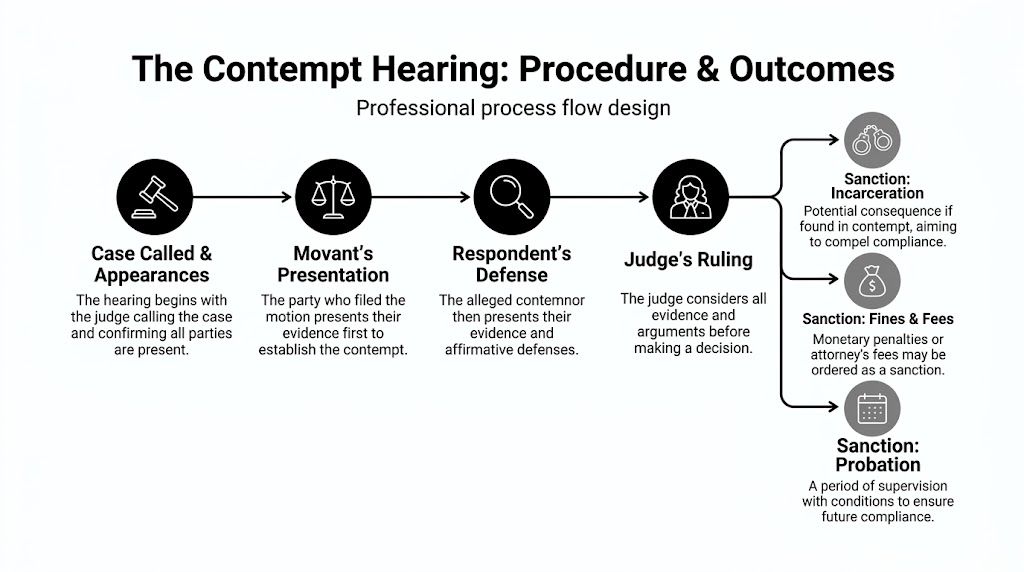
A child support contempt hearing in Texas usually moves fast. Judges expect a clean presentation tied to the order, the payment record, and the pleadings. They are not there to revisit the divorce, relitigate parenting disputes, or sort through unsupported explanations.
What happens when the case is called
The court first confirms who is present and whether the respondent received proper notice. If the respondent does not appear, the risk goes up immediately. In an enforcement case seeking contempt, the court can issue a capias if the statutory requirements are met.
If both sides are present, the movant goes first. The usual sequence is simple. Admit the controlling order, identify the missed payment dates and amounts, prove nonpayment through the official record or other admissible evidence, and ask for the specific relief pleaded. Section 157.002 of the Texas Family Code matters here because enforcement pleadings must identify the provisions violated and the manner of noncompliance with enough detail to support contempt.
The respondent's side should be just as organized. Cross-examine on gaps in the payment history, challenge any date or amount that does not match the order, object when the requested relief exceeds the pleadings, and present documents in chronological order. A scattered story loses force quickly.
How judges evaluate proof in a contempt setting
Contempt is technical. For incarceration, the order must be clear enough to be enforced by contempt, and the violations must be proved with specificity. Under Texas Family Code § 157.166, if the court finds contempt, the enforcement order must set out the provisions violated, the manner of noncompliance, and the punishment imposed.
For the parent filing enforcement, that means building the case in numbered violations, not broad accusations. For the parent responding, it means forcing precision. If the motion lumps dates together, misstates the amount due, or relies on a payment record with obvious holes, those weaknesses matter.
I tell clients to treat the hearing like an audit. Every payment alleged. Every payment made. Every missed date. Every exhibit tied to a line in the motion.
Contempt, arrears judgments, and other relief are different remedies
A court can enforce child support in more than one way at the same hearing. Contempt is one remedy. A cumulative money judgment for confirmed arrears is another. Texas Family Code § 157.263 addresses a cumulative judgment for past-due support, and § 157.264 addresses interest. In many cases, the movant asks for both contempt and a money judgment, along with attorney's fees under § 157.167.
That combined approach is where offensive and defensive strategy meet. The filing parent wants admissible proof that supports every form of relief requested. The responding parent may not be able to erase the arrears issue, but may still narrow or defeat contempt exposure even if a money judgment is entered.
That distinction often shapes settlement discussions in the hallway before the case is called.
Possible sanctions if the court finds contempt
Texas Family Code § 157.166 authorizes the court to impose punishment for contempt. Texas Family Code § 157.211 permits community supervision in appropriate cases. Other enforcement tools can be ordered with or after the hearing.
| Sanction / Remedy | Governing Law (Texas Family Code) | What it means in practice |
|---|---|---|
| Contempt confinement | § 157.166 | Jail time for violations the court finds contemptuous |
| Community supervision | § 157.211 | Release under conditions such as payment schedules, reporting, or compliance terms |
| Cumulative money judgment for arrears | § 157.263 | Converts confirmed unpaid support into a collectible judgment |
| Interest on arrears | § 157.264 | Adds statutory interest to past-due child support |
| Attorney's fees and costs | § 157.167 | Fees may be ordered against the noncomplying party |
| Income withholding | Family Code enforcement provisions | Direct withholding from earnings for current support and arrears |
| Child support lien | Chapter 157 lien provisions | Attaches to certain property or claims to secure arrears |
| License suspension | Chapter 232, Family Code | Suspends eligible state-issued licenses for noncompliance |
For a broader look at what happens if child support is not paid in Texas, review the enforcement consequences outside the hearing itself.
Jail exposure is real, but procedure matters
Texas courts can order confinement for contempt in child support cases. The risk is serious, and it needs a serious response. But confinement is not automatic. The pleadings, notice, wording of the prior order, proof of each alleged violation, and the form of the proposed enforcement order all matter.
That is why preparation has to match the type of risk. A filing parent should arrive with a proposed order that complies with Chapter 157 and tracks each violation clearly. A responding parent should review the motion line by line, because contempt findings often rise or fall on drafting accuracy as much as testimony.
What the judge is usually trying to sort out
Most hearings fall into one of three patterns.
One is a clear enforcement case. The order is specific, the payment record is clean, and the violations are easy to prove. Those cases create the highest contempt risk and the strongest settlement pressure on the respondent.
Another is an arrears case with weak contempt proof. The court may still enter a money judgment, interest, and fees, but contempt may become harder to support if the motion, notice, or evidence is not precise enough.
The third is the avoidable mess. The movant overreaches, the respondent shows up with no records, both sides talk about everything except the pleaded violations, and the judge is left to impose structure on a file that should have been organized before docket call.
Courtroom discipline matters. Answer the question asked. Bring extra exhibit copies. Mark the exact payment entries you want the judge to see. If you are filing, prove each element cleanly. If you are defending, force the other side to do the same.
Frequently Asked Questions About Texas Child Support Contempt
Can I go to jail for one missed child support payment in Texas
Yes, if the court finds the missed payment was a willful violation of a valid order. Texas contempt law does not require a minimum arrears amount before confinement becomes possible. The key question is whether the violation can be proved and whether the nonpayment was willful.
If I lost my job, should I wait for the hearing and explain it there
No. Gather proof immediately and evaluate a modification request as soon as the income change happens. Waiting until the contempt setting is risky because the existing order remains enforceable until changed. A job loss can support a defense or a modification request, but only if you can document it.
Can I defend contempt by arguing the other parent blocked visitation
Usually no. Texas courts treat support and visitation as separate duties. If possession was denied, that may support a different enforcement action. It usually does not excuse nonpayment in a child support contempt hearing texas case.
Parents hurt themselves when they try to trade support for access. Texas courts generally won't accept that trade.
What if the payment record is wrong
Challenge it with documents, not assumptions. Bring payment confirmations, bank records, wage withholding stubs, money order receipts, and any communication showing where and when payment was sent. Many contempt cases narrow quickly once the ledger is cleaned up.
Can I get a court-appointed lawyer
If incarceration is possible and the respondent is indigent, Texas procedure may allow appointment of counsel in an enforcement proceeding. That issue should be raised early, not on the courthouse steps after the docket is called.
Can I file to modify support while the contempt case is pending
Yes, and in many cases you should at least evaluate it right away. Modification does not erase past due support already owed, but it can address an order that no longer matches current income, custody structure, or net resources. That is especially important in high-income cases and in situations where deviation under §154.123 may matter.
How do 50 50 custody cases fit into contempt disputes
Equal parenting time does not automatically eliminate support. Texas courts still examine net resources, the terms of the existing order, and whether deviation is justified. If the order was never changed, the signed amount remains enforceable until modified.
What if I miss the hearing date
That is one of the worst moves in the case. The court may proceed in your absence in some respects, and the judge may issue a capias. If you have a genuine emergency, act before the hearing if possible through counsel or a documented request, not after the fact.
Is paying something better than paying nothing
Usually yes from a practical standpoint, but partial payment does not automatically defeat contempt. It may help show effort and reduce arrears pressure, especially when paired with records and a realistic payment plan. It is not a substitute for modifying an unaffordable order.
What should I bring to court
Bring the current order, any later modifications, your payment records, income records, tax documents if relevant, job-loss or medical proof if that's part of your defense, and a written timeline. Bring paper copies in a form your lawyer or the court can use quickly. A phone full of screenshots is better than nothing, but it is rarely the best way to try a contempt case.
If you're facing enforcement or need to file it, Texas Child Support Law Office of Bryan Fagan works with Texas parents on child support establishment, modification, enforcement, and contempt defense under the Texas Family Code. A focused review of the order, payment history, service record, and income evidence can clarify whether your next move should be filing, settlement, modification, or immediate hearing preparation.