You just got laid off, the paycheck stopped, and the child support draft is still due. That's the moment a lot of Texas parents panic, because the order feels disconnected from reality, but the court order does not disappear when your job does. Under Texas law, the existing obligation stays in force until a court or the Office of the Attorney General formally changes it, and if you wait too long, the unpaid amounts can turn into arrears under the old order.
The right move is to act fast and stay disciplined. File for modification, keep documenting the layoff, and keep paying what you can under the current order until a judge or the OAG changes it. A child support modification after job loss in Texas is a legal process, not a phone call, not a handshake, and not a promise from the other parent that “we'll work it out later.”
What Happens to Child Support the Day You Lose Your Job
The day the layoff hits, the most dangerous mistake is treating child support like it automatically adjusts with your income. It doesn't. The Texas Attorney General says losing a job or earning less “doesn't mean your child support obligation automatically changes or goes away,” and the current order remains enforceable until it's formally modified.
That means the clock starts immediately. If you stop paying before the court signs a new order, those missed payments can become arrears under the existing obligation, even if your income has already disappeared. A modification can help you going forward, but it won't erase the fact that the old order was still in effect while you were waiting.
The four mistakes that cause the most damage
The first mistake is stopping payment cold without filing anything. That creates arrears exposure fast, especially when a parent assumes the judge will “understand” later. Judges understand job loss, but they also enforce existing orders.
The second mistake is assuming the other parent will agree to a lower amount. Even if both of you talk informally, a private agreement does not change the court order. The obligation stays exactly where it is until a court or the OAG changes it.
The third mistake is ignoring service and notice. If you file a case, the other side still has to be served or notified through the proper process, and missing that step can stall your case. The fourth mistake is waiting to gather paperwork. Every week you delay can make the financial picture worse and can make it harder to prove the layoff was involuntary.
Practical rule: keep paying under the current order if you can, but file immediately. The filing date matters because it creates the best chance of getting the court to review your actual situation as early as possible.
A simple example shows why the timing matters. If a parent owes support under an existing order and loses a job in March, then waits months to act, the original amount can keep accruing until the new order is entered. That's why the first 30 days matter so much, and why the next question is whether your situation fits one of Texas's legal modification standards.
The Two Legal Standards That Unlock a Modification
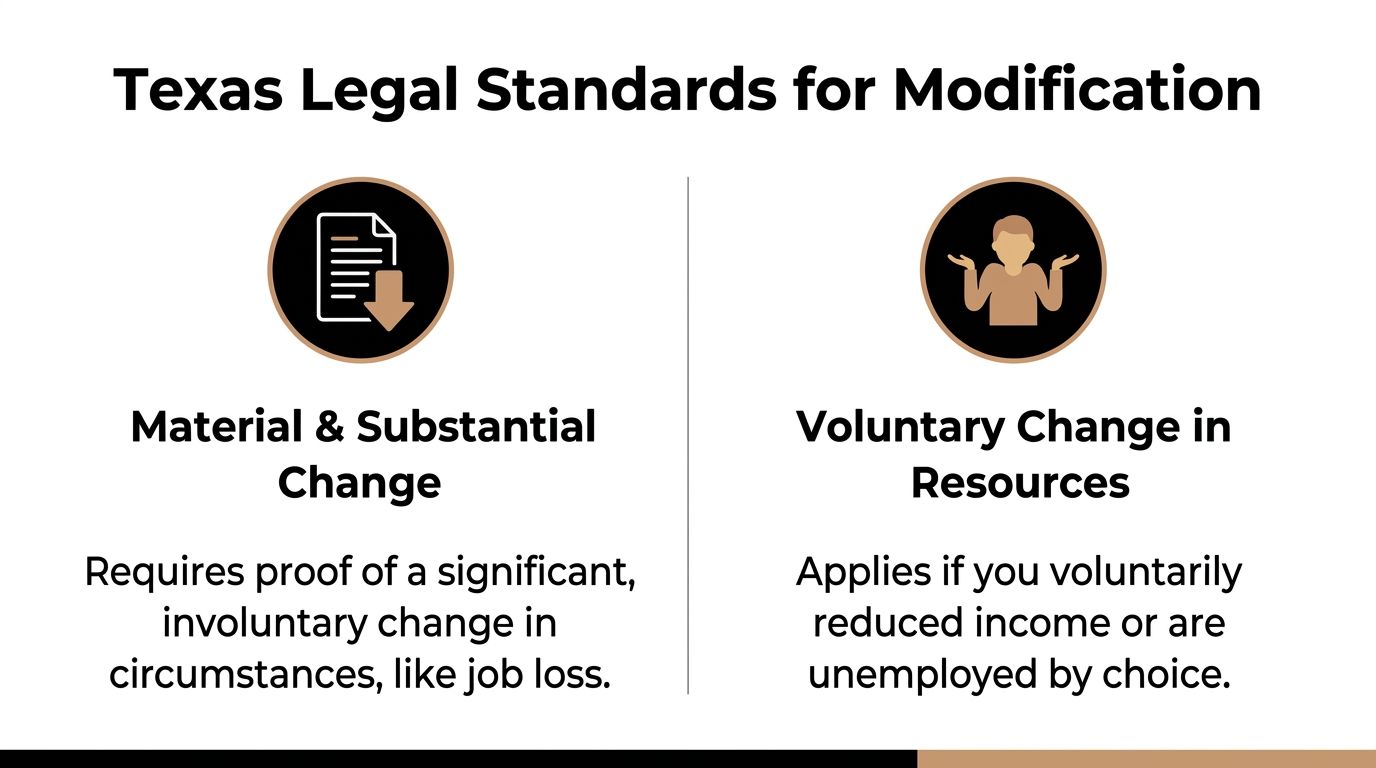
Texas does not reopen support orders just because the numbers feel tight. The law gives you two main ways back in, and you need to know which one fits your facts before you file. Texas Family Code §156.401 is the core modification statute, and Texas Law Help and the Attorney General both recognize the same basic pathways.
Material and substantial change after a layoff
The first path is a material and substantial change in circumstances. A layoff often fits, especially when it's involuntary and the loss is real, documented, and not a temporary dip you caused yourself. A company-wide reduction, a plant closure, or a termination tied to business conditions usually looks very different from a voluntary pay cut.
A 45-year-old project manager laid off from a $130,000 role is a classic example of the kind of case courts take seriously, because the drop is obvious and the evidence is usually clean. A small-business owner whose contract revenue dropped by half may also qualify, but that case usually needs stronger proof because courts want to separate market loss from self-directed choices.
The three-year review rule
The second path is the three-year review. If the order is at least three years old and the recalculated guideline amount would differ by 20% or $100, whichever is greater, the case can be reviewed even if you can't point to a dramatic life event. Texas Attorney General guidance also recognizes that a parent can request review when circumstances have changed, and that threshold becomes especially useful when old orders no longer match the current guideline picture.
That's where the new $11,700 net resources cap matters. An order from 2022 may now sit inside a different guideline range because the statutory cap changed effective September 1, 2025, which can materially affect a recalculation for higher earners. The current cap also matters in cases where the parent later recovers financially, because the guideline formula still starts with net resources under Texas Family Code §154.125.
If you're reviewing the statutory standard itself, Modifying Child Support Under §156.401 is the relevant reference point for when and how a Texas support order can be modified.
Filing Through the OAG Versus Filing in Court
Texas gives you two procedural lanes after a layoff, and the better one depends on how complicated your income picture is. One route runs through the Texas Office of the Attorney General Child Support Review Process, and the other runs directly through the court that issued the original order.
The OAG review path
The OAG process starts when one parent requests review. Both parties are contacted within 30 days, additional financial documents may be requested, and if the case qualifies the matter moves toward negotiation or court approval before a judge signs a new order. That process is usually the more efficient route when the issue is a straightforward guideline recalculation.
It's also the better choice when the evidence is clean and both sides are dealing mainly with an ordinary income drop. The OAG process is administrative, so it fits cases where the question is, “What should the guideline number be now?” rather than “Should the court deviate, impute higher income, or sort out contested arrears?”
The court petition route
A direct court filing is the right move when the case has more moving parts. You file a petition in the court with continuing exclusive jurisdiction, serve the other parent, exchange financial information, and take the case to hearing if it doesn't resolve. That route is slower and more formal, but it gives the judge room to address disputes under Texas Family Code §154.123, imputation issues, and other contested facts.
That is why a parent with a simple layoff often starts with the OAG, while a parent with a high-income record, a disputed work history, or a custody-driven deviation argument often needs the court track. The faster path is not always the better path if the facts are going to be contested anyway. For filing mechanics, how to file for child support in Texas is the procedural companion to the modification process.
The existing order still controls until a new one is signed. That's true in both lanes, so keep that in mind while the review is pending.
How Texas Calculates Support Under the New $11,700 Cap
Texas calculates guideline support using the obligor's net monthly resources under Texas Family Code §154.125. As of September 1, 2025, the guideline cap is $11,700 in net monthly resources, up from $9,200 before that date. Under the guideline schedule, the percentages are 20% for one child, 25% for two, 30% for three, 35% for four, and 40% for five or more.
What the cap changes in real life
The cap matters because Texas applies the percentage schedule to the first $11,700 of net monthly resources, not to unlimited income. So if a parent's net monthly resources are below the cap, the court uses the actual amount. If the parent's net monthly resources are above the cap, the formula still stops at the statutory maximum when computing the basic obligation.
For a parent with one child and $8,000 in net monthly resources before the layoff, the guideline amount would be 20% of $8,000, or $1,600 per month. If that same parent later recovers into a much higher income bracket, the guideline calculation still uses the capped amount once resources exceed $11,700.
What happens when the parent is unemployed
If a parent is unemployed, Texas courts may impute income based on what the parent could earn at a full-time minimum-wage job. Texas Law Help notes the current minimum wage is $7.25 per hour, or $290 per week before taxes. That can produce a much lower guideline amount than the prior order, but it doesn't mean support drops to zero just because a parent is between jobs.
A parent imputed at $1,257 per month would face a one-child guideline number of about $251 under the 20% schedule. That's a very different number from the pre-layoff order, but the court still needs proof that the unemployment is real and that the parent is looking for work.
| Number of Children | Percentage of Net Resources | Maximum at $11,700 Cap |
|---|---|---|
| 1 | 20% | $2,340 per month |
| 2 | 25% | $2,925 per month |
| 3 | 30% | $3,510 per month |
| 4 | 35% | $4,095 per month |
| 5 or more | 40% | $4,680 per month |
For a formula-driven overview, how to calculate child support in Texas is the right companion guide.
Building Your Evidence Packet Before You File
Your case is only as good as the documents you can put in front of a judge or OAG reviewer. The strongest post-layoff packets are organized, dated, and tied directly to the reason the income changed. If you wait until the hearing to start collecting records, you're already behind.
What to gather in the first two weeks
Start with termination records. That includes the layoff notice, separation agreement, final pay stub, and any WARN Act notice if the employer issued one. Those documents show the job loss was involuntary, which is the first thing the other side will try to attack.
Next, collect income history. Bring the last three years of tax returns, recent pay stubs, W-2s, severance statements, and unemployment benefit paperwork if you've applied. Those records show the court what your earning history looked like before the layoff and help rebut any claim that you're hiding income or describing the loss unfairly.
Then build a job search log. Save applications, recruiter emails, LinkedIn profile updates, interview records, and rejection letters or declined offers. That paper trail helps prove you're trying to return to work, not sitting on your hands while support goes unpaid.
A judge wants a timeline, not a story with missing dates. If the documents line up, your credibility goes up.
What the other side will look for
The weak spots are predictable. Failure to apply for unemployment benefits can make the layoff look less serious than it really was. Refusing comparable work, especially without a documented reason, can support a bad-faith argument that you're not minimizing the loss.
If you're doing the OAG review packet, the same records still matter, but the emphasis is on clarity and completeness. For a deeper checklist of what to pull together, evidence needed for a child support case in Texas tracks the kinds of documents that tend to matter most.
Defenses the Other Side Will Raise and How Courts Rule
The other parent, or the OAG, usually does not argue that the layoff never happened. The fight is usually about whether the income loss should count, how much income should be imputed, and whether support should have been paid while the case was pending.
Voluntary underemployment and imputed income
The most common defense is voluntary underemployment. If a parent quit a $90,000 job to take a $35,000 job for lifestyle reasons, a court is much less likely to reduce support than if the entire department was eliminated. Texas Family Code §154.066 gives courts room to impute income when a parent is intentionally earning less than they could.
That doesn't mean every low-income case loses. It means the parent has to prove the reduction was not a self-created strategy to cut support. In an involuntary layoff case, the court is looking for evidence of the termination itself, the job search, and the realistic earning capacity going forward.
Arrears between the layoff and the new order
The second defense is the arrears argument. If payments were missed before the new order was signed, the other side will say those amounts are still due under the old order. That position is usually strong because the existing order remains enforceable until modified.
What the judge wants to hear
Courts respond best when the affidavit is direct. A strong sworn statement says the layoff was involuntary, identifies the employer and date of separation, confirms what you're doing to find work, and explains why the current order no longer matches present income. It should not sound defensive or vague.
A good affidavit sounds like this in substance, not as a script. “My job ended because my position was eliminated. I am actively applying for comparable work, and I'm asking the court to recalculate support based on current net resources under the Family Code.” That kind of language helps because it lines up with the legal standard instead of arguing around it.
Your First 30 Days After a Texas Layoff
The first month after a layoff is a race between your paperwork and the old order. If you handle the next few weeks correctly, you give yourself a real chance to reduce future support without turning the delay into an arrears problem. If you handle it casually, the case gets harder fast.

Start by filing the modification request as soon as you can. Do not wait for the “perfect” packet if the layoff is already real. The filing starts the process, whether you choose the OAG review path or a petition in court, and it tells the other side and the court that the support number is now in dispute.
Then keep paying under the current order if possible. That's not because the old number is fair. It's because the order is still enforceable until modified, and paying while the case is pending protects you from avoidable arrears exposure. At the same time, apply for unemployment benefits that same week and start documenting every job search step daily.
After that, push for a financial records exchange. You need the other side's income information if the case will involve deviations, custody arguments, or a contested ability-to-pay issue. A simple guideline recalculation may move quickly through the OAG, but a contested court case needs complete financial disclosure.
Which path makes sense
Choose the OAG review if the layoff is clean, the numbers are straightforward, and you want an administrative process that tracks guideline support. Choose the court petition if the facts are disputed, the case involves imputed income, or you need the judge to address §154.123 deviation arguments. High-income cases, mixed-employment histories, and cases with complex custody schedules usually benefit from counsel early.
A Texas modification is rarely instant. Many cases take 60 to 120 days from filing to order, and the new order is generally not retroactive to the date of job loss. That's why the sooner you file, the better your position tends to be.
FAQs
Do unemployment benefits count as income for child support in Texas?
Usually, yes, they can matter in the support calculation because Texas uses net monthly resources under §154.125. The court looks at the financial picture, not just the label on the payment. That said, unemployment benefits don't erase the layoff or guarantee the same child support number. The procedural steps in the earlier sections still control, so file quickly and document the benefit application.
Can my modification go back to the date I was laid off?
Usually no. A modification is generally not retroactive to the layoff date, which is why filing date matters so much. The old order remains enforceable until a new order is signed, and missed payments can become arrears. That's the core reason to move immediately after the job loss instead of waiting for a better time to prepare.
What happens to medical support and dental support if my income drops?
A drop in income doesn't automatically remove medical support or dental support obligations. Those issues are handled through the order and the court's review of current circumstances, just like cash support. If the support case is being modified, the judge can look at the full financial picture, but you should not assume health-related obligations vanish just because wages fell.
How does 50/50 custody affect a job-loss modification?
A 50/50 schedule can affect guideline support, but it does not eliminate the need to modify an existing order after a layoff. The court still looks at §154.123 for deviations and §154.125 for guideline resources. If custody and income both changed, that's a strong reason to file in court rather than relying only on an informal agreement or a simplified review.
If you're dealing with a layoff and a support order you can't keep up with, Texas Child Support Law Office of Bryan Fagan can help you evaluate the right modification path, organize the proof, and prepare for either an OAG review or a court hearing. Visit Texas Child Support Law Office of Bryan Fagan to get a focused look at your options and move before arrears build under the current order.