Under Texas Family Code §154.069 and §156.404, a new spouse's income is not added to a parent's net resources when calculating child support, so remarriage alone does not change the guideline amount. Even if the new spouse earns substantially more, Texas law keeps the support calculation focused on the legal parent's own resources.
That answer surprises many parents because household finances often change dramatically after remarriage. The legal result, however, is narrower than the financial reality. A new spouse's earnings stay outside the formula, while the parent's own bonuses, commissions, rental income, business receipts, and other resources remain relevant. The September 1, 2025 increase in Texas's guideline cap from $9,200 to $11,700 also changes the litigation strategy in high-income cases, particularly disputes over deviations, hidden income, and earning capacity.
The Statutory Rule Excluding a New Spouse's Income
Texas draws a bright line between a parent's resources and a new spouse's resources. Under Texas Family Code §154.069, the court may not add any portion of a spouse's net resources to the obligor's or obligee's net resources when setting child support. The statute also prevents the court from subtracting a spouse's needs when deciding whether support should be modified. The parallel modification rule appears in §156.404. See the Texas Family Code provisions governing net resources and modification.
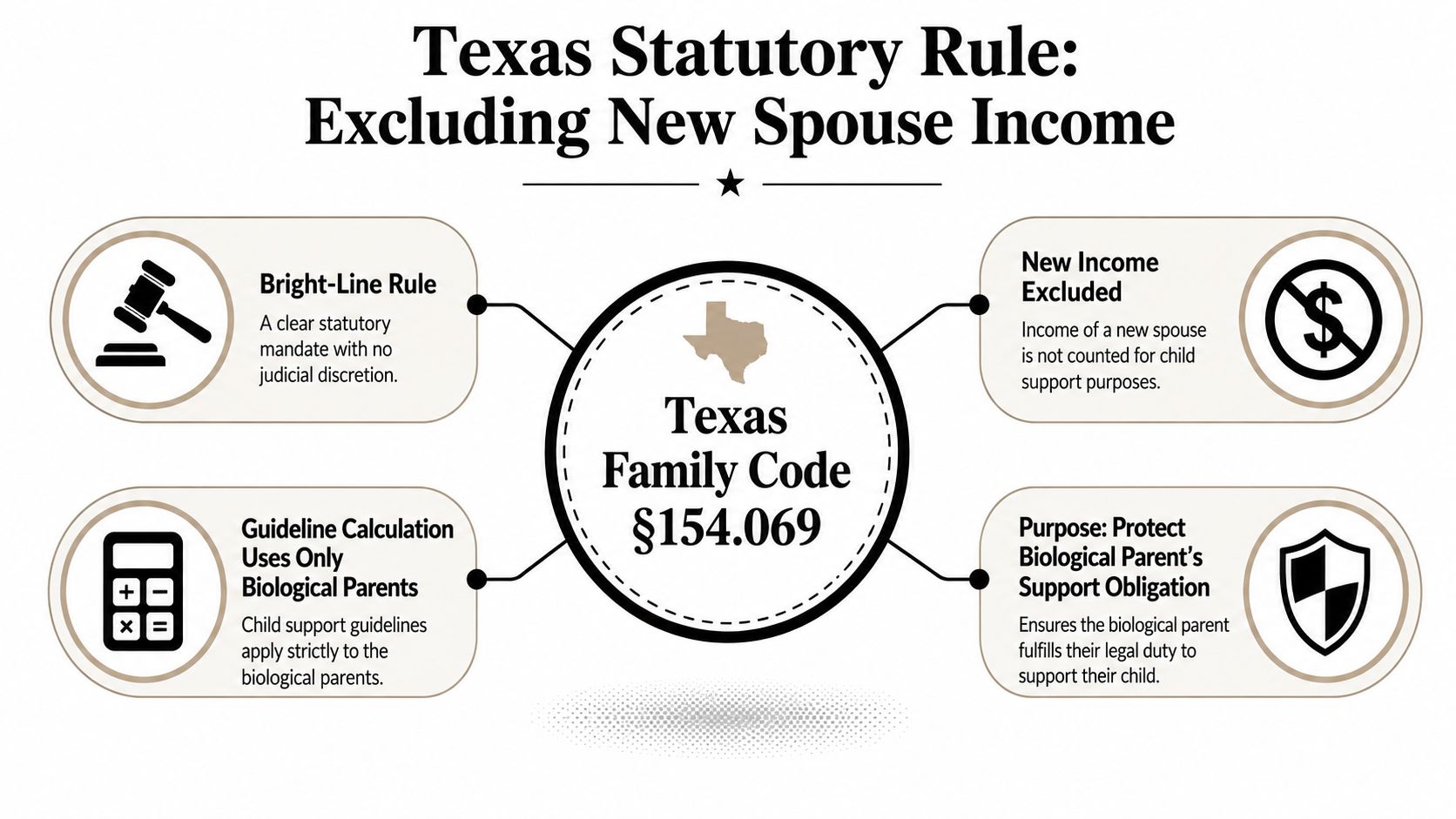
The practical consequence is straightforward. If a parent remarries, the court doesn't combine the household's earnings and recalculate support. A step-parent has no legal duty to support the child for purposes of adding that person's income to the biological or legal parent's resources. The same principle applies whether the new spouse earns less than the parent, earns substantially more, or pays most household expenses.
What the court counts instead
Texas defines the evaluated parent's net resources broadly. Depending on the facts, the calculation can include:
- Employment income, including wages, commissions, and bonuses.
- Investment receipts, including interest and dividends.
- Business income, including income from self-employment.
- Rental income, after appropriate expense deductions.
- Other receipts that qualify as resources under the statutory framework.
That broad definition prevents a parent from shielding personal income merely because the household includes a new spouse. If the parent receives a bonus, operates a business, collects rent, or earns investment income, those resources may matter even though the spouse's separate earnings do not.
Practical rule: Household wealth isn't the same thing as the obligor's statutory net resources.
This distinction matters in both initial support cases and modification proceedings. A parent can't demand a lower obligation by subtracting the new spouse's needs, and the other parent can't demand a higher guideline amount by adding the spouse's paycheck. The legal inquiry remains tied to the parent whose support obligation is being determined.
For a practical discussion of the issue, see Texas child support and remarriage. The difficult cases begin when one side argues that the spouse's finances reveal something about the parent's own income, earning capacity, or credibility. That is an indirect evidentiary question, not permission to include the spouse's income directly.
How Texas Calculates Guideline Child Support Under the 2025 Cap
The September 2025 cap increase changes the starting point for many high-income support disputes. It does not change the rule excluding a new spouse's earnings. Guideline support remains tied to the obligor's monthly net resources and the number of children. Under Texas Family Code §154.125, the presumptive percentages are 20% for one child, 25% for two children, 30% for three children, 35% for four children, and 40% for five children. The five-child percentage serves as the floor for six or more children. See the Texas guideline percentage provisions.
Effective September 1, 2025, the standard guideline calculation applies up to $11,700 in monthly net resources, according to the Texas Attorney General's child support calculator. Before that change, the commonly used ceiling was $9,200 per month. The higher cap places more of the obligor's own resources inside the presumptive calculation. It does not permit the court to add a new spouse's income.
The basic calculation
A practitioner usually handles the guideline calculation in this sequence:
- Determine the obligor's gross monthly resources.
- Subtract allowable deductions to reach monthly net resources.
- Apply the guideline ceiling when net resources exceed the cap.
- Apply the percentage corresponding to the number of children.
- Analyze medical support, dental support, possession, and any requested deviation separately.
At the cap, the standard amounts are:
| Number of Children | Guideline Percentage | Maximum Monthly Support |
|---|---|---|
| One child | 20% | $2,340 |
| Two children | 25% | $2,925 |
| Three children | 30% | $3,510 |
| Four children | 35% | $4,095 |
| Five children | 40% | $4,680 |
These figures apply the statutory percentages to $11,700, consistent with the method described in this guide to how Texas courts calculate net resources. If the obligor's monthly net resources are $14,000, the standard formula generally uses $11,700 rather than the full $14,000. For one child, the presumptive capped amount is $2,340.
If net resources fall below the cap, the court uses the supported net-resource figure rather than automatically substituting $11,700. The evidence must therefore establish the parent's actual monthly resources, including variable compensation and qualifying receipts. A useful reference on How Child Support Is Calculated in Texas explains the guideline formula and the role of net resources.
In a high-income case, the cap sets the guideline baseline. The September 2025 increase may reduce the gap between the guideline amount and the support sought, which can affect whether a party pursues a deviation and what financial evidence becomes worth presenting. A court still must analyze any requested departure under the applicable statutory factors, and a new spouse's paycheck remains outside the obligor's guideline income.
When a New Spouse's Finances Can Indirectly Affect the Case
The statutory exclusion doesn't make every fact about the new spouse irrelevant. It limits what the court may count as the parent's resources. The other side may still use household financial evidence to argue that the parent's sworn financial picture is incomplete, that income has been shifted, or that the parent is voluntarily earning less than the parent could earn.

The line between evidence and inclusion
Consider a parent who reports limited income but maintains a household with expensive housing, frequent discretionary spending, and business expenses paid through a joint account. The other parent may argue that the financial records show undisclosed personal income or that the parent has access to resources not reported in the discovery responses. That argument asks the court to identify the parent's own resources. It doesn't allow the court to label the new spouse's paycheck as the parent's income.
The same issue can arise when the new spouse pays the parent's personal expenses. Payment of an expense may be relevant to credibility or actual financial circumstances, but the legal characterization matters. A spouse's earnings don't become the obligor's net resources merely because the couple shares a home or account. The court must distinguish between the spouse's separate income and receipts, benefits, or income that belong to the parent.
Imputation and underemployment arguments
A parent may also face an imputation argument. If the parent leaves a job, reduces work, or reports income inconsistent with established skills, the opposing party may contend that the parent is underemployed or voluntarily unemployed. The spouse's financial support can become part of the factual narrative because it may explain how the parent maintains the household despite reporting limited earnings.
That doesn't mean the court can use the spouse's income as a substitute. The stronger approach is to focus on the parent's earning capacity, employment history, qualifications, business records, and actual receipts. The weaker approach is to argue only that the new spouse earns a high income, without connecting that fact to the legal parent's own resources or earning capacity.
The question isn't whether the new spouse is prosperous. The question is whether the legal parent's financial evidence is accurate and complete.
Prepare bank statements, pay records, bonus documentation, business ledgers, rental records, and records showing who paid which expense. A clean evidentiary record helps the court apply §154.069 without allowing either side to confuse household lifestyle with statutory income.
Deviations from the Guidelines Under Section 154.123
The guideline amount under §154.125 is presumptive, but it isn't always the final order. Under Texas Family Code §154.123, a court may deviate when applying the guideline amount would be unjust or inappropriate. The statute identifies factors such as the child's age and needs, each party's ability to contribute, custody and visitation time, and travel expenses associated with access. The statutory deviation factors under §154.123 provide the framework.
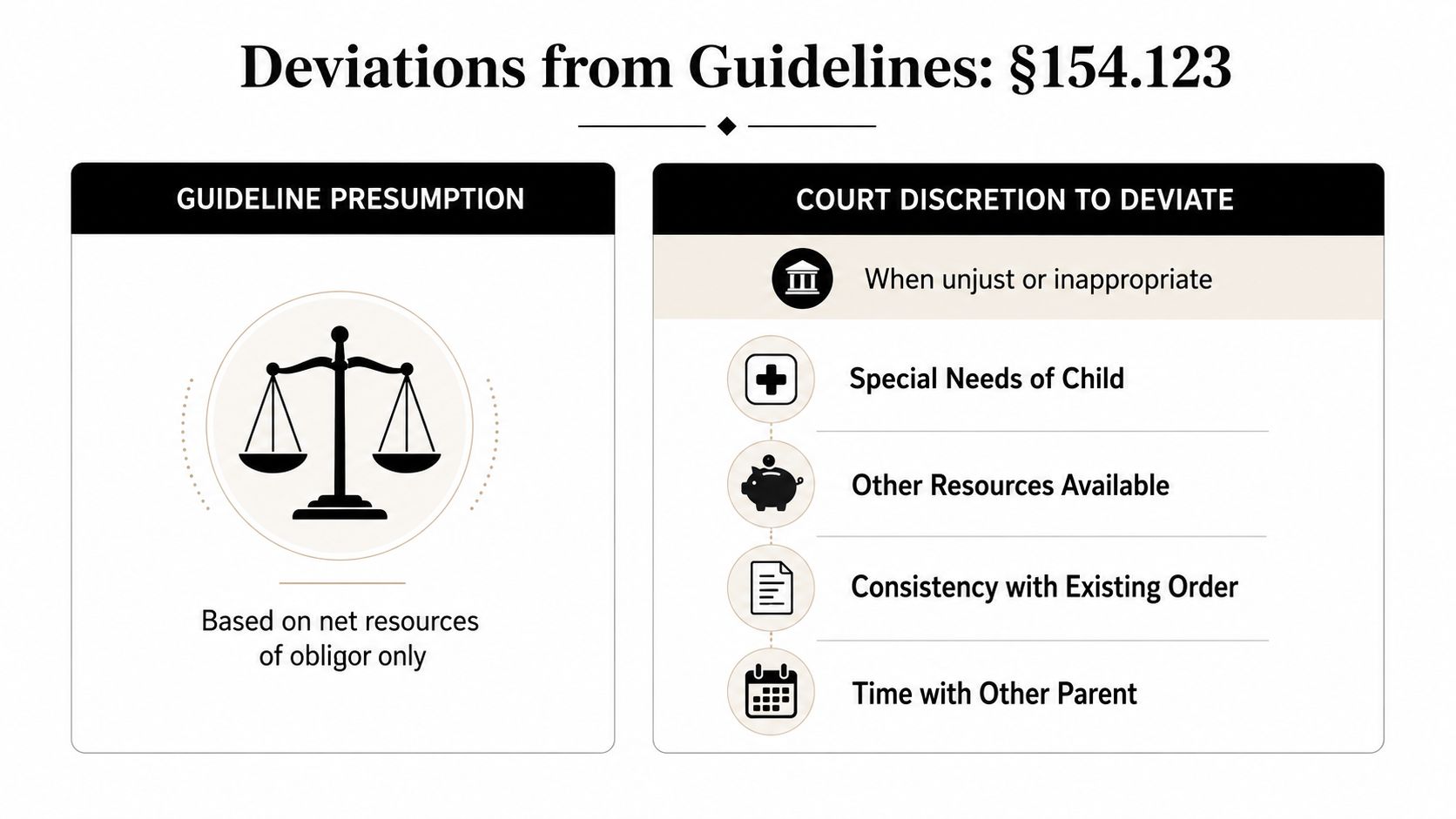
The 2025 cap increase changes the practical stakes. More high-income parents now have guideline calculations that reach the new ceiling, but income above $11,700 in monthly net resources isn't automatically multiplied into the baseline formula. A parent seeking more support must therefore present evidence supporting a deviation, rather than treating every dollar above the cap as automatically subject to the guideline percentage.
Baseline calculation compared with deviation analysis
| Guideline presumption | Deviation analysis |
|---|---|
| Uses the obligor's net resources | Examines whether the result is unjust or inappropriate |
| Applies the statutory percentage | Considers the child's proven needs and statutory factors |
| Stops at the applicable cap | Can address circumstances not captured by mechanical multiplication |
| Provides a starting amount | Requires evidence supporting a departure |
Suppose the guideline calculation reaches the cap for one child. An upward-deviation request might rely on documented extraordinary medical costs, special educational needs, or substantial travel expenses connected to the possession schedule. General claims that the household is affluent won't carry the same weight as admissible evidence tied to the child's actual needs.
A downward request also requires evidence. A parent may point to possession-related travel, other legally relevant obligations, or a material change affecting the ability of the parties to contribute. The new spouse's income still cannot be directly added, and the spouse's needs cannot be deducted under the statutory rules. The focus remains on the child, the parents, and the factors listed in §154.123.
For a more detailed discussion of the comparison between guideline support and judicial discretion, review how judges calculate child support deviations in Texas.
The most persuasive presentation separates the guideline number from the requested adjustment. It identifies each expense, explains why it is child-related, supplies supporting records, and shows why the presumptive amount would be inadequate or excessive.
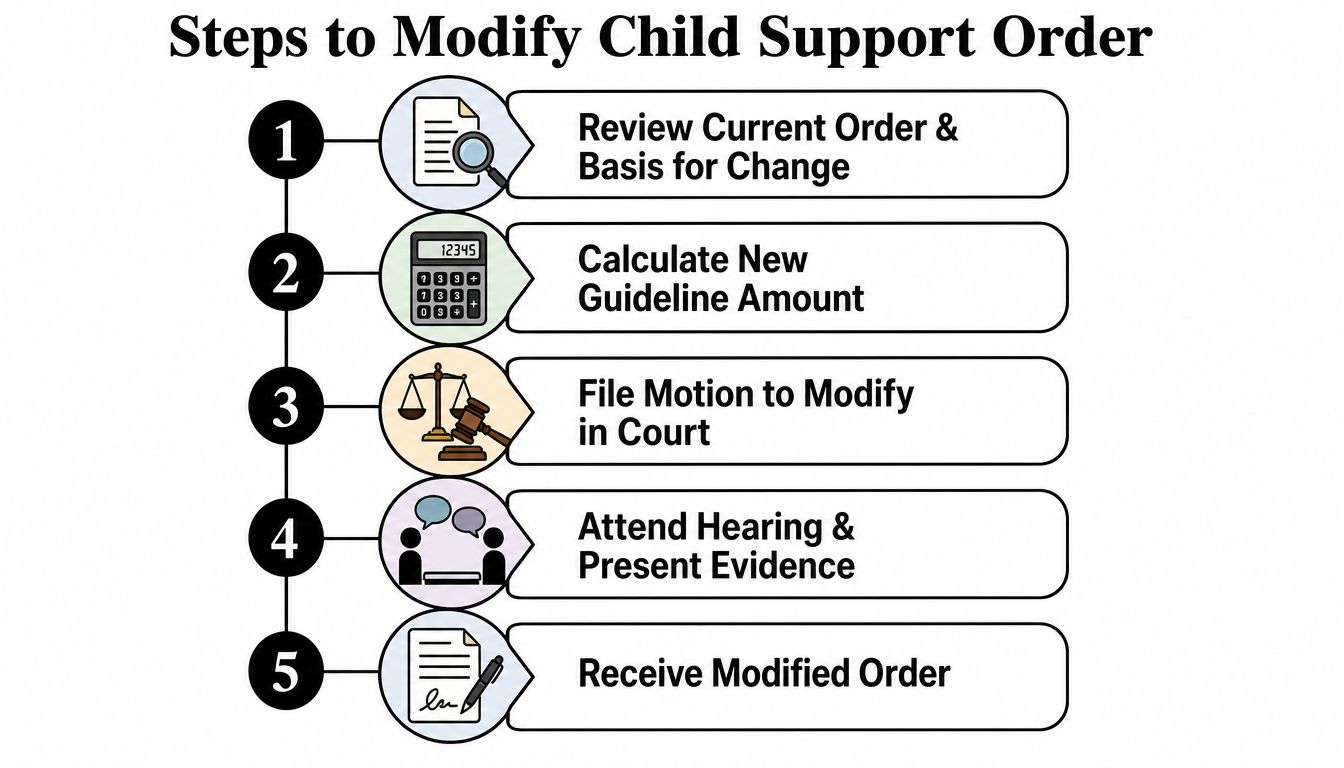
Procedural Steps to Modify or Challenge a Child Support Order
A remarriage doesn't modify a Texas child support order by itself. A parent seeking a change must use the formal modification process and prove a statutory basis for changing the existing order. The Texas Attorney General describes a process involving a completed request, service on the other party, and either an administrative Child Support Review Process, known as CSRP, or a court hearing when judicial action is required. The Texas Attorney General modification process provides the official procedural roadmap.
Build the case before filing
Start by reviewing the current order. Identify the existing net-resource findings, possession terms, medical-support provisions, and any language addressing deviation. Then determine what has changed and whether the requested relief concerns an increase, reduction, enforcement issue, or correction of an improper income calculation.
A practical preparation file should include:
- Income records: Recent pay documentation, bonus and commission records, tax materials, and business or rental records.
- Expense evidence: Receipts and statements for child-related medical, educational, and travel costs.
- Household records: Joint-account materials and payment histories that clarify whether an expense was paid by the parent or the new spouse.
- Order history: The existing order, prior modifications, enforcement records, and proof of payments.
The filing party must make sure the other parent is properly served. Service gives the court authority to proceed and gives the opposing party notice of the requested change. Informal discussions or private agreements don't replace a modified court order when the existing order remains in effect.
Choose the correct procedural path
CSRP is an administrative process used to establish, modify, or enforce child, medical, and dental support obligations and to address paternity. If the case requires judicial findings, contested evidence, or relief beyond the administrative setting, the matter proceeds through court practice, including a hearing.
Completed modification forms are directed to the Child Support Division in Austin under the Attorney General's stated process. Whether the case proceeds administratively or in court, the parent requesting relief must present evidence supporting the change. The 2025 cap increase alone isn't an automatic modification order.
Common Defenses Against Improper Income Arguments
The most direct defense is statutory. If the other side proposes adding a new spouse's wages, bonuses, or business receipts to the obligor's net resources, object under §154.069. If the other side seeks to subtract the spouse's needs in a modification analysis, §156.404 supplies the corresponding protection.
That objection should be paired with a precise alternative calculation. Don't rely on a broad complaint that the other side is treating the household as one economic unit. Identify the parent's own income, allowable deductions, variable compensation, and qualifying receipts, then show exactly which proposed item belongs to the spouse rather than the obligor.
Attack the calculation, not the family structure
Lifestyle evidence can be useful, but it can also mislead. A large home or expensive vehicle may reflect the spouse's earnings, inherited assets, debt, or a shared financial arrangement. None of those facts automatically establishes the parent's net resources.
Use discovery to separate the accounts and obligations:
- Trace ownership: Determine whose name appears on accounts, contracts, property records, and business documents.
- Trace payments: Identify whether the parent or spouse paid each disputed expense.
- Test variable income: Compare reported bonuses, commissions, distributions, and rental receipts against deposit records.
- Challenge unsupported assumptions: Require the opposing party to connect household spending to the parent's own resources or earning capacity.
The cap increase also offers a disciplined defense in high-income cases. The fact that the ceiling is now $11,700 doesn't itself prove that an upward deviation is warranted. Under §154.123, the requesting parent still needs evidence of the child's needs and the other statutory factors. A higher cap changes the guideline baseline, but it doesn't eliminate the need for proof.
A strong response gives the judge a reliable number, a clean exhibit trail, and a statutory reason to reject the proposed income theory.
If the evidence supports imputation, address the parent's work history and earning capacity directly. If it doesn't, explain why household support from a new spouse cannot be converted into the obligor's income merely through inference.
Frequently Asked Questions About Remarriage and Texas Child Support
Does a step-parent's income count in Texas child support?
Generally, no. Under §154.069, the court may not add the new spouse's net resources to the parent's net resources. The court evaluates the legal parent's own qualifying resources instead.
Can remarriage reduce child support?
Remarriage alone doesn't change the guideline calculation. A separate change affecting the parent's own income, legally relevant obligations, or other statutory circumstances may support a modification, but the spouse's needs aren't deducted under §156.404.
What if the custodial parent marries a high earner?
The custodial parent's new spouse's income isn't added to that parent's resources for the guideline calculation. The court may still examine the custodial parent's own financial resources and the child's needs when considering support or a deviation under §154.123.
Does remarriage affect child support arrears or enforcement?
No automatic cancellation or reduction follows remarriage. Existing arrears remain enforceable unless addressed through the appropriate legal process. Enforcement and modification are separate issues, and a parent should continue complying with the current order while a requested change is pending.
Is the 2025 cap change by itself grounds for modification?
No. The guideline cap increased from $9,200 to $11,700 effective September 1, 2025, but a parent still must initiate the formal process and prove a statutory basis for modifying the existing order. The cap may affect the calculation and litigation strategy, but it doesn't create an automatic new order.
Can the court consider the new spouse indirectly?
The spouse's income can't be directly included. Household financial evidence may still be relevant if it helps establish the parent's own undisclosed resources, earning capacity, or credibility. The distinction should be made clearly in pleadings, discovery, and exhibits.
Texas Child Support Law Office of Bryan Fagan handles child support establishment, modification, enforcement, and defenses involving remarriage, high-income calculations, net resources, and §154.123 deviations. Visit Texas Child Support Law Office of Bryan Fagan to discuss the current order, the 2025 cap, and the evidence needed for your Texas hearing.