The envelope shows up, or opposing counsel emails a proposed order. You read the number once, then again, because it doesn't match what you bring home. A lot of Texas parents end up in that spot. They assume the court has already decided what they owe and there's no room to fight it.
That's wrong.
If you want to know how to avoid paying too much child support in Texas, start with this rule: don't argue from frustration. Argue from the Texas Family Code, your net resources, and your documents. Courts don't lower support because a payment feels unfair. Courts lower it when the numbers were calculated wrong, the evidence is incomplete, or the facts justify a different result under Texas Family Code §154.123 and §154.125.
The law gives you tools. Use them correctly and you can stop a bad number from becoming a signed order, or fix an old order that no longer matches reality.
Ensuring a Fair Child Support Order in Texas
A fair child support order isn't about escaping responsibility. It's about preventing a number that is inflated, sloppy, or detached from the actual evidence.
Texas courts don't base support on raw salary headlines. They focus on monthly net resources, and the court can also consider whether a guideline result should be adjusted under Texas Family Code §154.123. That matters because many parents walk into court thinking the judge will glance at a pay stub and pick a number. Good judges don't do that. They look at what the statute requires, what the record shows, and whether either side has done the math correctly.
What usually goes wrong
In real cases, overpayment problems usually start in one of four places:
- Bad income framing. The other side uses gross income instead of net resources.
- Missing records. You don't bring enough proof, so the court fills the gap with assumptions.
- Informal arrangements. You and the other parent “agree” to something that never gets signed into a court order.
- No strategic response. You react emotionally instead of building a record.
Practical rule: If a fact helps your child support position, prove it with paper. If you can't prove it, don't expect the judge to rely on it.
What a fair result actually looks like
A fair result is legally grounded. That means the judge or associate judge can trace the order back to the Family Code, the evidence, and any justified deviation. Under Texas Family Code §154.125, guideline child support follows a statutory framework. Under §154.123, the court may depart from that framework when applying the guideline amount would be unjust or inappropriate.
That's where smart case preparation changes outcomes. You don't need a dramatic story. You need a clean financial file, a coherent explanation, and a legal theory that fits the facts.
Mastering the Texas Child Support Calculation
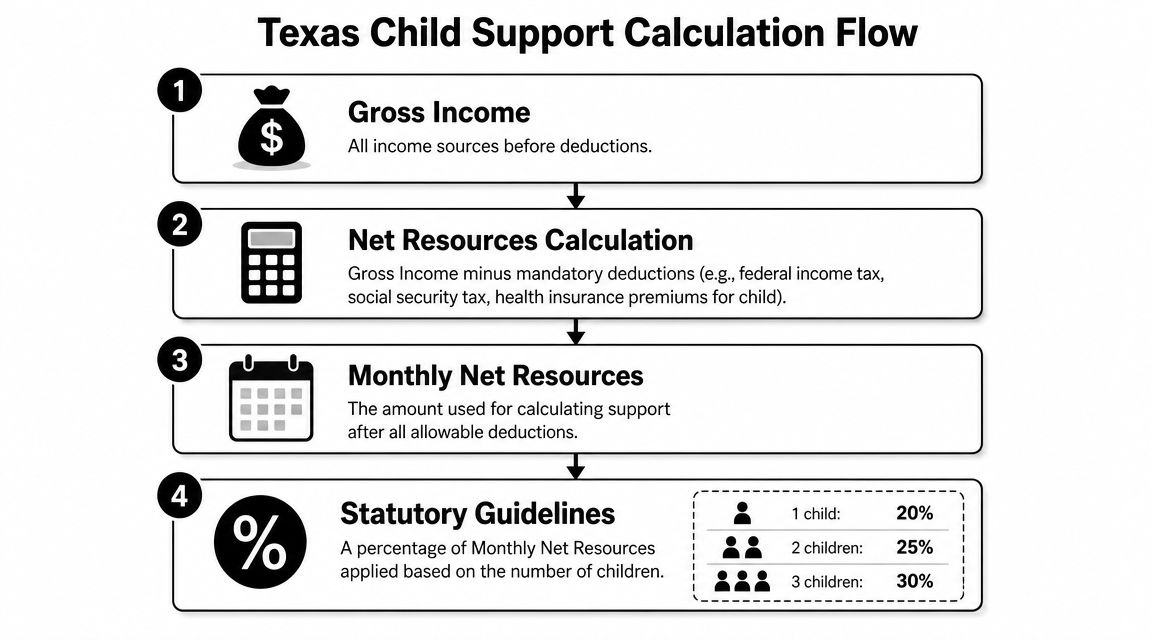
Most parents overpay because they misunderstand the starting point. Texas child support is based on monthly net resources, not gross income. Texas Law Help states that the guideline percentages are 20% for one child, 25% for two, 30% for three, 35% for four, and 40% for five, with at least 40% for six or more, and that the low-income schedule applies when monthly net resources are $1,000 or less for cases filed on or after September 1, 2021, while the older guideline cap was $9,200 per month before the later update (Texas Law Help on child support and lower incomes).
Start with net resources, not paycheck envy
Under Texas Family Code §154.062, the court works from net resources. Under §154.125, it applies the guideline percentages to that number.
That means your first job is to separate the legal calculation from the emotional one. “I earn a decent salary” is irrelevant. “My monthly net resources under the statute are X” is useful.
If you need a more detailed breakdown of the mechanics, review this Texas child support calculation guide.
The four-part calculation
-
Identify income sources
Gather wage records, salary, commissions, bonuses, and other income the court can count under the Family Code. -
Calculate net resources
The legal issue isn't what hits your gross annual compensation statement. The issue is what remains after the statutory calculation. -
Apply the guideline percentage
Under §154.125, the percentage depends on how many children are before the court. -
Check the cap issue
In high-income cases, the cap matters because the guideline formula doesn't automatically keep scaling forever.
A simple example
Assume a parent has already calculated monthly net resources and the case involves one child. Under Texas Family Code §154.125, the guideline percentage is 20%. If the case involves two children, the guideline percentage becomes 25%. The legal fight usually isn't over the percentage. It's over whether the net resources number is right in the first place.
That's why I tell clients not to obsess over the table until we've tested the inputs.
The fastest way to overpay is to accept the other side's income worksheet without rebuilding it line by line.
The 2025 cap change matters
A major change took effect on September 1, 2025, when Texas increased the child support net-resource cap from $9,200 to $11,700 per month, meaning high-income parents now face guideline calculations on a larger income band before any upward deviation analysis begins. That same reporting explains that parents with earnings between $9,200 and $11,699 are now subject to the regular guidelines without the old cap cutting off the calculation, and any modification based on the new cap requires affirmative action rather than automatic adjustment (Texas child support guideline cap update).
Here's the practical takeaway. If your income falls in that band, old assumptions may be outdated. If you already have an order, don't assume the amount changes on its own. You still have to take action through the court.
Gathering Evidence to Prove Your Financial Reality
Judges don't reward incomplete stories. They decide cases based on what they can verify.
If you show up with vague claims about reduced income, unstable work, business losses, or shared expenses, you invite the court to distrust your numbers. Under Texas Family Code §154.068, disclosure failures can hurt you badly because the court may credit the other side's evidence if you haven't produced your own financial information.
Bring records that answer the judge's actual questions
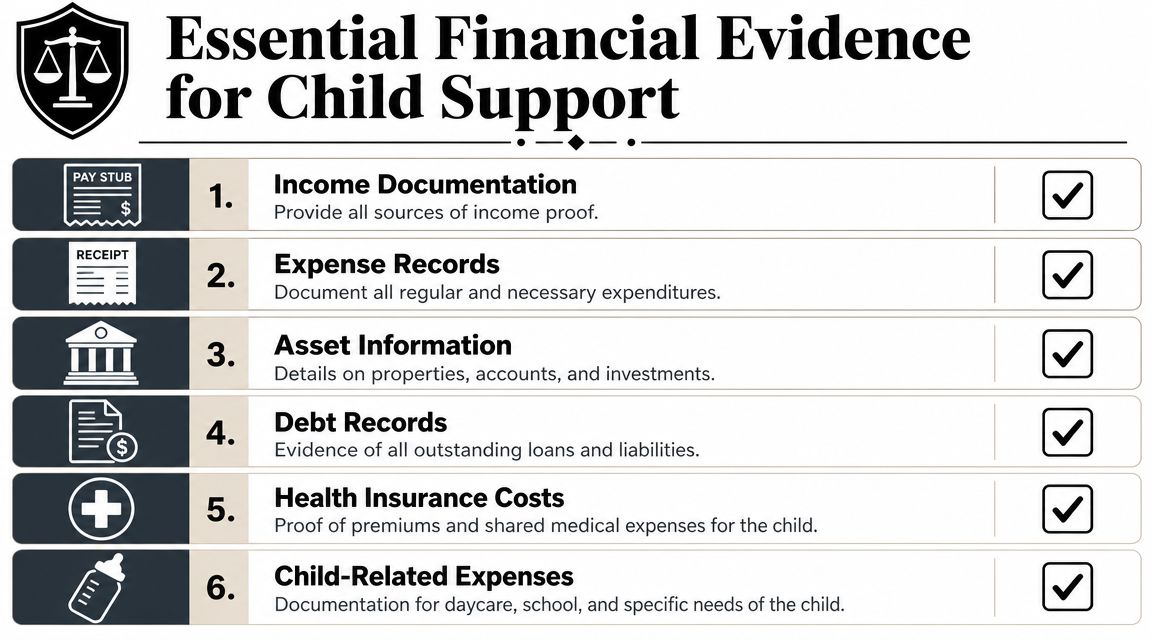
The evidence file that helps most often includes:
- Income proof. Recent pay stubs, employer verification, and complete tax returns.
- Bank activity. Statements that show deposits and consistency, or inconsistency, in earnings.
- Insurance records. Proof of health insurance premiums tied to the child.
- Support history. Existing orders and payment records if you support another child under a different order.
- Parenting records. Calendars, possession logs, and communications that show how parenting time works in real life.
For a more focused checklist, use this evidence guide for Texas child support cases.
If your income is irregular, your proof has to be better
Self-employed parents, commission earners, and parents between jobs get scrutinized more heavily. That's not unfair. It's predictable.
Texas Law Help notes that if a parent is unemployed or underemployed, a Texas court may impute income based on what that parent could earn at a full-time minimum-wage job. It also states that SSI is not counted as income, and an order can be reduced to $0 if SSI is the only income source (Texas Law Help on child support income rules).
That rule cuts both ways. If you are unable to earn what you used to, document the reason. If you tell the court business is “slow” without further detail, expect pushback.
What to collect before any hearing
Use this short working file checklist:
| Document | Why it matters |
||—|
| Recent pay records | Shows current earnings |
| Tax returns | Helps test patterns and credibility |
| Bank statements | Confirms deposits and cash flow |
| Job search records | Counters claims of voluntary unemployment |
| Medical or childcare records | Supports or rebuts deviation arguments |
| Possession logs | Helps frame actual parenting responsibilities |
If you can't substantiate reduced earnings, deductions, or child-related costs, the court is more likely to calculate support from a broader and less favorable picture.
One practical note. If you're asking the court to believe your current income is lower than before, don't make the judge hunt for the explanation. Put it in a clean packet with exhibits, dates, and a short summary that matches the documents.
Modifying Your Order When Circumstances Change
A child support order doesn't rewrite itself when your life changes. If your income drops, your schedule changes, or the old number no longer fits the law, you need a modification. Until a new order is signed, the old one controls.
That is where many parents make expensive mistakes. They rely on text messages, verbal agreements, or temporary side deals. Those don't stop wage withholding and they don't protect you from arrears.
The two legal doors into modification
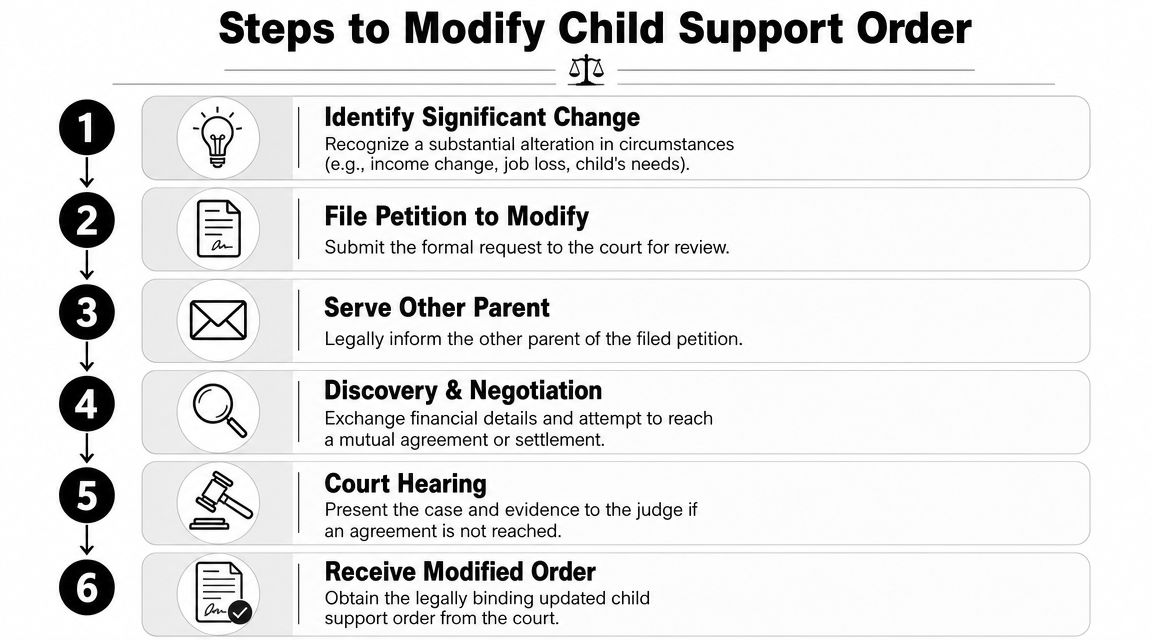
The strongest technical path for a parent who believes they are paying too much is to file a formal modification and prove either a material and substantial change in circumstances or eligibility under the three-year review rule, where the recalculated amount must differ from the current order by at least 20% or $100 per month (Flatiron Legal on changing an unfair child support order).
Under Texas Family Code Chapter 156, those are the gateways. If you don't fit one, the court may leave the order alone even if you dislike it.
How the process actually works
-
Review the current order carefully
Confirm what county issued it, what amount is ordered, and whether income withholding is in place. -
Recalculate support correctly
Compare the current order to a fresh legal calculation based on current facts. -
Gather your evidence package
The best practice is to collect tax returns, current pay records, bank statements, and employer information before filing. -
File the petition in the issuing court
Most modification actions go back to the court that signed the order unless jurisdiction has changed.
The court process usually continues with service on the other parent, possible temporary negotiations, discovery if needed, and then either settlement, mediation, or a hearing.
This video gives a useful visual overview of the process:
Don't wait for the problem to fix itself
A delayed filing usually means a delayed remedy. If your income dropped months ago and you keep paying an amount that no longer matches reality, every month you wait can deepen the problem.
Courtroom advice: File when the evidence is ready, not when the pressure becomes unbearable.
And once the case is filed, stay disciplined. Answer discovery. update records. appear at hearings. Modification cases are often won by the parent who is more organized, not the parent who is more upset.
Strategic Options Beyond the Guidelines
You can follow the guideline percentages perfectly and still end up with an unfair order. That happens when a parent walks into court with no theory of the case beyond "the math should fix it." In Texas, the better approach is to build a record that shows why the guideline number misses the actual facts.
Texas Family Code §154.123 gives the court room to depart from the guideline amount when applying the guidelines would be unjust or inappropriate. Use that statute aggressively, but use it with proof. Judges do not reduce support because a parent feels overcharged. They act when the evidence ties your facts to a recognized reason for deviation.

50 50 custody still requires a real support analysis
Equal parenting time does not cancel child support in Texas. If you have a true 50/50 schedule, treat it as a deviation argument that needs documentation, not as an automatic win.
The court will still look at each parent's resources, who pays which recurring child expenses, and whether one household is carrying more of the financial load. Your job is to prove the full picture. Show what you pay directly for housing, food, school costs, insurance, activities, and transportation during your possession periods. A parent who merely says, "I have the child half the time," usually loses that argument.
High-income cases are won on proof of needs
Above the guideline cap, the case changes. The fight stops being about a simple percentage and starts being about the child's proven needs. Keep it there.
Do not let the other side inflate support by blurring the line between the child's needs and an adult's preferred lifestyle. Force specificity. Ask for itemized expenses, supporting records, and a clear explanation of what the child needs beyond the guideline amount. If your case turns on income above the cap, review this guide to high-income child support in Texas before you frame your evidence.
Deviation arguments that actually matter
Some arguments move a Texas judge. Some do not. Focus on the ones the statute supports and the evidence can prove:
- Expanded possession. Show the exact schedule and the actual costs you cover in your home.
- Travel expenses. If visitation requires significant travel, document those out-of-pocket costs with receipts, mileage logs, and booking records.
- Child-specific expenses. Separate real needs from broad claims about comfort, convenience, or status.
- Unequal payment of extras. If you already pay insurance, school tuition, tutoring, therapy, or activity fees, put those numbers in evidence.
- Income that looks larger on paper than it is in practice. This comes up often with self-employment, commission income, and irregular compensation. You need organized records that explain the difference.
Details matter here. So does presentation. A clean spreadsheet tied to bank records and invoices is often more persuasive than ten paragraphs of complaints.
Texas Child Support Law Office of Bryan Fagan handles child support establishment, modification, enforcement, and high-income support disputes under the Texas Family Code. If you use counsel, hire someone who knows how to prove a deviation case, not someone who only repeats the guideline chart.
Texas Child Support FAQs
Can I just agree with the other parent to lower support?
No. If the order says one amount and you pay another, the ordered amount still controls until a judge signs a new order. Informal side agreements are one of the fastest ways to create arrears.
If I lose my job, can I stop paying until I find another one?
No. You need to seek a formal modification. If you do nothing, the current order keeps accruing. If unemployment is real and documented, the court can consider that. If the judge thinks you're voluntarily underemployed, that becomes a different fight.
Does Texas always follow the guideline amount?
No. The guidelines are the starting point, not the end of the analysis. Under Texas Family Code §154.123, the court can deviate when a guideline result would be unjust or inappropriate. But judges need evidence and a reason grounded in the statute.
If I have equal parenting time, why would I still pay support?
Because conservatorship and support are related but not identical. A parent can have extensive time with the child and still owe support depending on the income picture, the child's needs, and how the court applies the Family Code.
What if the other side says I earn more than I do?
Then your records matter more than your objections. Produce accurate tax documents, current pay information, banking records, and any proof showing the claim is inflated. If you're self-employed, expect the court to look closely at whether your reported income matches your actual financial reality.
What if I'm paid irregularly or work on commission?
You can still make a strong case, but your documentation has to be cleaner. Don't hand the court a confusing stack of statements and expect sympathy. Organize the file. Show patterns. Explain irregular months with backup.
Can a court use income I'm not actually earning?
Yes, in some situations. If the court finds you are unemployed or underemployed without a good reason, it may impute income. That is why job search records, medical evidence, or business records can become decisive.
Can I challenge support above the cap in a high-income case?
Yes. The core issue is whether the child has proven needs supporting additional support above the cap. That fight is usually won through careful evidence, not broad arguments about fairness.
What should I do before my hearing?
Do these five things:
- Recalculate support. Use net resources, not gross assumptions.
- Prepare exhibits. Bring organized records, not loose papers.
- Tie arguments to the statute. Judges want legal relevance.
- Anticipate cross-examination. Fix weak spots before court.
- Ask for specific relief. Don't ramble. State the amount or ruling you want.
What is the biggest mistake parents make?
They treat child support as a private negotiation instead of a court case. It's a court case. The parent who acts like it's a court case usually gets the better result.
If you're dealing with an inflated proposed amount, a stale order, or a high-income dispute, the Texas Child Support Law Office of Bryan Fagan helps Texas parents establish, modify, enforce, and defend child support orders under the Texas Family Code. If you want a fair number, start with a real calculation, a clean evidence file, and a strategy built for court.