If you're asking can child support be increased texas, the short answer is yes. Texas courts can raise a child support order, but they won't do it just because costs feel tighter than they used to. You have to fit your case into a recognized modification path under the Texas Family Code and present the right proof.
That matters because most parents who start this process are in the same position. The current order may have made sense when it was signed, but now groceries cost more, school expenses keep showing up, a child needs added care, or the other parent is earning more than they were when the case ended. In higher-income cases, the September 1, 2025 increase to the statutory net resources cap also creates a serious opportunity if the existing order was built on the old cap and no one has gone back to court.
A strong modification case is usually about timing, evidence, and strategy. You need to know whether you qualify under Texas Family Code §156.401, whether the original order was guideline-based, how §154.125 affects the new calculation, and whether §154.123 gives the court a reason to deviate in a shared custody or high-income case. Done correctly, a modification can produce a better order and a faster path to enforcement.
Your Guide to Increasing Child Support in Texas
Texas law allows child support to be increased, but only through a formal modification. You can't rely on a private text-message agreement, and you can't assume the court will update an old order on its own. If the amount needs to change, the order has to change.
Most increase cases fall into one of two tracks. The first is a material and substantial change in circumstances under Texas Family Code §156.401. The second is the three-year review rule, which applies when the order is old enough and the guideline amount differs enough from the current amount.
For many parents in 2026, the practical issue isn't whether an increase is possible. It's which route gives the cleaner path. If the paying parent's income has climbed, if the child's needs are higher, or if an older order is still tied to a lower calculation baseline, there may be a solid basis to act.
Practical rule: The best modification cases start before filing. Gather income records, prior orders, and child-related expense proof first. Then decide which legal theory fits. Filing first and searching for proof later usually weakens leverage.
The other key point is this. The law gives you an opening, but procedure decides whether you collect more support. Filing in the correct court, serving the other parent, requesting temporary relief when appropriate, and preparing for contested income evidence often determine the result.
The Legal Grounds for a Child Support Increase
A parent comes in with an order signed years ago, a child whose expenses now look nothing like they did then, and the other parent earning far more than the court considered the first time. The question is not whether the old amount feels low. The question is whether the facts fit a modification ground the judge can grant under the Texas Family Code.
Texas gives you two main legal paths under Texas Family Code §156.401. One is proof of a material and substantial change in circumstances. The other is the three-year review rule, which applies when the order is old enough and the support amount is far enough off from the current guideline figure. As noted in E. Hargrave Law's discussion of Texas child support modification, both routes require a formal modification case, not an informal side agreement.

Material and substantial change under Section 156.401
This is the ground I use most often because it gives the court room to deal with real life instead of forcing the case into a narrow formula. The prior order may no longer fit because income changed, the child's needs changed, or the parenting schedule now operates differently than the order assumed.
Common facts that support an increase include:
- The obligor's income has risen materially since the last order.
- The child now has recurring medical, therapy, tutoring, or special education costs.
- The actual possession schedule has shifted in a way that affects day-to-day expenses.
- Health insurance, uninsured medical costs, or other child-related expenses now fall differently than they did before.
The judge will want proof tied to dates. Show what the circumstances were when the last order was signed, then show what they are now. Pay stubs, tax returns, bonus records, employer compensation statements, medical invoices, and school records usually matter more than affidavits full of conclusions.
This is also where the September 1, 2025 cap increase starts to matter strategically. In a high-income case, a parent seeking more support still needs a valid modification ground first. The higher cap helps the amount of the increase only after you establish the court's authority to modify. If you are preparing a case that may be affected by the new ceiling, review how the $11,700 child support cap changes guideline support calculations before you file so your evidence package matches the math you will ask the court to apply.
The three-year review route
The second path is more mechanical. If the existing child support order is at least three years old, and the amount that would be ordered under current guidelines differs from the existing amount by at least 20% or $100, the court may modify under Texas Family Code §156.401 without requiring the same level of narrative proof about changed life circumstances.
That route can be useful in older cases where the paper trail is clean and the prior order was based on guideline support. It can also be useful after the 2025 cap increase if the old order was calculated under the prior ceiling and the new guideline amount now clears the statutory threshold.
The catch is important. The three-year rule is often unavailable in negotiated cases involving non-guideline support terms, which is common in higher-income divorces. If the old order reflects a custom number instead of a guideline calculation, the safer strategy is usually to build a material-and-substantial-change case from the start.
When the facts are disputed
Contested modification cases usually turn on one of three fights: what the obligor earns, whether the original order was guideline based, and whether the present parenting arrangement matches the written possession order.
That last issue matters in many 50/50 cases. Equal time does not automatically eliminate child support in Texas, and it does not block an increase. But a 50/50 schedule gives the other side more room to argue over who pays for the child's fixed expenses, who carries insurance, and whether the existing order already accounted for a shared-possession structure. Those cases need a tighter record. Bank statements, payment histories, reimbursement records, and a calendar showing the actual possession pattern often decide them.
What judges usually want to see
Strong modification files are organized and specific:
- The prior order and any later modifications
- Current income records for both parents when relevant
- Tax returns, W-2s, 1099s, K-1s, or business records in self-employment cases
- Proof of the child's current needs and recurring expenses
- A calculation that shows exactly why the requested amount fits the Family Code
Judges do not reward guesswork. They want a record they can sign an order on. In practice, the parent who arrives with verified income proof, a timeline of changed facts, and a calculation tied to the statute usually has the stronger position.
Calculating the Increase with the New $11,700 Cap
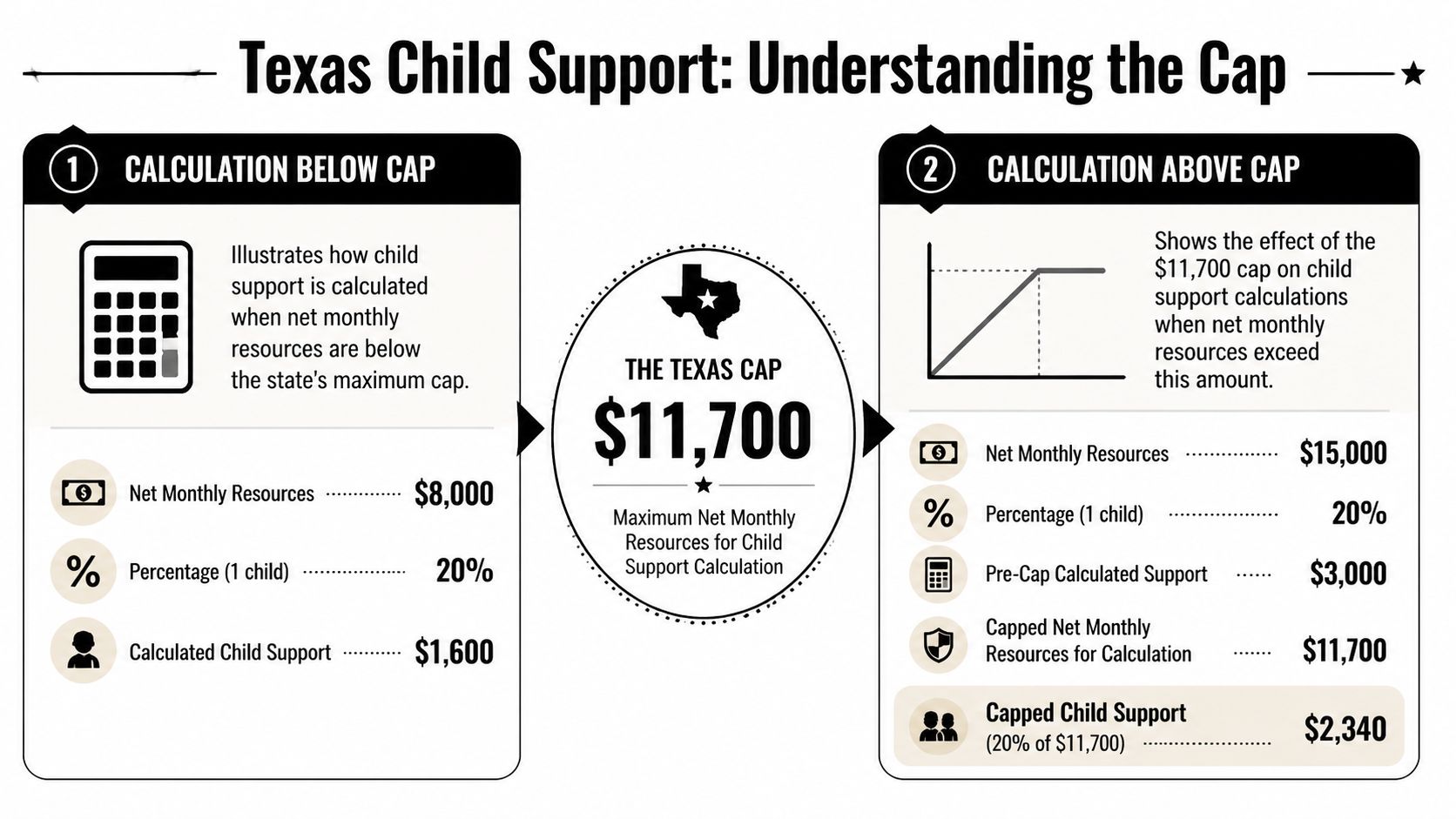
The most important number in many 2026 increase cases is the updated statutory cap on net monthly resources. Effective September 1, 2025, Texas raised the cap from $9,200 to $11,700 per month, and that change directly affects guideline support calculations under Texas Family Code §154.125. As explained in McClure Law Group's summary of the cap increase, this is a 27% increase, and for one child the maximum presumptive support rises from $1,840 to $2,340, which is a $500 monthly increase.
How the guideline math works under Section 154.125
For a standard guideline case, the court determines the obligor's net monthly resources and then applies the statutory percentage for the number of children before the court. Under the verified Texas guideline percentages, the statute uses 20% for one child, 25% for two, and scales upward to not less than 40% for six or more.
For parents whose net monthly resources are below the cap, the math is straightforward. If net monthly resources are $8,000 and the case involves one child, 20% produces $1,600 in guideline support.
For parents above the cap, the court applies the percentage to the capped amount for the presumptive guideline figure. If net monthly resources are $15,000, the one-child guideline doesn't use the full amount for the baseline. It uses the capped figure of $11,700, producing $2,340 at 20%.
For a plain-language walkthrough of how the revised framework operates, see this explanation of the $11,700 Texas child support cap.
Old cap versus new cap
The cap increase matters most when the paying parent's income was already high enough that the old order hit the prior ceiling. In those cases, the new law can support a higher presumptive amount if the case is filed and the order is modified.
| Number of Children | Guideline % | Max Support at $9,200 Cap | Max Support at $11,700 Cap | Monthly Increase |
|---|---|---|---|---|
| 1 | 20% | $1,840 | $2,340 | $500 |
| 2 | 25% | $2,300 | $2,925 | $625 |
| 3 | 30% | $2,760 | $3,510 | $750 |
| 4 | 35% | $3,220 | $4,095 | $875 |
| 5 or more | 40% | $3,680 | $4,680 | $1,000 |
What works and what doesn't
Parents often make two strategic mistakes here.
The first mistake is assuming the order updates automatically because the statute changed. It doesn't. Existing orders require a modification petition to capture the higher cap.
The second mistake is treating the cap increase as the entire case. It's not. You still need to connect the calculation to your actual order, your filing date, and the legal path that applies. For some parents, that will be the three-year review route. For others, it will be a material and substantial change argument tied to current income and current child-related needs.
Higher-income increase cases often turn on one narrow question. Was the old order already constrained by the prior cap? If yes, the new cap may materially change the guideline result. If no, the cap increase may matter far less than people think.
A practical example
Suppose the existing order was entered before September 1, 2025, and the obligor's net monthly resources were above the old statutory ceiling. If the case involves two children, the prior maximum guideline amount under the old cap was $2,300. Under the new cap, that maximum is $2,925.
That doesn't guarantee an increase in every case. But it gives a clear framework for evaluating whether the difference is large enough to support filing and whether the order's history allows use of the three-year review mechanism.
The strongest cap-based modification petitions usually do three things well:
- Tie the prior order to the old cap: Show the court exactly how the previous number was reached.
- Prove current income cleanly: Use current financial records that support the revised net-resource calculation.
- Frame the filing correctly: Plead the appropriate legal basis rather than relying on the cap change as a talking point alone.
Strategic Nuances for High-Income and 50/50 Custody Cases
A lot of parents assume child support is always a fixed percentage problem. In real cases, that assumption breaks down fast. Texas Family Code §154.123 allows courts to deviate from guideline support, and those deviation arguments show up most often in high-income and shared-possession cases. As noted in this discussion of high-income child support in Texas, courts may lower support in 50/50 arrangements, and for parents above the $11,700 cap, support beyond the guideline amount usually requires proof of the child's proven needs.
For additional context on how these cases are evaluated, review high-income child support in Texas.
High-income cases above the cap
Once net monthly resources exceed the statutory cap, the guideline amount becomes the starting point, not always the ending point. If the obligee wants support above the capped guideline figure, the court generally expects evidence of the child's specific needs.
That proof has to be child-focused. Broad statements that the obligor earns a lot won't carry the day. The better record shows actual expenses tied to the child, such as tuition, specialized educational support, recurring medical needs, therapy, or similar costs the court can evaluate directly.
What usually doesn't work is asking the judge to keep applying percentages upward with no developed proof. Courts often reject that approach because the statute doesn't make support above the cap automatic.
Shared custody and deviation arguments
A true 50/50 arrangement changes the litigation posture. It doesn't eliminate child support, and it doesn't guarantee a reduced amount either. But it does create room for deviation arguments under §154.123 because the standard guideline model assumes one parent has the child more of the time.
In these cases, judges often examine the practical division of care and expense. Who pays for school-related costs. Who covers recurring activities. Who carries insurance. Who handles the ordinary day-to-day spending when the child is with them. A possession schedule that looks equal on paper may not be equal in practice.
Balanced possession often shifts the fight from pure percentage math to fairness and proof. The parent with the cleaner evidence usually has the advantage.
The appellate case In re C.C., Jr. (Tex. App. 2023) is relevant because it confirms that deviations can be appropriate in balanced-custody situations. The point for strategy is simple. If you're asking for an increase in a 50/50 case, don't walk into court with only a guideline worksheet. Walk in with a developed deviation argument.
The real trade-off
In high-income and shared-custody litigation, pursuing the maximum possible number isn't always the smartest move. Sometimes the stronger result is a support amount the judge views as practical, enforceable, and tied to evidence. Overreaching can damage credibility.
A disciplined case plan usually asks:
- Is the capped guideline number itself the target
- Is there admissible proof for needs above that amount
- Does the possession schedule support deviation up or down
- Will the judge see the request as child-focused rather than parent-focused
Those questions matter more than abstract arguments about fairness. Courts don't reward broad rhetoric. They reward records that fit the statute.
The Modification Process A Step-by-Step Roadmap
Most support increases are won before the hearing date. The side that organizes the file first usually controls the pace of the case. That starts with evidence, not drafting.
Parents also need to plan for delay. According to TexasLawHelp's guide to changing a child support order, major Texas counties can have 6 to 12 month court backlogs, the $11,700 cap doesn't update existing orders automatically, and requesting temporary orders can be an important way to seek relief while the case is pending.
Step one gathers the proof before filing
Before filing a petition, pull together the documents that will carry the case:
- Prior court orders: You need the signed order you want modified and any later clarifying orders.
- Income records: Recent pay stubs, W-2s, tax returns, and any compensation records that reflect current earnings.
- Child expense records: Medical invoices, school bills, therapy statements, or other recurring costs tied to the child.
- Insurance documents: Premium information and proof of who is paying.
- Possession evidence if relevant: Calendars, communications, or other records showing the practical parenting schedule.
If the other parent is self-employed or paid irregularly, expect the income fight to become the center of the case. In that setting, subpoenas, business records, and bank records often matter more than a single pay statement.
Step two files in the court that issued the order
A support modification is generally filed in the court with continuing jurisdiction over the case. The pleading is typically a Petition to Modify the Parent-Child Relationship or similar modification pleading, depending on the procedural posture.
The petition should identify the legal basis clearly. If you're using the three-year review route, say so and allege that the order is old enough and the difference meets the statutory threshold. If you're relying on material and substantial change, plead the specific changes that justify relief.
For parents comparing options, this guide on how to modify child support in Texas outlines the filing framework in more detail.
Step three serves the other parent correctly
Service is where avoidable mistakes happen. If the other parent isn't properly served, your hearing can be delayed or reset, and any advantage you had may disappear.
Don't rely on informal notice. A text message saying "I filed" isn't legal service. Use formal service unless the other side signs a proper waiver and your attorney confirms it's sufficient for the relief requested.
Step four uses temporary orders when delay is costly
If the case is likely to move slowly, temporary relief may matter. In the right case, a request for temporary orders can put the increase issue before the court earlier instead of waiting for a final trial setting.
That isn't automatic, and it isn't appropriate in every case. But where income is clear, the old order is plainly outdated, or the child's current needs are pressing, temporary orders can change the economics of the case.
A short overview can help before a hearing:
Step five pushes discovery with purpose
Discovery should answer specific questions. How much is the obligor earning now. Are bonuses, commissions, or business distributions being left out. Was the old order guideline-based. Are there facts supporting deviation.
Useful tools may include:
- Requests for production for payroll and tax records
- Interrogatories about employment, compensation structure, and benefits
- Subpoenas to employers or financial institutions when necessary
- Depositions if the income story doesn't make sense on paper
Step six prepares for mediation or final hearing
Most courts want parties to attempt resolution before a contested final hearing. If settlement is possible, make sure the agreement becomes a signed order. Informal side deals are dangerous because they don't replace the enforceable court amount.
If the case proceeds to hearing, your presentation should be simple. Start with the current order. Show why the legal standard is met. Present the income evidence. Present the child-focused need evidence. Then walk the judge to the requested number under the Family Code.
Enforcement, Retroactive Support, and When to Hire an Attorney
A judge signs the modification order. The number goes up on paper. Then the other parent changes jobs, payroll never starts withholding, and the higher amount does not reach your child for weeks or months. I treat enforcement as part of the modification strategy, not as cleanup after the hearing.
An increased child support order is only as useful as the collection method behind it. In many cases, the first tool to lock down is an Order Withholding Income under the Texas Family Code. If wage withholding is available, get it drafted, signed, and sent out fast. Waiting invites delay, excuses, and accounting disputes.
That matters even more in the cases this article focuses on. If the September 1, 2025 cap increase to $11,700 affects your support number, delay in collection can erase much of the practical benefit. In a high-income case, one missed month can mean a meaningful shortfall. In a 50/50 case, poor enforcement can also blur who is carrying the child’s recurring expenses, which can affect later deviation arguments under § 154.123.
Retroactive increase issues
Texas courts can modify child support prospectively, and the filing date matters. As a practical matter, parents who wait usually give up money they could have sought after filing and service. If you expect the new cap to change the guideline analysis, or you expect the court to revisit off-guideline support in a shared custody arrangement, filing sooner usually puts you in a stronger position.
Retroactivity has limits. A court does not usually reach back and rewrite months that passed before a modification suit was filed. That is why I tell clients to stop treating text-message promises as a plan. File the case. Get the other parent served. Put the court in position to act.
The strategy is simple. If the current order was set before September 1, 2025 and the obligor’s net resources are high enough for the new cap to matter, do not wait to “see if things improve.” Preserve the earliest workable date for relief.
When legal representation becomes important
Some cases are routine. The cases involving serious money, shared custody, disputed income, or an old non-guideline agreement usually are not.
You should strongly consider hiring counsel if any of these apply:
- Income is hard to pin down: The obligor is self-employed, receives bonuses, commissions, K-1 distributions, restricted stock, or irregular compensation.
- The prior order was not a straight guideline order: The modification standard may turn on whether you can prove a material and substantial change under Texas Family Code § 156.401.
- You have a 50/50 possession schedule: The argument often shifts from a worksheet fight to a deviation case under § 154.123, with focus on who pays health insurance, school costs, activities, tutoring, travel, and day-to-day support.
- The obligor earns above the guideline cap: You may need evidence of the child’s proven needs under § 154.126, especially if you want support above the presumptive amount tied to the new $11,700 cap.
- Enforcement will be contested: If the other parent changes employers often, works through a business entity, or has a history of partial payment, the order needs to be drafted with collection in mind.
- The other side already has counsel: That usually means formal discovery, evidentiary objections, and a more disciplined hearing record.
One legal issue deserves special attention. If the original order came from an agreed amount outside the guideline framework, the three-year review concept may not carry the case. The fight may center on proving a material and substantial change since the last order. That distinction often decides whether a modification is straightforward or heavily contested.
In high-income and 50/50 cases, lawyers add value before the hearing, not just at it. The job is to trace all compensation sources, frame the child’s proven needs correctly, decide whether to press for guideline support under the new cap or above-guideline support, and make sure withholding and enforcement language are ready when the judge rules.
For parents who want structured help with modifications, enforcement, high-income calculations, and contested support issues, the Texas Child Support Law Office of Bryan Fagan provides services focused on those matters under the Texas Family Code.
Frequently Asked Questions About Increasing Child Support
What if I think the other parent is hiding income
Treat that as an evidence problem, not a suspicion problem. Courts respond better when you ask for targeted discovery than when you make broad accusations. In the right case, that can include payroll records, tax returns, business records, subpoenas, and a deposition. If the income picture is incomplete, the court may scrutinize credibility closely.
Can we agree to raise child support without a hearing
You can reach an agreement, but the agreement still needs to become a signed court order. An informal arrangement isn't a safe substitute for a modification order. If payments stop later, enforcement usually turns on the written order, not the side agreement.
Does the September 2025 cap increase automatically raise my current order
No. Existing orders require court action to use the higher cap. If your current amount was entered under the earlier framework and the obligor's resources were high enough for the cap to matter, filing a modification may be worth immediate review.
What if we have 50/50 custody
That doesn't automatically block an increase, and it doesn't automatically eliminate support. Shared possession often shifts the analysis toward §154.123 deviation factors. The court may look beyond the standard worksheet and examine who pays recurring child-related expenses.
Can I ask for more than the guideline amount in a high-income case
Yes, but only with proof that supports the child's proven needs beyond the capped guideline amount. The stronger the request, the more specific the evidence should be. General claims about lifestyle or the other parent's earning power usually aren't enough on their own.
Should I file now or wait
If the order is outdated and you already have the records to support a modification, waiting usually helps the other side more than it helps you. A filed case creates a court framework, starts the formal process, and puts you in position to pursue temporary relief if the facts justify it.
If you need a strategic review of whether your order can be increased, the attorneys at Texas Child Support Law Office of Bryan Fagan handle child support modification, enforcement, high-income support disputes, and 50/50 custody calculations across Texas. A focused case assessment can identify the right legal basis under the Texas Family Code, the documents you'll need, and whether it makes sense to pursue temporary orders while the modification is pending.