You're sitting in a Galveston County courthouse hallway with an older child support order in your hand. Your income has changed, the other parent's income may have changed, or the September 1, 2025 guideline update has raised a question that the original order never addressed. The practical issue is immediate: should you file a modification now, wait for more financial records, or pursue administrative help through the Texas Office of the Attorney General?
That decision turns on more than the new cap. The $11,700 monthly net-resource cap, the material-and-substantial-change standard, the child's actual needs, the possession schedule, and the way Galveston County courts process family cases all matter. A child support attorney in Galveston County should be able to connect those pieces before you walk into a hearing, not after the judge asks for documents you didn't bring.
When a Galveston County Parent Searches for Child Support Help
A parent earning above the former guideline ceiling arrives at the 405th District Court with an older order and current pay records. The question is direct: did the September 1, 2025 change automatically increase support? No. Texas raised the monthly net-resource cap used for guideline calculations from $9,200 to $11,700, but an existing order stays in effect until a court or authorized administrative process changes it. The updated cap affects a potential new calculation, not the validity of the prior order.
That timing issue determines the next move. A cap increase may support review, yet the requesting parent must still establish a legally sufficient basis for modification. Texas modification practice generally relies on a material and substantial change in circumstances or a guideline-based review standard. A parent should not expect the first payment cycle after the effective date to rewrite an older order. At the same time, waiting can create problems when income, employment, custody, or the child's needs have already changed.
Choosing between private litigation and OAG services
Galveston County's Family Section handles child support matters alongside divorce, custody, parentage, enforcement, and adoption proceedings. Its court information also addresses practical administration, including creation of a new child support account. Galveston County's Family Section illustrates why local filing and processing details matter even though Texas law controls the formula.
A private modification proceeds through the local district court. Counsel can manage pleadings, service, discovery, hearing preparation, and requests for temporary relief, but the parent must complete the required filing and service steps. The Texas Office of the Attorney General may assist with review and enforcement in cases administered through the Title IV-D system. That agency process does not provide private representation for every disputed issue.
Practical rule: The 2025 cap change is a reason to evaluate your order, not a reason to assume your payment changed automatically.
Evidence will shape the result. A high-income parent should gather dependable net-resource records, including pay information and documentation of other income. A receiving parent should document the child's needs and the paying parent's actual financial capacity. Both parents must identify the correct procedure: a guideline calculation, a deviation request, an enforcement action, or a new modification suit.
Before filing, compare the effective date of the cap change with the facts supporting modification and the time needed to obtain records, serve the other parent, and secure a hearing in Galveston County. That review can prevent a parent from treating a new guideline ceiling as an automatic order change.
How Texas Calculates Child Support Under the 2025 Guidelines
A Galveston County support calculation begins with net resources, not gross salary. Under Texas Family Code §154.062, the court may consider wages, commissions, overtime, tips, bonuses, self-employment income, rental income, and other cash-flow sources. It then applies permitted deductions, such as payroll taxes, federal income tax calculated under statutory assumptions, state tax, union dues, health or dental insurance, cash medical support, and certain retirement contributions.
The calculation sequence
Identify all income sources. Commission statements, bonus records, business ledgers, rental records, and bank deposits can matter as much as ordinary pay stubs.
Apply statutory deductions. Personal expenses do not automatically reduce income. Each deduction must fit a statutory category and be supported by reliable records.
Determine monthly net resources. The court compares that figure with the applicable statutory guideline cap.
Apply the child-support percentage. Texas Family Code §154.125 applies guideline percentages to monthly net resources up to the cap. The current cap is $11,700 effective September 1, 2025. The Texas Register notice on the updated cap identifies the amount used for guideline calculations.
| Number of Children | Percentage of Net Resources |
|---|---|
| One child | 20% |
| Two children | 25% |
| Three children | 30% |
| Four children | 35% |
| Five or more children | 40% |
For example, $9,000 in monthly net resources produces $1,800 per month for one child, because 20% of $9,000 is $1,800. The same resources produce $2,250 per month for two children. The percentage applies to the defined net-resource base, not gross compensation.
The increased cap also raises the presumptive maximums for capped calculations. At $11,700, the guideline amounts are $2,340 for one child, $2,925 for two children, and $3,510 for three children. The Texas guideline calculation materials provide these updated examples.
For a plain-language explanation, see How Child Support Is Calculated in Texas. A calculator can organize the initial figures, but it cannot decide disputed income, allowable deductions, or whether a modification is legally justified. The Texas child support calculation and modification tools can help prepare that review.
The timing matters in Galveston County. The September 1, 2025 cap does not by itself rewrite an existing order. A parent whose resources exceed $11,700 also does not receive an automatic percentage award on every dollar above the ceiling. The court must address the applicable modification facts and, where appropriate, the deviation analysis under Texas Family Code §154.123. A calculation is the starting point, not the final order.
Deviations Under Texas Family Code §154.123
Guideline support creates a starting presumption, not an inflexible result. Under Texas Family Code §154.123, a court may order an amount different from the guideline amount when evidence rebuts the presumption that strict application serves the child's best interest and supports a variance. Texas Family Code §154.123 identifies factors the court may consider, including the resources and earning potential of both parents, the child's needs, and changes in income or attributed income from property or assets.
What the requesting parent must prove
The party seeking a deviation carries the practical burden of building a record. A lawyer who merely tells the court that the family had a higher standard of living hasn't supplied enough detail. The evidence should connect the requested amount to the child's needs and the parents' actual financial capacity.
Useful records can include:
- Income documentation: pay stubs, commission reports, bonus histories, tax records, business statements, and rental records.
- Child-related expenses: daycare invoices, tuition records, activity costs, medical bills, therapy records, and uninsured health expenses.
- Existing obligations: other court-ordered support, debt tied to a business, and documented responsibilities for other children.
- Possession evidence: calendars, travel records, exchange costs, and proof of the actual schedule rather than the schedule printed in an old order.
Galveston County associate judges may focus on whether the claimed expense is necessary, reasonable, and attributable to the child. They may also examine whether a parent is intentionally underemployed, whether business income has been shifted, and whether reported deductions reflect a genuine obligation rather than a convenient accounting entry.
Why the cap matters in high-income cases
The cap limits the ordinary guideline calculation. It doesn't eliminate the court's authority to consider facts outside the guideline amount. When a parent's net resources substantially exceed the cap, the receiving parent may argue that the capped amount doesn't meet proven needs. The paying parent may respond that the requested increase is unsupported, duplicative, or unrelated to the child.
The stronger case uses a child-specific budget and dependable financial records. The weaker case relies on broad claims about wealth without showing what the child needs or how the requested amount should be structured.
A deviation request succeeds through proof, not through income labels alone.
Filing a Modification in Galveston County
Suppose a Galveston County parent loses employment, receives materially lower compensation, or discovers that the other parent's bonus income has changed the support calculation. The first question is whether the facts establish a material and substantial change since the last order or otherwise satisfy the applicable guideline review standard. The 2025 cap can be relevant, but it doesn't by itself erase the existing order.
The private court route
A private modification generally follows a defined sequence:
Gather the comparison records. Assemble the existing order, recent income information, tax records, insurance costs, possession records, and documents showing the changed circumstance.
Prepare the pleading. The filing is commonly an Original Petition to Modify the Parent-Child Relationship, with requested changes identified clearly.
File with the district clerk. E-filing through the Galveston County District Clerk begins the case and results in a cause number. Filing fees and local filing requirements should be confirmed before submission.
Serve the other parent. Personal service through a process server is one option. A cooperating parent may sign a waiver of service, but the waiver must be prepared and filed correctly.
Request temporary relief when needed. A temporary orders hearing may address interim support or related issues while the case proceeds. Expedited treatment depends on the facts and the court's calendar. A lawyer should present the reason for urgency with documents, not merely label the matter urgent.
Prepare for final hearing. The court will compare the old order with current income, needs, possession, and statutory factors. The final order, not the petition, changes the obligation.
The Texas Attorney General describes a separate administrative modification process requiring a completed request form and agency processing. The OAG support modification process is most relevant when the order is administered through the Title IV-D system. Administrative review can be useful, but a contested high-income deviation, disputed business income, or complicated possession issue may require focused court litigation.
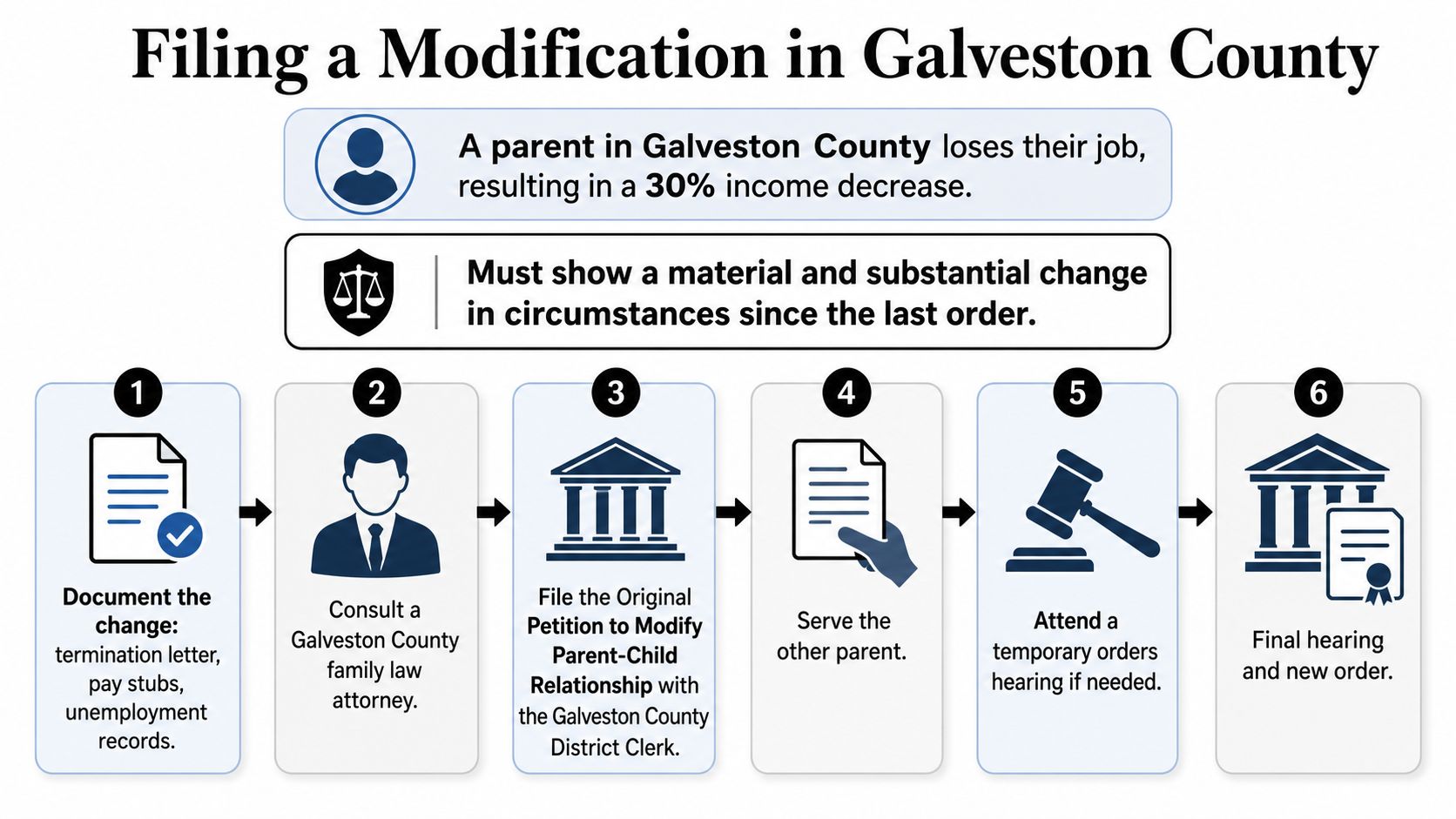
For a practical overview of the modification process, review How to Modify Child Support in Texas. Before a hearing, organize the evidence around the legal threshold. Show what changed, when it changed, how it affects the calculation, and why the requested order follows the child's needs and the statutory framework.
High-Income and 50/50 Custody Cases After the Cap Increase
A high-income case and a true equal-possession case can look similar on paper, but they raise different questions. The first asks whether the capped guideline figure adequately addresses the child's needs. The second asks how both parents' resources, actual possession, and duplicated expenses affect the result.
Above-cap income
Assume an obligor has $25,000 in monthly net resources. The guideline calculation doesn't just apply the percentage to the entire amount. The statutory cap applies to the ordinary guideline calculation, and any request to account for income above the cap requires a deviation analysis under §154.123. The court may consider private education, significant medical needs, activities, travel, housing-related child expenses, or other proven needs, but the evidence must be specific.
A parent seeking more should present invoices, contracts, and a realistic budget. A parent resisting more should test whether the expenses are necessary, already covered elsewhere, or unsupported by the evidence. The court isn't required to treat family wealth as an automatic entitlement to every requested expense.
Equal possession
A 50/50 schedule doesn't automatically eliminate support. Texas Family Code §153.001 addresses public policy concerning conservatorship and possession, while the child-support calculation remains governed by Chapter 154. The court can examine the actual overnight schedule, insurance payments, childcare, travel for exchanges, and the way each parent pays ordinary expenses.
The label “50/50” can conceal important differences. One parent may pay health insurance, carry daycare costs, maintain the child's primary school residence, or absorb travel expenses. Another may have equal possession on paper but exercise fewer periods in practice. Those facts can support a deviation argument, but they don't produce an automatic formula.
| Factor | Standard Case | Above-Cap Income | 50/50 Possession |
|---|---|---|---|
| Starting point | Guideline percentage applied to capped net resources | Capped guideline amount plus possible §154.123 analysis | Guideline calculation remains relevant |
| Main dispute | Correct income and deductions | Child's proven needs and excess financial capacity | Actual possession and shared expenses |
| Important records | Pay records and insurance costs | Business records, tuition, medical and activity expenses | Possession calendar, exchange costs, childcare and insurance |
| Common mistake | Using gross income | Assuming the cap ends the analysis | Assuming equal time means no support |
Equal possession changes the facts the court considers. It doesn't automatically change the governing statute.
Parents should present the actual arrangement, not a simplified label. A detailed schedule and expense allocation will usually help more than a bare assertion that the parties “split time equally.”
Enforcement Tools When Payments Stop
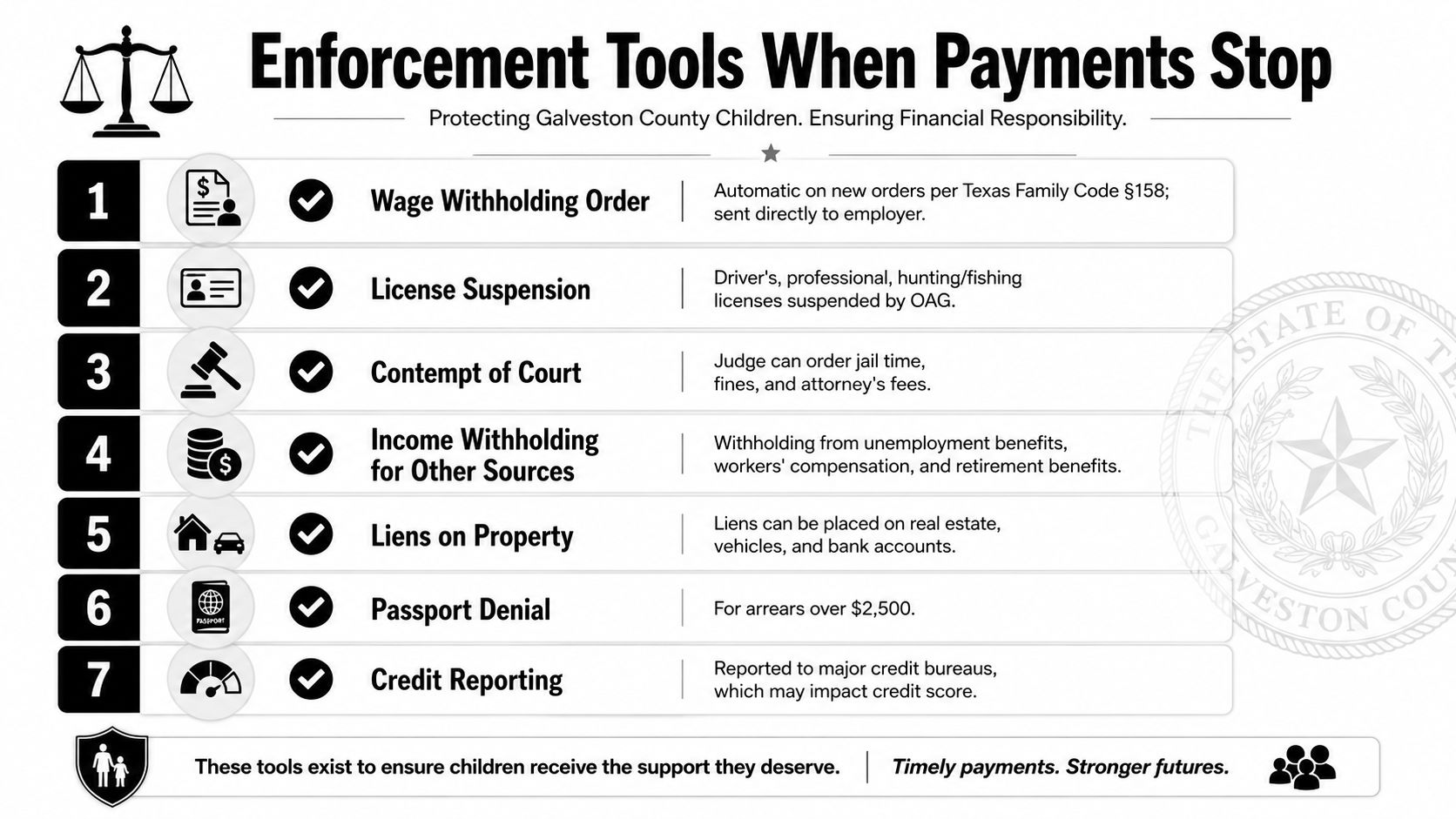
When payments stop, preserve the payment history first. Keep the order, payment records, notices, employer information, communications, and records showing unpaid amounts. Texas identifies the Attorney General as the state agency responsible for enforcing child support orders and collecting and distributing payments, while Galveston County courts remain central for judicial enforcement and contempt proceedings.
Wage withholding and administrative enforcement
Texas Family Code Chapter 158 supports income withholding. A withholding order can direct an employer to send current support and, where authorized, additional amounts toward arrears. That additional withholding can increase the total amount taken from a delinquent obligor's paycheck, so the employer's records and the arrearage balance should be checked carefully.
The OAG may also pursue administrative remedies, including license-related enforcement and payment collection through the state system. A private enforcement case may be more appropriate when the dispute involves hidden income, contested arrears, self-employment, or a need for court findings.
Court enforcement
A Galveston County court can address unpaid support through an enforcement proceeding. Contempt relief requires proof that the order was clear, the obligor had notice, the obligation was within the obligor's ability to comply, and the violation occurred. The court may consider arrears, additional withholding, attorney's fees, and other authorized remedies.
Self-employed obligors require a different paper trail. Bank records, business ledgers, merchant deposits, invoices, and ownership information may show that reported wages don't reflect available resources. A court can't enforce what the record fails to establish, so the requesting parent should identify the missing evidence before filing.
For a broader procedural overview, see How to Enforce Child Support in Texas.
The following video provides additional general information about enforcement concepts:
When to Contact the Law Office of Bryan Fagan
Contact a Galveston County child support attorney before filing when your net resources exceed the cap, your possession schedule is equal, or the other side is likely to request a §154.123 deviation. Early preparation matters because income disputes become harder when a parent is self-employed, owns a business interest, receives bonuses, or has compensation that doesn't appear on a standard pay stub.
A review is also appropriate when an existing order contains an unclear possession schedule, a child's support period is approaching its end, or the OAG is pursuing wage withholding or another enforcement remedy. Counsel can compare the existing decree with current facts, identify the correct procedural route, and prepare the financial record for a modification or enforcement hearing.
The Texas Child Support Law Office of Bryan Fagan handles establishment, modification, enforcement, and defense of Texas child support orders, including high-income calculations, arrears, medical support, wage garnishment, 50/50 possession disputes, and complex income questions. Parents evaluating legal representation may also find family law firm SEO results useful when researching how family law practices present their services and case information online.
Bring the complete order, payment history, income records, insurance information, and possession calendar to the initial evaluation. A lawyer can't assess the modification standard accurately from a monthly payment amount alone.
Frequently Asked Questions About Child Support in Galveston County
Should I file before or after September 1, 2025?
The effective date matters to the guideline calculation, but it doesn't automatically change an existing order. A parent should evaluate whether a material and substantial change, a guideline review basis, or a deviation issue already exists. Waiting for a particular payment cycle isn't a universal requirement, and filing early may preserve evidence and address a current financial problem sooner.
What happens when net resources exceed $11,700?
The guideline percentages apply to monthly net resources up to $11,700 under Texas Family Code §154.125. Income above that amount isn't automatically ignored, but the court must analyze whether a variance is justified under §154.123. Strong evidence includes the child's documented needs, both parents' resources, business and bonus records, medical or educational expenses, and reliable proof of actual earning capacity.
Can the court award retroactive support?
A court may consider retroactive child support when the facts and pleadings support it, but a parent shouldn't assume that every unpaid period becomes an automatic judgment. The court will examine notice, prior support, the child's needs, the parents' resources, and applicable statutory limits. A request for retroactive relief should be pleaded and supported with records rather than raised casually at the hearing.
Does true 50/50 possession eliminate support?
No. Equal possession doesn't automatically cancel the guideline calculation. The court can consider the actual schedule, each parent's net resources, insurance, childcare, travel, and duplicated household expenses when deciding whether a deviation is appropriate. A parent seeking a different amount should present a precise expense allocation and possession record.
| Question | Short Answer | Key Statute or Standard |
|---|---|---|
| Does the cap automatically change an old order? | No, a new order or authorized review is required. | Modification procedure and current guideline cap |
| Are percentages applied above $11,700? | The ordinary guideline calculation stops at the cap, while above-cap relief requires deviation analysis. | Texas Family Code §§154.123 and 154.125 |
| What proves a modification? | Evidence of a material and substantial change or another recognized review basis. | Texas modification standard |
| Does 50/50 possession mean zero support? | No, possession is one factor among income, needs, insurance, and shared expenses. | Texas Family Code Chapter 154 and deviation analysis |
The most useful preparation is factual. Identify the changed circumstance, calculate net resources under §154.062, document the child's needs, and decide whether the case belongs in a private Galveston County filing, an OAG review, an enforcement proceeding, or more than one path.
The Texas Child Support Law Office of Bryan Fagan can review your existing order, analyze the post-September 1, 2025 cap, and prepare a modification, deviation, or enforcement strategy for Galveston County. Visit Texas Child Support Law Office of Bryan Fagan to request a case evaluation focused on your income records, possession schedule, and current child-support dispute.