You're in Round Rock or Cedar Park, the other parent has stopped contributing, and you're trying to decide what to do first. Should you apply through the Texas Office of the Attorney General, walk into the courthouse in Georgetown, or start both processes at once? The practical answer is that filing for child support in Williamson County is not one action. It's three coordinated tracks: opening state child support services, filing the court case that gives a judge authority to enter orders, and routing payments through the state disbursement system.
If you treat those tracks as interchangeable, your case can stall even when your underlying claim is straightforward. The correct sequence depends on whether you're establishing support for the first time, modifying an existing order, enforcing unpaid support, or handling custody and support together.
Filing for Child Support in Williamson County Starts with Three Tracks
A parent separating in Williamson County usually faces three separate filing decisions.
Track one, the OAG application
The Texas Office of the Attorney General is the main state-level entry point for child support services. You can call (800) 252-8014 to request an application by mail, or apply online through the Child Support Interactive system, as explained by the Texas Attorney General's child support application guidance.
The OAG's IV-D system can assist with locating a parent, establishing paternity, establishing support, and implementing income withholding. This is the enforcement track. It's often the practical choice when the other parent is a regular wage earner and you want the state to manage collection after an order is entered.
Track two, the Williamson County court case
A court must have a case before it can issue a binding child support order. For an original case, that generally means filing a Suit Affecting the Parent-Child Relationship, commonly called a SAPCR. TexasLawHelp explains that an original SAPCR is filed in the county where the child lives, either through E-File Texas or in person at the district clerk's office. The Williamson County family-court filing path runs through the District Clerk's office at the Justice Center, 405 MLK Jr. St., Georgetown. County family-court information and forms are available through the Williamson County family court page.
Track three, payment routing
Payments don't become local courthouse transactions. Williamson County states that child support payments have been directed to the San Antonio Disbursement Unit since September 2004, and payment changes must be routed through the District Clerk according to the county's published information.
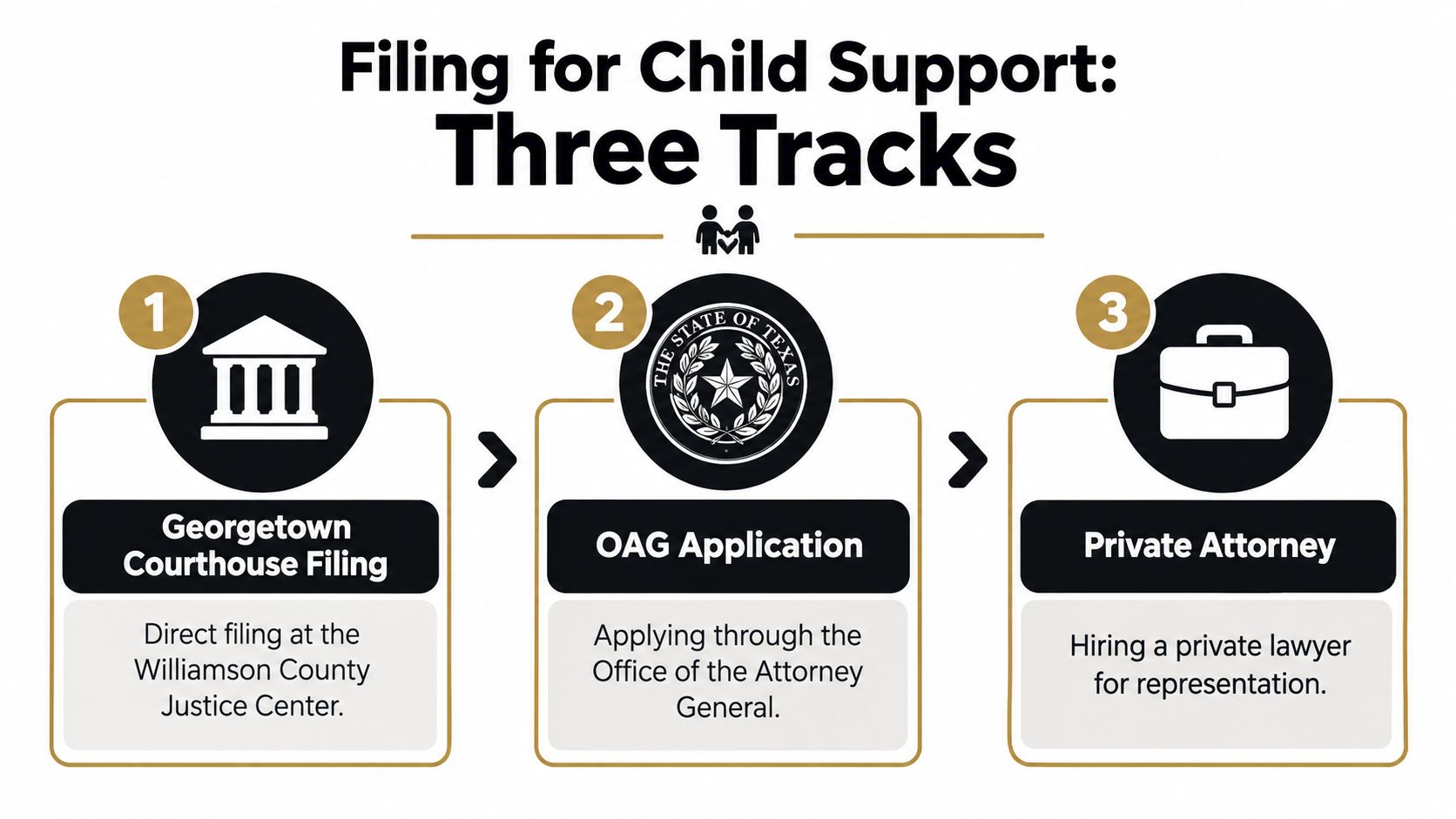
Practical rule: Opening an OAG case, filing a SAPCR, and routing payments are related tasks, not substitutes for one another.
If you're building a practice or choosing professional help, operational systems matter too. Resources on solo attorney growth insights can be useful for understanding how lawyers manage intake and client communication, but your immediate priority is getting the correct case and payment tracks moving.
Choosing Between the OAG and a Private SAPCR Suit
The OAG route and a private SAPCR suit can produce a child support order, but they serve different strategies. Choose based on the complexity of the dispute, not on habit.
The OAG is usually the sensible starting point when the case involves a straightforward wage earner, disputed paternity that needs state assistance, or an existing order requiring routine enforcement. The application can begin online or by mail, and the OAG can use state enforcement processes. The tradeoff is control. You generally won't control discovery, hearing scheduling, or the broader custody issues the way you would in a private lawsuit.
A private SAPCR suit is stronger when support is only one part of the dispute. A private lawyer can plead custody, possession, medical support, temporary orders, and other child-related issues in one court action. That route also makes more sense for high-income parents, complicated 50/50 possession disputes, significant income disagreements, or a requested deviation under Texas Family Code §154.123, which allows a court to consider additional factors when the guideline amount doesn't fit the evidence.
| Factor | OAG IV-D Application | Private SAPCR Suit |
|---|---|---|
| Primary purpose | State establishment and enforcement services | Court litigation over support and related child issues |
| Cost structure | State application route | Filing costs and attorney time |
| Control over hearings | Limited control | Greater control through private counsel |
| Wage withholding | Designed to support income withholding | Can request and implement court-ordered withholding |
| Discovery | Limited compared with private litigation | Formal discovery strategy is available |
| Best fit | Straightforward employment and enforcement cases | High-income, contested custody, complex income, or deviation cases |
The OAG and private routes can sometimes operate at the same time. If private litigation produces the controlling order, the state case may need to be closed or adjusted so the systems don't conflict.
For a focused overview of the state role, The Texas Attorney General Child Support Division Explained describes what the OAG Child Support Division does and when to use it. A broader procedural reference is also available in this guide to how to file for child support in Texas.
Law firms also have to communicate complicated choices clearly. A resource on Bruce and Eddy legal marketing offers context on presenting legal services and information, but your filing decision should remain tied to the facts of your case.
Preparing and Filing the SAPCR Packet in Williamson County
A weak packet creates avoidable delay. Before filing at the Georgetown Justice Center, organize the documents so the clerk can identify the case, the child, the requested orders, and the payment account without guessing.
Assemble the core documents
For an original SAPCR involving child support, the packet should generally include:
- SAPCR petition: Identify the parents, the child, jurisdictional facts, conservatorship requests, possession requests, and support requests.
- Record of Support Order, Form 1828A: TexasLawHelp identifies this form as part of the filing packet used to create the child support account.
- Proposed child support order: Include the guideline calculation and requested medical-support provisions where applicable.
- Income withholding order: This gives the employer or other payor the information needed to withhold support after the order is entered.
- Standing order and local requirements: Review the Williamson County family forms and any standing order that applies to the filing.
- Vital-statistics paperwork: Use the required Bureau of Vital Statistics form when parentage or paternity information is contested or needs to be established.
Verify the case style, every child's legal name, each child's date of birth, addresses, and the ZIP code used for payment routing. If a filing asks the clerk to create an account, inaccurate identifying information can cause problems later even if the judge signs the order.
File at the right intake location
The Williamson County District Clerk's office handles family-court filings at the Justice Center in Georgetown. County information identifies weekday office hours as 8:00 a.m. to 4:30 p.m. for the filing location described in the local procedure.

You can file online through E-File Texas or submit documents in person. If you can't afford the filing fee, ask about a statement of inability to afford court costs or the applicable fee-waiver procedure. Don't assume the clerk will correct an incomplete packet at the window. Confirm the accepted payment method before you go, and keep file-stamped copies of everything submitted.
The county's mailing address for the District Clerk is P.O. Box 24, Georgetown, TX 78627. Payment-routing changes must go through the District Clerk rather than being handled informally by phone. If your issue is an existing order rather than an original SAPCR, The Step-by-Step Child Support Modification Process addresses what to expect when filing to modify a child support order.
How Williamson County Courts Calculate Support After the 2025 Cap
Texas uses guideline percentages applied to an obligor's monthly net resources. Texas Family Code §154.125 establishes the presumptive percentages and applies them to monthly net resources up to the statutory cap. Effective September 1, 2025, the cap increased from $9,200 to $11,700, according to the Texas legislative update and official tax-chart materials.
Monthly net resources are not the same as gross salary. The calculation generally starts with income and accounts for allowable deductions such as federal income taxes, Social Security and Medicare taxes, state income tax where applicable, and the child's portion of health insurance and union dues. The correct calculation belongs in the pleadings and financial evidence, not in an informal estimate.
| Number of Children | Percentage of Net Resources | Monthly Cap ($11,700) | Statute |
|---|---|---|---|
| One child | 20% | $2,340 | Texas Family Code §154.125 |
| Two children | 25% | $2,925 | Texas Family Code §154.125 |
| Three children | 30% | $3,510 | Texas Family Code §154.125 |
| Four children | 35% | $4,095 | Texas Family Code §154.125 |
| Five children | 40% | $4,680 | Texas Family Code §154.125 |
For example, if the obligor has $11,700 in monthly net resources and two children are before the court, the guideline calculation is $11,700 multiplied by 25%, or $2,925 per month. The cap applies per obligor, not per case. If the obligor has income above $11,700, the court doesn't automatically apply the percentage to every dollar.
High-income cases require evidence
Under Texas Family Code §154.123, a court may consider additional factors and deviate from the guideline amount. The court can examine the child's needs, the other parent's resources, extraordinary expenses, and the lifestyle evidence presented. The parent requesting more than the guideline baseline must present proof, not just point to a high salary.
Equal possession doesn't automatically eliminate support. A 50/50 schedule may affect the analysis, but the guideline amount usually remains the starting point unless the evidence supports a deviation. For a practical explanation of the math, see how to calculate child support in Texas. An online estimate, as discussed in Using a Texas Child Support Calculator: What It Can and Can't Tell You, is a starting point, not a final court number.
Service of Process Temporary Orders and Your First Hearing
After the clerk accepts the SAPCR, the other parent must receive legally valid notice. The district clerk issues citation, and service may proceed through a sheriff's deputy or a certified private process server. A voluntary waiver may be possible in an appropriate case, but don't treat a text message or informal conversation as service.
Personal service generally starts the answer deadline. Under Texas procedure, the served parent has a 20-day answer period, with the applicable calculation governed by the service date and court rules. If the other parent doesn't answer or appear, a default hearing may become available, but the court still requires proof supporting the requested orders.
Temporary orders come before the final track
If immediate support, possession, or protective provisions are needed, request temporary orders. Williamson County scheduling practices vary by docket, but temporary matters may be addressed within 10 to 21 days in the status or docket-call setting described in the filing plan. Your request should include financial disclosures and the required income-withholding-for-temporary-support paperwork when seeking temporary support.
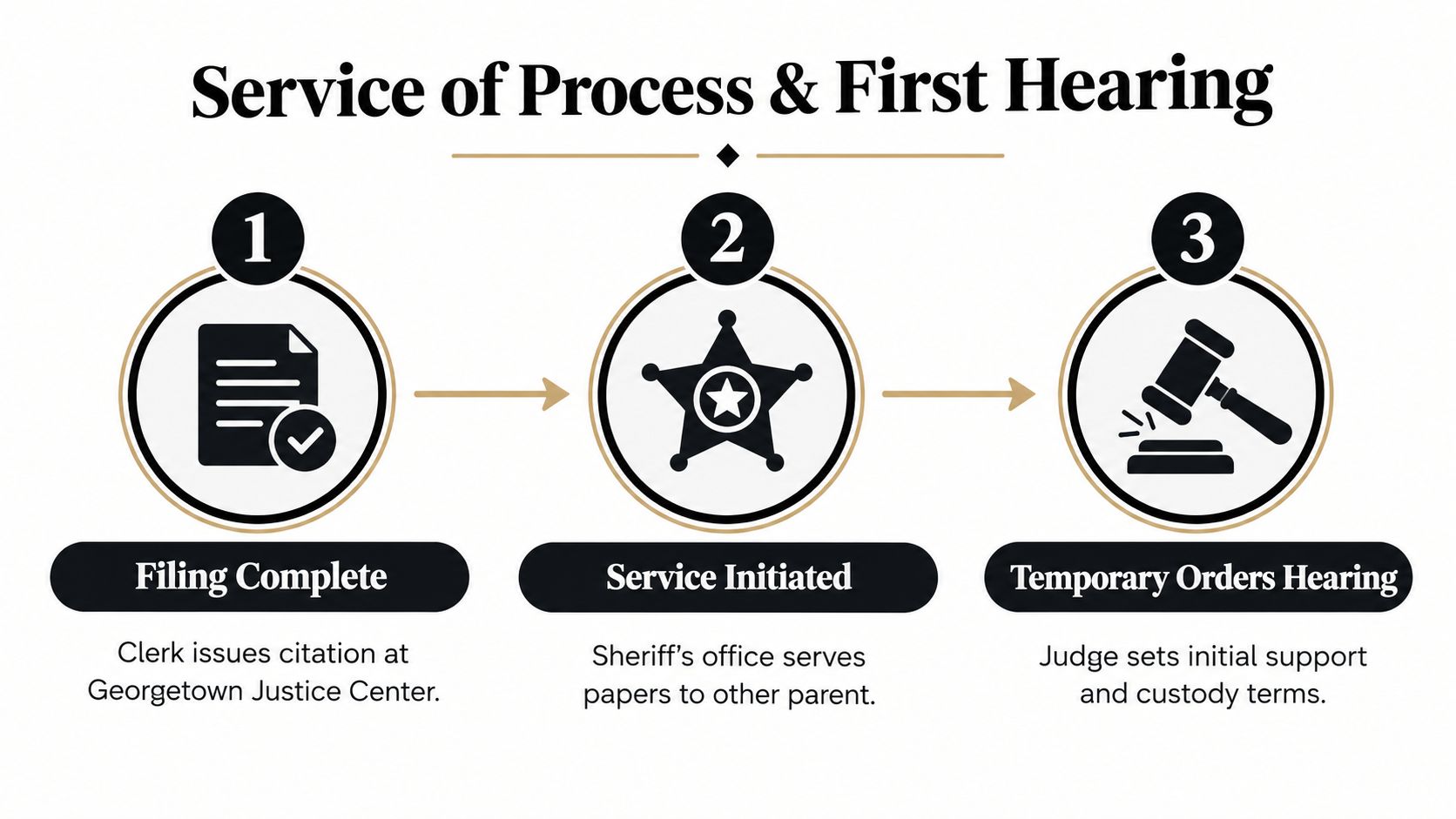
At the first hearing, expect short presentations rather than a full trial. The judge may address temporary support, possession, immediate documentation, mediation, and the next procedural deadline. A pretrial conference can then move the case from temporary orders toward a final order.
Read the notice carefully. Texas child support notice-of-hearing guidance can help you understand what the notice is intended to communicate, but you still need to follow the specific date, location, and filing instructions in your case.
The court process is easier to follow when you know what each hearing is supposed to accomplish.
Enforcement and Modification Once an Order Exists
An order is only useful if the payment system and enforcement tools are connected to it. Texas Family Code Chapter 157 permits enforcement proceedings, while Texas Family Code §158.101 supports income withholding as a central collection mechanism. Texas child support statistics report that over 80% of collections in Child Support Division cases are made through wage withholding. That makes the withholding order an implementation document, not an afterthought.
Payments still route through the San Antonio Disbursement Unit, not a local clerk's cash desk. If an employer changes, an address changes, or a payment-routing detail is wrong, correct the record through the proper state and county channels.
| Enforcement Tool | Statutory Basis | Typical Trigger | Speed of Relief |
|---|---|---|---|
| Income withholding | Texas Family Code §158.101 | Delinquent or ordered support requiring payroll withholding | Often the most direct recurring collection method |
| Motion to enforce | Texas Family Code §157.001 | Missed payments or violation of an order | Depends on service and hearing availability |
| Contempt | Chapter 157 | Willful violation supported by admissible proof | Court-controlled |
| License suspension | Texas Family Code §232.002 | Qualifying child-support delinquency | Requires statutory process |
| Passport denial | Texas Family Code §232.011 | Qualifying federal enforcement conditions | Depends on federal processing |
| Bank levy or tax-refund interception | State and federal enforcement procedures | Arrears and collectible debt | Variable, based on account or refund timing |
Modification requires a new order
The amount doesn't change because parents agree privately. The Texas Attorney General states that an existing court-ordered amount changes only through another court order. In an active OAG case, a parent can submit a formal Request for Review, after which the appropriate modification action may follow.
A modification can be based on a material and substantial change under Texas Family Code Chapter 156, or on the statutory review standard that applies in the circumstances. The court reviews current net resources, possession, needs, and other legally relevant facts. Keep pay records, tax information, insurance costs, and proof of changed circumstances organized before requesting review.
Common Williamson County Filing Pitfalls to Avoid
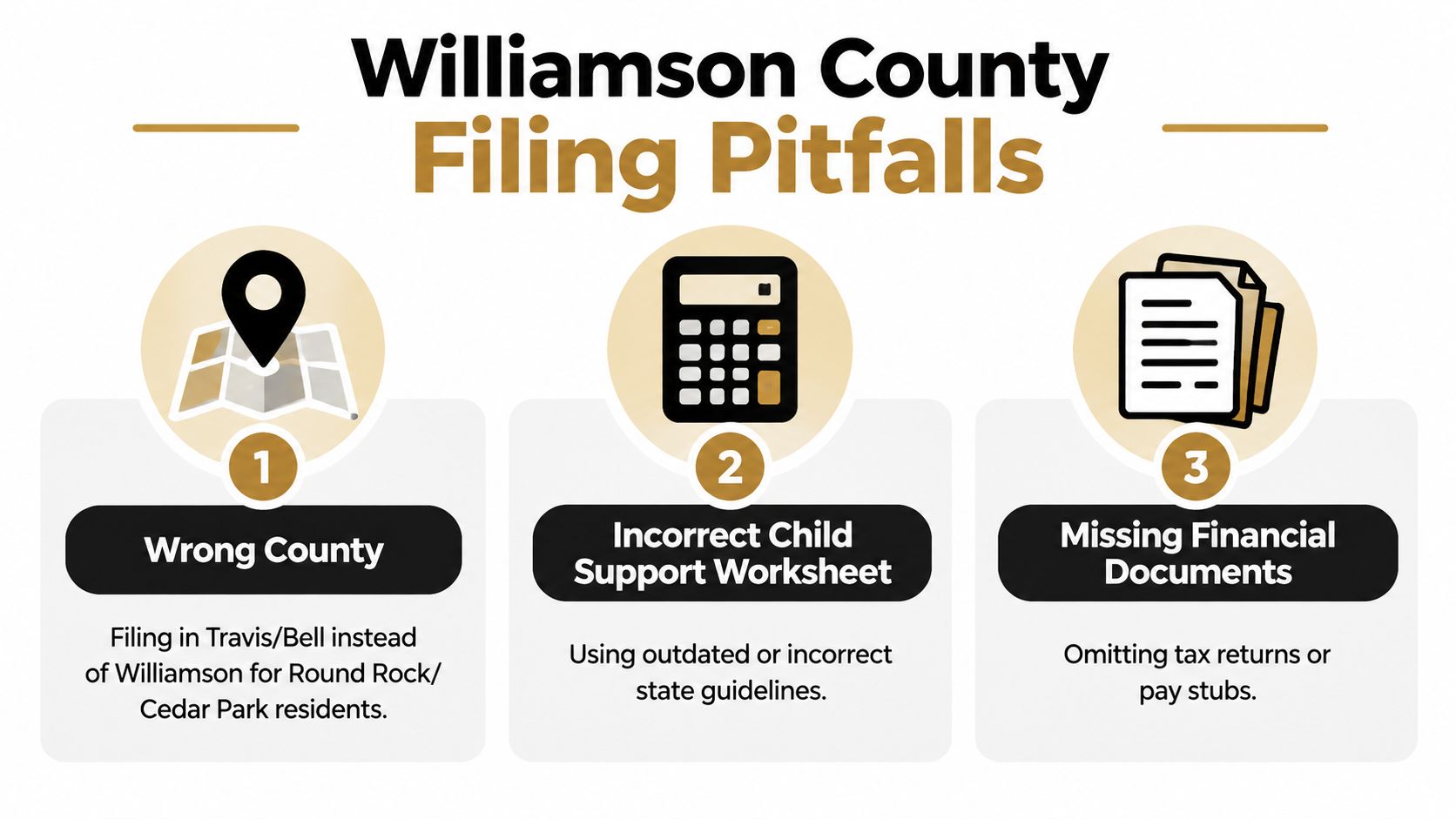
Most delays come from preventable filing mistakes. The parent may have a valid support claim, but the clerk, process server, OAG, or disbursement system can't move the case because one basic field or filing choice is wrong.
Venue errors and incomplete pleadings
Wrong county: An original SAPCR generally belongs where the child lives. Filing in Travis or Bell County because the other parent works there can create a venue problem when the child lives in Georgetown, Cedar Park, Round Rock, Hutto, or Leander. Check the child's actual residence and use TexasLawHelp's distinction between original SAPCR filings and modifications, which are generally filed where the current order was made.
Missing custody terms: A private SAPCR that requests support but leaves possession and conservatorship terms vague can create an incomplete dispute. If you need a Standard Possession Order or a customized schedule, plead it clearly and attach proposed language rather than leaving the issue for an impromptu hearing.
Wrong case type: Establishment, modification, and enforcement are different proceedings. A modification isn't an original SAPCR, and an enforcement motion isn't a substitute for a new modification order. Put the existing cause number, court, and current order in the packet when you're asking to modify or enforce.
Payment and service failures
No disbursement account coordination: A local order doesn't mean payments will automatically reach the correct account. Include the Record of Support Order fields accurately and confirm the San Antonio Disbursement Unit routing information. The Williamson County clerk's published family-court materials explain that payment changes must go through the District Clerk.
Bad service address: Serving a self-employed obligor at an old business address may produce a return that doesn't support a valid judgment. Gather residential, business, mailing, and employer information, and update the process server when the OAG locator produces stale information.
Interstate enforcement skipped: If the other parent lives or works outside Texas, ask about the Uniform Interstate Family Support Act process. A Williamson County order can be registered and enforced in another state, but the receiving state needs the correct certified order and registration materials.
Questions parents ask before filing
Can I obtain retroactive support beyond four years? Texas Family Code §154.009 addresses retroactive child support, and the court considers the facts rather than treating every late filing the same. Late-established paternity can affect the evidence, notice, and period requested. Gather proof of the child's expenses, payments already made, the parent's ability to pay, and when paternity became established. This week, create a dated payment and expense ledger.
Does 50/50 conservatorship eliminate support? No. Equal possession doesn't automatically produce a zero order. The court begins with the guideline framework, and the 40% figure for five or more children remains part of that framework unless deviation evidence supports a different result. If resources differ substantially, prepare income records and possession calendars before asking the court to depart from the guideline.
Should I hire private counsel or use the OAG with the $11,700 cap? Use the OAG for a straightforward wage-earner case where enforcement is the main concern. Consider private counsel when income exceeds the cap, a deviation under §154.123 is likely, 50/50 possession is disputed, or the other parent hides income. This week, list every income source, business interest, benefit, and recurring child expense before choosing the route.
Can unemployment, disability, or voluntary underemployment affect support? The court may examine whether reported income reflects actual earning capacity and whether disability affects the ability to work. Voluntary underemployment can lead to an argument for imputed income, but the result depends on evidence. Collect termination records, medical documentation, job-search records, and historical earnings now.
How do military BAH and BAS factor into net resources? A service member stationed at Fort Cavazos should disclose military compensation and benefits rather than assuming only base pay matters. The court calculates net resources from the financial evidence and applicable deductions. Obtain the service member's pay records, housing and subsistence information, tax documents, and insurance deductions before the hearing.
What happens at a review-and-adjustment hearing after three years? The court reviews the existing order against current income, expenses, possession, and statutory requirements. A review isn't an automatic increase or decrease. Submit updated financial records and explain the specific change you want the court to order.
Can a Williamson County order be enforced across state lines? Yes, UIFSA provides a registration and enforcement framework for interstate support orders. The receiving state still needs proper documentation and registration. Request certified copies of the order and payment history, then identify the other state's child support enforcement office or counsel this week.
A parent can use the OAG, private counsel, or both at different stages. The Texas Child Support Law Office of Bryan Fagan handles establishment, modification, enforcement, wage withholding, arrears, 50/50 custody calculations, retroactive support, and income disputes, including cases involving the updated cap and §154.123 deviation arguments.
Visit Texas Child Support Law Office of Bryan Fagan to discuss the correct Williamson County filing track, prepare the SAPCR and payment-routing documents, and assess whether the 2025 cap or a high-income deviation changes your strategy. Bring your existing orders, income records, payment history, and custody schedule so the legal team can help you move from uncertainty to a concrete filing plan.