You're sitting at the kitchen table in Montgomery County with a child support order, a payment history, and an account that keeps coming up short. The other parent says the job disappeared, the money is coming soon, or the problem belongs to the Attorney General's office. Meanwhile, rent, school expenses, and medical costs don't wait. Child support enforcement in Montgomery County, Texas, moves when the right agency or court receives a complete, provable request.
The practical question isn't whether enforcement exists. It's which tool fits the conduct you can prove. The Texas Attorney General may handle administrative collection, but only a Montgomery County district court can decide contempt, enter an enforceable arrears judgment, modify an order, and impose judicial remedies under the Texas Family Code.
How Child Support Enforcement Works in Montgomery County, Texas
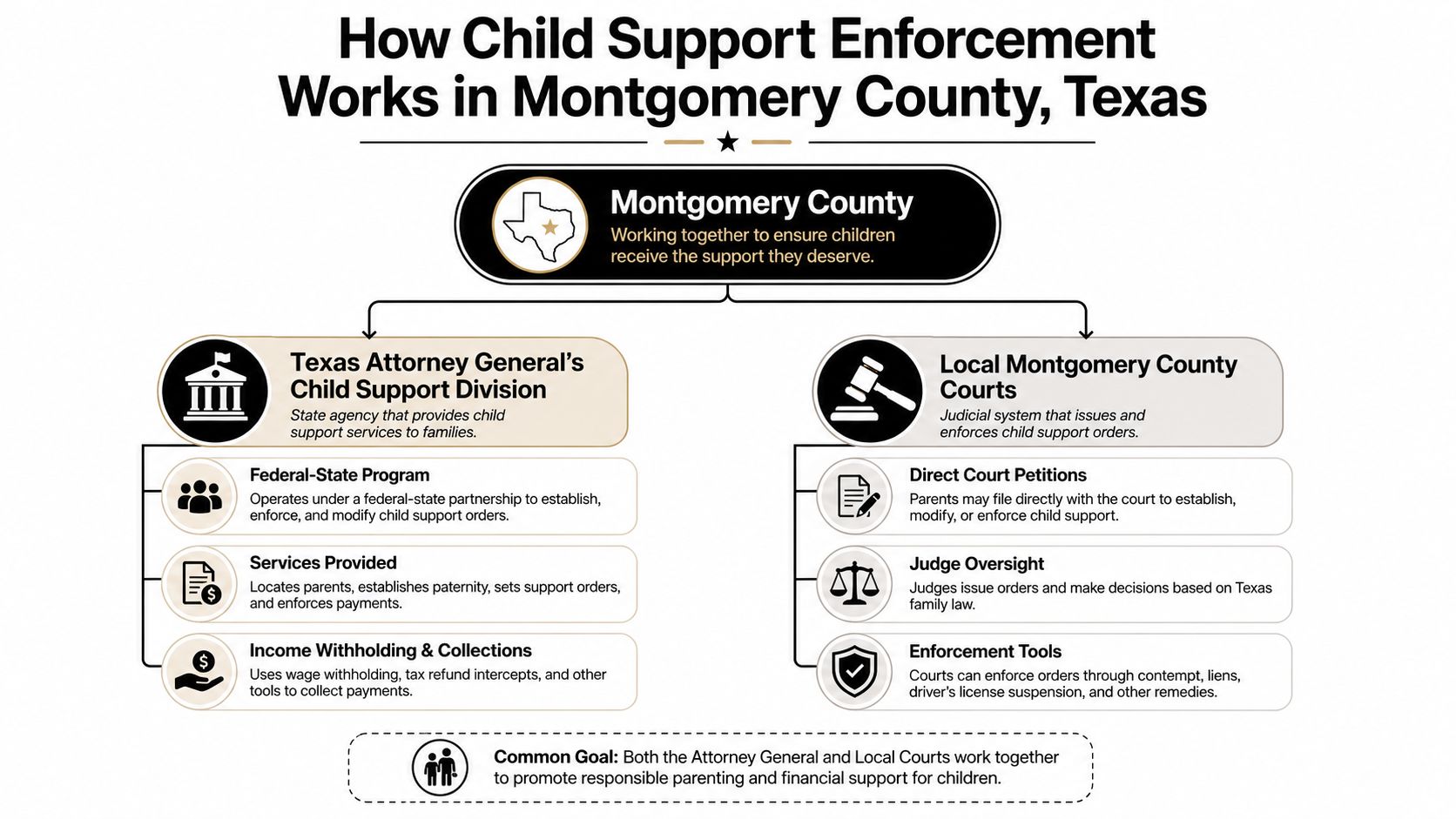
Montgomery County parents deal with two connected systems. The Texas Attorney General's Child Support Division operates the statewide IV-D program, including case administration, income withholding, payment processing, and interstate cooperation. The local district courts in Conroe handle the judicial side, including enforcement motions, contempt findings, modifications, and orders under Chapters 157 and 158 of the Texas Family Code.
Choose the right door first
Use the Attorney General's route when you need administrative collection tools, especially income withholding, payment distribution, location services, or interstate assistance. The state system can use employer and government data to locate an obligor and transmit withholding information. It's usually the least expensive starting point because the agency route generally doesn't require the private filing and attorney costs associated with a contested court case.
The AG's office isn't your private courtroom lawyer. It may not pursue every contempt theory, evidentiary dispute, or strategic request that matters to your family. If the obligor is denying arrears, hiding self-employment income, violating a specific payment provision, or ignoring prior enforcement efforts, you may need to file a Motion to Enforce in the Montgomery County district court yourself.
Confirm venue before filing. Review the existing order, cause number, parties, and current court assignment. Montgomery County family cases are heard in district courts in Conroe, and the district clerk's filing procedures and available electronic portals control how your pleading gets submitted. Court filings ordinarily carry filing fees, although a parent who qualifies for pauper's status can ask the court to waive them.
Practical rule: The AG system collects administratively. The judge decides whether the obligor's violation supports contempt and what judicial remedy follows.
Texas Child Support Calculations and the $11,700 Cap
In Montgomery County, enforcement depends on the support order already signed. The key question is whether that order used the obligor's actual net monthly resources. Texas Family Code §154.125 establishes percentage guidelines, while §154.123 allows a court to deviate when statutory factors support a different amount.
Effective September 1, 2025, the guideline calculation applies a $11,700 monthly net-resource cap. The Texas Attorney General child support calculator identifies the guideline schedule for monthly net resources at or below that amount. The standard percentages are:
| Number of Children | Percentage of Net Resources |
|---|---|
| One | 20% |
| Two | 25% |
| Three | 30% |
| Four | 35% |
| Five | 40% |
| Six or more | At least 40% |
What the calculation looks like
With $11,700 in monthly net resources and one child, the guideline amount is $2,340 per month. With $8,000 in net resources, the guideline amount for one child is $1,600 per month, before any deviation or special finding. Use those figures to check whether the order appears consistent with the guideline calculation, then compare the result with the signed order and payment history.
Net resources may include wages, commissions, bonuses, royalties, severance, qualifying benefits, and self-employment income after reasonable business expenses. A Montgomery County judge examines the complete financial picture, not just the amount shown on a paycheck. Review the income categories explained in What Counts as Net Resources for Child Support before claiming that the order used the wrong income figure.
Texas also has a separate low-income schedule for monthly net resources below $1,000. Under Family Code §154.125(c), courts presumptively apply that lower schedule. High-income and special-needs disputes require specific evidence. A judge can order support above the cap when proven needs and statutory factors justify it, so the parent requesting a deviation should bring financial records, documented expenses, and evidence tied to the statutory factors, not general complaints.
Filing a Motion to Enforce in Montgomery County Courts
A strong enforcement case starts with a pleading that lets the judge verify the violation quickly. File in the court connected to the existing order when jurisdiction and venue are proper. Montgomery County district court filings are handled through the district clerk's office at 301 North Main Street, Conroe, subject to current clerk procedures and electronic filing requirements.
Build the evidentiary record
Your motion should identify the existing order by cause number and state each provision the obligor violated. Attach an affidavit of arrears that lists payment due dates, amounts owed, credits received, and the balance claimed. Explain the calculation method. A vague statement that “payments are missing” gives the respondent room to attack your proof and gives the judge little to work with.
The affidavit must be properly verified. Bring the order, payment ledger, bank records, wage information, messages about missed payments, and any prior agency accounting. If the AG payment history differs from your ledger, reconcile the discrepancy before the hearing rather than presenting two unexplained balances.
A motion to enforce may seek an arrears judgment, income withholding, contempt, a wage or property remedy, or other relief authorized by Chapter 157. If you need contempt, identify each alleged violation clearly enough for the court to determine whether it was intentional and within the obligor's ability to comply.
Service controls the hearing
Texas Family Code Chapter 157 requires proper notice and service. Under Texas procedure, personal service of the motion and hearing notice must occur at least 10 days before the hearing, and the notice must state the hearing's date, time, and place. Texas Bar Practice's discussion of Chapter 157 explains the service requirement and the consequences of joining enforcement with another claim. Texas child support enforcement filing guidance
A waiver of citation can be used when legally appropriate. Service by publication is exceptional and requires court approval. Give the process server an accurate address, workplace information, vehicle description, and other location details. File the return of service before the hearing.
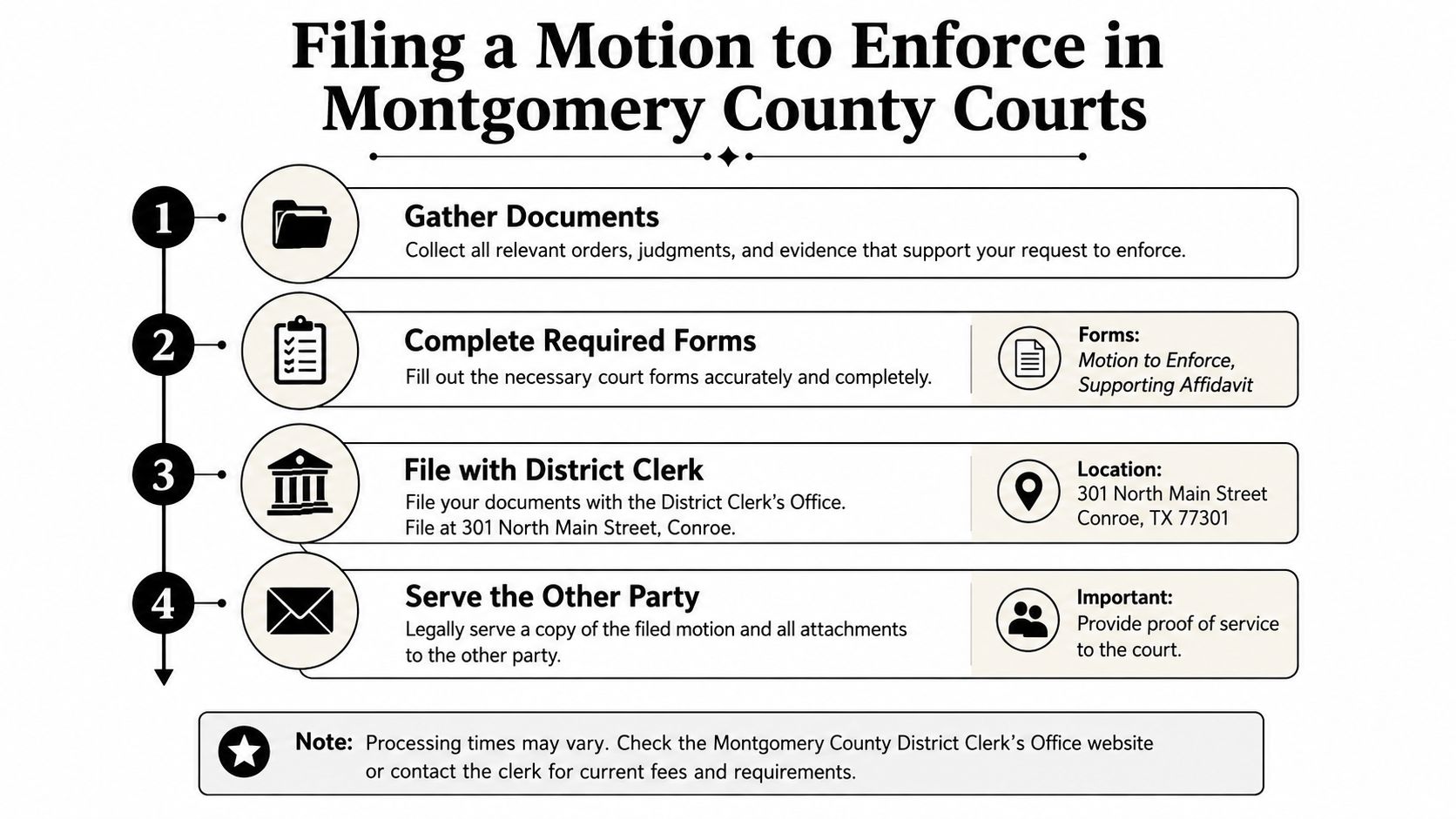
Prepare the notice of hearing, order to appear, respondent response form, and a proposed order with spaces for the judge's findings. Parents who want a practical overview of preparing a contempt filing can review filing a motion for contempt of court. The proposed order won't replace proof, but it can help the court record the arrears, purge terms, withholding instructions, and deadlines accurately.
Enforcement Remedies Texas Courts Actually Use
The correct remedy depends on the obligor's behavior. Don't ask for every available sanction just because you're frustrated. Ask for the tool that addresses the actual collection problem and support it with records.
| Remedy | Texas Authority | Speed | Best Trigger |
|---|---|---|---|
| Income withholding | Chapter 158 | Administrative and ongoing | Employer-paid wages or regular compensation |
| Contempt | Chapter 157 | Requires notice and hearing | Proven intentional violation of a clear order |
| Property lien | Chapter 157 and related enforcement provisions | Depends on identifying property | Real property or valuable assets subject to collection |
| License suspension | Chapter 232 | Administrative process with statutory notice | Persistent delinquency and failure to resolve the account |
| Passport denial or restriction | Federal and state enforcement process | Depends on agency processing | Serious delinquency and international travel concerns |
Match the remedy to the payment pattern
Income withholding is usually the most practical remedy when the obligor has a traceable employer. Chapter 158 allows withholding from wages and certain income streams, making it useful even when the obligor refuses to pay voluntarily. If the parent changes jobs, update the employer information immediately.
Contempt is different. Under Chapter 157, the court can require the obligor to appear, determine whether the violation was intentional, enter an arrears judgment, and set a purge condition. Jail is possible when the statutory requirements are met, but contempt is not automatic. The order must be clear, the violation must be proven, and the obligor must have had the ability to comply.
A property lien becomes more useful when the obligor owns identifiable property but claims there's no cash. License remedies can pressure a person whose work, driving, or recreational privileges matter. Passport enforcement is better suited to a documented travel or flight concern than to an ordinary missed-payment dispute.
For a broader discussion of matching enforcement options to the facts, review how to enforce child support in Texas. The judge responds to payment records, employer information, asset evidence, and service proof, not an angry narrative.
A Realistic Enforcement Timeline in Montgomery County
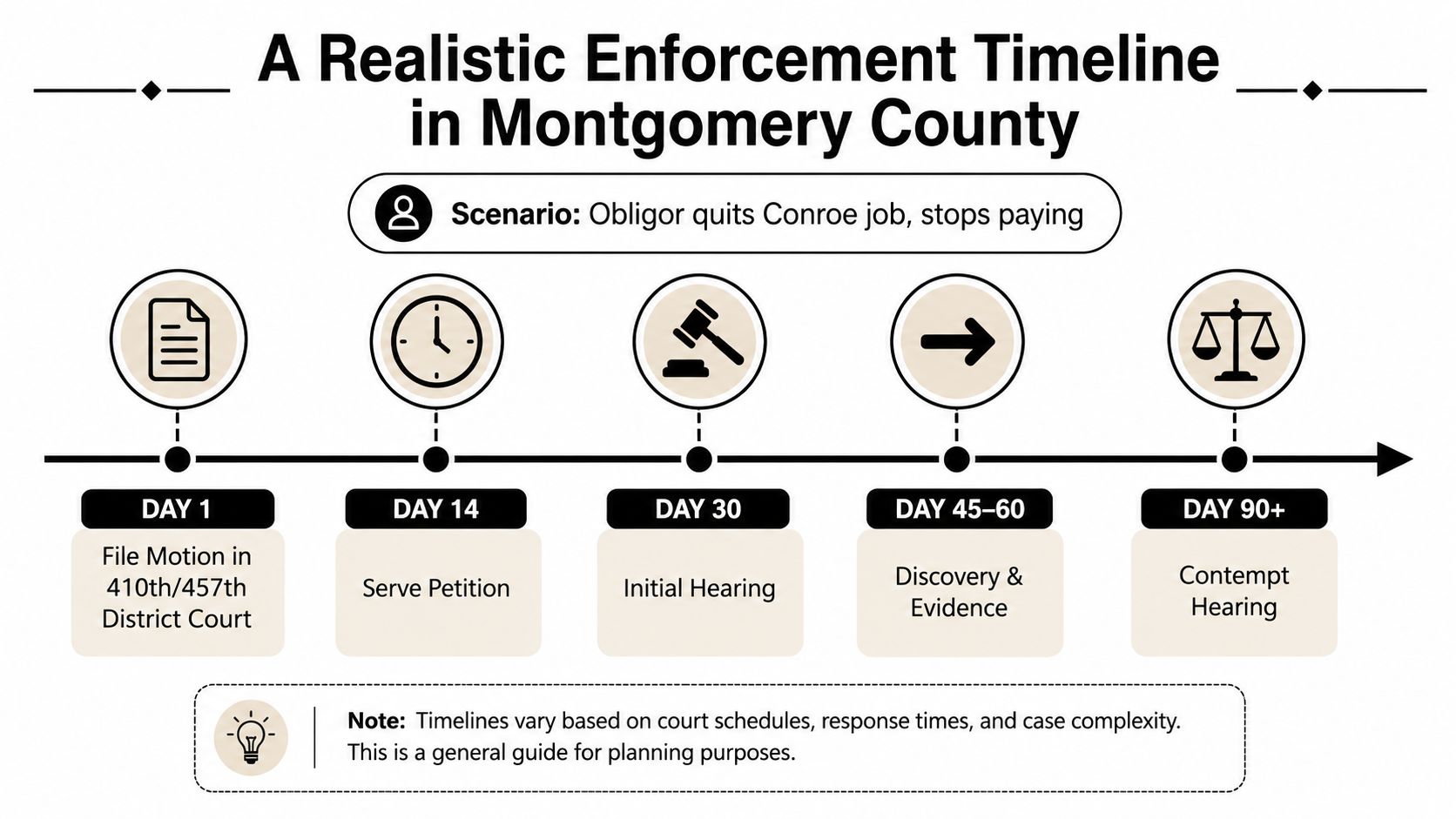
Assume an obligor works near Conroe, leaves that job, and stops paying. The custodial parent has an existing order and files a Motion to Enforce in the 410th or 457th District Court, depending on the assigned case and current jurisdiction.
The filing and service period
During the opening period, the parent files the motion, verified arrears affidavit, supporting payment records, proposed order, and hearing materials. The parent also gives the process server enough information to locate the respondent. Service may involve a constable or another authorized process server, depending on the circumstances and local procedures.
Service isn't a technical afterthought. Without valid notice, the court may postpone the hearing, and the parent loses time while the arrears continue. Keep the filed return of service and bring a copy to court.
The response and factual dispute
After service, the obligor may file a response, challenge the ledger, claim unemployment, or file a motion to modify. A modification request doesn't erase existing arrears, and it doesn't automatically suspend the current order. Until a judge signs a new order, the existing payment obligation remains the benchmark for enforcement.
The custodial parent should separate the issues. Prove the missed payments first, then address whether current income supports a prospective modification. Bank records, job history, tax documents, business records, and communications can reveal whether the job loss was genuine or whether income moved off the books.
The hearing and collection order
At the hearing, the judge may determine arrears, sign an income withholding order, set a purge amount if contempt is proven, and address the legal consequences of the violation. The exact schedule depends on service, docket availability, contested evidence, and whether the obligor creates a modification dispute.
Once wages are located, withholding payments route through the Texas Child Support State Disbursement Unit in San Antonio before distribution to the receiving parent. Parents who need a broader discussion of timing can review how long a child support case takes in Texas. Use the timeline as a planning framework, not a promise that every case reaches a hearing on the same schedule.
When to Hire the Law Office of Bryan Fagan
Self-filing can make sense when the obligor has a known employer, recent payments are documented, arrears are limited, and neither side disputes the order. In that situation, an administrative income-withholding request may solve the problem without turning the case into a contested courtroom fight.
The calculation changes when the obligor hides income, operates a business, moves across state lines, contests the arrears ledger, or forces a contempt proceeding. Those cases require more than completing a form. They require tracing income, proving the order's terms, establishing service, responding to defenses, and presenting a remedy the judge can lawfully impose.
Signs the case has outgrown self-filing
- Income is concealed: The obligor reports little salary while spending at a level that suggests other resources.
- The account is disputed: The payment record contains credits, reversals, cash payments, or agency adjustments that neither side has reconciled.
- The case crosses borders: The parent lives or works outside Montgomery County or Texas, creating service and interstate enforcement complications.
- Contempt is on the table: Jail, a purge condition, or a contested finding requires precise pleadings and admissible proof.
- Modification overlaps enforcement: The obligor claims reduced income while you need arrears collected under the existing order.
The Texas Child Support Law Office of Bryan Fagan handles establishment, modification, enforcement, and defense under Texas Family Code Chapters 157 and 158. Its practice includes high-income support disputes, business-owner income, arrears, wage garnishment, medical support, retroactive support, and disagreements over net-resource calculations.
That representation is most useful when the opposing parent controls the records, changes employment repeatedly, or uses delay to avoid a clear payment obligation. A lawyer can also coordinate an enforcement request with a modification strategy, rather than allowing an emergency filing to create avoidable problems in the broader case.
Common Texas Child Support Enforcement Questions
Is there a statute of limitations on child support arrears?
Texas Family Code §157.005 generally allows enforcement of child support arrears without the short deadline many parents assume. Keep payment records and court orders permanently. Old arrears still require proof, and a weak ledger can create avoidable disputes even when the underlying obligation remains enforceable.
What happens at a first contempt hearing?
The judge reviews the order, alleged violations, service, payment history, and the obligor's ability to comply. If contempt is proven, the court may enter an arrears judgment and set a purge condition. The court won't punish a person for failing to do something the order didn't clearly require.
Can income withholding reach a self-employed obligor?
Ordinary employer withholding is harder when the obligor controls a business or receives irregular compensation. The court can still examine business records, deposits, distributions, and other resources, and it can use judicial remedies available under the Texas Family Code. A self-employed obligor isn't exempt from support enforcement.
Does unemployment cancel child support?
No. Losing a job doesn't automatically change an existing order. The obligor must pursue modification under the applicable Texas standards, and the court evaluates current net resources and the child's proven needs. Missed payments continue to accrue until an effective modified order changes the obligation.
What leads to license suspension?
Texas administrative enforcement can pursue driver, professional, hunting, or fishing license consequences when statutory conditions are met and required notices are provided. A parent should treat a suspension notice as a deadline to resolve the account, request a review, or pursue an appropriate payment arrangement.
When can passport enforcement apply?
Passport denial or restriction addresses serious delinquency and qualifying federal enforcement conditions. It isn't the routine response to every missed payment. Provide accurate arrears information and travel facts if international flight is a genuine concern.
How long does a modification take after a material change?
There's no universal schedule. The court must receive a proper modification request, provide notice, and evaluate evidence of changed circumstances under Texas Family Code Chapter 156. Filing promptly matters because a later order generally doesn't rewrite every past due amount.
Can a non-custodial parent recover overpaid support?
Recovery isn't automatic. The court examines the payment history, the order, credits, and the reason for the overpayment. A parent should present a reconciled accounting and request the specific credit or relief supported by the record rather than just stopping future payments.
If your Montgomery County case involves contested arrears, hidden income, interstate enforcement, or contempt, contact the Texas Child Support Law Office of Bryan Fagan for a focused review of the order, payment history, and enforcement option.
Texas Child Support Law Office of Bryan Fagan helps Montgomery County parents establish, modify, enforce, and defend child support orders, including arrears, wage withholding, high-income calculations, and complex income disputes. Visit Texas Child Support Law Office of Bryan Fagan to request a strategy session focused on the documents, filing route, and remedy your case requires.