The phone call usually comes at an awkward time. A Texas parent is getting ready for a child's 18th birthday, or maybe the child has already turned 18, and the issue is plain, hard, and immediate: the care needs are not going away. School may end, standard child support may be winding down, but the supervision, therapy, medications, transport, and daily structure still have to be paid for.
That is where child support for a disabled adult child in Texas changes everything. Texas does not treat every case like ordinary child support that ends at majority. The law allows indefinite support when the statutory requirements are met, and the court can keep support going for as long as the disability-related need exists under Texas Family Code § 154.302, rather than stopping at the usual age-based endpoint (Texas Family Code discussion). But the court does not hand that order out because a child has a diagnosis. You have to prove the right facts, and you have to prove them with evidence a judge can rely on.
A parent walking into this hearing needs a sharper plan than the one used in a routine guideline case. The court will look at disability timing, care needs, available family resources, benefits, trust planning, and whether anyone is already paying for substantial supervision. If you miss the timing issue or ignore the child's benefit picture, you can lose a case that looked strong on emotion alone.
When Standard Child Support Ends and Lifelong Care Begins
A lot of Texas families hit the same wall. The child is turning 18, the other parent starts talking about support ending, and the family realizes the expenses have not changed one bit. In some homes, the adult child still needs help dressing, taking medication, moving safely, handling routines, or getting through the day without constant oversight.
Texas law gives that family a path, but it is not the same path as ordinary child support. For disabled adult children, the court can continue support indefinitely if the statutory criteria are met, and that is a major shift from the normal age-based cutoff discussed in when child support ends in Texas. The old rigid idea was simple. The new Texas framework is more demanding, but it is also more realistic for families dealing with lifelong disability.
The point is not to argue that adulthood ends financial responsibility. The point is to show the court that adulthood does not end dependency. Texas moved toward a needs-based model after the 1989 legislative change, which opened the door for support after adulthood when the disability existed or was known before age 18 (Texas law history). That history matters because judges still expect you to prove the child's need, not just cite the age.
Practical rule: if your child's disability will require substantial care after 18, don't wait until the birthday passes to think about support. Delay makes the evidence fight harder.
A parent who wants support has the burden. The court will not assume the child qualifies, and it will not do the work for you. If you're preparing for a hearing, start with the medical timeline, the caregiving record, and the benefits picture, because that is where these cases are won or lost.
The Two Threshold Requirements Under Texas Family Code §154.302
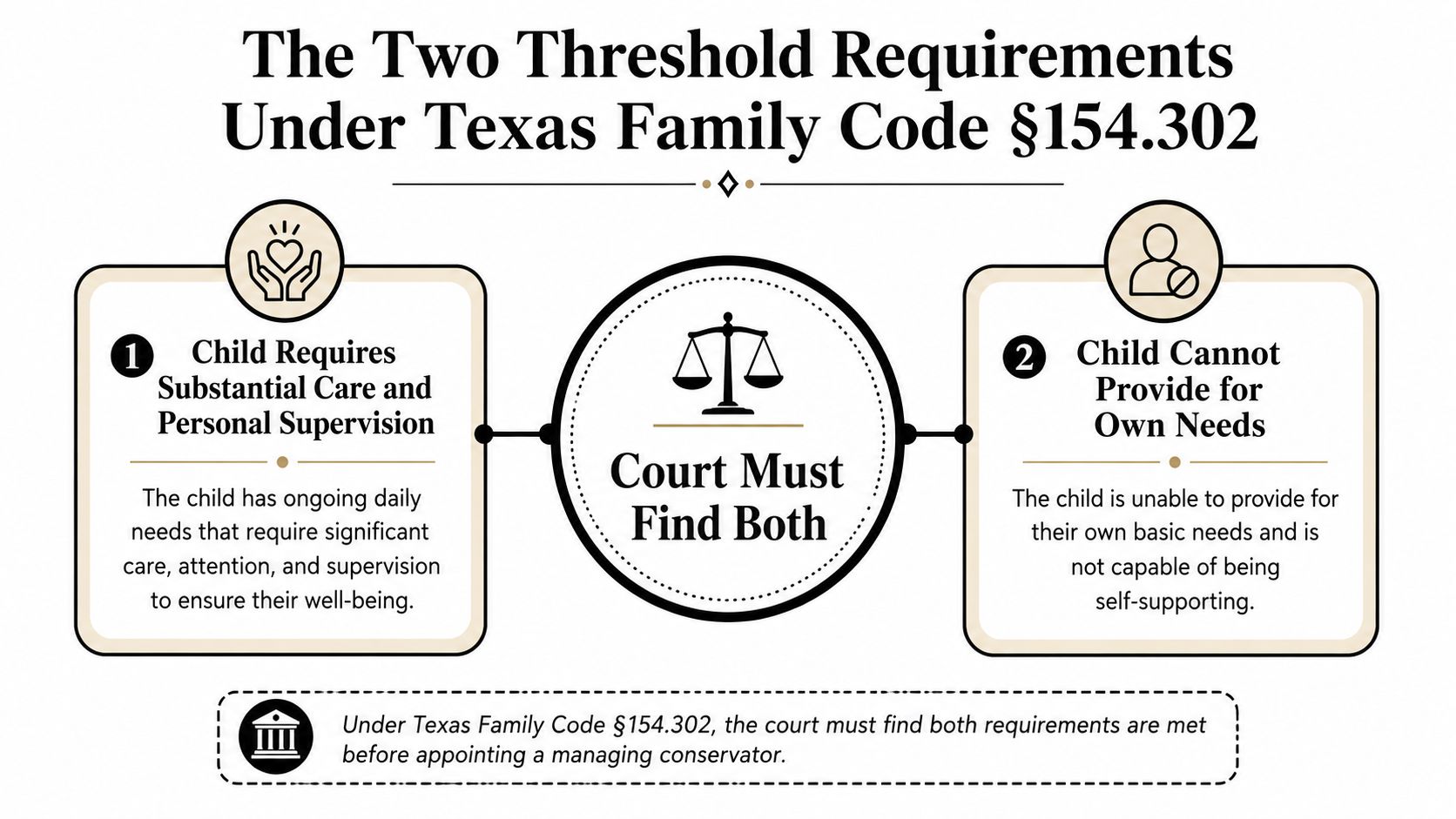
A Texas judge will not order indefinite support for a disabled adult child unless the evidence clears two gates. First, the adult child must need substantial care and personal supervision because of a mental or physical disability. Second, the disability must have existed, or its cause must have been known, before the child's 18th birthday (Texas Family Code § 154.302). Miss either fact, and the request is exposed.
The first requirement demands proof of real-world dependency, not a diagnosis standing alone. The court looks for evidence that the adult child needs ongoing help with safety, medication, transportation, behavior control, decision-making, or ordinary daily tasks that cannot be handled independently. A medical label does not carry the case if the child can function without meaningful supervision.
The second requirement is where families lose ground. The disability, or the cause of it, must trace back to a time before age 18, and the court expects proof that is grounded in records, not just memory. Childhood treatment notes, school accommodations, therapy history, and long-running care documents matter because they show the condition was not invented after adulthood for litigation purposes.
That timing rule reflects the change Texas made in 1989, which allowed continued support for disabled adult children while keeping the pre-18 requirement in place. Families often think the problem is only proving present need. It is not. The court also wants a clean timeline that ties the adult child's condition to childhood, and that is why Texas family code child support guidance should be reviewed early, not after the hearing is already set.
Benefits history also matters here, because it affects how the court reads the case. SSI, SSDI, trusts, and in-kind support do not decide whether the statute is met, but they shape the court's view of actual dependence and what support order makes sense. A child who receives public benefits or trust distributions may still qualify for support, yet the court will look closely at who is paying for what, and whether cash support needs to be structured to avoid harming benefits.
Texas law also gives the court flexibility about where the payments go. In a qualifying case, support can be paid to a parent, another custodian, the adult child, or a special needs trust. That choice is not a formality. It can affect benefit eligibility, accounting, and whether the support order helps the child without creating a separate problem.
The job for the moving party is plain. Prove the disability existed on time, prove the child still needs substantial supervision now, and be ready to explain every dollar of outside support the child already receives.
The Four Evidence Categories Courts Weigh Under §154.306
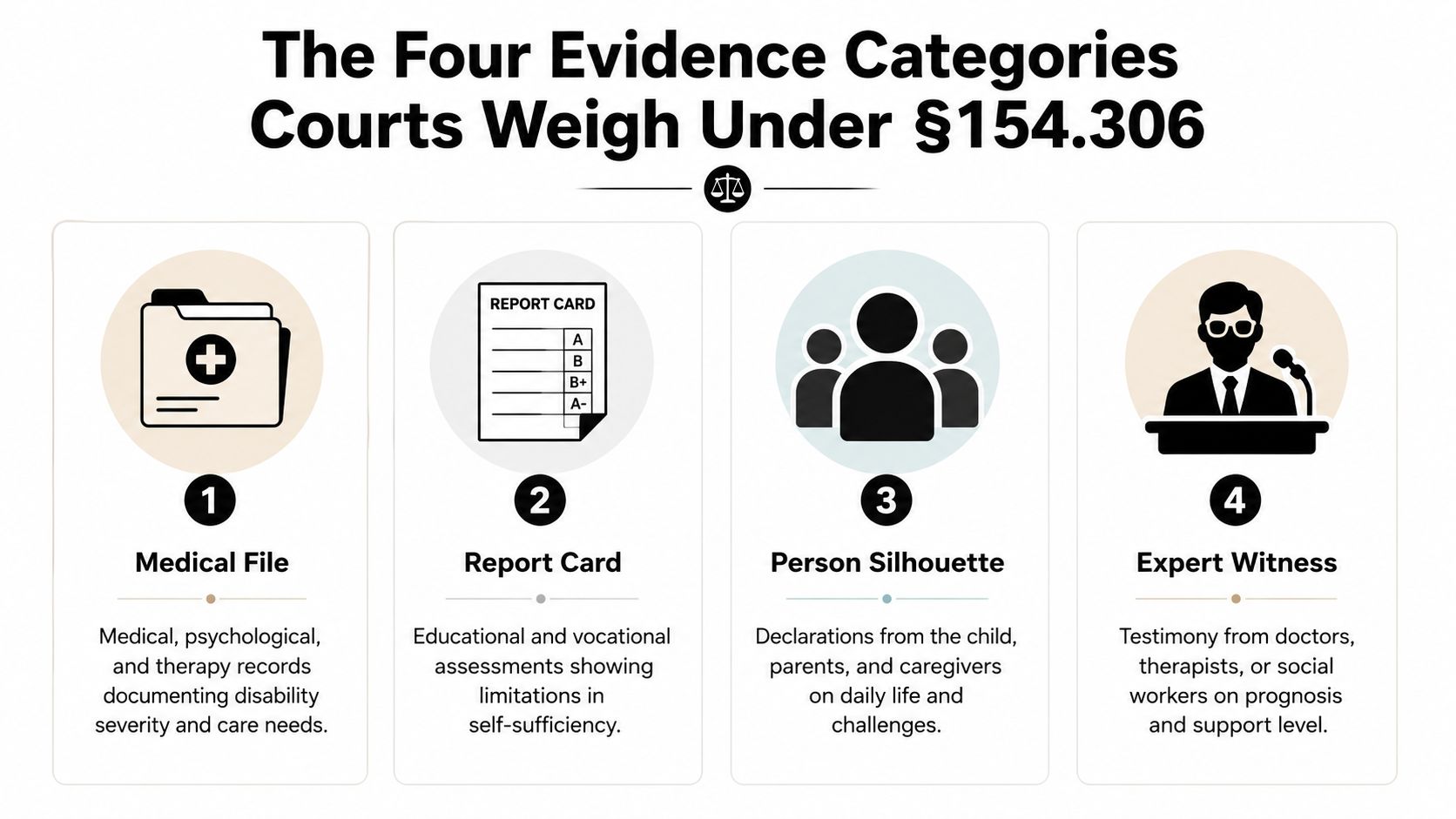
Once the threshold issue is met, Texas Family Code § 154.306 turns the hearing into a fact-specific review of the child's real life and the parents' real resources (Texas Family Code § 154.306). Judges must consider four categories, and you should prepare each one as if the other side is going to challenge every detail. That's because they probably will.
Build the case around the child's needs, not labels
The first category is the adult child's current and future disability-related needs. Medical records matter, but so do therapy notes, school transition plans, occupational assessments, daily routine logs, and any evidence showing what the child can't do without help. A diagnosis starts the conversation. Functionality decides the outcome.
Show who is actually carrying the load
The second category is whether a parent already provides substantial care or supervision. Courts care about the lived reality. If one parent is driving the child to appointments, managing medications, and handling daily oversight, that should be documented clearly. Declarations from caregivers, doctors, therapists, and even school or program personnel can make the difference between a thin file and a persuasive one.
Don't ignore the money side
The third category is the financial resources available to both parents. A judge will not order support in a vacuum. If one parent has substantially more resources, that can affect the amount and allocation of support. The fourth category is broader still, any other resources or public programs available for support, which is where benefits, trusts, and outside income come into play.
A hearing on adult-disabled-child support is not won with sympathy. It's won with records that answer the judge's questions before the judge has to ask them.
If you're gathering documents, the most useful ones are the ones that show the child's daily reality and the parents' financial reality at the same time. That is why the internal link on evidence needed for a child support case in Texas is worth reviewing early. Judges look for concrete proof, not vague statements about hardship.
A strong petition usually has medical file support, functional assessments, caregiver testimony, and a financial statement that tracks resources accurately. If one of those pieces is missing, the other side will exploit the gap.
How SSI, SSDI, and Trusts Change What Courts Actually Order
Most family-law guides get too shallow. They tell you disabled adult child support may be available, then stop there. Texas law does not stop there. The court must consider any other financial resources or other resources or programs available for the child, and that is where SSI, SSDI, vocational income, trust assets, and family-paid support can change the final order (Texas Family Code § 154.306).
Benefits can reduce the need the court sees
SSI and SSDI are not treated the same way in every family's story, but both matter because the judge is looking at the full resource picture. If the adult child already receives outside support, the court may view the remaining gap differently. The same is true when the child has vocational income or substantial in-kind help from family, such as housing, food, or transportation that lowers monthly need.
Trust planning can protect benefits and support the child
Texas law also allows payment into a special needs trust in qualifying cases. That is not a technicality. For families worried about preserving public benefits, it is often the cleanest way to structure support without creating a direct-income problem for the child. If support goes straight to the adult child or is handled carelessly, it can create avoidable issues with need-based programs.
The hard truth about independent resources
Courts sometimes deny support when the adult child has enough independent income or resources to meet their needs. That is the contrarian point many families don't hear until late. Disability alone does not guarantee an order. The core question is whether the child still needs court-ordered help after all other resources are counted.
| Factor | What the Court Looks At | Practical Effect |
|---|---|---|
| SSI or other need-based benefits | Whether the child already has outside support | Can reduce the gap the court sees |
| SSDI or earned income | Whether the child has regular income available | May lower or eliminate the need for additional support |
| Special needs trust | Whether support can be routed to preserve benefits | Can support long-term planning |
| In-kind family support | Whether parents already pay for housing, care, or transport | Can affect the judge's view of what is truly unpaid |
If you want one part of the strategy that separates good orders from bad ones, it is this: map every benefit, every payment, and every shared expense before the hearing. Courts do not reward families for guessing.
Filing, Service, and Hearing Procedures for Indefinite Support
A petition starts the case, and it has to be filed in the correct court with the correct legal theory. If the court already has continuing jurisdiction over the parent-child case, the request usually proceeds as a modification. If that jurisdiction is missing, the filing must establish why that court can hear the request at all. Get that wrong, and you waste time before the merits ever get reached.
Get service right the first time
The other parent must be properly served unless the case becomes agreed. Papers have to be delivered in a legally valid way, not just handed over informally. Defective service can delay the hearing, and it can also give the other side a clean way to attack the order later. In a support case involving a disabled adult child, delay matters because the child's needs do not stop while the case sits on the docket.
Bring hearing-ready evidence, not a stack of loose papers
At the hearing, the judge expects testimony and documents that connect the child's condition, needs, and available resources to the statutory requirements. Medical records, caregiver testimony, resource statements, and benefit information should be organized before you ever walk into the courtroom. The court will not piece the case together for you.
If the case is contested, credibility matters. Judges pay attention to who has real knowledge of the child's daily needs, who is guessing, and who is trying to minimize or inflate the resource picture. If the case is agreed, the paperwork still has to be exact, because an imprecise agreed order can create problems later when enforcement or modification becomes necessary.
Procedurally, a few points deserve attention:
- File the petition early: waiting until a crisis forces the issue only makes proof harder.
- Serve cleanly: service defects waste hearing settings and can derail temporary relief.
- Prepare for modification rules: support can change if there is a material and substantial change in the child's needs or either parent's resources.
- Use the hearing to build the record: the judge's order should reflect the evidence, not assumptions.
Bottom line: a good disabled-adult-child support order depends on procedure and proof working together. If either one is sloppy, the other side gains an advantage.
Enforcement still matters after the order is signed. If a parent stops paying, the order can be enforced through the family-court system like other support obligations, but enforcement is only as strong as the order itself. A vague order invites arguments. A precise order gives the court something real to enforce.
Calculating Support Under the $11,700 Net Resource Cap
Texas still starts with the guideline framework, then tests whether the facts justify a different result under § 154.123. For high-resource parents, the updated $11,700 net monthly resource cap effective September 1, 2025 matters because it limits how much of a parent's income is used in the guideline calculation before the court considers deviation factors. The cap increase is reflected in the Texas child support income-cap update for 2025 (2025 income cap update).
The guideline formula is only the starting point
For one child, the standard guideline percentage is 20% of net resources, applied up to the capped amount in a typical guideline analysis. That gives the court a starting figure, not a final answer. In an adult-disabled-child case, the court then looks at the child's care needs, benefits, trust structure, and the parents' resources under §§ 154.302, 154.306, and 154.123.
Practical examples in real cases
If a parent earns above the cap, the court generally does not keep counting beyond the capped net resources for guideline purposes. The starting amount comes from the capped number, then the judge may adjust up or down if the disability-related facts justify it. If the adult child has independent income or benefit support, the judge may order less than the guideline starting point because the actual unmet need is smaller.
If both parents have similar resources, the dispute often shifts from raw income to who is already paying for care, housing, and supervision. In a 50/50 arrangement, that doesn't automatically erase support. For a disabled adult child, the judge still looks at who is paying for disability-related needs and whether one parent's share is being covered by benefits or in-kind support.
| Parent Monthly Net Resources | Capped Amount | 20% Guideline, 1 Child | Potential Deviation Factors |
|---|---|---|---|
| Below cap | Actual net resources | Based on actual resources | Child's needs, benefits, trust planning, caregiving load |
| At cap | $11,700 | 20% of cap | Existing care expenses, public programs, parent resources |
| Above cap | $11,700 for guideline use | 20% of cap | Disabled adult child needs, independent income, supervised care |
Texas Family Code § 154.123 lets the court deviate when the circumstances justify it. In a disability case, that means the judge can weigh the adult child's actual care needs against the resource picture, rather than treating the case like ordinary support.
If your numbers are close to the cap or well above it, don't guess. Build the resource analysis line by line, or the other side will do it for you.
When to Consult a Texas Child Support Attorney
Bring an attorney in early if the disability is contested, the benefit picture is messy, the parents' resources are high, or a modification is already on the table. Those are the cases where small procedural mistakes become expensive fast. They also require a clean evidentiary record, and that record is much easier to build before the hearing than after it.
A serious strategy session should cover three things immediately, the child's pre-18 disability proof, the current and future care needs, and the complete list of resources that the court will consider. You should also walk in with financial documents, benefit notices, treatment history, and any existing support order. If you don't have those papers ready, you're not ready for the hearing.
The Texas Child Support Law Office of Bryan Fagan handles child support establishment, modification, enforcement, and complex income disputes under the Texas Family Code, including cases involving the guideline cap, deviations, and benefit-sensitive support planning. That matters in disabled adult child cases because the wrong order can disrupt benefits or miss the child's long-term needs.
If you're dealing with child support for a disabled adult child in Texas, don't wait for the court to sort out the hard questions for you. Visit Texas Child Support Law Office of Bryan Fagan to speak with a team that handles the legal and financial details before they become hearing-day problems.