A Texas parent paid in Bitcoin says the reported paycheck is modest, yet exchange records show regular deposits, staking rewards, and transfers into a bank account. The other parent sees those transactions and asks a practical question: does crypto count as income for child support, or is it merely an investment?
Texas courts generally don't decide the issue based on the label “cryptocurrency.” They examine whether the activity created actual available financial resources, whether the benefit was realized, and whether it belongs in the parent's monthly net resources under Texas Family Code §154.062. For orders entered or modified on or after September 1, 2025, the guideline calculation uses a monthly net-resource cap of $11,700, which creates a separate question for higher earners: should the court apply the guideline amount, or consider an upward deviation under §154.123?
This guide breaks the issue into three categories: realized income, capital return, and property. It then applies those categories to guideline calculations, evidence, court procedure, modification requests, and enforcement. If you're preparing for a Texas child support hearing, start with the Texas child support guidelines explained and then organize your crypto records around the legal questions the judge must answer.
Introduction Why Crypto Changes Texas Child Support Calculations
Consider a parent who receives part of a consulting fee in Bitcoin. During the same period, that parent earns staking rewards and sells coins to pay household expenses. On paper, the parent may report little traditional wage income. In practice, the wallet and exchange history may show a recurring flow of economic benefit.
The other parent might argue that every deposit is income. The crypto holder might respond that some transfers merely represent money originally invested, while other tokens remain unsold. Both positions can be incomplete. Texas law requires the court to separate the nature of each transaction before deciding what belongs in the child support calculation.
Practical rule: The important question isn't whether the asset is crypto. The question is what the transaction represents and whether it created a resource the parent actually received or controlled.
Texas child support is based on monthly net resources, not gross wages. Under Texas Family Code §154.062, the analysis can include self-employment income, interest, dividends, capital gains, and “all other income being received.” That broad language gives a recipient parent a basis to examine crypto compensation, mining proceeds, staking rewards, and realized gains. It also gives the payor a basis to distinguish true income from a return of invested capital.
The timing of the support case matters too. The statutory cap used in guideline calculations increased from $9,200 to $11,700 effective September 1, 2025, and the change was described as the first Texas child-support guideline increase since 2019 (Wilson Legal Group explains the 2025 cap change). The updated cap applies to orders entered or modified on or after the effective date, subject to the case posture and applicable law.
A strong hearing presentation therefore follows a logical sequence. First, classify the crypto event. Next, calculate the realized net benefit and determine the parent's monthly net resources. Finally, apply the guideline cap and decide whether above-cap income supports a deviation under Texas Family Code §154.123. That sequence keeps the dispute focused on evidence instead of labels.
How Texas Defines Net Resources and Guideline Support
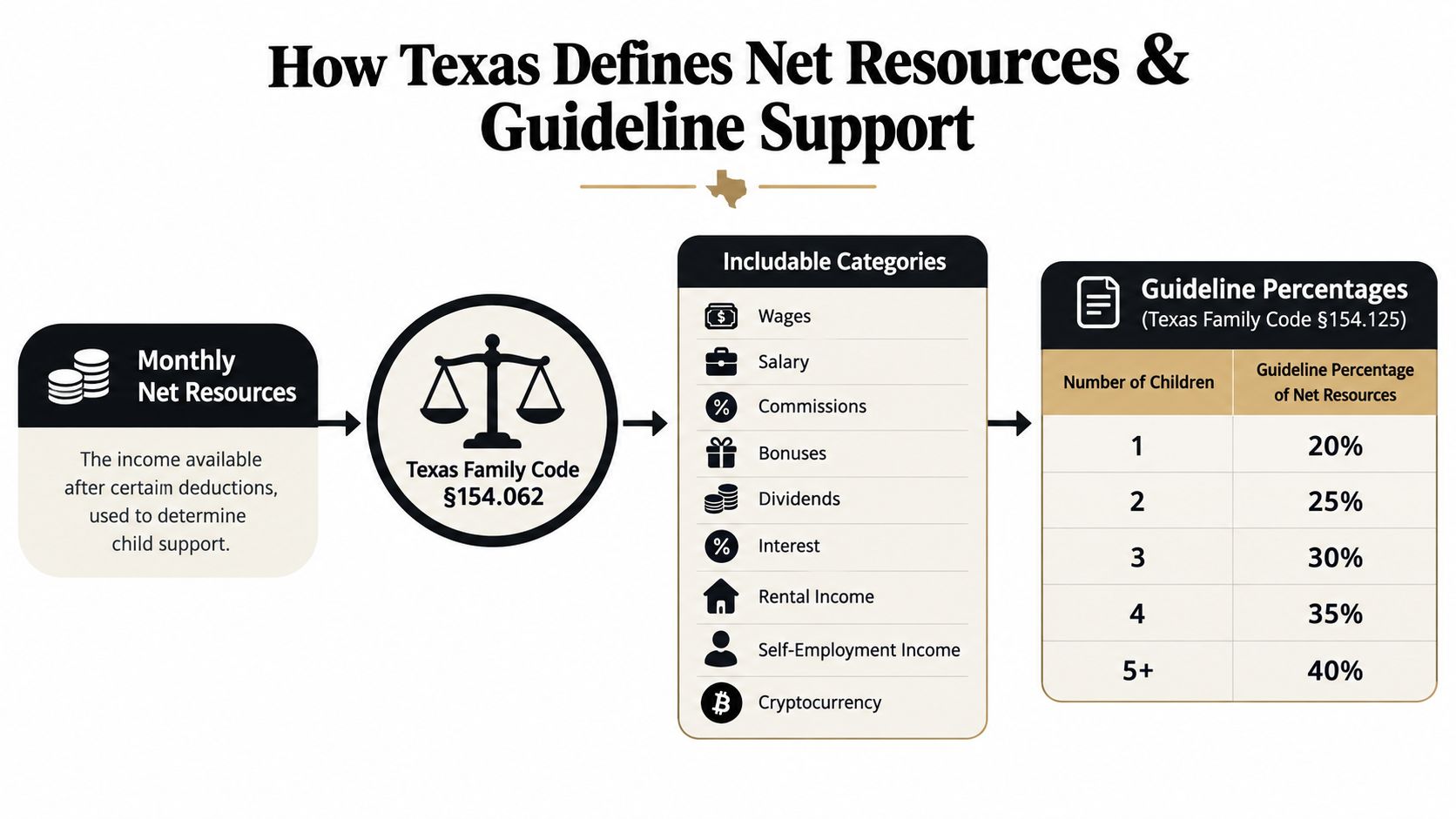
Texas Family Code §154.062 supplies the starting point. The court asks what the parent's monthly net resources are after applying the statutory framework, rather than multiplying gross pay by a support percentage. The statute's broad categories include wages, salary, commissions, bonuses, self-employment income, interest, dividends, rental income, capital gains, and all other income being received. Crypto must be placed into that framework before anyone can calculate support.
Step one identify the resource
A crypto payment may be compensation for services. Mining proceeds may reflect work and equipment operation. Staking rewards may resemble a yield-producing payment. A sale of coins may create a realized gain, but part of the proceeds can also represent the return of the money originally invested. Each event needs its own accounting treatment.
The court may also examine whether a parent controls the resource even if the money hasn't moved into a checking account. Control, liquidation, recurring receipt, and actual use can help show whether a digital asset produced an available economic benefit during the relevant period. Unexplained transfers between wallets don't automatically establish income, but they can create questions that require records and testimony.
Parents who need a broader explanation of which income sources are included can review What Counts as Net Resources for Child Support as a reference point for the Texas calculation.
Step two apply the guideline percentages
Texas Family Code §154.125 sets the guideline schedule for an obligor whose monthly net resources are at or below the statutory cap. The schedule remains 20% for one child, 25% for two children, 30% for three children, 35% for four children, and 40% for five or more children (the Texas Register publication contains the updated statutory framework).
For a parent with $11,700 in monthly net resources and one child, the presumptive guideline calculation is 20% of $11,700, or $2,340 per month. The same cap produces $2,925 for two children and $3,510 for three children, when the applicable guideline percentages are applied to the capped amount (the 2025 cap discussion provides these guideline figures).
The cap limits the guideline formula. It doesn't mean the court ignores all income above it. Once the parent's resources exceed the cap, the court considers whether evidence rebuts the presumption that the guideline amount serves the child's best interest. That is where §154.123 and specific written findings become important.
When Crypto Counts as Income Versus Property or Capital Return
The most useful way to analyze crypto is to stop treating it as one category. A Texas court may view a transaction as realized income, capital return, or property whose value has not yet been realized. The classification affects whether the amount enters net resources and how the parent proves the calculation.
Realized income
Mining and staking rewards usually present the clearest income argument when the parent receives tokens for providing computational work, validating transactions, or committing assets to a staking program. A parent paid in crypto for services faces a similar issue. The form of payment doesn't necessarily change the underlying economic substance.
Suppose a parent receives tokens as compensation and immediately transfers them to an exchange or bank account. The records can show both receipt and control. The court may examine the token value when received, what happened afterward, and whether the payment was part of a recurring business or employment arrangement.
Capital return
Texas Family Code §154.062 includes capital gains and other income being received, but it excludes a return of principal or capital. That distinction matters when a parent sells coins purchased with previously earned funds. The gross sale proceeds aren't automatically the same as income. The analysis may require proof of cost basis, sale price, exchange fees, and the portion representing gain.
For example, a sale can contain two components. One part returns the money originally invested. Another part represents a realized increase in value. Without transaction-level records, a parent may have difficulty showing where one ends and the other begins.
Property and unrealized appreciation
A coin that remains unsold may have market value, but price appreciation alone isn't necessarily a monthly cash receipt. A parent who holds crypto through a period of market growth may own more valuable property without receiving a spendable payment. The court can still examine control, liquidity, transfers, and the parent's overall financial condition, particularly when deciding whether a guideline deviation is justified.
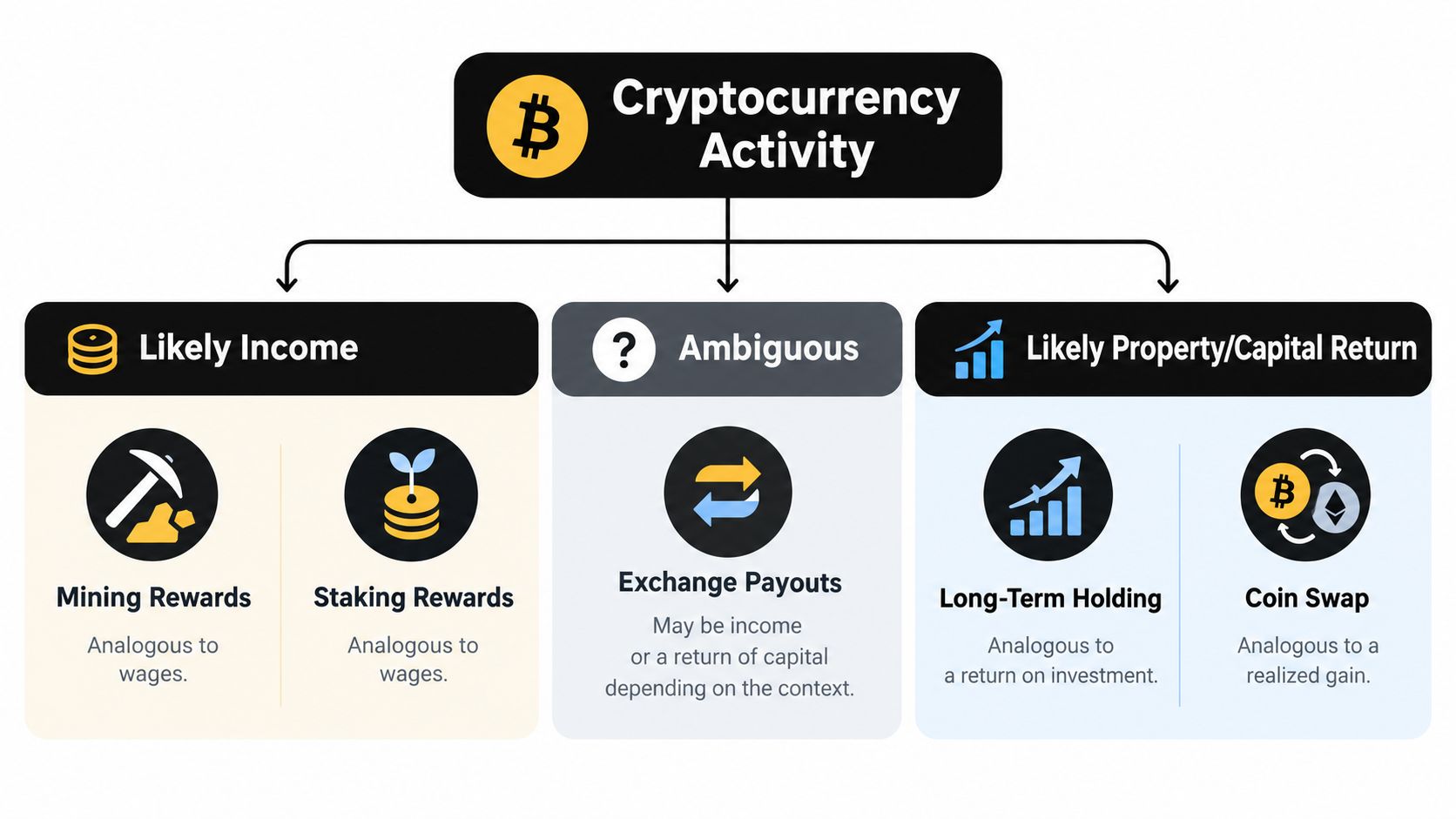
Exchange payouts can fall into an intermediate category. A payout might reflect trading profit, a withdrawal of invested principal, staking income, or a mixture of these. The court needs records that identify the source instead of relying on a wallet balance alone. The distinction is similar to the broader question of how courts treat other nontraditional compensation, including stock options in Texas child support calculations.
The practical question for every crypto event is simple: was it compensation, yield, a realized gain, a return of principal, or unsold property? A clear answer requires a transaction history that connects the event to the parent's financial records.
Calculating Support With Crypto at and Above the $11,700 Cap
A parent at the cap and a parent above the cap don't face identical guideline analysis. Under Texas Family Code §154.125, the guideline percentages apply to monthly net resources up to $11,700 for orders entered or modified on or after September 1, 2025 (the Dallas discussion of the updated charts explains the cap and above-cap analysis).
For one child, a parent with $11,700 in monthly net resources has a presumptive guideline obligation of $2,340 per month. If the parent also has crypto income above that cap, the additional amount doesn't automatically increase guideline support in a straight line. Instead, the recipient must present evidence supporting a deviation under §154.123, and the court must determine whether the guideline amount would be unjust or inappropriate in light of the child's proven needs and the statutory factors.
Two paths at the hearing
| Income Scenario | Guideline Treatment | Court Analysis Required |
|---|---|---|
| Net resources at or below $11,700 | Apply the percentage schedule under §154.125 to the applicable monthly net resources. | Confirm the resource figure, deductions, number of children, and other guideline factors. |
| Net resources above $11,700 because of realized crypto income | Apply guideline math through the cap, then consider whether additional support is justified. | Evaluate the child's proven needs, the nature and reliability of crypto receipts, available resources, and the statutory factors under §154.123. |
| Crypto receipts vary sharply between periods | Avoid treating a single wallet snapshot as the entire support picture. | Review records over the relevant period and determine a reasonable monthly resource figure supported by evidence. |
A high-income crypto case often turns on the difference between classification and deviation. The recipient may successfully prove that staking rewards or realized trading gains are countable resources, yet still need separate evidence to support an amount above the guideline ceiling. The payor, meanwhile, should distinguish recurring receipts from speculative appreciation and prove the cost basis for transactions claimed as capital return.
Section 154.123 requires specific written findings when the court deviates from the guideline amount (Texas Family Code §154.123). Those findings should identify why the guideline amount doesn't serve the child's best interest and how the evidence supports the ordered amount.
Filing Service Hearing and Modification Steps in Texas
Crypto income enters the child support case through procedure. A parent must put the issue before the court in a filed suit affecting the parent-child relationship or a request to modify an existing order. Informal accusations about hidden wallets won't change the support amount by themselves.
The court workflow
File the case or modification request. The pleading should identify the requested support relief and explain why crypto-related resources matter to establishment, modification, or enforcement.
Complete service of process. The other parent must receive formal notice through legally authorized service. Service gives the court a procedural basis to proceed and gives the responding parent an opportunity to answer.
Use discovery to obtain records. Requests should target exchange statements, wallet addresses, blockchain transaction histories, bank deposits, tax forms, payment-platform records, and documents showing cost basis or fees. Requests with a clear focus are more useful than a demand for every financial document without a defined time period or subject.
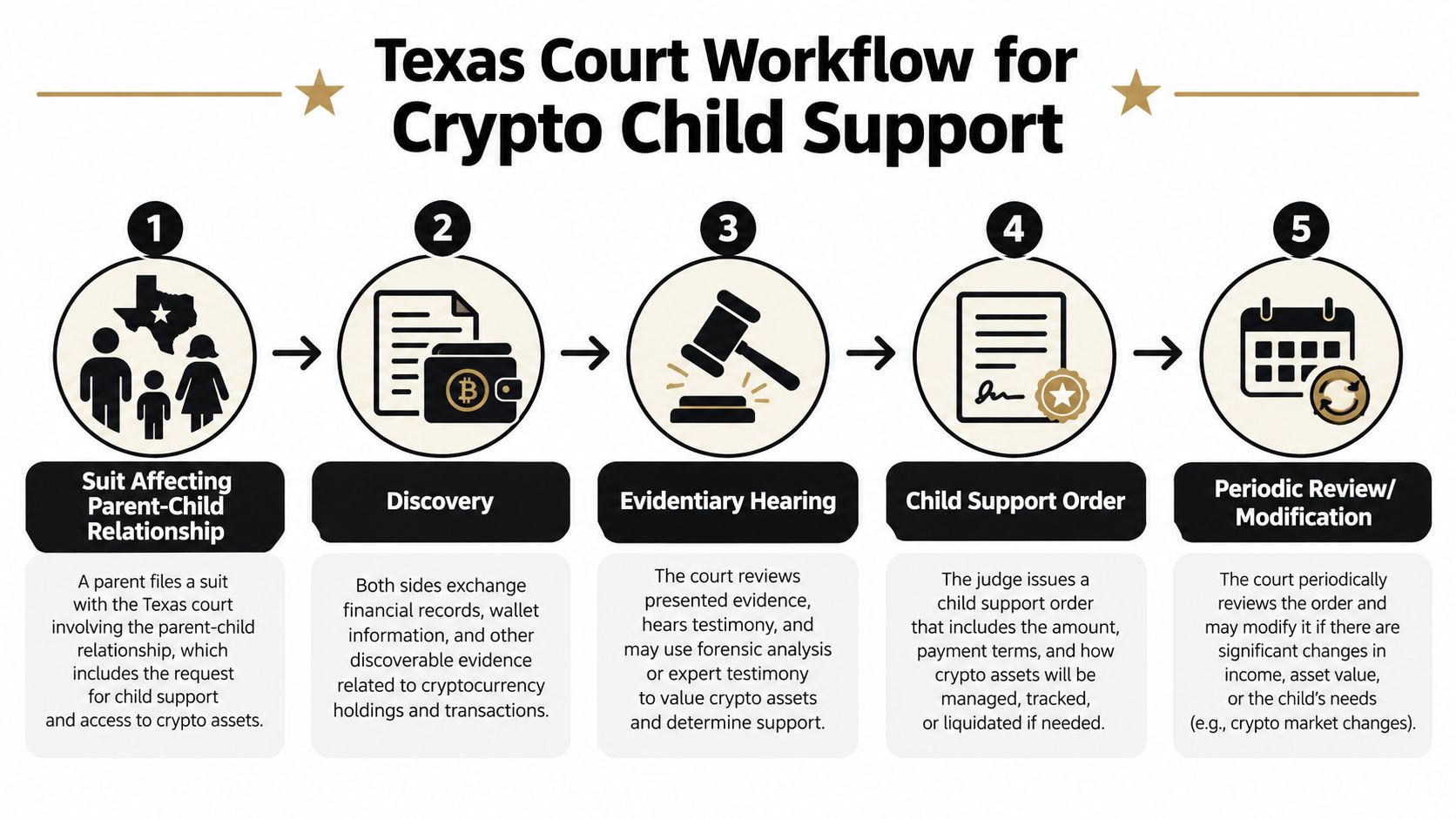
Present the evidence at a hearing. The judge can apply the guidelines or consider a deviation under §154.123. The evidence should connect crypto activity to monthly net resources and explain why a particular valuation or averaging method is reliable.
Obtain an order and monitor later changes. A new order establishes the enforceable obligation. A later modification requires another court process and supporting proof.
The 2025 cap increase doesn't automatically change an existing final order. A parent must obtain a new order through an establishment or modification proceeding. Cases filed on or after the effective date, and cases still pending on that date, can raise important questions about which cap applies, while an older final order generally remains in place until modified (the legislative text addresses the effective-date framework).
For broader context on developments involving digital assets and courts, readers can review what happened in crypto legal news, while keeping the child support analysis tied to Texas evidence and the Family Code.
Proving Valuing and Enforcing Volatile Crypto Income
A parent who says “I have no income” may face difficult questions when the financial records show recurring digital inflows. Texas practice can rely on exchange statements, wallet transfers, bank deposits, tax forms, and transaction histories to test that statement. Digital-payment evidence can be especially important because the court can compare testimony with the actual movement of funds.
Build a transaction record
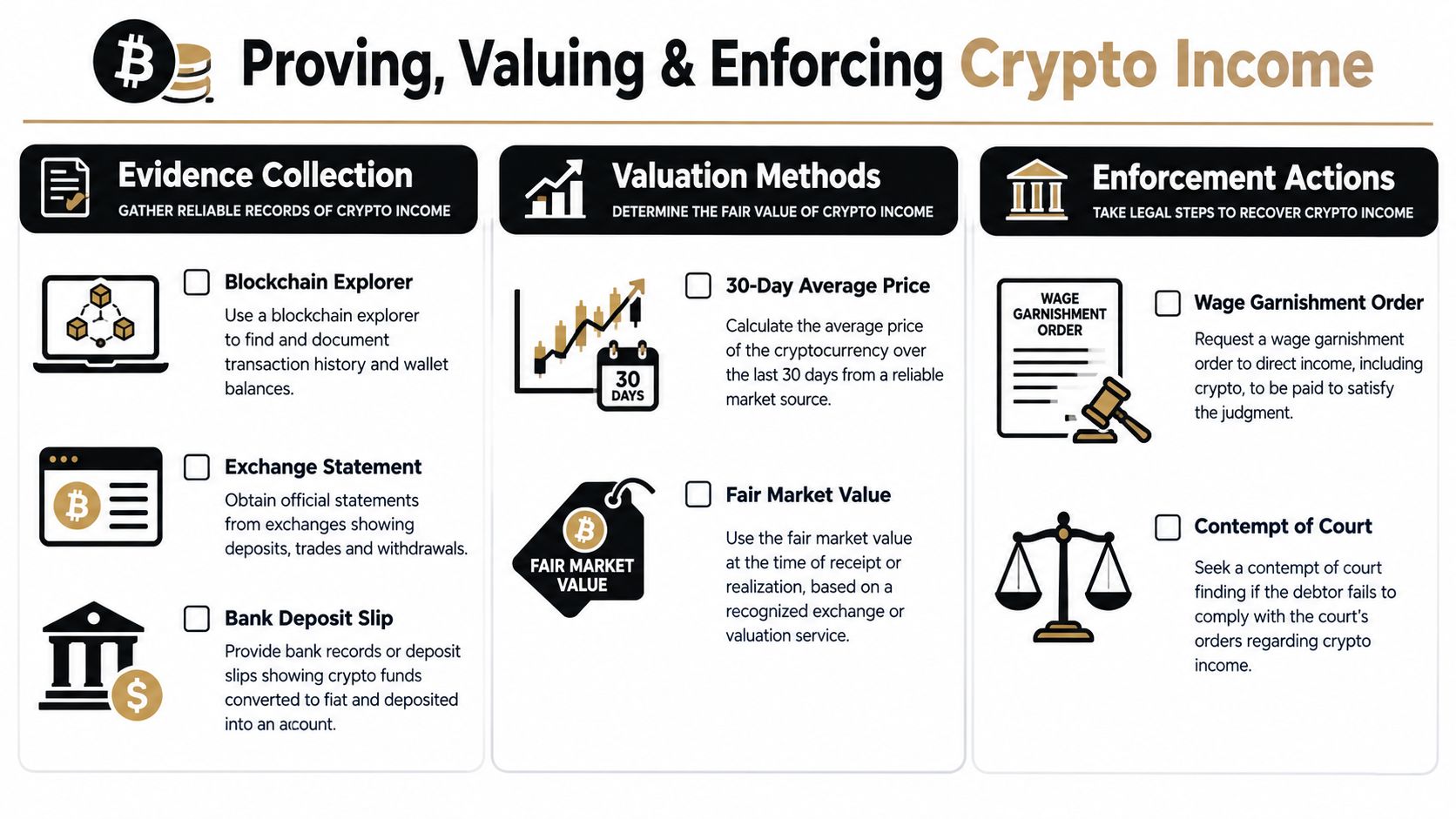
Start with documents that identify the source, date, value, destination, and purpose of each material transaction. Useful evidence may include:
- Exchange statements: Obtain account histories showing deposits, withdrawals, trades, staking receipts, and liquidation activity.
- Wallet records: Connect wallet addresses to the parent through discovery, testimony, or linked transfers, then trace incoming and outgoing transactions.
- Bank statements: Match crypto cash-outs to deposits and identify whether the parent used the money for ordinary expenses.
- Tax documents: Compare reported gains, business income, and digital-asset disclosures with exchange and wallet activity.
- Cost-basis records: Separate proceeds from principal by identifying acquisition cost, realized gain, and transaction fees.
Courts may average irregular crypto receipts over a relevant period to produce a more stable monthly resource figure. Averaging can prevent a parent from presenting only a low month or a recipient from relying on one unusually high liquidation event. The proposed method should explain why the period and transactions reflect ongoing resources rather than a one-time event.
A parent seeking to prove income should present a coherent reconciliation, not a pile of screenshots. Guidance on what benefits reviewers look for can help explain why bank statements are more persuasive when they are complete, traceable, and consistent with other records. For a broader Texas evidence checklist, see how to prove income for child support.
Enforcement after the order
Once support is ordered, unpaid amounts can become arrears. If the parent liquidates crypto while failing to pay, the recipient can use enforcement procedures available under Texas law, which may include wage withholding where applicable and contempt proceedings. The remedy depends on the order, the payment history, and proof that the parent had the ability to comply.
If resources aren't adequately proven, Texas law allows the court to consider imputed income at minimum wage (Texas Family Code §154.068). That possibility makes accurate disclosure important for both sides. A recipient needs admissible proof, and a payor needs documentation that distinguishes income from principal, property, and unrealized value.
Practical Next Steps and Answers for Texas Parents
The most reliable preparation follows a three-part test:
- Classify the event. Identify whether the crypto was compensation, mining or staking income, a realized gain, a return of principal, or unsold property.
- Quantify the realized net benefit. Reconcile token value, sale proceeds, cost basis, fees, reinvestment, and transfers.
- Apply the cap and deviation framework. Use §154.125 through the $11,700 monthly net-resource cap, then address any requested deviation under §154.123 with evidence of the child's proven needs and the parent's available resources.
A payor should preserve exchange exports, wallet histories, bank statements, tax records, invoices, and proof of acquisition cost. A recipient should request those records specifically, identify unexplained deposits, compare reported income with actual transfers, and ask the court to make clear findings about recurring crypto resources. Both parents should avoid relying on a single market snapshot.
Frequently asked questions often have fact-dependent answers:
Does crypto always count as income?
No. The court examines what the transaction represents. Compensation, staking rewards, mining proceeds, and realized gains may be included, while a return of principal or unrealized appreciation may require different treatment.
Does earning above the cap automatically increase support?
No. The guideline calculation stops at the statutory cap, and additional income may support a deviation only after the court analyzes the evidence under §154.123.
Can an existing order change automatically after September 1, 2025?
No. The parent seeking a different amount must obtain a new order through an establishment or modification proceeding.
What should I do before a crypto support hearing?
Prepare a transaction-by-transaction schedule, preserve original records, identify the requested classification for each category, and connect the proposed monthly figure to bank, exchange, wallet, and tax evidence. The Texas Child Support Law Office of Bryan Fagan handles establishment, modification, enforcement, and complex income disputes involving Texas child support calculations.
If crypto receipts are recurring, hidden, disputed, or large enough to reach the cap, address the issue before the hearing rather than waiting for testimony to expose gaps in the record. The Texas Child Support Law Office of Bryan Fagan can review the available financial history, develop discovery focused on digital assets, and prepare arguments under §§154.062, 154.123, and 154.125. Visit Texas Child Support Law Office of Bryan Fagan to begin organizing your establishment, modification, or enforcement strategy.