You're standing outside a courtroom in San Antonio with a hearing notice in one hand and incomplete financial records in the other. You may be trying to establish support, reduce an order after a job change, or collect payments that have stopped. The courthouse process can feel confusing, but the issues that move a judge are practical: correct jurisdiction, reliable income evidence, proper service, and a proposed order that follows Texas law.
The child support court in Bexar County operates through a specialized track within the county's Civil Courts system. Understanding where to go, how Texas calculates support, and what evidence to bring can prevent avoidable delays and give you a clearer position before the associate judge.
Where Bexar County Handles Child Support Cases
Your first courthouse visit may begin with security screening, an elevator ride, and a docket call where several families are waiting for the same type of proceeding. The relevant location is the Bexar County Child Support Court at 100 Dolorosa, 4th Floor, Room 411, San Antonio, Texas 78205. The county lists 210-335-2725 as the public phone number for the Child Support Court, while the Civil Courts page identifies 210-335-2000 for court settings and related contact matters. These details appear in the official Bexar County Child Support Courts directory.
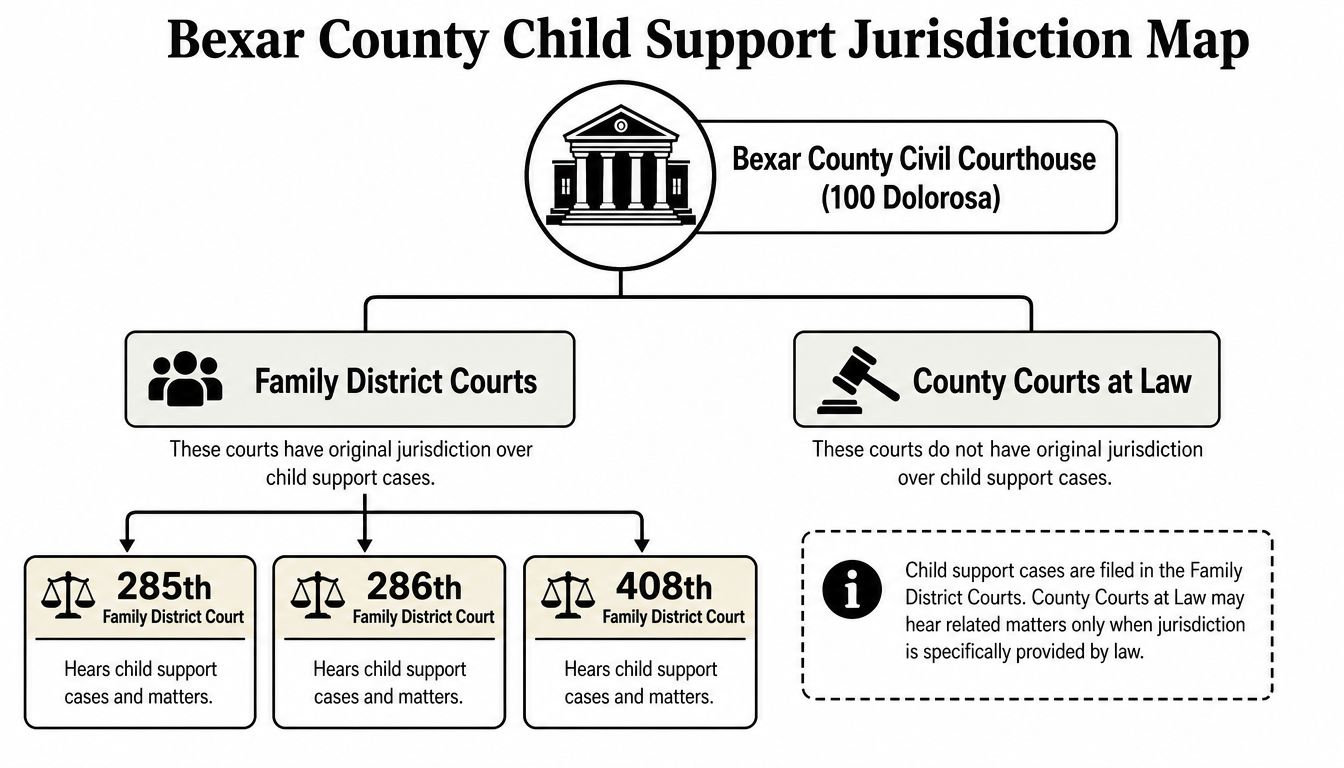
Bexar County officially maintains two Child Support Courts, and two appointed Associate Judges preside over them. The county states that these courts handle child support cases filed by the Office of the Attorney General. That jurisdictional point matters. A Title IV-D establishment or enforcement matter may be directed into this specialized court track rather than handled as an ordinary civil docket.
The local court structure
The specialized track doesn't mean every family law issue belongs in the same room. Child support proceedings are separate from felony criminal dockets at the Justice Center and from protective-order proceedings at the Family Justice Center. A parent should read the hearing notice carefully, confirm the courtroom, and use the court's published contact information rather than assuming the case will be heard wherever a prior family matter was assigned.
The District Clerk's office handles filings for private family law cases. The Office of the Attorney General's San Antonio office commonly initiates Title IV-D matters, including establishment and enforcement cases. A parent filing privately should confirm the correct clerk, cause number, assigned court, and filing requirements before submitting documents.
What happens on hearing day
Arrive early enough to clear security, locate the courtroom, and check in as directed by the clerk or bailiff. Bring your hearing notice, identification, filed pleadings, financial records, and proposed orders. Don't rely on your phone as the only place where documents are stored.
Associate judges may hear evidence, make rulings, and prepare recommendations or orders within the authority assigned to them. If a party disagrees with an associate judge's ruling, Texas procedure may provide a de novo hearing before a district judge, but the deadline and filing requirements matter. Treat the associate judge hearing as a real evidentiary proceeding, not an informal meeting.
For a more local orientation, review this Bexar County child support resource before you go. The practical objective is simple: appear in the correct courtroom, understand what kind of hearing is scheduled, and organize the evidence around the exact relief you're requesting.
How Guideline Child Support Is Calculated in Texas
Texas starts with monthly net resources, not just a parent's gross salary. Texas Family Code §154.062 defines the income and deductions used in the calculation, while §154.125 establishes the guideline framework and its maximum net-resource amount.
As of September 1, 2025, the guideline cap increased from $9,200 to $11,700 in monthly net resources. The Office of the Attorney General's 2025 revised tax chart confirms the adjusted amount. Section 154.125 applies the guidelines to net resources up to the published maximum, and the statute explains that the cap is periodically adjusted for inflation through the Title IV-D agency. See the Texas Family Code §154.125 framework.
Start with income, then calculate net resources
The court may examine wages, bonuses, commissions, overtime, self-employment income, retirement income, and rental income. A business owner can't assume that a low salary ends the inquiry if business records show additional personal or business resources available to the parent.
The calculation then considers legally permitted deductions, such as federal income tax, Social Security, Medicare, and applicable state income tax deductions for the relevant pay period. Health insurance or medical support issues can also affect the final support analysis. The point is to prove each number with records, not estimates.
For a focused explanation of the income sources included in the calculation, see What Counts as Net Resources for Child Support. Once net resources are established, the standard percentages apply according to the number of children before the court.
Guideline amounts at the new cap
| Number of Children | Percentage of Net Resources | Monthly Amount at $11,700 Cap |
|---|---|---|
| One child | 20% | $2,340 |
| Two children | 25% | $2,925 |
| Three children | 30% | $3,510 |
| Four children | 35% | $4,095 |
| Five or more children | 40% | $4,680 |
These amounts are calculated from the statewide percentage schedule and the $11,700 cap, as summarized by the Texas child support guideline calculation resource. For example, if the court determines that the obligor's monthly net resources are at or above the cap and there is one child, the guideline baseline is 20% of $11,700, or $2,340 per month.
That figure is presumptive, not untouchable. Under §154.123, the court may consider factors such as the child's needs, each parent's resources and obligations, health insurance, childcare, extraordinary medical costs, educational expenses, possession arrangements, and other circumstances affecting the child's best interest. Bring invoices, receipts, insurance records, and testimony that connect each expense to the requested deviation.
Practical rule: A judge can't evaluate an extraordinary expense that you merely mention. Put the amount, frequency, payer, and child-related purpose into admissible evidence.
Filing a Child Support Case in Bexar County
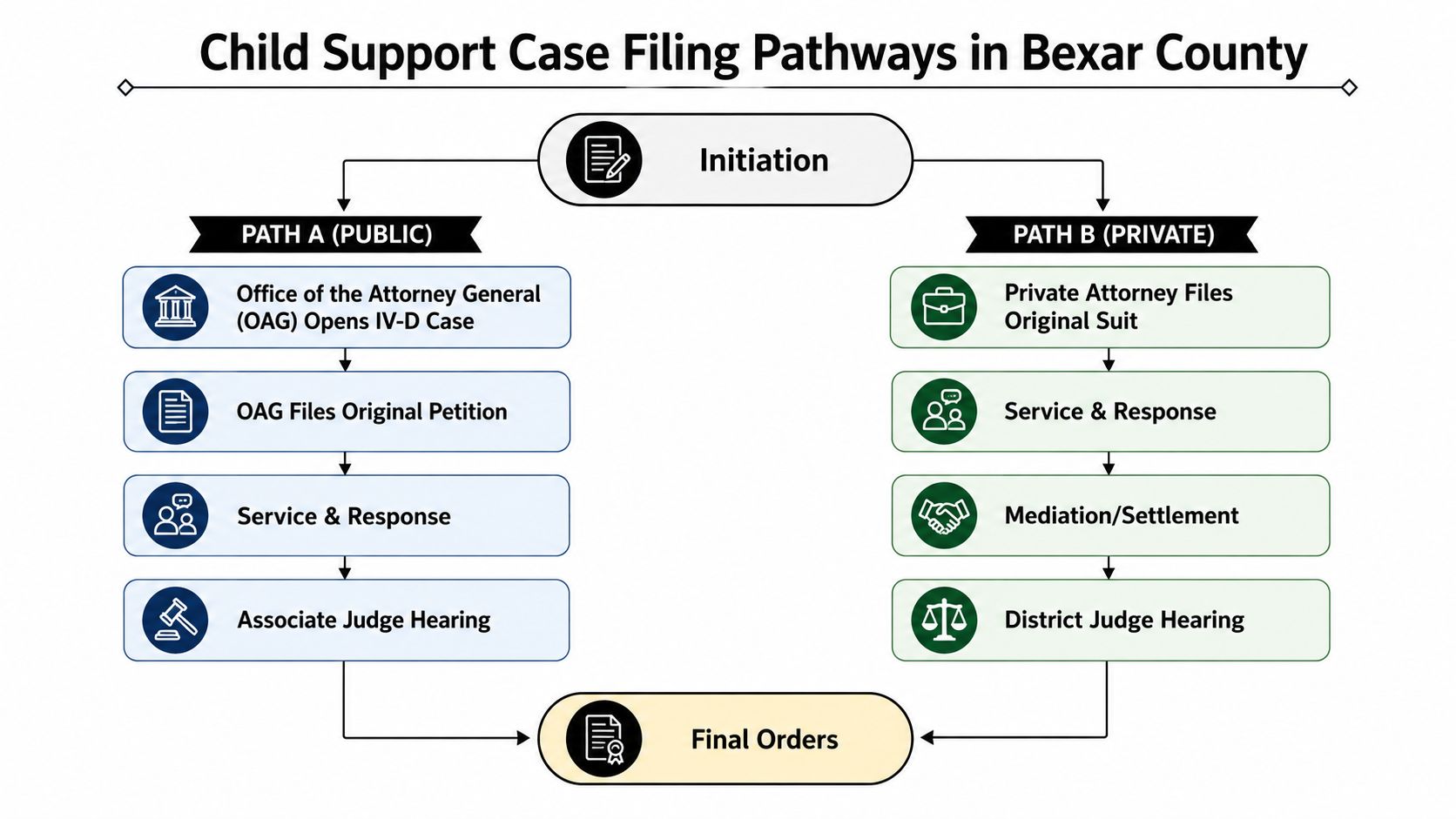
A Bexar County case generally begins through one of two routes. The Office of the Attorney General may open a Title IV-D case and file an original petition, or a parent or custodian may file a private suit through the District Clerk. The correct route depends on whether the family is seeking government child support services or pursuing the case privately.
A private filing may involve a Petition to Establish Parentage and Child Support or a Petition to Modify the Parent-Child Relationship, depending on the relief requested. The filing package may also include the Standing Order, Vital Statistics form, and Certificate of Last Address. Local requirements can also call for a Financial Information Sheet and supporting income documentation.
Build the filing record carefully
Attach or prepare records that allow the court to evaluate income and child-related expenses. Commonly requested materials include tax returns, pay stubs, and proof of health insurance availability. The exact documents required can depend on the proceeding and local procedures, so confirm the current filing instructions with the clerk or counsel.
The District Clerk will apply the applicable filing fee schedule. If you're requesting a waiver or indigency determination, complete the required affidavit accurately and provide the information the court requests. An incomplete filing can delay service and postpone the hearing.
Service determines whether the case can move forward
After filing, the respondent must receive legally sufficient notice unless service is waived. In Bexar County, service may be completed by the Bexar County Constable or another authorized process server. A respondent may sign a waiver of service when appropriate. If ordinary service fails, the court may authorize alternative service, including publication, when the legal requirements are met.
Don't treat a text message or informal email as a substitute for formal service. Defective service can undermine the hearing and force the case to be reset.
The case then proceeds through scheduling, response deadlines, conferences, status settings, and eventually a hearing on the merits. A private case may involve mediation or settlement discussions before a final hearing. If the parties sign an agreement, confirm that it is properly drafted, signed, filed, and entered as an enforceable order. Understanding the elements of contracts and consent can help you recognize why signatures, authority, clarity, and mutual agreement matter, although a child support agreement still must comply with Texas family law and receive court approval.
Modifying an Existing Child Support Order
An existing order doesn't change because a parent's income changed or because Texas revised its guideline cap. You must file a modification proceeding and prove the statutory basis for changing the order under Texas Family Code Chapter 156.
Texas law recognizes two primary modification paths. Under §156.401, a party may seek modification after the order has been in place for more than three years when the current amount differs from the guideline amount by 20% or $100. A modification may also be available when there has been a material and substantial change in circumstances. The Texas Attorney General describes the procedural requirements in its support modification process.
Compare the available triggers
| Trigger | Statutory Basis | What Petitioner Must Show | Typical Bexar County Evidence |
|---|---|---|---|
| Three-year guideline difference | §156.401 | The order was last set more than three years ago and the guideline comparison meets the required threshold | Current pay stubs, tax returns, prior order, calculation worksheet |
| Material and substantial change | §156.401 | A significant change affecting income, needs, insurance, obligations, or possession | Pay records, termination documents, medical records, childcare receipts |
| Changed income classification | §§154.062, 154.125 | Current net resources were calculated incorrectly or a source of income was omitted | Business records, bonus history, commission statements, rental records |
| Requested deviation | §154.123 | The presumptive guideline amount is unjust or inappropriate under the child's circumstances | Insurance costs, medical bills, education records, expense proof |
The strongest modification record compares the old order with a current guideline calculation line by line. Redact sensitive information when appropriate, but leave enough detail for the judge to verify the figures. Include W-2s, tax returns, recent pay stubs, proof of involuntary job loss when applicable, records of new legal support obligations, and daycare or medical receipts when those facts support the requested change.
Plead the deviation, don't merely request it
If you're asking for an amount above or below the guideline baseline, identify the specific §154.123 factors and connect each factor to evidence. A general statement that the order is unfair won't carry the same weight as a documented explanation of the child's extraordinary expenses, the parties' resources, or a material change in possession.
A temporary support request under §156.006 may be appropriate while the modification case is pending. Temporary relief still requires a focused presentation. Bring current financial evidence and explain why waiting for final trial would create a concrete problem for the child or the paying parent.
Enforcing Child Support and Pursuing Arrears
Unpaid support requires a different strategy from establishing or modifying an order. The Office of the Attorney General can pursue enforcement in Title IV-D cases under Chapter 231, while a custodial parent may file a private enforcement action through counsel or directly with the court.
Income withholding under §158.101 is generally required for new child support orders. It directs an employer or other payor to withhold support from income and send the funds through the appropriate payment system. That remedy works best when the obligor has identifiable, steady income. It becomes less effective when the parent changes jobs, works for cash, owns a business, or has inconsistent compensation.
Match the remedy to the default
A Motion for Enforcement is the central private tool when withholding doesn't resolve the arrears. The motion should identify the order, each alleged violation, the dates and amounts due, payments credited, and the relief requested. Bring a payment history, copies of the order, communications about missed payments, and evidence showing the parent had the ability to comply if contempt is requested.
Chapter 157 provides contempt remedies. Civil contempt is designed to compel compliance, while criminal contempt punishes a proven violation. Because confinement may be requested, a parent facing contempt needs proper notice and a serious defense focused on ability to pay, compliance history, and the accuracy of the arrearage calculation.
Other tools include license suspension under §232.001, which can affect professional, driver's, and recreational licenses, as well as federal passport denial procedures. A property lien under §157.317 may protect accumulated arrears against qualifying property interests. Each remedy has a different purpose, and filing every possible request without matching it to the evidence can dilute the presentation.
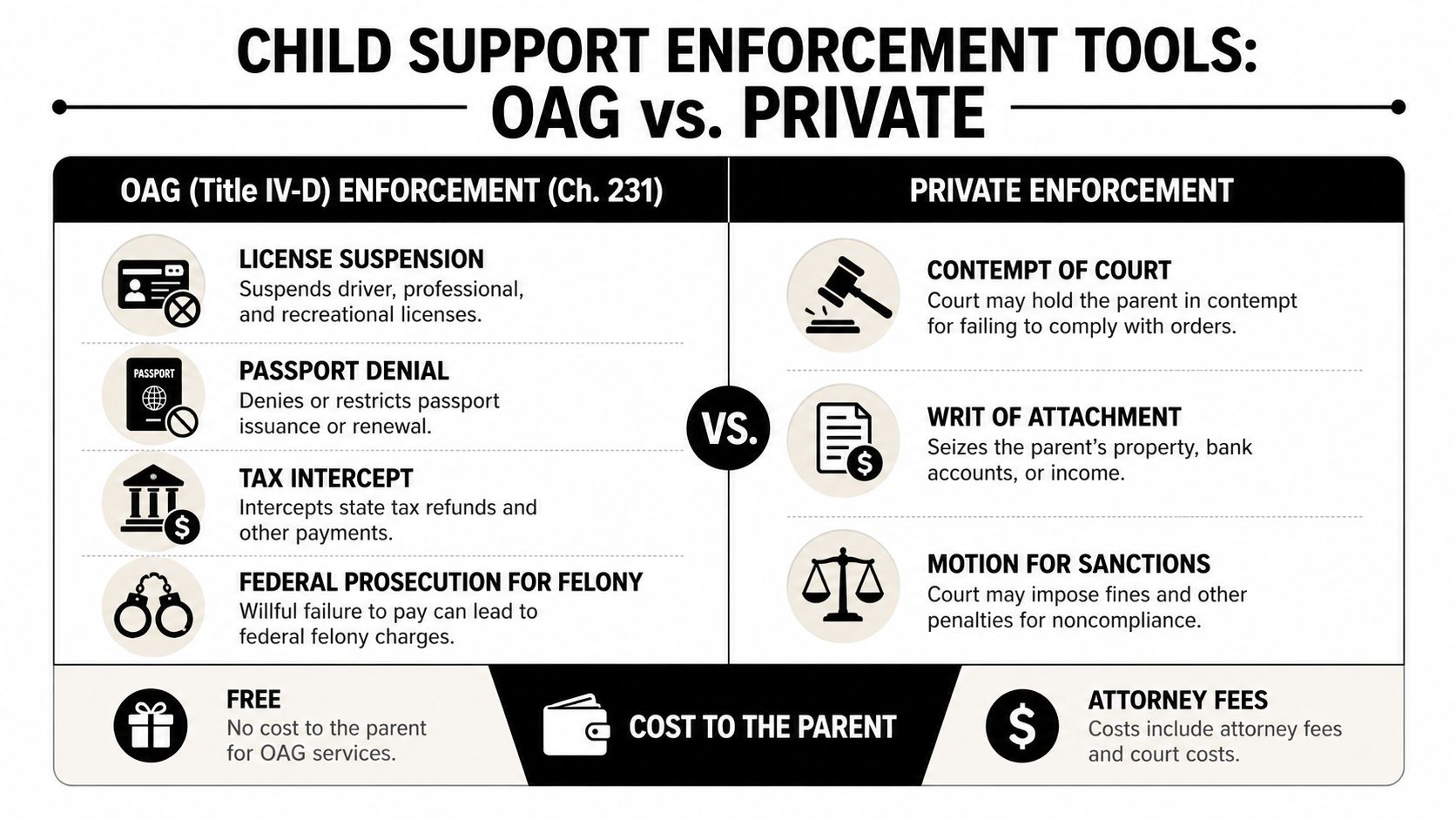
The Texas child support enforcement guide can help you distinguish administrative collection from a court-filed enforcement action. Use wage withholding for steady-pay defaults, contempt when the evidence supports willful nonpayment, and liens when arrears have accumulated and identifiable property is available.
A hearing may also result in a bench warrant if a properly noticed party fails to appear. Don't ignore a citation, enforcement motion, or court setting. Missing court can create a problem separate from the original payment dispute.
Preparing for Your Hearing in San Antonio
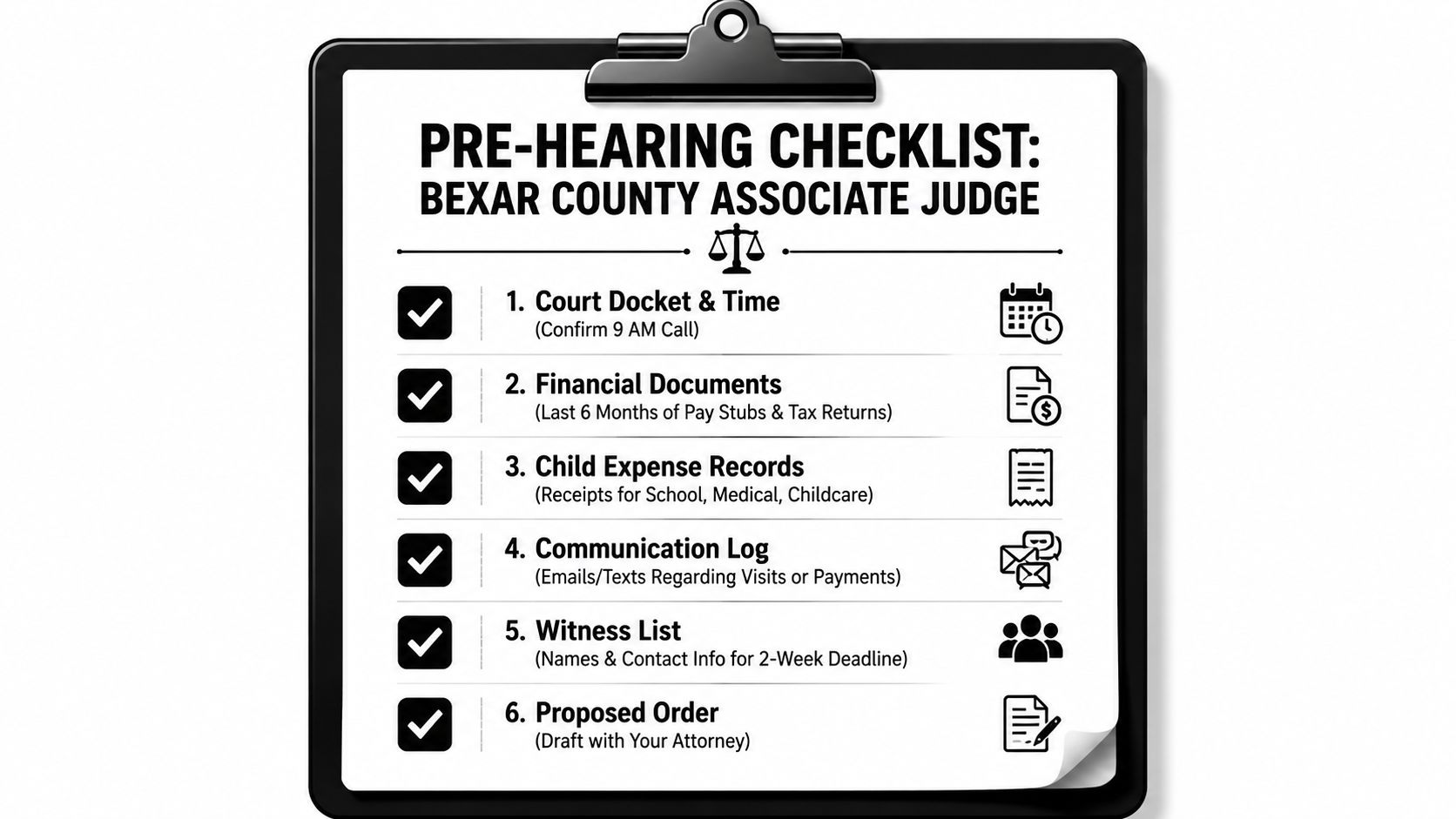
A strong hearing presentation begins before you enter the courthouse. Organize your records at least two weeks before the docket date so you have time to identify missing documents, exchange exhibits when required, and prepare a proposed order.
Your financial file should include two years of tax returns, three months of pay stubs, the most recent W-2, and a current employer statement. Add proof of bonuses, commissions, self-employment income, rental income, or other resources if they affect the calculation. If the other parent's income is disputed, request records through the appropriate discovery process instead of relying on assumptions.
Organize child-related expenses
Create a separate exhibit group for childcare, health insurance premiums, extraordinary medical expenses, and educational costs. Each receipt should identify the provider, date, amount, and child-related purpose. A spreadsheet can help, but the underlying invoices and payment records matter more than a summary you prepared for court.
Bring several copies of filed pleadings, financial records, proposed orders, and exhibits as required by the court. Keep your argument short and organized. The judge needs to understand what order exists, what changed or was violated, what evidence proves it, and what specific relief you're requesting.
Conduct matters on a busy docket
Dress respectfully, silence your phone, and check in with the clerk or bailiff. Address the associate judge formally and don't interrupt the opposing party. The court reporter creates the record, so speak clearly and wait until a question is finished before answering.
For witness preparation, review the timeline rather than scripting testimony. Explain the difference between personal knowledge and speculation. When introducing an exhibit, identify what it is, establish its relevance, and follow the court's instructions. Don't object just to appear aggressive, and don't argue with the witness.
After a bench ruling, the parties may need to sign off on a proposed order. Read every line before signing. Confirm the support amount, start date, withholding terms, medical support provisions, arrearage findings, and any enforcement language accurately reflect the ruling.
When Hiring a Texas Child Support Attorney Makes Sense
Self-representation can work when the facts are clean, the parties agree, and the requested order is straightforward. It becomes risky when income is complex, contempt is pending, jurisdiction is disputed, or the amount at stake makes a small calculation error expensive.
The September 1, 2025 cap increase matters most to higher earners whose net resources exceed the former cap. For example, a parent with $250,000 in monthly net resources still encounters the statutory guideline ceiling, not an unlimited percentage applied to every dollar. At the $11,700 cap, each percentage-point change in the applied rate equals $117 per month, or $1,404 per year, per child-related calculation. Those figures come directly from the cap and should be verified against the actual number of children, statutory adjustments, and any deviation analysis. The cap itself doesn't decide whether an upward deviation is justified.
Decide based on complexity, not pride
| Case Factor | Self-Rep Is Realistic | Hire an Attorney |
|---|---|---|
| Income records | Clean paystub and wage history | Business ownership, commissions, bonuses, or disputed income |
| Case posture | Agreed order or uncontested modification | Contested establishment, modification, or enforcement |
| Enforcement | Payment history is clear and withholding is available | Contempt, arrears dispute, or ability-to-pay defense |
| Jurisdiction | Both parents and the child's case are local | Interstate issues under UIFSA |
| Hearing risk | Limited factual disagreement | Possible confinement, sanctions, or transfer disputes |
| Requested relief | Guideline amount with no unusual expenses | Deviation under §154.123 or high-income support strategy |
You should strongly consider counsel if you're defending contempt under §157.002, facing possible confinement, litigating business-owner income attribution, dealing with interstate jurisdiction under UIFSA, or seeking to transfer a matter from an associate judge bench to a district court. Those issues involve procedural and evidentiary consequences that are difficult to repair after a hearing.
Self-representation is more realistic for an agreed order, a clean wage case below the cap, or an uncontested modification with complete records. If you need help locating counsel, consider the Bexar County Lawyer Referral Service or a local CLS program if you qualify.
The Texas Child Support Law Office of Bryan Fagan handles establishment, modification, enforcement, arrears, wage withholding, medical support, high-income calculations, and disputed net resources under the Texas Family Code. Visit Texas Child Support Law Office of Bryan Fagan to discuss your Bexar County hearing, review the income evidence, and build a plan for the specific relief you need.