A parent usually reaches this point on an ordinary weekday, not in a calm moment. School paperwork is stacked on the table, rent is due, and the child's expenses have not paused just because the relationship ended. The immediate problem is simple: get a child support order in place that is clear, enforceable, and strong enough to hold up if the other parent misses payments.
Texas has a process for that, but the process you choose matters. Some parents can open a case through the Office of the Attorney General and get a workable order at a lower upfront cost. Others lose months by going that route because the case involves disputed paternity, irregular income, a self-employed parent, or custody issues that the OAG will not resolve for them. In those cases, hiring a private attorney often costs more at the start and saves time, missed evidence, and repeat court settings later.
The legal standard is not the hard part. Texas courts generally begin with the child support guidelines in the Texas Family Code, using the obligor's net resources and applying presumptive percentages based on the number of children before the court. The primary practical considerations are: where to file, how quickly your county moves, whether service is done correctly, and whether you can prove income with records a judge will rely on.
That is why filing for child support in Texas is partly a legal task and partly a strategy decision. The right approach depends on cost, speed, complexity, and how much conflict is already built into the case. A parent who chooses the right lane early usually gets to a usable order faster.
Securing Your Child's Financial Future in Texas
A parent often comes in with the same concern: “I'm not trying to fight. I just need help supporting my child.” That's the right instinct. Child support cases usually work best when they're treated as a financial stability issue first and a conflict issue second.
Texas courts don't start from guesswork. They start from the statutory guideline model in Texas Family Code §154.125. In most cases, the court looks at the obligor's net income and applies the presumptive percentage for the number of children before the court. For many families, that predictability is helpful. It gives both parents a realistic frame for settlement and helps the judge move the case efficiently.
What the system is designed to do
The child support process is built to accomplish three things:
- Create a clear monthly obligation so there's no ongoing argument about what should be paid.
- Set up enforceable payment methods such as wage withholding when available.
- Give the court room to adjust if the usual guideline amount doesn't fit the facts under provisions such as §154.123.
That last point matters. The guideline amount is the starting line, not always the finish line. If a child has unusual medical needs, childcare expenses, or other facts that make the standard number unfair, the court can consider those facts.
Practical rule: A workable child support order is one the court can calculate, the employer can withhold, and the parties can understand without guessing.
The first fork in the road
Most parents have two realistic ways to begin. They can use the Office of the Attorney General Child Support Division, or they can file through a private attorney in the county court handling the parent-child case.
Neither route is automatically better. The state process is useful in some straightforward cases. Private representation is often more effective when the case involves contested parenting time, hidden income concerns, paternity disputes, or a need for faster action.
That choice affects nearly everything that follows, including timing, control, and how aggressively the case is prepared for court.
The First Decision Attorney General vs Private Attorney
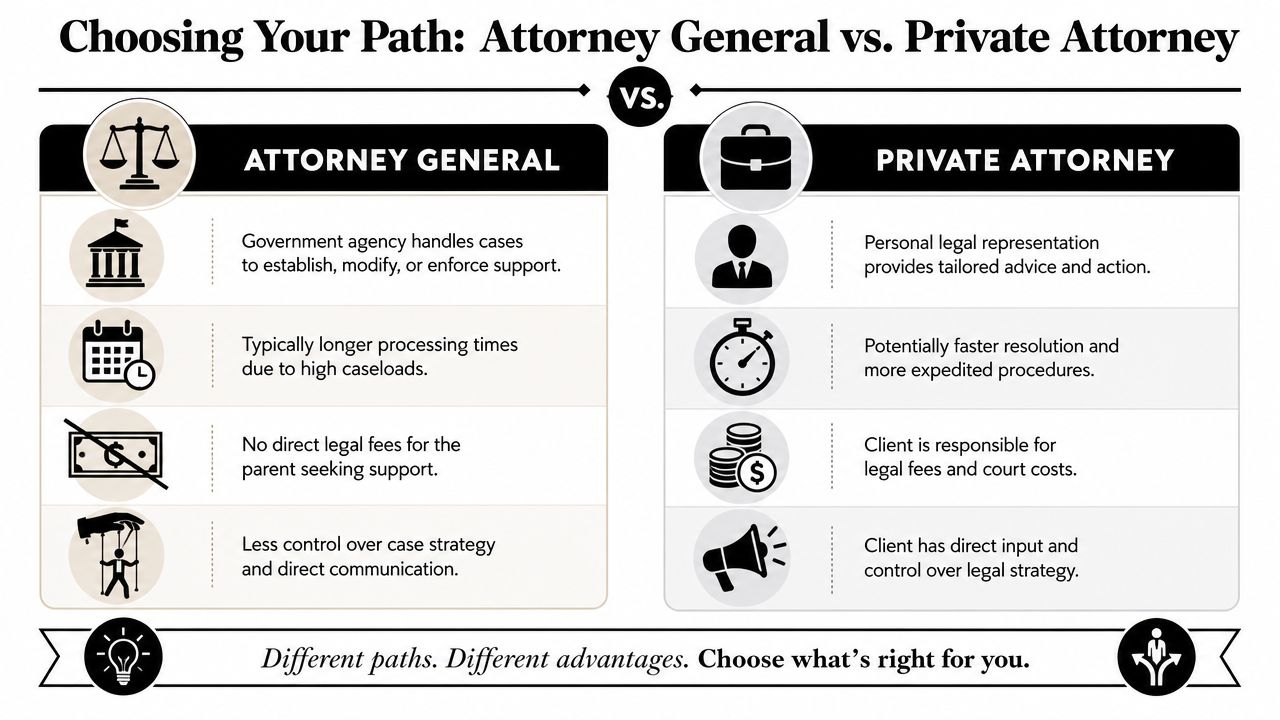
The first real strategy call is whether to let the state run the case or to hire counsel and control the pace yourself. Parents often assume the only difference is cost. It isn't. The bigger difference is control over the file, the timeline, and the level of attention paid to the facts.
When the Attorney General route makes sense
The Office of the Attorney General is often a practical fit if the case is simple. If paternity is already established, the other parent has a regular paycheck, and your goal is to get a basic order entered with wage withholding, the OAG process may do the job.
It also helps that the application process is accessible. The online filing route requires the noncustodial parent's current employer name and address because wage withholding is usually the main enforcement tool. If that employer information is missing, enforcement often slows by an average of 3 to 4 weeks in the OAG filing process described here.
That detail gets overlooked all the time. Parents know the other parent works “for a construction company” or “at a warehouse,” but they don't have the actual employer address. In practice, that missing piece can stall the first meaningful enforcement step.
Where the OAG process can frustrate people
The Attorney General does not act as your personal lawyer. The agency handles support matters, but it doesn't tailor the case the way private counsel does. That matters when the facts don't fit neatly into a standard wage-withholding model.
Here are the usual trade-offs:
| Path | Often works well for | Common drawback |
|---|---|---|
| Attorney General | Straightforward support establishment and enforcement | Less direct control over timing and case strategy |
| Private attorney | Disputed income, contested custody issues, negotiation, court presentation | You pay legal fees and court-related costs |
If you already expect a fight over income, a disputed possession schedule, or a deviation request under §154.123, the state process can feel slow because the case doesn't move at the pace of your problem.
If the issue is simply “set support and withhold wages,” the OAG can be enough. If the issue is “prove income, address custody, and push the case to hearing,” private representation usually gives you more leverage.
When hiring private counsel is the better investment
A private attorney is often worth it when any of these facts are present:
- Self-employment or inconsistent income: Tax returns, bank records, and business documents usually need closer scrutiny.
- A custody dispute tied to support: Support and conservatorship often affect each other, even though they are legally distinct issues.
- A need for immediate procedural action: Private counsel can prepare the petition, service, hearing settings, and evidence with one coordinated strategy.
- Retroactive support concerns: If back support needs to be requested clearly from the beginning, precision matters.
Some parents also want direct advice on enforcement strategy after the order is signed. If that's your concern, it helps to understand how child support enforcement works in Texas before you choose a filing path.
A practical middle ground exists too. Some parents begin with the OAG and move to private counsel when the case becomes contested. That can work, but it usually means correcting delay rather than avoiding it.
How Texas Courts Calculate Child Support
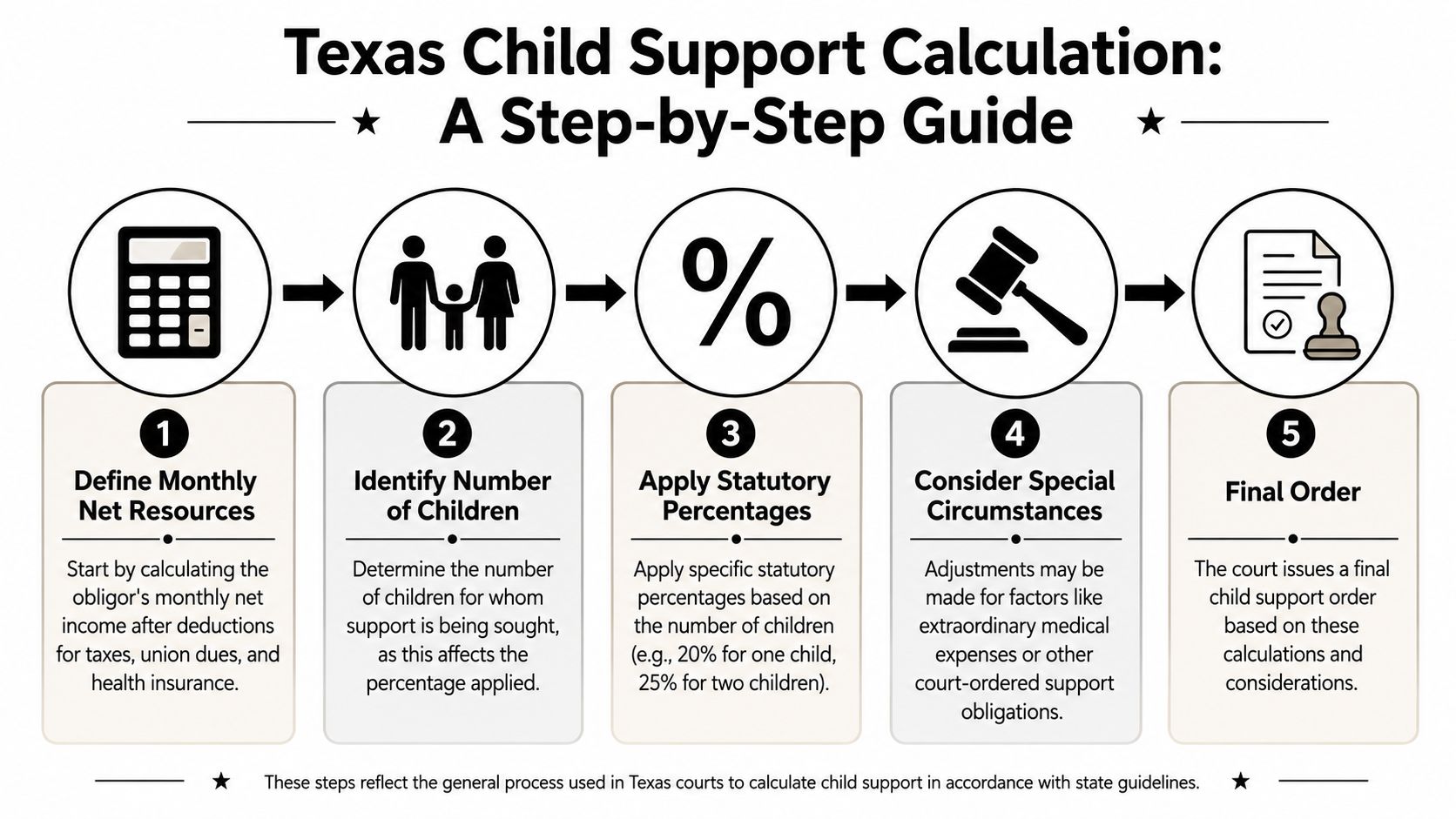
Texas courts start with one number: the paying parent's monthly net resources. That is the number that drives the guideline calculation under Texas Family Code §§154.062 and 154.125. Parents often walk in focused on salary, overtime, or what the other parent "really makes." The court still has to reduce that income to net resources using the deductions allowed by statute.
Under §154.062, income can include wages, salary, commissions, bonuses, self-employment income, rental income, unemployment benefits, severance, retirement income, and other compensation. The court then applies the deductions the statute allows, including Social Security taxes, federal income tax based on the tax rate for a single person claiming the standard deduction, union dues, and the cost of the child's health or dental insurance if that parent pays it. Cases involving cash income, side work, or a closely held business usually turn on proof. That is one reason OAG cases and private-attorney cases can play out differently. If income is straightforward, guideline support is usually easier to pin down. If income is irregular or underreported, the better question is not "what does the formula say?" but "what can you prove?"
The calculation method courts actually use
In practice, courts usually work through child support in this order:
- Determine what income counts under §154.062.
- Calculate monthly net resources after the statutory deductions.
- Apply the guideline percentage under §154.125.
- Decide whether the facts justify a deviation under §154.123.
- Address proven needs above the cap under §154.126, if that issue is raised and supported by evidence.
Parents who want a more detailed breakdown of the first step should review how Texas courts calculate net resources, because that is where many estimate errors start.
What the guideline percentages look like
If the court finds monthly net resources of $6,000, the presumptive guideline amount for one child before the court is usually 20 percent. For two children, it is usually 25 percent. For three children, 30 percent. Texas Family Code §154.125 lays out those percentages.
That sounds simple. It is, if the income picture is clean.
The disputes I see most often are not about the percentage. They are about the starting number. W-2 employees with regular paystubs are usually easier to calculate. Self-employed parents, parents paid partly in cash, and parents whose compensation runs through a business often require bank records, tax returns, profit-and-loss statements, and sometimes a harder push in discovery. That is where hiring private counsel can change the result. The OAG can establish support, but it generally will not build a custom income-proof case with the same intensity as private counsel in a contested matter.
Parents also need to separate base child support from the rest of the order. Medical support, dental support, uninsured medical expenses, and retroactive support are different issues. They affect the total financial picture, but they are not all folded into the guideline percentage.
The statutory cap matters in higher-income cases
For orders signed or modified on or after September 1, 2025, Texas raised the cap on monthly net resources used for guideline child support from $9,200 to $11,700 under §154.125. For one child, that means the presumptive maximum guideline amount is based on 20 percent of $11,700 unless the child's proven needs support more under §154.126.
Here is the practical effect:
| Issue | Rule |
|---|---|
| Net resources at or below the cap | The court usually applies the guideline percentage to the actual monthly net resources |
| Net resources above the cap | The presumptive guideline amount is based on the capped amount, unless evidence shows the child has proven needs that justify more |
In a high-income case, filing choice matters. The OAG process can work if both sides largely agree on income and the dispute is narrow. If the paying parent has business income, deferred compensation, multiple entities, or inconsistent reporting, private counsel is often better positioned to develop the record needed for a higher and more accurate support figure.
Lower-income guidelines and deviation requests
Texas uses a lower-income schedule for parents with very limited monthly net resources. Courts also have discretion to deviate from the standard guideline amount under §154.123 if the evidence supports it. Common reasons include unusual medical needs, childcare expenses, educational costs, travel expenses for possession, or a possession schedule that affects day-to-day expenses in a meaningful way.
County practice matters here more than generic guides admit. In Harris, Dallas, Bexar, and Travis Counties, judges and associate judges often expect the parent asking for a deviation to show organized backup, not broad claims about fairness. In smaller counties, the process may feel less formal, but the same rule applies. If you want the court to move off the guideline number, bring documents and tie them to the child's needs.
A calculator can estimate support. Evidence determines what number ends up in the order.
For a plain-language overview of the formula, How Child Support Is Calculated in Texas explains how the Texas guidelines work and how net resources affect the final amount.
The Legal Process Filing Service and Hearings
Once you know what support may look like, the case becomes procedural. At this stage, many parents lose time. Not because the law is mysterious, but because the paperwork and service rules are unforgiving.
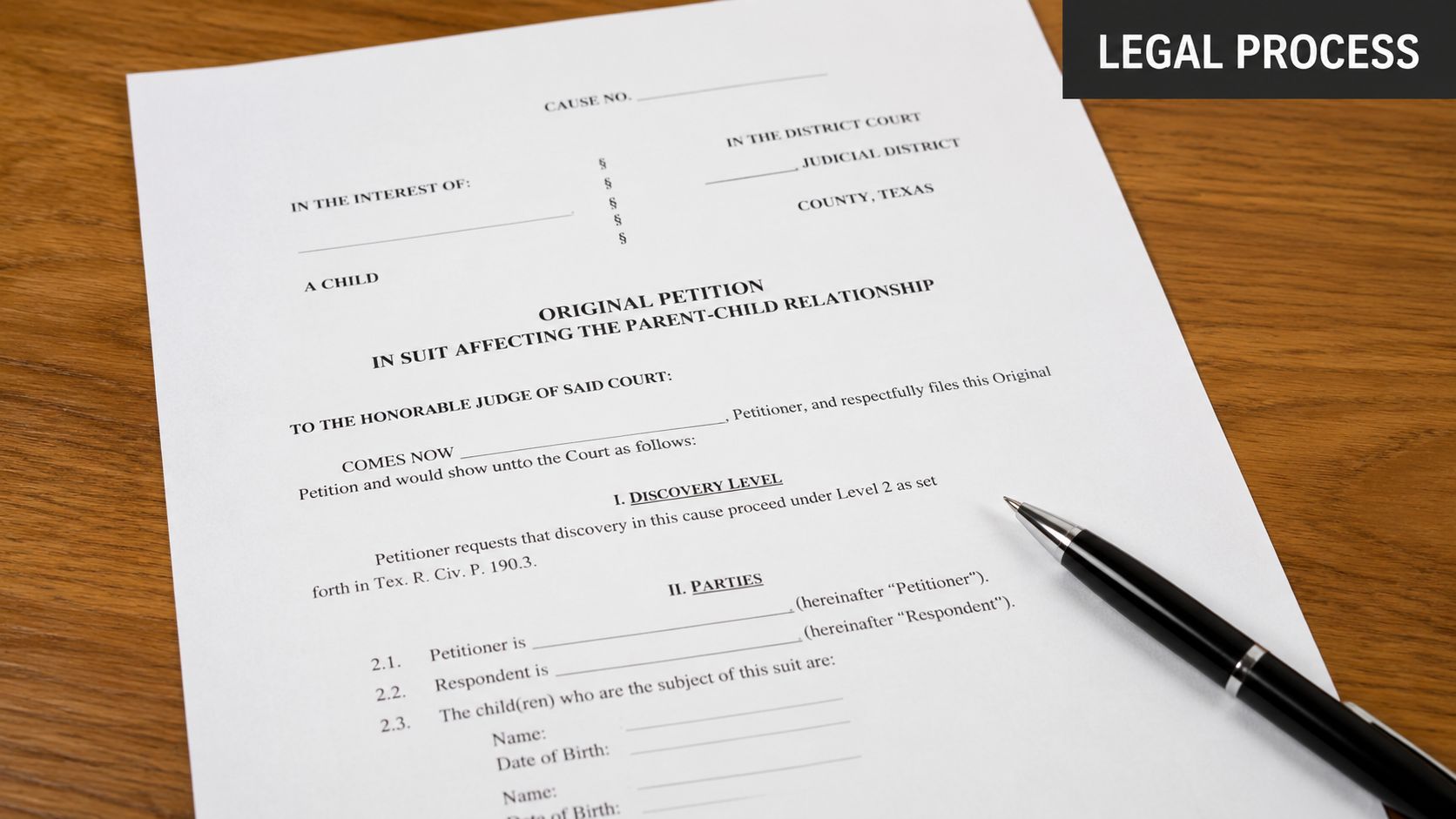
Filing the case the right way
If there isn't already an active family case involving the child, support is usually requested in a Suit Affecting the Parent-Child Relationship, commonly called a SAPCR. If the parents are divorcing, support is usually handled inside the divorce case instead of a separate suit.
The petition needs to do more than ask for monthly support. It should also address the child's residence, conservatorship issues when relevant, medical support, and any request for retroactive support if the facts justify it. Leaving key relief out at the beginning often creates problems later.
Service is not a technicality
The other parent has to be formally served unless there is a lawful waiver. In Texas, improper service of process can void the hearing and force you to start over. In contested cases involving income disputes, the likelihood of immediate guideline approval drops to under 40%, and those cases often move into deviation arguments under §154.123 as described in this discussion of Texas filing pitfalls.
That's why I tell parents not to treat service like paperwork they can improvise. Use a constable or a certified process server. Get the return filed properly. Check the details before the hearing is set.
Courtroom reality: Judges will forgive anxiety. They won't forgive defective service.
What happens after service
After valid service, the other parent gets a chance to respond. If there's no answer on file and the procedural requirements are satisfied, the court may proceed by default. If an answer is filed, the case may move into temporary orders, negotiation, mediation, or a final hearing depending on the county and the level of conflict.
A hearing notice matters as much as the initial petition. Parents often confuse “I told them about court” with legal notice. If you need a clearer picture of that step, this guide to a Texas notice of hearing is useful because it focuses on the formal court process rather than informal communication.
Here's a practical overview of the flow:
- File the petition: Start the case in the proper county and cause number.
- Complete service correctly: Use formal service unless a valid waiver is in place.
- Watch for the answer: A case can move very differently depending on whether the other parent responds.
- Prepare for temporary issues: Support may need to be addressed before final orders if the case won't resolve quickly.
County practice also matters. In Harris County, Dallas County, Travis County, Bexar County, and Tarrant County, e-filing and local court procedures can differ in small but important ways, especially on hearing settings, required forms, and local standing orders. Those aren't reasons to panic, but they are reasons to check the local rules before filing or setting any hearing.
A short overview can help if you prefer to see the process discussed visually.
Preparing for Court Paternity Evidence and Timelines
Walk into a Texas child support hearing without proof of paternity or reliable income records, and the case usually slows down fast. The court can only order support on facts it can verify. In practice, this stage is where a lot of parents lose time they could have saved with better preparation.

Paternity comes first when it is not already established
If the father signed an Acknowledgment of Paternity, that often removes one major obstacle. If he did not, or if paternity is disputed, the court may require genetic testing and a separate adjudication of parentage before it sets final support.
That matters strategically. The Office of the Attorney General can help establish paternity and child support in the same general process, which keeps filing costs low. The trade-off is speed and control. If the other parent is avoiding service, denying paternity, or working for cash, a private attorney can usually push the case more aggressively, request targeted discovery, and set hearings with a tighter strategy.
In counties like Harris, Dallas, Bexar, and Tarrant, docket congestion alone can stretch out a paternity dispute. Travis County judges also tend to expect cleaner paperwork and prompt compliance with local settings procedures. Those local habits do not change the law, but they do affect how long your case sits before someone makes a decision.
Income proof decides how credible your position looks
Texas child support is based on monthly net resources under Texas Family Code §154.062. The court is looking for actual proof of earnings and allowable deductions, not estimates, guesses, or arguments about what a parent "must be making."
Good evidence usually includes:
- Recent pay stubs: These show current wages, overtime, and sometimes year-to-date income.
- Tax returns and W-2s or 1099s: These help spot bonuses, side work, and inconsistent reporting.
- Bank records: Deposits can matter when a parent is self-employed or paid irregularly.
- Profit and loss statements: Useful in business-owner cases, though judges often compare them against deposits and tax filings.
- Health insurance proof: Bring records showing who pays the child's premium and the monthly cost tied to the child.
Self-employment cases are where the OAG route often becomes less efficient. OAG staff handle high volume dockets. They do important work, but they are not building a custom evidence plan for every contested case. If income is straightforward, that may be enough. If income is buried in business accounts, cash payments, or inconsistent tax filings, a private attorney usually gives you a better shot at presenting the full picture.
Timelines depend on conflict, county practice, and how complete the file is
Parents ask for a deadline. Courts usually cannot give one early in the case.
An agreed case with established paternity and clean payroll records may move relatively quickly. A contested case can take much longer if service is difficult, genetic testing is needed, or one parent shows up with incomplete financial information. Continuances are common when records are missing. So are reset hearings.
The best way to shorten the process is simple. Show up with a file that answers the judge's obvious questions before the judge has to ask them.
That means dates, names, pay records, insurance documents, and any paternity paperwork should be organized before the hearing is ever set. If you hire private counsel, that preparation usually happens earlier and in more detail. If you go through the OAG, expect a more standardized process and fewer opportunities to shape the case around the problem facts.
A complete file gives the court a reason to rule. A thin file gives the court a reason to wait.
After the Order Is Signed Enforcement and Modification
A signed child support order only helps if it can be collected and, when life changes, updated the right way. In Texas, many orders include income withholding because it gives both parents a clean payment record and reduces disputes about whether support was paid.
That system works well when the obligor has steady W-2 income. It is less dependable when the parent changes jobs often, works for cash, is self-employed, or has irregular contract income. That is one of the practical differences between an OAG case and a privately managed case after the order is entered. The OAG can enforce support, but a private attorney usually has more time to trace payment problems, prepare a targeted enforcement filing, and push disputed facts to hearing faster when the case needs closer attention.
If support is not being paid
Start with the records. Get the payment history, save texts and emails, keep bank records, and note each missed due date. In enforcement cases, details matter. A parent who walks into court with a precise ledger is in a much better position than one who only has a general complaint that payments have been inconsistent.
Texas courts can enforce child support in several ways, including correcting withholding issues, confirming arrears, entering money judgments, and using other remedies allowed by the Family Code. In serious cases, enforcement can carry consequences beyond just ordering the unpaid amount. The remedy depends on what the order says, how the payments were supposed to be made, and how well the nonpayment can be proved.
Speed matters here. If months pass without action, the arrearage usually gets harder to explain and harder to collect.
Parents also make a common mistake after informal payment changes. For example, if the paying parent starts sending partial payments directly by Venmo instead of through the State Disbursement Unit, that can create proof problems even if some money changed hands. The court still looks first at the signed order and the official payment record. Clean procedure protects both sides.
The Texas Child Support Law Office of Bryan Fagan publishes guidance on post-order support issues, including enforcement, arrears, and wage withholding. That can help parents understand the process before deciding whether the OAG route is enough or the case needs private counsel.
Modification is a separate lawsuit
Child support does not adjust itself because a parent lost a job, got a raise, had another child to support, or started following a different possession schedule. Until a judge signs a new order, the old order controls.
Texas modification cases usually turn on one of two paths under the Family Code. There has either been a material and substantial change in circumstances, or enough time has passed that the guideline amount would differ enough to justify review. In practice, the first path is the one I see discussed most often because the facts are usually front and center. Job loss, disability, a major increase in income, or a significant change in the child's needs can all matter, but they still have to be proved.
Common grounds include:
- A meaningful change in either parent's income
- New medical, educational, or support needs for the child
- A change in health insurance availability or cost
- A possession arrangement that now affects the support analysis
- Prior financial information that was incomplete or is no longer accurate
Side agreements create expensive problems. If one parent agrees to accept less for a few months, or the other parent agrees to pay extra outside the order, neither deal changes the court's numbers unless it is reduced to a new signed order. I regularly warn parents about this because they assume a friendly agreement will protect them later. Usually it does not.
The filing choice matters here too. If the modification is straightforward and neither parent is fighting over income, the OAG process may be enough. If the case involves self-employment, hidden income, disputed health insurance costs, or a request to deviate from guideline support, private counsel often gives you a better return because the case needs document requests, witness prep, and a sharper presentation than a standard docket usually allows. In larger counties, crowded dockets can also affect how much time a court gives each case, so preparation has to do more of the work.
Frequently Asked Questions About Texas Child Support
A parent usually asks these questions after the case gets real. The other parent says 50/50 means no support, claims cash income is impossible to prove, or suggests an off-the-books agreement to keep things friendly. Those decisions can cost far more than they save.
Does a 50 50 possession schedule cancel out child support
No. Texas courts can still order support in a 50/50 schedule because support is based on more than parenting time alone. Judges look at income, health insurance, who pays day-to-day expenses, and whether a deviation from the guidelines under Texas Family Code §154.123 makes sense in that specific case.
In practice, equal periods of possession do not mean each parent carries the same financial load.
Can parents agree to their own child support amount
Yes, if the agreement is turned into a signed court order. Until then, it is just an agreement between parents, and it may not protect either side later.
Courts will usually approve agreed support if the numbers are close to the guideline amount or the parents can clearly explain why a different amount serves the child's best interest. Parents get into trouble when they treat informal agreements like enforceable orders. They are not.
What if the other parent is self-employed or hiding income
That usually requires records well beyond a pay stub. Bank deposits, 1099s, invoices, business account statements, tax returns, and expense claims often matter more than what the parent says they earn.
This is one of the clearest OAG-versus-private-attorney cases. If the file involves regular payroll income, the OAG process may be enough. If income runs through a business, cash app transfers, or irregular deposits, private counsel often gives you a better shot because someone needs to request records, organize them, and present a clean story to the judge.
Can I stop paying support if I'm being denied visitation
No. Support and visitation are enforced separately. Refusing to pay support usually creates arrears, interest, and enforcement exposure, while the possession problem still remains.
The better move is to file to enforce the possession order.
What if the other parent says they're unemployed
A court can look at earning ability in some cases instead of accepting unemployment at face value. Texas law allows support to be calculated using presumed income tied to full-time minimum wage, unless a statutory exception applies, including certain incarceration situations.
Proof is key. If the parent recently quit a job, works for cash, or has a work history that does not match the story being told in court, bring documents and testimony that show it.
Should I file with the OAG or hire a private attorney
Start with the facts, not the slogan. The OAG works well for many straightforward establishment cases, especially when paternity is clear, income is easy to verify, and neither parent is fighting over extras. It costs less up front, but the process can move slowly, and in busy counties the hearing time is often short.
Private counsel usually makes more sense when the case involves contested paternity, self-employment income, retroactive support, reimbursement claims, a request to deviate from guidelines, or county-specific procedural issues that can affect timing and preparation. In Harris, Dallas, Bexar, Tarrant, and Travis Counties, docket pressure alone can change how aggressively a case needs to be prepared. If the facts are disputed, paying for strategy early often costs less than fixing a bad order later.
If you need practical guidance on how to file for child support in Texas, including whether to proceed through the Attorney General or with private counsel, Texas Child Support Law Office of Bryan Fagan handles cases involving establishment, modification, enforcement, net resource disputes, retroactive support, and contested hearings across major Texas counties.