No. In Texas, child support is not taxable income for the parent who receives it, and it is not deductible for the parent who pays it. That answer is straightforward, but the part that usually matters in real life is how that rule affects support calculations, tax filing strategy, and courtroom advantage when parents disagree about income, expenses, or who claims the child.
If you're reading this around tax season, you're probably dealing with one of three situations. You're receiving support and wondering whether the IRS expects you to report it. You're paying support and hoping it reduces your taxable income. Or you're in the middle of a Texas family law case and trying to understand how child support, net resources, and tax-related decisions fit together before a hearing.
The short answer settles the tax question. The harder questions come right after it. If child support isn't taxable, what counts as income when Texas calculates support? What changes for high-income earners once the $11,700 net monthly resource cap takes effect on September 1, 2025 in guideline calculations? And if the payments themselves don't create a deduction or taxable event, where do tax advantages show up in a child-related case?
Those are the issues that drive litigation strategy. They also shape settlement terms. Parents often spend time arguing about the wrong financial point while missing the issues that affect cash flow, annual filings, and the court's view of reasonableness under Chapter 154 of the Texas Family Code. For a broader look at current Texas child support developments, see these Texas child support laws for 2026.
The Simple Answer and the Real Question for Texas Parents
The direct answer to is child support taxable in Texas is no. That rule is settled. What isn't always settled is how parents should plan around that rule when they are preparing a budget, negotiating a decree, or walking into court with competing views about support.
A parent receiving child support doesn't add those payments to gross income for federal tax purposes. A parent paying support can't subtract those payments to reduce taxable income. In practical terms, that means child support doesn't operate like wages, business income, or a deductible expense. It sits outside that tax framework.
That matters because parents often build arguments around assumptions the court won't use. A paying parent may think, "I'm already losing this money every month, so I should get some tax benefit." The law doesn't allow that. A receiving parent may worry that accepting support will increase tax exposure. It won't.
Practical rule: In a Texas child support case, separate the tax treatment of the payment from the legal calculation of the obligation. They are related in planning, but they are not the same issue.
The more important question is usually this: if child support itself is tax-neutral, where should you focus? In most cases, the answer is on three pressure points:
- Guideline math under Tex. Fam. Code § 154.125: the court starts with net monthly resources and applies the statutory percentage.
- Above-guideline disputes under Tex. Fam. Code § 154.123: high-income cases often turn on proven needs, not broad claims about lifestyle.
- Dependency and child-related tax benefits: these can have more annual tax significance than the support payment's tax treatment.
If you're preparing for court, don't waste time trying to turn child support into a deduction or taxable receipt. The law won't bend there. Focus instead on the income evidence, the structure of the order, and the tax benefits that can be allocated or negotiated.
The IRS Rule on Child Support Payments
Federal tax law controls the tax treatment of child support. Texas doesn't create a separate income tax rule here, and because Texas has no state income tax, the analysis is even cleaner for most parents. The key point comes from the IRS rule summarized by TexasLawHelp's discussion of child support and taxes.
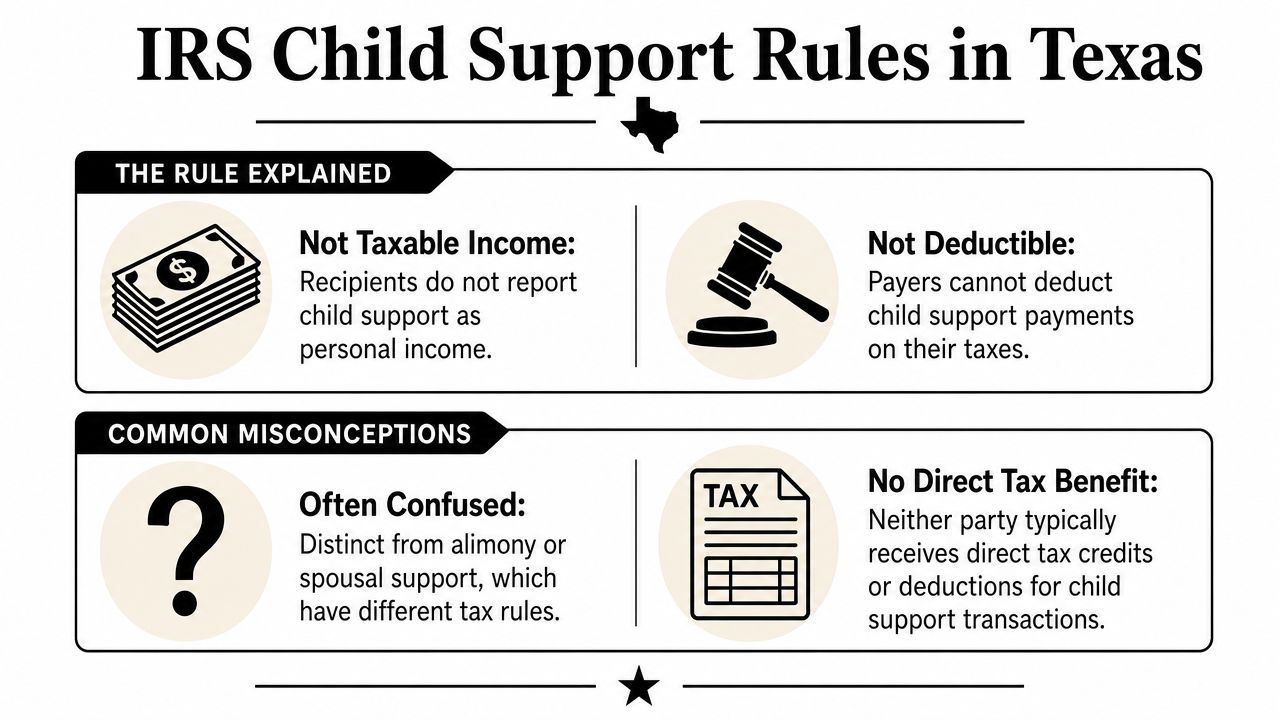
"Child support payments are neither deductible by the payer nor taxable to the recipient."
Why the rule exists
The tax code treats child support as money transferred for the child's benefit, not as income earned by the receiving parent. That's why the recipient doesn't report it as gross income. It's also why the paying parent doesn't get a deduction. The government doesn't treat the payment as a tax-favored expense. It treats it as a private support obligation.
That distinction becomes important when parents blur the lines between child support and spousal maintenance. They are not interchangeable. If an order labels a payment as child support, the federal tax treatment follows that label and function. Trying to recast support informally after the fact usually creates confusion, not an advantage.
What works and what doesn't
What works is keeping payment categories clear in the final order. If your decree or order separates child support from other obligations, tax filing is cleaner and enforcement is easier.
What doesn't work is making assumptions based on fairness rather than law. Courts hear this often:
- "I pay support, so I should deduct it." That isn't allowed.
- "I receive support, so I need to reserve money for income tax." That isn't required for the child support payment itself.
- "If we call it something else, the IRS will treat it differently." Labels alone don't fix a badly drafted or misleading order.
If you're also trying to understand the Texas formula itself, How Child Support Is Calculated in Texas gives a focused overview of the guideline formula and how net resources determine the support amount.
Keep tax filing and support enforcement aligned. The cleaner the order, the fewer disputes you invite when payment histories and tax records are reviewed side by side.
How Texas Calculates Child Support
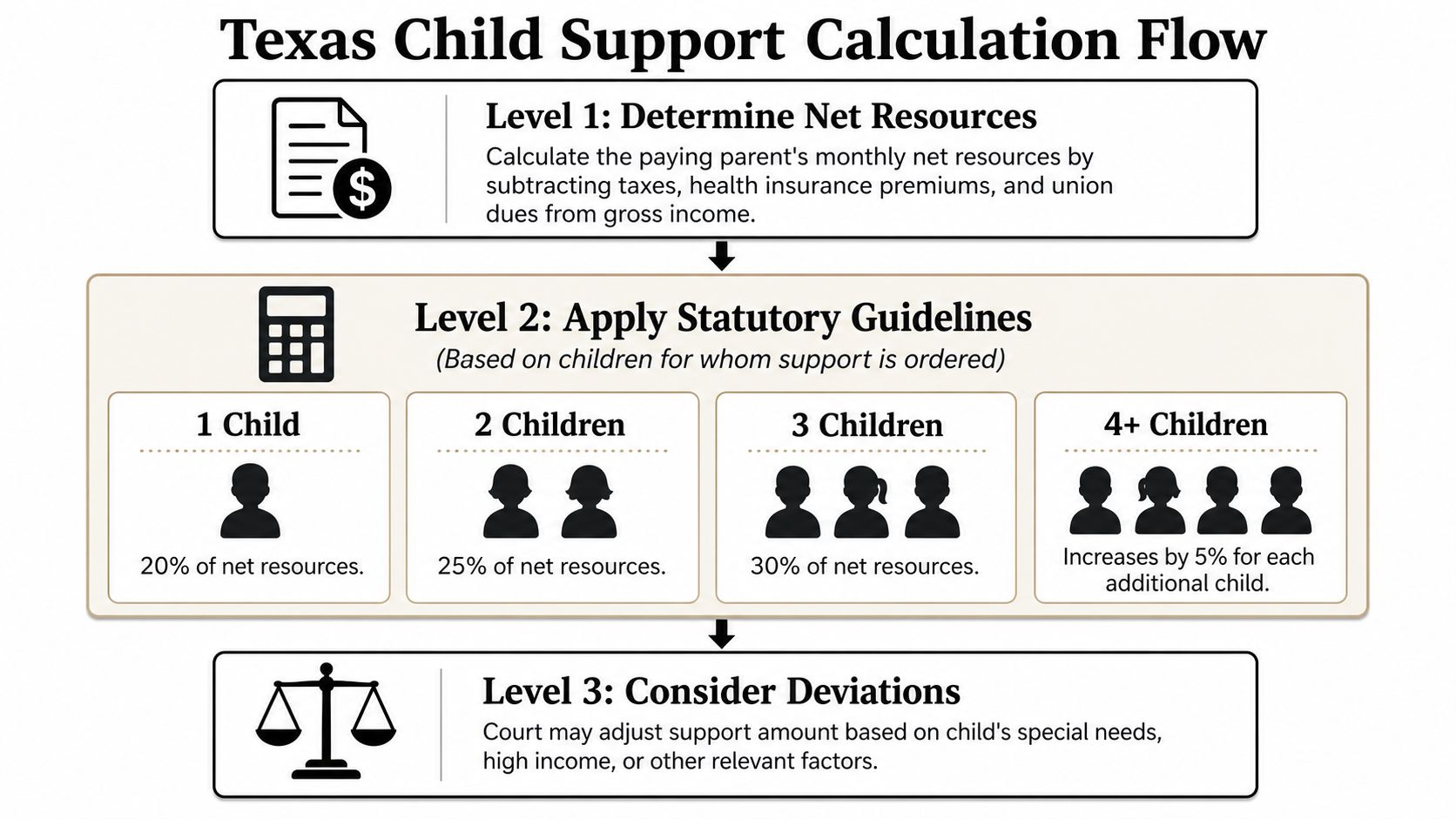
Texas uses a percentage-of-income model. Under Tex. Fam. Code § 154.125, the court applies guideline percentages to the obligor's net monthly resources, not gross pay. The percentages and the cap are summarized in the Texas child support tax guide discussing § 154.125.
The guideline percentages under Section 154.125
For guideline support, Texas applies these percentages to net monthly resources:
| Children before the court | Guideline percentage |
|---|---|
| 1 child | 20% |
| 2 children | 25% |
| 3 children | 30% |
| 4 children | 35% |
| 5 children | 40% |
| 6 or more children | At least 40% |
The cap matters. The same source notes that the net resource cap rises from $9,200 to $11,700 effective September 1, 2025. For cases governed by that updated cap, guideline support is calculated on the first $11,700 of net monthly resources.
What counts as net monthly resources
Under Tex. Fam. Code § 154.062, courts do not merely look at a paycheck and apply a percentage. They start with gross income and subtract specific items used to determine net resources. The verified materials identify these deductions as:
- Social Security taxes at 6.2%
- Medicare taxes at 1.45%
- Federal income tax for a single person claiming one exemption and the standard deduction
- Union dues
- Health insurance expenses for the child
That structure is why two parents with similar gross income can still end up with different support numbers. The court is trying to reach a legally defined net-resources figure, not a rough estimate.
A real-world calculation example
Assume an obligor earns $15,000 in monthly gross income. The court doesn't apply 20% straight to that gross figure. It first subtracts the deductions recognized under § 154.062 to determine net monthly resources. Then it applies the statutory percentage under § 154.125.
If the case involves one child, the court applies 20% to the obligor's net monthly resources, subject to the applicable cap. If the net monthly resources are above the cap in effect for the case, the guideline amount is calculated only on the capped amount unless the court goes above guidelines under another section.
That is where many self-prepared calculations fail. Parents often argue from gross pay, or they use take-home pay from a pay stub without matching the statutory deductions. Courts want the statutory method.
For a deeper walk-through of the math, including how to organize the numbers before hearing, review this guide on how to calculate child support in Texas.
Courtroom habit: Bring a clean income summary with documents that match the statute. Judges tend to trust calculations that track § 154.062 and § 154.125 line by line.
Navigating High-Income Cases and Support Above Guidelines
High-income cases don't eliminate the guideline formula. They shift the focus of the dispute. Once net monthly resources exceed the statutory cap, the court calculates guideline support on the capped amount and then asks whether additional support is justified under Tex. Fam. Code § 154.123.
The governing rule is summarized in TexasLawHelp's guide to child support in Texas. When an obligor's net monthly resources exceed the $11,700 cap as of September 1, 2025, the court may order support above the guideline amount based on the child's proven needs and the parent's ability to pay.

Proven needs decide the dispute
Success or failure in many cases often hinges on how arguments are structured. A parent asking for more support can't rely on broad statements like "the other parent makes a lot of money" or "the child deserves the same lifestyle." Those arguments may have emotional force, but § 154.123 turns the analysis toward evidence.
Strong evidence usually includes specific records and testimony tied to the child's actual needs, such as:
- Medical expenses: ongoing treatment, therapy, or specialized care.
- Education costs: school-related expenses if they are part of the child's proven needs.
- Recurring activity costs: expenses that are regular, documented, and child-focused.
A parent resisting above-guideline support should challenge whether the request is really about the child or whether it is an attempt to shift general household spending.
A strategic example
Take a case where the obligor's net monthly resources are above the cap and the child has recurring educational and medical expenses. The receiving parent should organize records, show the monthly nature of those costs, and connect them directly to the child. The paying parent should test each claimed expense. Is it necessary? Is it documented? Is it already covered elsewhere in the order?
In high-income litigation, the court doesn't award extra support just because the obligor can afford it. The court looks for proof tied to the child.
That is why these cases are document-heavy. Tax returns, compensation records, insurance records, and expense summaries all matter. If you're dealing with that kind of dispute, this overview of high-income child support in Texas is a useful starting point.
Child Support and Your Right to Claim Dependents
Many parents ask the wrong tax question. They focus on whether child support is taxable and miss the issue that often carries real annual tax impact: who claims the child for federal tax purposes.

Child support itself doesn't decide the dependency claim. Paying support doesn't automatically give a parent the right to claim the child, and receiving support doesn't automatically settle the issue either. In practice, this is a separate point that should be addressed clearly in negotiations and in the written order.
Why this issue matters in settlement
Parents regularly treat the dependency claim as an afterthought. That's a mistake. In settlement discussions, the right to claim a child can be used as a bargaining tool when the parties are close on support, possession, or allocation of child-related expenses.
A useful approach is to deal with dependency language the same way you handle possession and payment terms. Make it explicit. Tie it to compliance if appropriate. Keep the wording precise enough that both parents and their tax preparers can follow it.
What doesn't work is a vague side agreement. Informal understandings create tax filing conflict and post-decree litigation. If a parent is supposed to receive the right to claim the child, the paperwork and court order need to match that plan.
Court strategy and filing discipline
In contested cases, lawyers should treat the dependency claim as a financial asset, not a footnote. That doesn't change the tax-neutral status of child support. It does change how you negotiate the broader economic picture around the child.
A short explainer can help frame that issue before you negotiate further:
If you're the parent seeking that tax benefit, don't assume the court will clean up a vague agreement later. Put the issue on the table early, draft it carefully, and make sure your final order says exactly who may claim the child and under what conditions.
The Legal Process for Establishing and Modifying Support
Getting the tax answer right doesn't create a child support order. Texas parents still need to follow the proper legal process to establish or change support. The procedural framework is outlined in the Texas Attorney General child support FAQ.
Establishing a child support order
Parents generally start in one of two places. They can apply for services through the Office of the Attorney General, or they can file a petition in court. The Office of the Attorney General provides child support services at no cost to eligible parents, including income verification, calculation of net resources, and enforcement tools such as wage garnishment or tax return interception.
The basic sequence looks like this:
- File the case: either through the OAG process or through a district court filing.
- Serve the other parent: service of process gives formal notice of the case and hearing.
- Prepare the financial record: income documents, insurance costs, and any disputed expense evidence need to be organized before the hearing.
- Attend the hearing: the court applies the Family Code and enters an enforceable order.
Modifying an existing order
Modification cases are where strategy matters most. Parents often wait too long, rely on informal agreements, or assume a verbal change will protect them. It won't.
Under the same Attorney General materials, a court may modify support if there has been a material and substantial change in circumstances, or if at least three years have passed and the current order differs by 20% or $100 from the amount calculated under current guidelines.
What to do first: Compare the current order to the present guideline calculation, then gather evidence showing what changed. File before arrears or underpayments get worse.
What works in court
Courts respond to documents, not frustration. If income changed, show it. If health insurance costs changed, document them. If the child now has needs that weren't reflected in the prior order, prove that with records and testimony.
One practical option for parents who need help with establishing, modifying, enforcing, or defending a support case under the Texas Family Code is Texas Child Support Law Office of Bryan Fagan, which handles those categories of child support matters across multiple Texas jurisdictions.
Frequently Asked Questions About Texas Child Support and Taxes
If we agree privately that support will be handled differently, does that change the tax treatment
No. A private agreement between parents doesn't convert child support into taxable income or a deductible payment. The better question is whether the agreement is enforceable at all. If you want child support terms changed, put the issue before the court and get a signed order.
Is child support the same as alimony or spousal maintenance for tax purposes
No. They serve different legal purposes and are treated differently. If a payment is child support, don't assume it carries the same tax consequences as spousal support. In practice, poorly drafted orders create avoidable tax confusion.
Can a court order more than the guideline amount in a high-income case
Yes, but not automatically. In a case above the statutory cap, the court looks at the child's proven needs and the parent's ability to pay under Tex. Fam. Code § 154.123. A parent asking for more support should be ready with records, not conclusions.
If I'm unemployed, can the court still order child support
Yes. Texas courts may base support on the income from a full-time minimum-wage job unless the obligor receives only SSI, which isn't counted as income for child support purposes. This issue is often litigated when a parent claims reduced earning capacity without persuasive proof.
Does paying child support let me claim the child on my taxes
Not by itself. The dependency claim is a separate issue from the support payment. If that right matters in your case, address it directly in negotiations and in the final order.
What is the biggest mistake parents make with child support and taxes
They focus on the wrong benefit. Child support itself doesn't create a deduction or taxable event. The more valuable issues are often proper income calculation, the wording of the order, modification timing, and the allocation of dependency-related tax benefits.
If you're dealing with support calculations, a modification request, or a dispute over how child-related tax issues should be handled in a Texas order, Texas Child Support Law Office of Bryan Fagan provides representation for establishing, modifying, enforcing, and defending child support cases under the Texas Family Code.