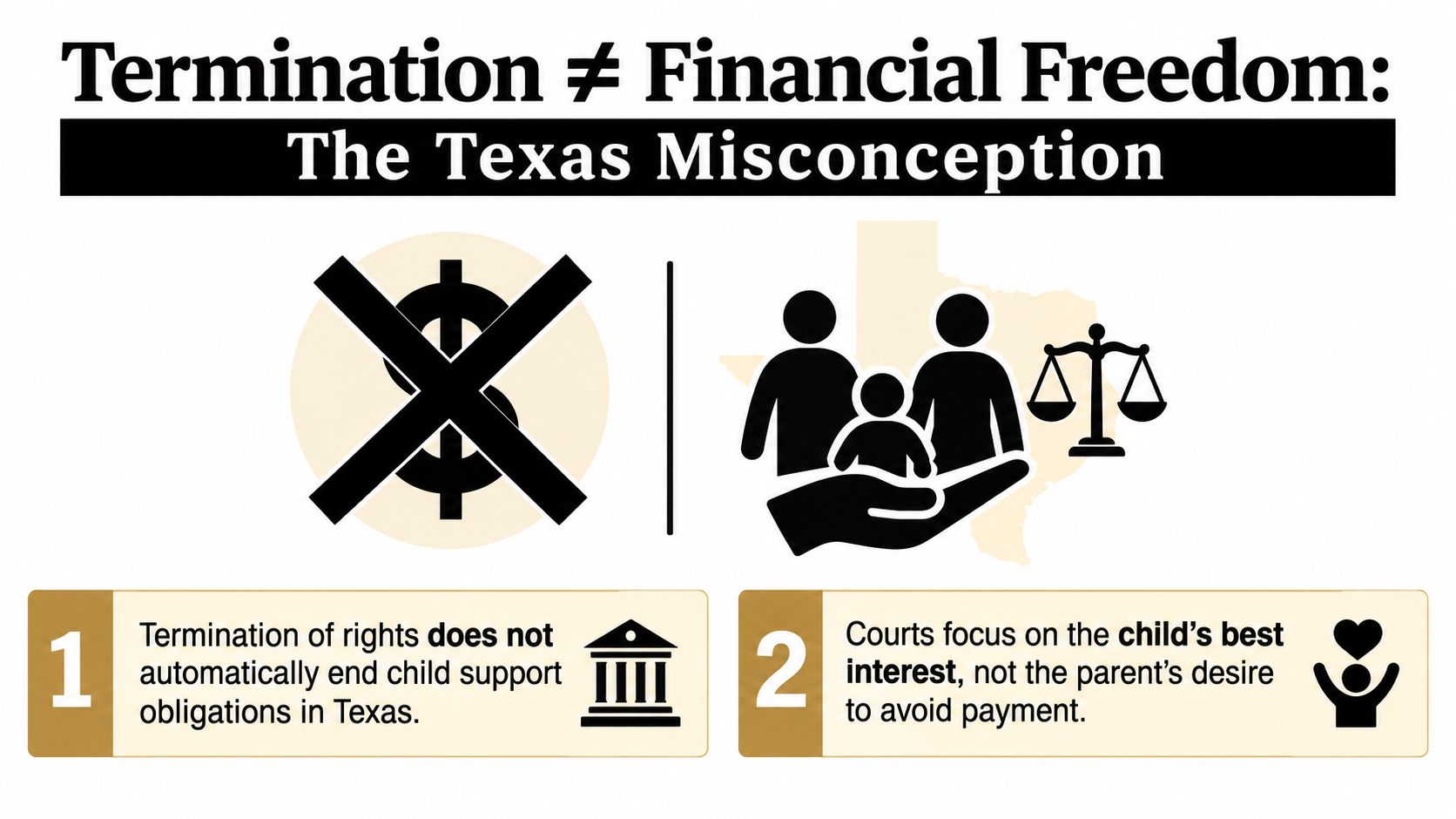
The worst advice in Texas family law is still the most popular one, sign away parental rights and the child support problem disappears. It doesn't. Termination of parental rights, future child support, and past-due arrears are separate legal questions, and if you treat them as one, you can walk into court with the wrong strategy and the wrong expectations.
In Texas, the court controls the outcome. A parent can't end the relationship by agreement alone, and a signed relinquishment doesn't become effective until a judge signs a court order ending the parent-child relationship under Chapter 161 of the Texas Family Code TexasLawHelp on terminating parental rights in Texas. That matters because the legal fight is not just about whether rights end, it's about whether the order affects ongoing support, what happens to arrears, and whether a failure to pay can itself become part of the termination case.
What Texas Parents Get Wrong About Termination and Child Support
Parents usually ask the wrong question first. They ask whether they can “sign away rights” to stop paying, when the core issue is whether the court will end future support, leave arrears intact, or refuse termination altogether because the evidence doesn't support it. Texas law treats those issues separately, and that separation is where most self-represented mistakes happen.
The legal relationship is not the same as the debt
A termination order under Texas Family Code §161.206 ends the parent-child legal relationship, but it does not automatically wipe out back child support already owed. TexasLawHelp is explicit that terminating parental rights won't erase arrears, and if support is already overdue, that debt remains collectible TexasLawHelp on child support in Texas. The order usually changes the future, not the past.
That is the central strategic point. If you're the parent paying support, you need to know whether you're trying to end future obligations, resolve existing arrears, or both. If you're the custodial parent, you need to protect the arrears claim before agreeing to language that sounds clean but leaves money on the table.
Practical rule: don't confuse ending parental status with canceling a support balance. Those are different fights.
The third question is just as important. Even when a parent wants termination, the court still looks at the child's best interest and the statutory basis for the request. In other words, the judge is not there to approve a convenient financial escape hatch.
For clients comparing termination timing with the end of ordinary support, When Does Child Support End in Texas? is the right starting point because the events that end a support obligation are not the same thing as a blanket cancellation of debt. That distinction drives everything else in this area.
Legal Standards for Terminating Parental Rights in Texas
Texas doesn't let a parent-child relationship end by casual agreement or private promise. Chapter 161 governs both voluntary and involuntary termination proceedings, and the court must sign the order before the relationship changes TexasLawHelp on terminating parental rights in Texas. That means every case starts with statute, not with sentiment.
The court needs a statutory ground and clear proof
The judge must find a recognized ground for termination and make a best-interest decision. Texas public guidance identifies common grounds such as abandonment, endangerment, and failure to support the child in accordance with the parent's ability for at least one year Texas State Law Library termination guide. That last ground matters in support-driven cases because nonpayment isn't just a collections issue, it can become part of a termination petition when the facts support it.
The burden is not loose or casual. A court has to be convinced by clear and convincing evidence, which is a high evidentiary standard. In practical terms, the petitioner needs records, testimony, payment history, messages, school or medical evidence, and a coherent timeline that proves more than frustration or temporary hardship.
What actually helps and what usually fails
A strong case usually looks like documented nonpayment, repeated missed contact, evidence of ability to work, or conduct that puts the child at risk. A weak case usually relies on anger, old arguments, or the assumption that a parent's silence proves abandonment without hard proof. Courts do not sever parental rights because one side is tired of conflict.
A nonpayment ground also needs context. A parent who lost a job, made partial payments, or faced documented barriers is in a very different position from one who chose not to pay despite working ability. The court looks at ability, timing, and credibility, not just the raw fact that money wasn't sent.
Bottom line: if you're building a termination case, gather evidence as if you're preparing for trial, because that's exactly what the court is doing.
Voluntary Relinquishment Versus Involuntary Termination Versus Adoption
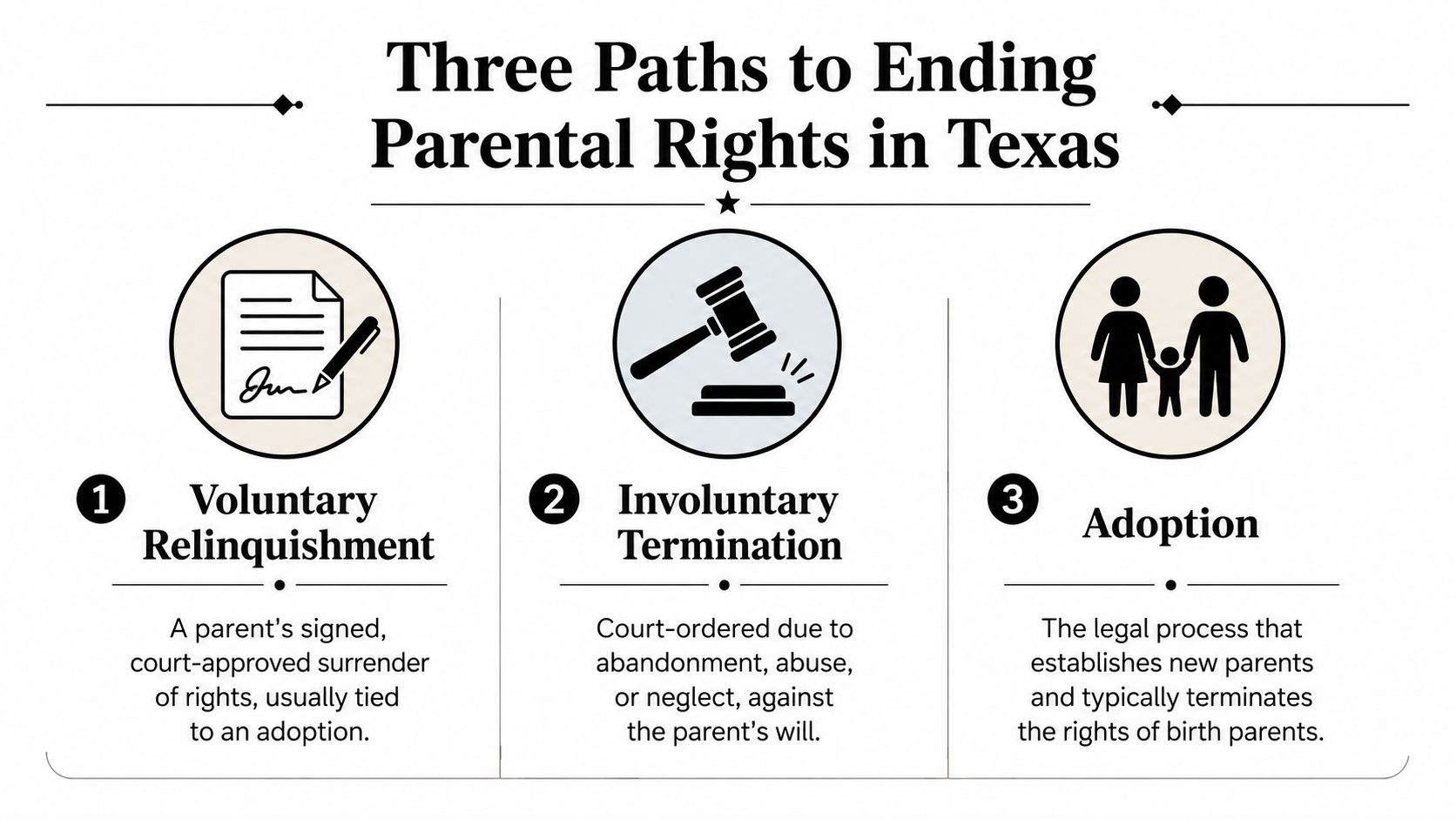
These three paths sit on different tracks, and mixing them up causes bad strategy. A parent signing away rights for an adoption is not in the same position as a parent defending against a petition filed by the other parent or by the state. If you treat them as the same thing, you can make the wrong move on support, custody, and parentage.
Voluntary relinquishment is a court-approved surrender
Voluntary relinquishment starts with the parent's signed surrender of rights, but the paper alone does not end the legal relationship. The court still has to approve it, and Texas procedure does not treat a private agreement as self-executing. TexasLawHelp explains that a signed relinquishment or waiver is ineffective until the judge signs the order TexasLawHelp on terminating parental rights in Texas. That matters because child support does not disappear just because the parents signed something in private.
Involuntary termination is contested and evidence-heavy
Involuntary termination is the contested route. A parent, a relative, or DFPS can file the case, and the court then applies Chapter 161 to decide whether a statutory ground exists and whether termination serves the child's best interest. If nonpayment is the theory, the proof has to fit the statute, and the court will look at more than anger, blame, or a broken relationship.
A parent's pattern of not paying support can do more than create arrears. Under the right facts, it can support an involuntary termination ground, which is why support history and termination strategy belong in the same conversation from the start.
Adoption is a separate proceeding
Adoption creates the new legal parent-child relationship. It normally follows termination, because the birth parent's rights have to be cut off before a court can finalize the adoption. That means adoption planning and termination planning need to work together, especially when child support obligations and arrears are part of the file.
The parentage issue often controls the whole case. If paternity has not been established correctly, the support case and any termination strategy can shift in a hurry, which is why the Acknowledgement of Paternity matters before anyone treats a man as the legal father.
What strengthens and what weakens a case
A strong case usually includes a clean record of nonpayment, repeated missed contact, evidence of earning capacity, or conduct that puts the child at risk. A weak case leans on resentment, old fights, or the assumption that silence equals abandonment. Texas courts do not sever parental rights because one side wants the dispute to end.
Context matters in support-driven cases. A parent who lost a job, made partial payments, or hit documented barriers stands in a different position from a parent who chose not to pay while able to work. Judges focus on ability, timing, and credibility, and they expect a real timeline, not general complaints.
Bottom line: if termination is on the table, treat the support record, the parentage record, and the termination ground as one case, because that is how the court will see it.
The Procedural Path of a Texas Termination Case
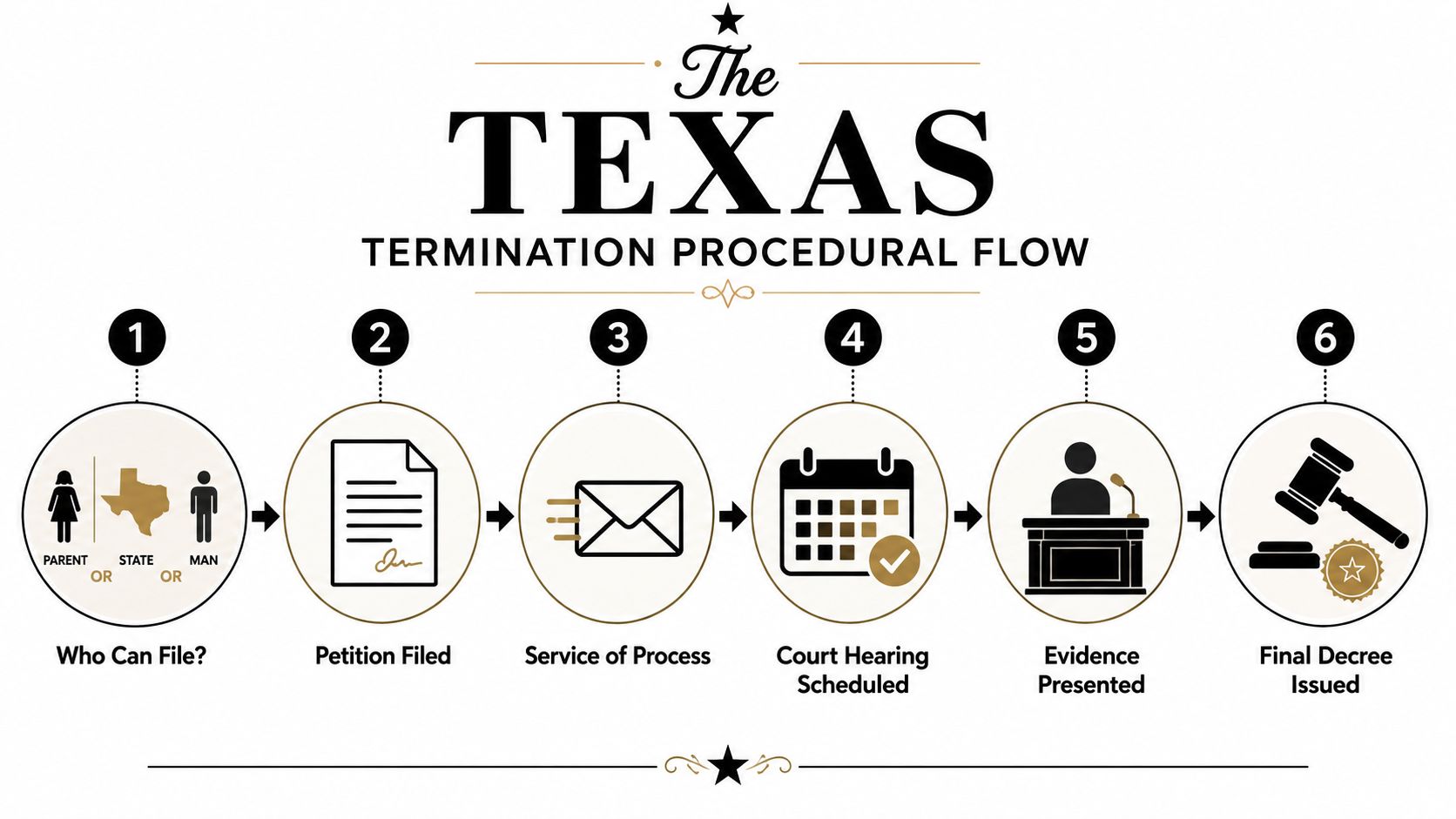
Termination cases move through Texas courts like real litigation, because that's what they are. A petition gets filed, the other side must be served, evidence gets exchanged through the hearing process, and the judge signs a final order only after statutory and best-interest issues are resolved Texas State Law Library termination guide. If you skip any of those steps, you don't have a real case.
Filing and service are not optional
Texas law requires a real petition, not a handshake agreement. The filing party must use the proper procedure, and the other parent has to receive service unless the case is handled in a way the court specifically permits. That service step matters because a default termination order entered without proper notice can create a vulnerable record.
The hearing is where the record gets built
At the hearing, the judge hears the evidence, tests the statutory ground, and considers best interest. Texas procedures also allow the court to appoint an attorney ad litem or similar representative for the child in cases where the child's interests need separate protection. That's not decoration, it's part of how the court makes sure the child's position isn't swallowed by the parents' conflict.
Reinstatement is narrow for a reason
Texas treats termination as highly final. A reinstatement petition is allowed only in a narrow set of circumstances, including that the original termination suit was filed by DFPS/CPS, the child has not been adopted, the child is at least 12 and consents, at least 2 years have passed since the termination order, and there is no pending appeal Texas Law Library on reinstatement. Those constraints show exactly how seriously Texas treats the order once the judge signs it.
If DFPS is involved, the timeline gets more complicated, not less. The court's focus stays on the child and the legal record, not on whatever private agreement the adults wish would control.
How Texas Calculates Child Support Before and After Termination
Until a termination order takes effect, Texas still uses the child-support guidelines in Texas Family Code §154.125. The system is based on net resources, not gross pay, and the court applies the guideline percentages to the obligor's net monthly resources up to the current cap. Deviations are possible under §154.123 when the facts justify it.
The calculation starts with net resources
The court first identifies income that counts, then subtracts allowed items to get net resources. In real cases, that means a pay stub is only the starting point. The court can look at wages, bonuses, self-employment income, and other included resources, then adjust for the deductions the statute allows.
The key number to watch is the $11,700 net monthly resource cap effective September 1, 2025. Above that cap, guideline support doesn't scale forever. The court still uses the capped amount as the guideline base unless it finds a reason to deviate Texas Child Support Law Office of Bryan Fagan's calculator page.
A simple example makes the math real
Assume a parent has net monthly resources of $8,000 and one child. Under the guideline framework in §154.125, the court applies the applicable percentage to that net figure. If the parent's net resources were above the cap, the court would start with the capped amount instead of the larger number.
Now add the deviation question under §154.123. A judge can move away from guideline support when the child has special needs, when medical expenses are unusual, when possession is highly atypical, or when other statutory factors make the guideline amount unfair. The point is not that deviations are common. The point is that they have to be justified.
Support orders and termination strategy have to align
A parent who expects termination in the near future shouldn't ignore the current support order. That order stays enforceable until the court changes it. A parent who expects to keep a support claim should also avoid sloppy modification language, because informal side deals don't replace a court order.
Practical takeaway: calculate the current order first, then decide whether termination, modification, or enforcement should be filed. Don't try to use one filing to fix all three problems unless the facts support it.
A Real-World Case Study in Nonpayment and Termination
A father keeps steady work for part of the year, has a court-ordered child support obligation, and also owes medical support. He stops paying for long enough that the custodial parent files enforcement and a separate termination petition based on failure to support. That is the kind of file where the collection case and the termination case land in the same courtroom, and the judge has to sort out both the money judgment and the parent-child relationship.
The court looks at ability, not excuses
The statute turns on ability to support during the required period. The court will look at earning capacity, recent jobs, cash work, partial payments, and text messages about money. Informal contributions, such as buying groceries or paying a bill directly, may show some help, but they do not automatically defeat a termination ground if the ordered support was ignored.
Unemployment does not end the analysis. A parent who can work but chooses not to, or who hides income, can still face a strong termination case. Incarceration is fact-sensitive too. It may affect ability, but it does not wipe out the support history the court is asked to judge.
A parent in this position should expect the other side to focus on conduct, not explanations. If the record shows repeated nonpayment and no credible proof of support, the statutory ground gets sharper, not weaker.
The enforcement case and termination case can move together
Texas law lets the custodial parent pursue both remedies at once. The arrears case seeks collection, while the termination case asks the court to end the legal relationship based on the statutory ground. Those are different remedies aimed at different problems, and the same facts can support both.
That is why the collection side matters even in a termination fight. If a parent wants to understand the enforcement tools that stay available after nonpayment, what happens if child support is not paid gives the right starting point. The point is simple. The support history can create an advantage for enforcement and also supply the statutory basis for termination.
A parent facing this kind of case needs a clean paper trail. Receipts, bank statements, employment records, and proof of direct support should be organized before the hearing. If they are not, the court will hear the other side's version with very little to push back against.
The strategy question is not whether support and termination are related. They are. The key question is which facts prove ability, which facts prove nonpayment, and whether the record is good enough to support both collection and termination in the same proceeding.
What Happens to Child Support Arrears After Termination
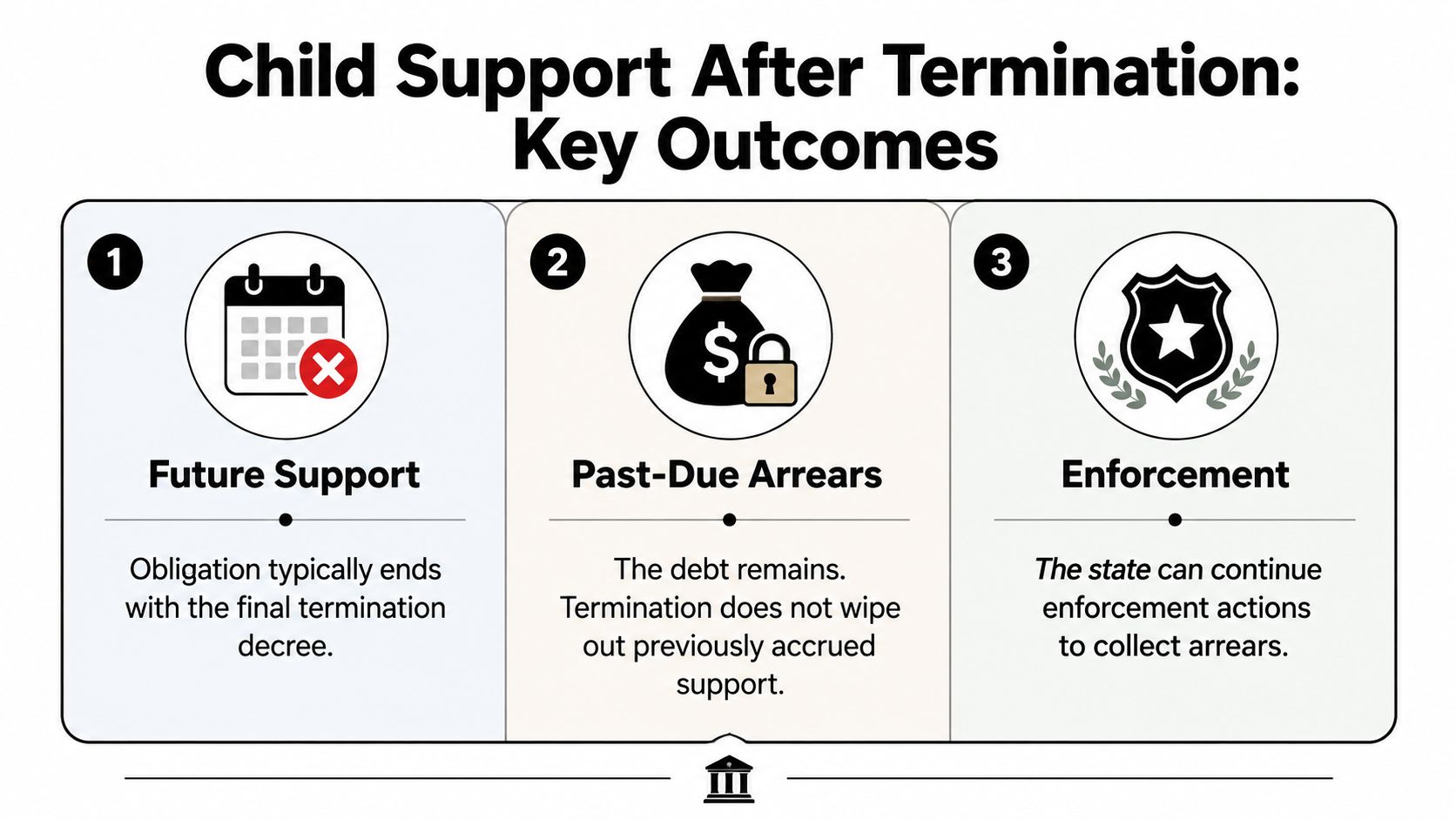
Termination changes future duty. It does not wipe out arrears already on the books. Texas treats the unpaid balance as a separate debt, and the court will not pretend it disappeared just because parental rights ended TexasLawHelp on child support in Texas.
Arrears survive because they are already vested
Once a support payment comes due and goes unpaid, that missed payment becomes part of the arrears balance. A termination decree may end the running obligation for future months under Texas Family Code §161.206, but it does not rewrite the payment history. The court can end the parent-child legal relationship and still leave the debt intact.
That is the part people miss. They treat termination like a financial reset. Texas does not do that.
Collection continues through normal enforcement tools
After termination, the custodial parent or the State can still pursue collection through the same enforcement machinery used in ordinary support cases. That includes wage withholding, license suspension, contempt, liens, and other collection steps tied to the existing arrears balance. If you want the collection side handled aggressively, the practical roadmap starts with how to collect back child support.
The debt can also be pursued through account freezes and lien procedures when the facts support those remedies. Those tools matter because termination cuts off future support, but it does not stop the collection process already in motion.
Modification is the only real way to change the arrears path
Arrears are not erased by wishful thinking or by a later fight over custody. If the balance is wrong, the answer is to challenge the accounting, prove payments, or seek relief through the proper court process before the order becomes harder to attack. If the balance is valid, the only practical question is how it will be collected.
A parent who is behind on support should also understand the risk on the front end. Persistent nonpayment can support an involuntary termination ground under Chapter 161, so the arrears issue can cut both ways. That makes the record on payment history, proof of support, and enforcement activity the part that matters in court.
Waivers and settlements must be drafted carefully
If the parties try to settle arrears during a termination case, the language has to be exact. A sloppy agreement can leave future support ended, arrears still collectible, and the parties fighting later over what was waived. The court will enforce the order it signs, not the informal deal the parents thought they made.
The safest approach is to treat termination and arrears as separate questions inside one strategy. Ending rights affects the future. The arrears balance remains a collection issue until it is paid, satisfied, or otherwise resolved by a valid court order.
Practical Next Steps for Custodial and Noncustodial Parents
Custodial parents should build the file before they build the argument. Save payment records, keep messages, document missed visits if they connect to abandonment or safety issues, and line up the evidence that supports the statutory ground you're alleging. If adoption is part of the plan, coordinate the termination timing with that process so the case doesn't stall after rights are severed.
Noncustodial parents need to be honest about the risk. If you're considering consent, understand the difference between ending future support and leaving arrears alive. If you're defending a contested petition, organize proof of support, income, unemployment, medical issues, and any reason the court should reject the alleged ground.
A few cases demand immediate legal attention:
- DFPS involvement: the case may move under a different procedural posture, and reinstatement rules can become relevant later.
- High-income support disputes: the §154.125 cap and §154.123 deviations matter a lot when income exceeds ordinary guideline assumptions.
- Any agreement to extinguish rights: if support, custody, arrears, and adoption are all on the table, the paperwork has to be drafted with precision.
Texas Child Support Law Office of Bryan Fagan handles support establishment, modification, enforcement, arrears, high-income disputes, and termination-related strategy across the state. If you're facing a termination case or you need to understand what happens to support when rights are at stake, visit Texas Child Support Law Office of Bryan Fagan and get the file reviewed before you sign anything.