A parent in Conroe may be watching an old child support order collide with new financial reality. One parent accepts a better-paying oilfield position, while the other loses restaurant hours in Shenandoah and continues paying childcare and school-related expenses for two children in Willis. The order may have made sense when it was entered, but it may no longer reflect either parent's income, possession schedule, or the children's needs.
Texas law provides two primary paths for child support modification in Montgomery County. Under Texas Family Code §156.401(a)(1), the court may modify support after a material and substantial change in circumstances. Under §156.401(a)(2), a modification may be available when at least three years have passed since the order was rendered or last modified and the guideline amount differs by 20% or $100 per month. The Texas Office of the Attorney General describes these standards as the central review framework for an existing order. Texas child support modification process
Those rules matter across Montgomery County, whether the parents live near The Woodlands, Splendora, Magnolia, Willis, Shenandoah, or Conroe. The practical work is proving eligibility, calculating current net resources, documenting changes, and presenting a proposed order that serves the child's best interest.
This guide focuses on the decisions that affect a real filing: which statutory pathway fits, what documents belong in the evidence packet, how the updated $11,700 monthly net-resource cap affects guideline calculations, and how to prepare for a Montgomery County hearing.
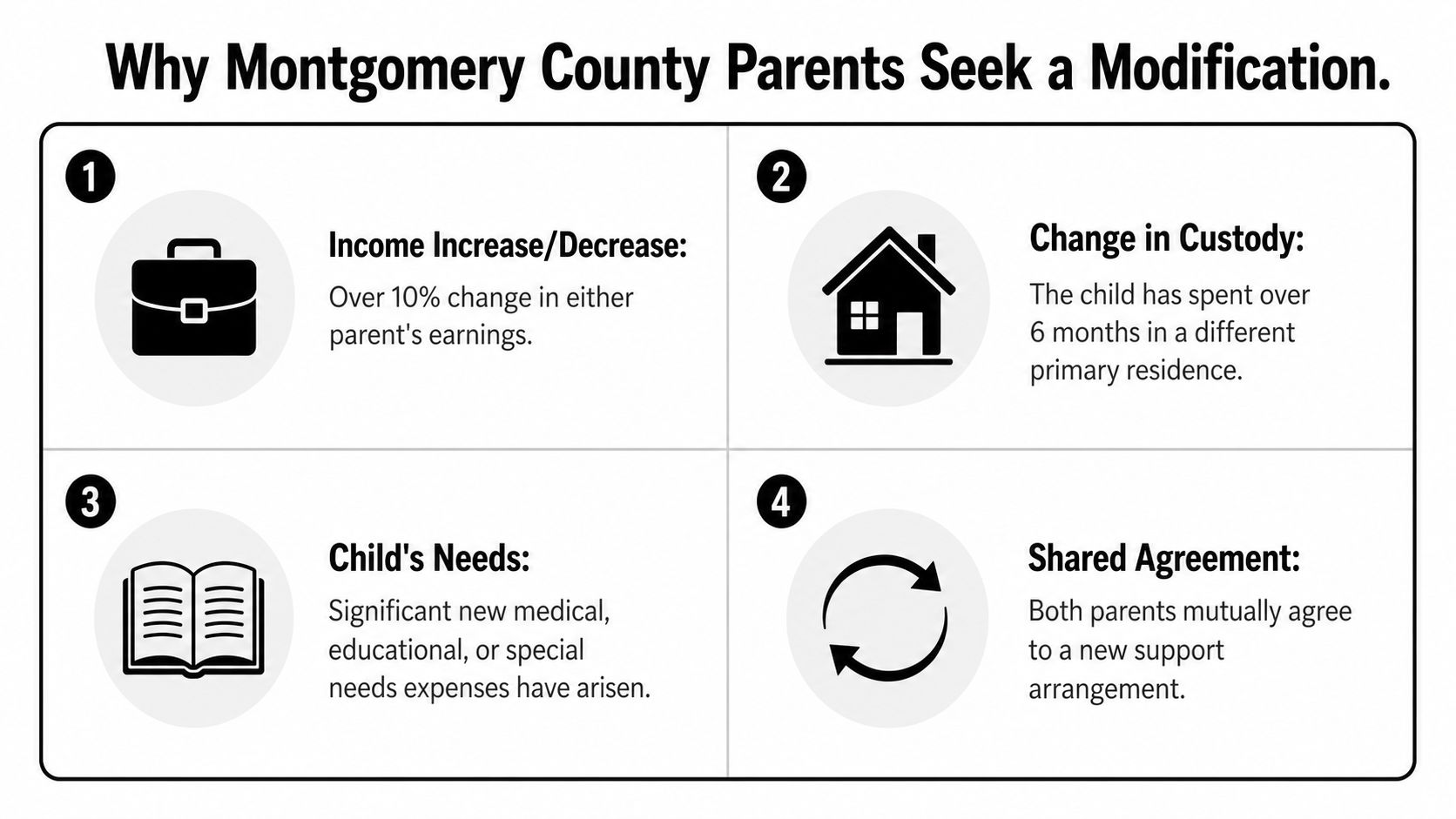
Why Montgomery County Parents Seek a Modification
A support order follows the facts presented to the court at a particular time. Montgomery County families rarely remain financially or logistically unchanged for long. A move from a Woodlands subdivision to a Magnolia commute, a new job near the energy corridor, a custody adjustment involving a parent in Splendora, or a change in health coverage can alter the assumptions behind the original order.
The order follows current facts
Suppose one parent's income rises after accepting an oilfield position, while the other parent's hours are reduced at a Shenandoah restaurant. The children still need transportation, childcare, medical care, and ordinary household support. If the order was entered years earlier, the court won't assume that the old amount remains appropriate. It will examine the current evidence and apply the statutory test.
The parent seeking relief must distinguish between a genuine legal change and a temporary frustration with the existing arrangement. A new dependent obligation, a significant income shift, a custody change, or a child-related expense may support modification when the facts meet the statutory standard.
Practical rule: A parent asking for modification should lead with dated proof and a guideline calculation, not a general statement that the order feels unfair.
Two routes to review
Texas Family Code §156.401 creates two core routes:
- Material and substantial change: The circumstances of the child or a person affected by the order have materially and substantially changed.
- Three-year guideline review: At least three years have passed since the order was rendered or last modified, and the guideline amount differs by at least 20% or $100 per month. Texas Family Code §156.401
The sections that follow translate those rules into filing steps, calculation examples, evidence categories, and hearing tactics. The goal is a clear answer to the questions parents usually ask before filing: Can I qualify, what should I submit, and how will the updated cap affect the proposed amount?
Grounds for Modification Under Texas Law
Texas courts don't modify child support merely because one parent wants a different payment. The request must fit one of the statutory pathways in Texas Family Code §156.401, and the evidence must connect the changed fact to the proposed support amount.
Material and substantial change under §156.401(a)(1)
The first pathway focuses on what changed after the prior order. Examples can include an involuntary job loss, a substantial pay reduction, disability, incarceration, a new medical condition affecting the child, or a significant shift in the child's primary residence. A parent who voluntarily reduces income usually faces a harder argument unless the evidence shows a legitimate reason and the requested amount still serves the child's best interest.
A custody change deserves careful attention. If the child has moved from one parent's primary household to a genuine shared arrangement, the court may need to recalculate support, medical support, and possession-related expenses. A label such as “50/50” isn't enough by itself. The parent should show the actual possession schedule, school-week routine, transportation responsibilities, and payment history.
The three-year review under §156.401(a)(2)
The second pathway is more mechanical. The order must have been rendered or last modified at least three years earlier, and the current guideline amount must differ from the existing amount by at least 20% or $100 per month. The test is a review trigger, not an automatic change. The court still enters a new order only after applying the law to the evidence.
Consider a one-child order requiring $1,200 per month. If the obligor's net resources rise from $5,000 to $8,600, applying the one-child guideline percentage produces a new amount of $1,720, a difference of $520 per month. The difference exceeds both the 20% and $100 thresholds, so the order may be reviewable on the three-year pathway, assuming the timing requirement is met. The guideline framework is addressed in Texas Family Code §§154.062 and 154.125. Texas child support guideline provisions
For a Montgomery County filing, attach or obtain the prior decree or modification order, current income records, and a calculation showing why the proposed amount differs. A petition that states only “income increased” gives the court less to work with than a petition that identifies the prior order, current net resources, and resulting guideline figure.
| Ground | Statutory Basis | Threshold Test | Typical Montgomery County Fact Pattern |
|---|---|---|---|
| Material and substantial change | Texas Family Code §156.401(a)(1) | Post-order circumstances materially and substantially changed | Job loss, disability, custody shift, incarceration, or new child medical needs |
| Three-year review | Texas Family Code §156.401(a)(2) | At least three years have passed and the guideline amount differs by 20% or $100 per month | Current income produces a materially different guideline calculation |
Filing and Procedural Steps in Montgomery County
A parent may agree to change support after a job loss, raise, or custody change, but that agreement does not replace the existing order. Until the court signs a new order, the ordered amount remains enforceable. Emails, texts, and private payments can help prove the parties' understanding, but they do not reliably change the legal obligation or erase arrears.
Start with the correct filing
The primary pleading is a Petition to Modify Parent-Child Relationship. The petition should identify the existing order, state the applicable ground under Texas Family Code §156.401, describe the changed facts, and request specific relief. In a case involving children, address the Standing Order that applies to suits affecting the parent-child relationship.
Tie the requested amount to the $11,700 monthly net-resource cap effective September 1, 2025. A filing should explain whether the requested modification depends on income below the cap, income reaching the cap, a custody change, or a requested deviation from guideline support. That connection gives the court a usable path from the evidence to the proposed order.
An Income Withholding Order is not required merely to file a modification. If the Texas Child Support Division already withholds support, address any requested change with the Division after a new order is signed or as the case directs. Filing the petition alone does not stop withholding.
The District Clerk accepts filings at the Montgomery County courthouse on Washington Street. Family matters are commonly placed on Wednesday dockets, but the setting depends on the court and case. Confirm current clerk and court requirements before filing.
Complete service before the hearing
The other parent is typically served personally through a process server or sheriff. A waiver of service may be available if the responding parent cooperates, but it must be completed correctly. The citation and service documents must provide the legally required notice, including at least 10 days before the hearing under the procedural circumstances described in the setting.
If the children have lived in Texas for at least six months, Texas generally retains jurisdiction under the UCCJEA, subject to the facts and prior orders. Montgomery County may be the proper county when the existing case and family connections remain there. Check jurisdiction and venue before filing.
Assemble the clerk and court packet
Prepare the petition, copies of the prior order, a certificate of last address, and any sworn inventory if property issues are part of the broader case. Organize current pay records, proof of deductions, custody information, and a proposed calculation tied to the September 1, 2025 cap. Not every exhibit must accompany the initial petition, but missing records can weaken the request later.
For a practical overview, see how to modify child support in Texas. The statutory framework is also summarized in Modifying Child Support Under §156.401.
An uncontested hearing may resolve in 30 to 60 days, while a contested matter may take three to nine months, depending on the dockets of the 386th, 410th, and 418th District Courts. These are planning estimates, not guarantees. Service problems, discovery disputes, custody evidence, and court availability can extend the schedule.
Calculating Guideline Support Under the Updated Cap
A Montgomery County modification calculation starts with net resources, not only the salary shown on a pay stub. Texas Family Code §154.062 identifies the resources used for support, and §154.125 supplies the guideline percentages. For higher-income parents, the revised cap effective September 1, 2025 controls the starting point.
The monthly net-resource cap increased from $9,200 to $11,700, a 27.17% increase calculated from those figures. The revised 2025 tax charts from the Texas Office of the Attorney General identify the new cap and effective date. Revised 2025 Texas child support tax charts Parents can also review the updated Texas child support cap calculation when checking the guideline math.
An existing order does not change by itself. The parent seeking a different amount must obtain a modification order before the new cap changes the legally enforceable obligation.
Applying the percentages
At the $11,700 cap, the guideline calculation is:
| Number of Children | Statutory % of Net Resources | Monthly Cap Calculation | Maximum Monthly Obligation |
|---|---|---|---|
| One | 20% | $11,700 × 20% | $2,340 |
| Two | 25% | $11,700 × 25% | $2,925 |
| Three | 30% | $11,700 × 30% | $3,510 |
| Four | 35% | $11,700 × 35% | $4,095 |
| Five | 40% | $11,700 × 40% | $4,680 |
A parent with $9,500 in monthly net resources and two children would apply the 25% percentage to $9,500, producing $2,375 per month before medical support or a deviation. A parent whose net resources meet or exceed the cap uses $11,700 for the guideline calculation, rather than the full amount above that ceiling.
Shared possession requires precise facts
A 50/50 possession schedule does not automatically divide guideline support in half. The court evaluates both parents' resources, actual possession, health insurance, childcare, transportation, and the children's needs. If the obligor has $11,700 in net resources, treating half as the base produces $5,850 as an illustration only, not an automatic formula.
The court may deviate under Texas Family Code §154.123 if evidence rebuts the presumption that guideline support serves the children's best interest and shows the guideline amount is unjust or inappropriate. Special medical needs, extraordinary travel between households, and unusual education or childcare costs may support a deviation, but the requesting parent must prove those facts. Texas Family Code §154.123 deviation factors
Evidence and Documentation That Wins Cases
A modification hearing turns on proof. Parents should organize exhibits by the legal issue they need to establish, rather than handing the court an unstructured stack of records.
Income evidence
For an income increase or decrease, collect:
- Recent pay stubs: Include records showing ordinary wages, overtime, commissions, and deductions.
- Tax records: Gather W-2s and relevant tax returns.
- Employment-change records: Use layoff, furlough, termination, promotion, or compensation letters.
- Benefit statements: Include unemployment benefit statements when a job loss is part of the request.
- Business records: A self-employed obligor, including one operating near The Woodlands, should prepare profit-and-loss records and supporting bank documentation.
Bonuses, equity compensation, commissions, contract payments, and business deductions require more analysis than a single payroll statement. The court needs a reliable picture of recurring and available resources.
Medical and child-needs evidence
A parent requesting a change in medical support should organize insurance policy summaries, premium information, Explanation of Benefits records, and receipts for therapy, prescriptions, or other out-of-pocket care. Link each expense to the child and identify whether it is recurring, unusual, reimbursable, or already addressed by the existing order.
Payment and arrears evidence
For enforcement defenses or arrears disputes, use payment ledgers, electronic transfer confirmations, cancelled checks, and bank statements. Cash payments without reliable documentation are difficult to prove.
Texas Rule of Civil Procedure 192 governs discovery and production. Respond promptly to requests for relevant financial and child-related documents, and follow the Montgomery County standing order regarding pre-hearing exchange, exhibit copies, and witness information. A parent who withholds records may lose credibility even when the underlying request has merit.
Evidence principle: Every requested change should have a document, a calculation, or a witness who can explain why the change is real and relevant.
Hearing Preparation and Possible Outcomes
A hearing isn't a conversation about which parent deserves more sympathy. The judge or associate judge evaluates pleadings, admitted exhibits, testimony, guideline calculations, and the child's best interest. Preparation should connect each exhibit to a requested ruling.
Build the hearing around the legal request
The obligor usually testifies about income, employment, deductions, possession, insurance, and payments. The obligee may testify about the children's residence, ordinary expenses, medical needs, childcare, and compliance with the existing order. Direct examination should establish the timeline first, then the changed fact, then the effect on the guideline calculation.
At temporary hearings, an associate judge may hear the matter and make recommendations or rulings subject to the applicable review process. The Montgomery County standing orders govern practical matters such as exhibit marking, witness lists, and exchanges. Counsel or a self-represented parent should confirm the current requirements before the hearing date.
Deviation requests need evidence
Texas Family Code §154.123 allows deviation when evidence rebuts the guideline presumption and establishes that guideline support would be unjust or inappropriate. A request based only on generalized travel costs or a parent's preferred lifestyle is weaker than a request supported by receipts, calendars, insurance records, medical documentation, and a clear explanation of how the deviation benefits the child.
The same discipline applies to medical support. Texas Family Code §154.062(a-2) addresses cash medical support and reimbursement concepts, while the existing order controls until modified. A parent seeking reimbursement should identify the expense, payment date, insurance treatment, notice provided, and amount requested.
Match preparation to the likely result
- Complete income proof: Supports a guideline recalculation and reduces disputes over net resources.
- Reliable possession records: Helps the court evaluate a claimed custody change rather than relying on labels.
- Medical and childcare exhibits: Supports medical-support adjustments or a §154.123 deviation.
- Payment records: Helps separate genuine arrears from amounts already paid.
- A proposed order: Gives the court a workable document covering support, medical support, withholding, and effective dates.
Retroactive relief and arrears require particular care. Texas Family Code §156.401 governs modification eligibility, but a court must also apply statutory limits and the facts when determining the effective date and any retroactive adjustment. A parent shouldn't assume that filing automatically changes the payment due each month.
The strongest settlement position usually comes from a calculation both sides can test. Trial risk rises when income is incomplete, possession is disputed, or the requested deviation lacks supporting evidence.
When to Bring in the Law Office of Bryan Fagan
Some Montgomery County cases are manageable with a straightforward wage history, a clear possession schedule, and agreement between the parents. Legal representation becomes more valuable when the support calculation depends on facts that a standard pay stub doesn't capture.
Fact patterns that require deeper analysis
Counsel is particularly useful when the case includes:
- Variable compensation: Bonuses, commissions, stock vesting, or irregular compensation can affect the net-resource analysis.
- Self-employment: Business deductions may require a close review of profit-and-loss records, bank activity, and personal expenses.
- Multi-state income: Employment, residence, or support obligations in another state can complicate discovery and jurisdiction.
- Contested custody changes: A claimed 50/50 schedule may conflict with school-week records, transportation evidence, or the actual possession history.
- High-income calculations: Parents near or above the $11,700 cap need a calculation that separates guideline support from any request for deviation.
- Enforcement disputes: Arrears, wage withholding, and medical-support reimbursement can create exposure beyond the requested modification.
Texas Family Code §154.123 deviation requests require evidence, not merely an argument that the guideline amount is inconvenient. A lawyer can identify the relevant factors, challenge incomplete financial records, and present a proposed order that addresses the practical details parents often overlook.
The Texas child support modification lawyer resource provides information about counsel for modification matters. The Texas Child Support Law Office of Bryan Fagan handles establishment, modification, enforcement, and defense of child support orders, including high-income disputes, arrears, medical support, 50/50 custody calculations, and complex net-resource questions.
Early preparation can help resolve service problems, identify missing records, preserve objections, and clarify whether settlement makes sense before testimony begins. It also gives a parent time to test the calculation against the updated cap and determine whether the evidence supports a guideline request, a deviation, or both.
Texas Child Support Law Office of Bryan Fagan helps Montgomery County parents evaluate modification eligibility, calculate support under the updated $11,700 net-resource cap, organize evidence, and address custody, medical support, arrears, and complex income issues. Visit Texas Child Support Law Office of Bryan Fagan to request a focused review of your existing order and prepare a practical strategy for the next filing or hearing.