You've checked the bank account again. The child support deposit is missing, or it's only a fraction of what the order requires. Your former spouse says money is tight, but you've seen the new vehicle, the business activity, or the sudden change from a regular paycheck to cash work. In Dallas County, waiting for voluntary compliance usually makes the problem harder to solve.
Child support enforcement in Dallas works best when you match the remedy to the payer's actual income and behavior. Wage withholding can be highly effective for a salaried employee, while contempt or a lien may be necessary when someone hides income or works independently. The right strategy also depends on whether the problem is temporary financial hardship, an incorrect order, or deliberate nonpayment.
When Dallas Parents Decide to Pursue Child Support Enforcement
A mother in Lake Highlands may notice the pattern first through failed deposits. One month is short. The next payment arrives late. Then the other parent stops responding, even though the child's expenses continue without interruption. The enforcement decision often comes when she realizes that another polite text won't produce a reliable payment.
The same realization can happen to a father in Oak Cliff. His former spouse may have left a well-paid job and started taking cash work, then claimed that the reduced income makes the existing order impossible. That situation requires more than looking at the latest paycheck. The court may need to examine whether the income reduction is genuine or intentional.
Four circumstances usually justify moving beyond informal requests:
- Arrears lasting 60 or more days: A continuing delinquency shows that the payment problem isn't merely a short administrative delay.
- A voluntary pay cut: A parent who leaves established employment for lower-paid work may still face enforcement based on earning capacity and the existing order.
- An interstate move: Relocation can complicate tracking, but it doesn't erase a Texas order or prevent the Texas Office of the Attorney General from pursuing collection.
- Partial payments that conceal the balance: Paying something isn't the same as complying. A recurring shortfall can create substantial arrears while giving the appearance of cooperation.
Practical rule: Separate inability to pay from refusal to pay before choosing a remedy.
A genuine reduction in income may call for a modification under Texas Family Code Chapter 156, not contempt. A parent who lost employment, suffered a serious health event, or experienced another legally significant change should seek a modified order. Until a court changes the order, however, the existing obligation generally remains enforceable.
Chapter 157 is different. It addresses enforcement of an existing support order, including proceedings that may seek contempt. Dallas parents should gather the order, payment history, bank records, messages, and evidence of the other parent's current employment before filing. Dallas County's judicial reporting framework tracks time from delinquency, filing, and service to disposition, confirming that case duration is an operational issue that varies by stage and court assignment. The county's judicial reporting framework is useful context, but it doesn't give every parent a guaranteed hearing date.
Delay has a price. Missing records become harder to obtain, employers change, and a parent who is paid in cash has more opportunity to move assets. The goal isn't to use every available penalty at once. It's to select the remedy most likely to create a dependable payment stream, then add pressure when the first method fails.
Texas Family Code Standards That Drive Every Enforcement Case
Every Dallas enforcement dispute starts with the underlying order. If the order is unclear, outdated, or based on incomplete income information, enforcement becomes more difficult because the court must determine what the obligor was required to pay.
Under Texas Family Code §154.125, the guideline calculation applies to the obligor's monthly net resources up to the statutory ceiling. Effective September 1, 2025, the cap is $11,700 per month, replacing the prior $9,200 cap. The Texas Register notice describing the amended ceiling is available through this Texas Register child-support cap notice.
The guideline percentages are applied to net resources, not gross salary. The standard percentages listed in the Texas framework are 20% for one child, 25% for two children, and 30% for three children, with additional children generally reflected through five-percentage-point increments. Net resources can involve salary, bonuses, commissions, rental income, retirement income, and other resources recognized by the court. Child support received and needs-based benefits such as SNAP or SSI aren't treated as the obligor's earnings for this calculation.
A parent earning $15,000 per month doesn't automatically have guideline support calculated on the entire amount. The presumptive calculation reaches only the first $11,700 of net monthly resources. For one child, 20% of $11,700 is $2,340. For two children, 25% is $2,925. Income above the cap may matter in a deviation analysis, but it doesn't automatically increase the guideline figure.
| Children | % of Net Resources | Cap-Based Max at $11,700 | Example at $15K Monthly Income |
|---|---|---|---|
| One | 20% | $2,340 | $2,340 |
| Two | 25% | $2,925 | $2,925 |
| Three | 30% | $3,510 | $3,510 |
For a practical explanation of How Child Support Is Calculated in Texas, focus on the guideline formula and how net resources determine the support amount. Courts may scrutinize overtime, second jobs, business expenses, depreciation, and personal expenses routed through a company. A self-employed parent can't present a low taxable income figure and expect the court to accept it without examining the business records.
Texas Family Code §154.123 governs deviations. A judge may consider a child's needs, unusual expenses, educational costs, medical circumstances, and other statutory factors when the guideline amount would be unjust or inappropriate. That distinction matters in enforcement because a parent can't enforce an amount that was never ordered, while a parent seeking more support must pursue modification and prove the basis for deviation.
The Administrative and Court Enforcement Pathway in Dallas County
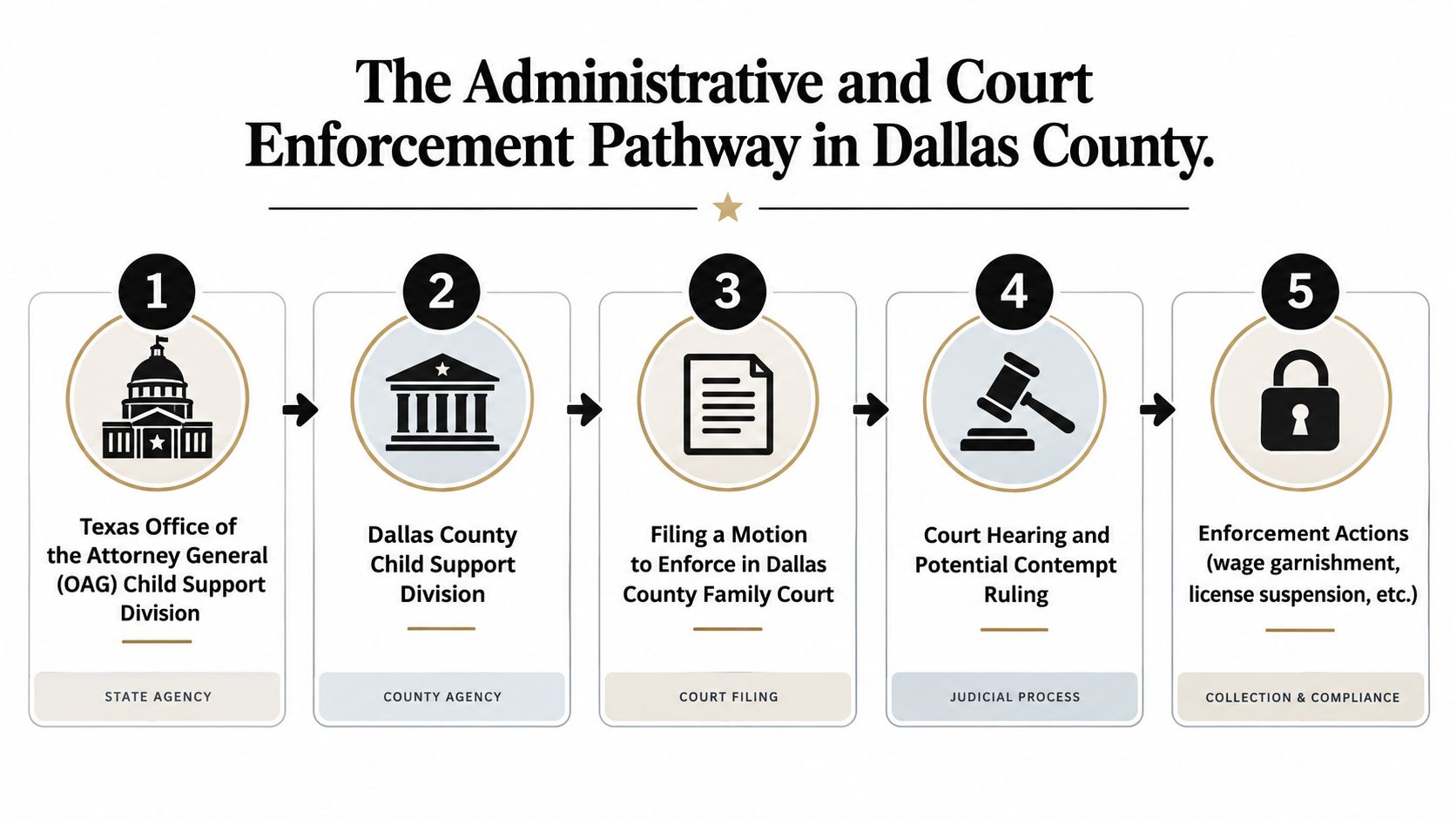
Most parents should start by confirming whether the order is properly registered with the Texas Office of the Attorney General Child Support Division. The OAG can use administrative collection tools, including income withholding, federal tax refund interception, license suspension, and passport denial. These tools work particularly well when the obligor has identifiable employment or receives traceable federal payments.
A parent can request OAG services or pursue enforcement with private counsel. The OAG's statewide system handled a 1.5 million-case child support services caseload at the end of state fiscal year 2019 and distributed more than 22.2 million payments through the State Disbursement Unit that year, according to the Texas Office of the Attorney General's public reports. Dallas cases operate inside that same high-volume Title IV-D structure.
Start with the payment record
Obtain the official payment history before alleging a balance. Compare it with bank statements and direct payments. Then identify the obligor's current employer, business, property, professional licenses, and likely income sources. The OAG may act administratively, but it doesn't function as your personal litigation counsel.
Income withholding falls under Texas Family Code Chapter 158. If the employer is known, a withholding order may be the fastest path to regular payments. If administrative tools stall, a private enforcement case or an OAG-initiated action can bring the matter before a Dallas County family court.
File and serve correctly
A court case generally requires a verified motion to enforce, the applicable income withholding paperwork, and a citation if contempt is requested. The filing location is the Dallas County family courthouse system, including the George L. Allen Sr. Courts Building at 600 Commerce Street. The petitioner must arrange service through a Dallas County constable, such as Constable Precinct 1, or a private process server.
Texas Family Code Chapter 157 requires personal service of a motion for enforcement involving child support no later than the 10th day before the hearing. If the enforcement concerns a child-support right assigned to the Title IV-D agency, the agency must receive notice as required by the statute and applicable procedure. The Dallas County child support court process should be reviewed alongside the actual order and filing requirements.
The other parent's answer deadline and the hearing setting depend on the type of proceeding and service. Dallas County hearings may be set weeks or months after filing, and the assigned court controls the docket. Don't treat an estimated setting as a promise. Confirm the notice, service return, court assignment, and hearing date before assuming contempt is available.
Comparing the Chapter 157 Tools That Actually Collect Money
Chapter 157 gives Dallas courts several enforcement tools, but they don't have equal value. The most dramatic remedy isn't always the one that produces money. Wage withholding usually beats punishment when the obligor has a stable employer, while contempt becomes more important when the parent controls the income stream.
Texas reported nearly $4.3 billion in child support collections in federal fiscal year 2023, with 66% of current support due collected and 66% of arrears cases receiving at least some arrears payment, according to the Texas Attorney General's legislative appropriations request. The same document reports that 86% of Title IV-D cases had court orders. The figures support a practical conclusion: establish and enforce a clear order first, then pursue the collection channel that reaches actual income.
| Remedy | Trigger or Threshold | Typical Timeline to First Payment | Best Use Case in Dallas |
|---|---|---|---|
| Income withholding | Existing enforceable order and identifiable employer | Usually the most direct route | W-2 employee with a Dallas-area employer |
| License suspension | Statutory delinquency requirements | Pressure develops after agency processing | Obligor whose work or driving privileges matter |
| Contempt | Willful noncompliance with a valid order and proper notice | Court setting required | Repeated nonpayment with ability to pay |
| Bond | Court-ordered security for future compliance | Depends on hearing and ability to post | Parent who repeatedly promises payment and defaults |
| Lien | Arrears connected to identifiable property or assets | Collection depends on sale or refinancing | Property-owning obligor |
| Arrearage judgment | Established unpaid balance | Useful for preserving and collecting debt | Disputed or aging arrears |
| Criminal referral | Serious, provable nonpayment meeting referral standards | Prosecutorial review adds another stage | Extreme cases where civil tools have failed |
A University Park obligor paid through a regular employer is a withholding case first. A self-employed obligor in Lake Highlands who reports little income but maintains business activity may require records discovery, a lien, an arrears judgment, and contempt. The remedy should follow the evidence.
The federal program reports that 71% of national child support collections come through income withholding, as reflected in the Congressional Research Service overview of the federal child support program. That doesn't mean every Dallas case resolves through payroll, but it does tell you where to look first.
Use the Texas child support enforcement options as a starting point, then sequence the tools. Start with withholding when possible, preserve the arrears through judgment, and use contempt when the evidence shows the obligor could pay but chose not to.
High-Income, 50/50, and Deviation Cases Under the 2025 Cap
High-income enforcement cases are rarely about multiplying a percentage against a pay stub. They're about defining net resources, proving the child's needs, and showing why the guideline figure does or doesn't reflect the family's actual circumstances.
Consider a Highland Park plastic surgeon with three children and gross earnings of $1.4 million. The guideline calculation begins with the statutory ceiling, not the entire gross figure. For three children, 30% of $11,700 produces $3,510 per month under the cap-based guideline calculation. The surgeon may argue that taxes and maximum retirement contributions reduce net resources substantially, perhaps toward $700,000 annually, while the other parent presents lifestyle records, tuition invoices, therapy expenses, orthodontic bills, travel, household spending, and business records.
The parent seeking additional support must build a §154.123 deviation record. The argument isn't that wealth alone automatically creates unlimited support. It's that the children's proven needs and the family's established standard of living justify a different amount than the presumptive guideline figure.
The evidence must connect income to need
Use complete financial discovery, not selected screenshots. Obtain tax returns, compensation records, bonus information, retirement documents, business ledgers, and records showing personal expenses paid through the practice. Pair that evidence with invoices and testimony concerning private school, medical care, therapy, orthodontia, and other child-specific costs.
A 50/50 possession case in Lakewood requires a different analysis. Equal possession doesn't automatically eliminate support. If both parents have comparable professional incomes, the court may review each parent's net resources, insurance obligations, proven expenses, and the practical costs of maintaining two households.
Texas Family Code §153.004 addresses possession and access considerations, but the support amount still depends on the statutory support framework and the evidence presented. The court reviews the guideline worksheet, the existing order, and the financial proof before deciding whether support remains due and which parent should pay.
In either case, file the correct modification or enforcement pleading, attach the existing order, provide required service, and present organized evidence. A new cap doesn't automatically rewrite an old order. The 2025 change applies to cases filed or pending on or after September 1, 2025, but an existing order normally remains in place until a court modifies it, as explained in this Texas 2025 child support cap analysis.
Common Defenses and Procedural Pitfalls in Dallas Enforcement
A strong arrears calculation can still fail if the filing party doesn't prove service. Contempt requires strict procedural compliance. A Dallas constable or private process server who doesn't complete a valid attempt under Texas Rule of Civil Procedure 106 may leave the court unable to enter a contempt finding, even when the payment history appears decisive.
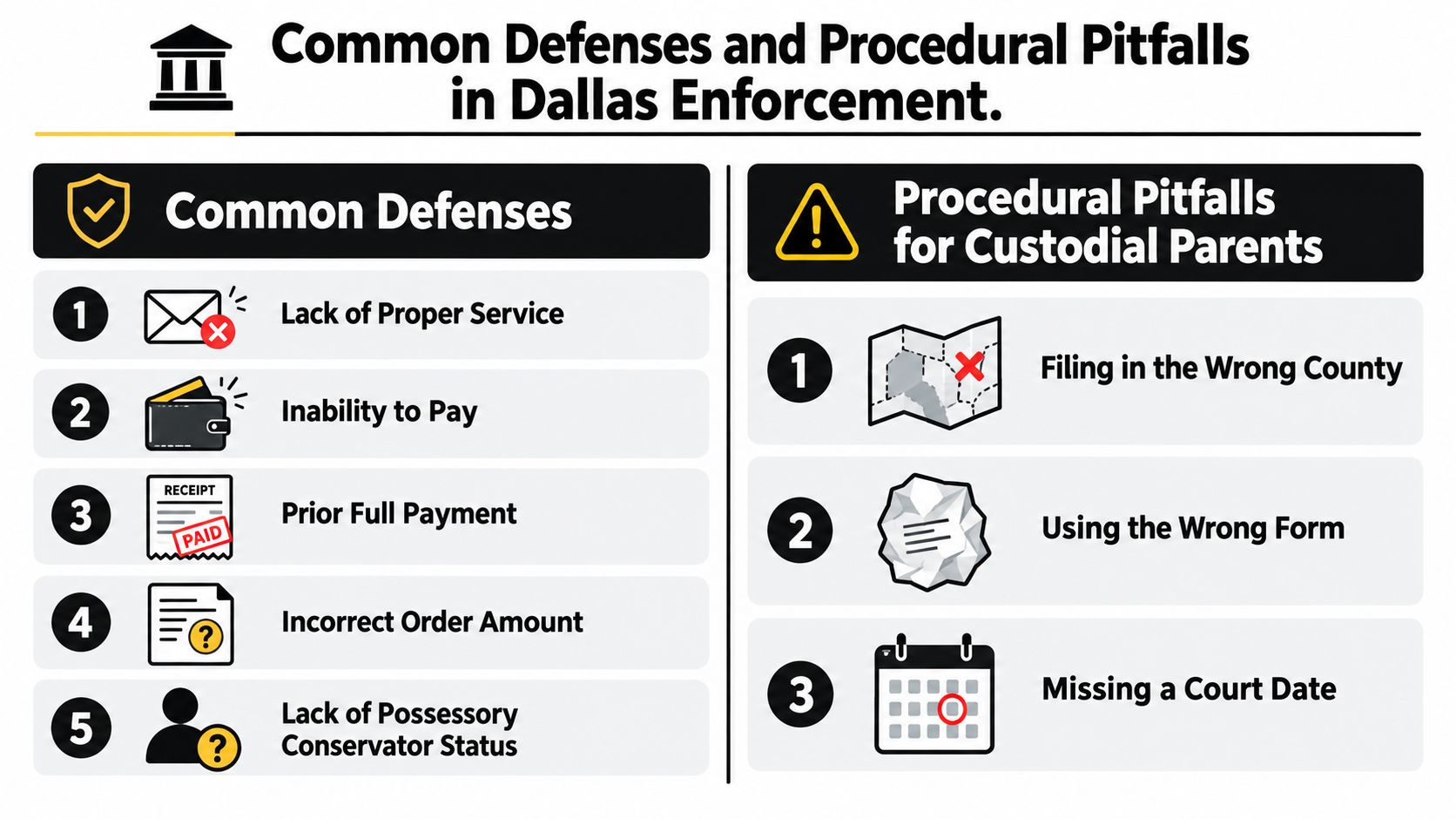
The defenses require targeted responses
An obligor may present old income records, such as tax returns from 2023, to dispute a support obligation in a later proceeding. That evidence may not show current earnings. Request current pay records, employer information, bank statements, and business records. If discovery responses are incomplete, use the appropriate motion to compel and seek an adverse inference where the procedural requirements support it, including the consequences associated with Rule 193.6 for excluded evidence.
Voluntary underemployment is another common defense. A genuine career change, illness, or job loss differs from leaving a reliable position to avoid support. Build the record around work history, qualifications, prior earnings, job-search efforts, business activity, and the timing of the income reduction.
Other defenses need careful treatment:
- Informal payment agreements: A text message or family arrangement doesn't automatically modify a court order. Preserve the communications and payment records, then analyze whether an equitable tolling argument has any legal foundation.
- Bankruptcy filing: A Chapter 7 filing can trigger an automatic stay affecting some collection activity. Counsel may need to request appropriate relief from the bankruptcy court before proceeding against protected property or pursuing a stayed action.
- Incorrect arrears balance: Reconcile the OAG history with cancelled checks, transfers, and direct payments before filing. A mathematical error can undermine credibility.
- Notice problems: Confirm personal service, hearing notice, and agency notice when Title IV-D rights are involved. Chapter 157's service rule is not a formality.
Before filing, audit the order, payment ledger, interest calculation, service plan, current income evidence, and requested remedies. Don't ask for contempt when your evidence only supports a money judgment or modification.
How a Dallas Child Support Attorney Moves Your Case Forward
You should consider hiring counsel when the obligor is self-employed, has changed jobs repeatedly, disputes the arrears balance, owns significant property, lives outside Texas, or has already ignored administrative enforcement. A private attorney is also valuable when you need contempt, discovery, a deviation, or a modification at the same time.
The first month should produce tangible progress:
- Case intake and document review: Give counsel the order, modifications, payment records, communications, and information about employment and assets.
- Dallas County file retrieval: The attorney obtains and reviews the clerk's file, prior pleadings, hearing history, and signed orders.
- OAG payment-history request: The official ledger is compared with your own records so the motion uses a defensible balance.
- Pleading strategy: Counsel determines whether to file a motion to enforce, seek contempt, request income withholding, pursue a judgment, or file a modification under Chapter 156.
- Service and setting: The office prepares service materials, coordinates with the process server, and seeks the next practical docket setting.
The remedy should match the problem. A wage-withholding motion addresses an identifiable paycheck. A license-suspension request may pressure a self-employed obligor whose livelihood depends on a license. A contempt packet is appropriate when the parent had the ability to comply, received proper notice, and repeatedly refused to pay.
Texas Child Support Law Office of Bryan Fagan handles Texas-specific establishment, modification, enforcement, arrears, wage withholding, high-income, and 50/50 custody matters. Parents comparing representation can review the firm's Dallas child support attorney services and bring a focused question about the order, the balance, the income, and the remedy most likely to produce payment.
Texas Child Support Law Office of Bryan Fagan can review your Dallas County order, payment history, income evidence, and enforcement options, then build a strategy around withholding, arrears recovery, modification, or contempt. Visit Texas Child Support Law Office of Bryan Fagan to request a strategy session focused on the next step in your child support case.